• Wyszukiwanie zaawansowane
  • Kategorie
  • Kategorie BISAC
  • Książki na zamówienie
  • Promocje
  • Granty
  • Książka na prezent
  • Opinie
  • Pomoc
  • Załóż konto
  • Zaloguj się

Formal Approaches to Languages of South America » książka


zaloguj się | załóż konto
Logo Krainaksiazek.pl

koszyk

konto

szukaj
topmenu
Księgarnia internetowa
Szukaj
Książki na zamówienie
Promocje
Granty
Książka na prezent
Moje konto
Pomoc
 
 
Wyszukiwanie zaawansowane
Pusty koszyk
Bezpłatna dostawa dla zamówień powyżej 20 złBezpłatna dostawa dla zamówień powyżej 20 zł

Kategorie główne

• Nauka
 [2946600]
• Literatura piękna
 [1856966]

  więcej...
• Turystyka
 [72221]
• Informatyka
 [151456]
• Komiksy
 [35826]
• Encyklopedie
 [23190]
• Dziecięca
 [619653]
• Hobby
 [140543]
• AudioBooki
 [1577]
• Literatura faktu
 [228355]
• Muzyka CD
 [410]
• Słowniki
 [2874]
• Inne
 [445822]
• Kalendarze
 [1744]
• Podręczniki
 [167141]
• Poradniki
 [482898]
• Religia
 [510455]
• Czasopisma
 [526]
• Sport
 [61590]
• Sztuka
 [243598]
• CD, DVD, Video
 [3423]
• Technologie
 [219201]
• Zdrowie
 [101638]
• Książkowe Klimaty
 [124]
• Zabawki
 [2473]
• Puzzle, gry
 [3898]
• Literatura w języku ukraińskim
 [254]
• Art. papiernicze i szkolne
 [8170]
Kategorie szczegółowe BISAC

Formal Approaches to Languages of South America

ISBN-13: 9783031223433 / Angielski / Twarda / 2023 / 422 str.
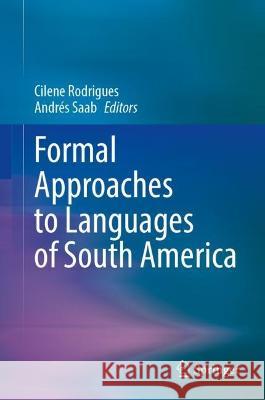
Cilene Rodrigues; Andrés Saab
Formal Approaches to Languages of South America Cilene Rodrigues Andr?s Saab 9783031223433 Springer - książkaWidoczna okładka, to zdjęcie poglądowe, a rzeczywista szata graficzna może różnić się od prezentowanej.

Formal Approaches to Languages of South America

ISBN-13: 9783031223433 / Angielski / Twarda / 2023 / 422 str.

Cilene Rodrigues; Andrés Saab
cena 645,58 zł
(netto: 614,84 VAT:  5%)

Najniższa cena z 30 dni: 578,30 zł
Termin realizacji zamówienia:
ok. 22 dni roboczych
Bez gwarancji dostawy przed świętami

Darmowa dostawa!
inne wydania

This book analyzes the linguistic diversity of South America based on approaches deeply rooted in the tradition of formal grammar. The chapters brought together in this contributed volume consider native languages all kinds of languages used in the region, including sign languages, indigenous languages and the romance languages (Portuguese and Spanish) originally introduced by European colonizers which underwent processes of transformation giving rise to new, local grammars.One fourth of the language families of the world are located in South America, but the majority of languages in the region are still understudied and out of the radar of theoretical linguistics mostly because their grammars are not well-known by international researchers. This book aims to fill this gap by bringing together studies rooted in the formal grammar approach first developed by Noam Chomsky, which sees language not only as mere corpora attested in oral and written production, but also as expressions of systems of thought and language production which are essential parts of human cognition.The book is divided in three parts – sign languages, romance languages and indigenous languages –, and brings together studies of the following South American languages:Brazilian Sign Language (Libras - Língua Brasileira de Sinais)Argentinian Sign Language (LSA - Lengua de Señas Argentina)Peruvian Sign Language (LSP- Lengua de Señas Peruana)Brazilian PortugueseChilean and Argentinian SpanishQuechuaParaguayan GuaraniA’ingaeMacro-Jê languagesFormal Approaches to the Languages of South America will be an invaluable resource both for theoretical linguists and cognitive scientists by providing access to top quality research on understudied languages and enabling these languages to be incorporated into comparative studies that can contribute to advance the knowledge of general principles governing all human languages.

This book analyzes the linguistic diversity of South America based on approaches deeply rooted in the tradition of formal grammar. The chapters brought together in this contributed volume consider native languages all kinds of languages used in the region, including sign languages, indigenous languages and the romance languages (Portuguese and Spanish) originally introduced by European colonizers which underwent processes of transformation giving rise to new, local grammars.  One fourth of the language families of the world are located in South America, but the majority of languages in the region are still understudied and out of the radar of theoretical linguistics mostly because their grammars are not well-known by international researchers. This book aims to fill this gap by bringing together studies rooted in the formal grammar approach first developed by Noam Chomsky, which sees language not only as mere corpora attested in oral and written production, but also as expressions of systems of thought and language production which are essential parts of human cognition. The book is divided in three parts – sign languages, romance languages and indigenous languages –, and brings together studies of the following South American languages:

  • Brazilian Sign Language (Libras - Língua Brasileira de Sinais)
  • Argentinian Sign Language (LSA - Lengua de Señas Argentina)
  • Peruvian Sign Language (LSP- Lengua de Señas Peruana)
  • Brazilian Portuguese
  • Chilean and Argentinian Spanish
  • Quechua
  • Paraguayan Guarani
  • A’ingae
  • Macro-Jê languages
Formal Approaches to the Languages of South America will be an invaluable resource both for theoretical linguists and cognitive scientists by providing access to top quality research on understudied languages and enabling these languages to be incorporated into comparative studies that can contribute to advance the knowledge of general principles governing all human languages.

Kategorie:
Nauka, Psychologia
Kategorie BISAC:
Psychology > Cognitive Psychology & Cognition
Language Arts & Disciplines > Linguistics - Morphology
Language Arts & Disciplines > Grammar & Punctuation
Wydawca:
Springer
Język:
Angielski
ISBN-13:
9783031223433
Rok wydania:
2023
Dostępne języki:
Ilość stron:
422
Oprawa:
Twarda
Dodatkowe informacje:
Wydanie ilustrowane

Table of contents


Chapter 1

Cilene Rodrigues and Andrés Saab


Part I: South-American Sign Languages

Chapter 2

The Morpho-Phonology of Nominal Plurality in Argentinian Sign Language (Lsa)

Yanina Boria and Carlos Muñoz Pérez


Chapter 3

The Grammar of Agreement in Libras

Guilherme Lourenço


Chapter 4

Argument Structure in Peruvian Sign Language

Miguel Rodríguez-Mondoñedo


Chapter 5

Blending Libras and Portuguese: Acceptability Variables

Ronice Müller de Quadros, Diane Lillo-Martin and Marilyn Mafra Klamt


Part II: South-American Romance Languages

Chapter 6

The Grammaticalization of igual in Argentinean Spanish

Ángela Di Tullio, Mercedes Pujalte and Pablo Zdrojewski


Chapter 7

Approaching the so Called “topic-subjects” in Brazilian Portuguese from Below

Jairo Nunes and Mary A. Kato


Chapter 8

Is Chilean Spanish a Canonical Pro-Drop Variety? On Subjecthood in Chilean Spanish

Iván Ortega-Santos


Chapter 9

Ways of number marking: English and Brazilian Portuguese

Roberta Pires de Oliveira


Part III: South-American Indigenous Languages

Chapter 10

Compounding Processes in Three Macro-Jê Linguistic Branches

Andrew Nevins and Mário André Coelho da Silva


Chapter 11

Poro‑/mba'e- antipassive prefixation in Paraguayan Guarani

Bruno Estigarribia and Ernesto López Almada


Chapter 12

Argument Structure and Morphology in Cochabamba Quechua

(with occasional comparison with other Quechua varieties)

Neil Myler


Chapter 13

Definiteness in A’ingae and its implications for pragmatic competition

Holly Zheng and Scott AnderBois


Index


Cilene Rodrigues is Adjunct Professor at Pontifical Catholic University of Rio de Janeiro (PUC-Rio) and Research fellow of Conselho Nacional de Pesquisa  (CNPq/Brazil). Her PhD thesis (University of Maryland, 2004) focused on licensing of null subjects in Partial Pro-drop languages.  She is currently directing research on: (a) the grammar of Brazilian Languages, especially Colloquial Brazilian Portuguese, Tupi-Guarani languages and Brazilian Sign Language (Libras); (b) evolution of language, with interdisciplinary investigations on language and psychosis, particularly schizophrenia, grammar and interjections, verbal versus vocal behavior, with fieldwork on the vocal repertoire of Capuchin monkeys.  

Andrés Saab studied Literature and Linguistics at the University of Buenos Aires and at the National University of Comahue (Argentina). In 2009, he defended his PhD dissertation on the theory of ellipsis. Currently, he is Independent Researcher at the Argentine National Scientific and Technical Research Council (CONICET), having the Argentinian Society for Philosophical Analysis (IIF-SADAF-CONICET) as official work-place, and Associate Professor at the University of Buenos Aires. His main research topics are ellipsis, copy theory of movement, null subjects and, more broadly, the syntax– interface connection. His research has been published by international journals and books (among others, Linguistic Inquiry, The Oxford Handbook of Ellipsis, Natural Language and Linguistic Theory, Lingua, Probus, Studia Linguistica). He is also co-author of Dimensiones del Significado. Una introducción a la semántica formal (with Fernando Carranza, SADAF, Buenos Aires, 2021), co-editor of Slurs and Expressivity. Semantics and Beyond (with Eleonora Orlando, Lexington, USA, 2021), and co-editor of the volume Romance Language and Linguistic Theory 2010 (with Irene Franco and Sara Lusini, John Benjamins, Amsterdam. 2012).  

This book analyzes the linguistic diversity of South America based on approaches deeply rooted in the tradition of formal grammar. The chapters brought together in this contributed volume consider native languages all kinds of languages used in the region, including sign languages, indigenous languages and the romance languages (Portuguese and Spanish) originally introduced by European colonizers which underwent processes of transformation giving rise to new, local grammars.  

One fourth of the language families of the world are located in South America, but the majority of languages in the region are still understudied and out of the radar of theoretical linguistics mostly because their grammars are not well-known by international researchers. This book aims to fill this gap by bringing together studies rooted in the formal grammar approach first developed by Noam Chomsky, which sees language not only as mere corpora attested in oral and written production, but also as expressions of systems of thought and language production which are essential parts of human cognition.

The book is divided in three parts – sign languages, romance languages and indigenous languages –, and brings together studies of the following South American languages:

  • Brazilian Sign Language (Libras - Língua Brasileira de Sinais)
  • Argentinian Sign Language (LSA - Lengua de Señas Argentina)
  • Peruvian Sign Language (LSP- Lengua de Señas Peruana)
  • Brazilian Portuguese
  • Chilean and Argentinian Spanish
  • Quechua
  • Paraguayan Guarani
  • A’ingae
  • Macro-Jê languages

Formal Approaches to the Languages of South America will be an invaluable resource both for theoretical linguists and cognitive scientists by providing access to top quality research on understudied languages and enabling these languages to be incorporated into comparative studies that can contribute to advance the knowledge of general principles governing all human languages.


Udostępnij

Facebook - konto krainaksiazek.pl


Opinie o Krainaksiazek.pl na Opineo.pl

Partner Mybenefit

Krainaksiazek.pl w programie rzetelna firma Krainaksiaze.pl - płatności przez paypal

Czytaj nas na:

Facebook - krainaksiazek.pl
  • książki na zamówienie
  • granty
  • książka na prezent
  • kontakt
  • pomoc
  • opinie
  • regulamin
  • polityka prywatności

Zobacz:

  • Księgarnia czeska

  • Wydawnictwo Książkowe Klimaty

1997-2025 DolnySlask.com Agencja Internetowa

© 1997-2022 krainaksiazek.pl
     
KONTAKT | REGULAMIN | POLITYKA PRYWATNOŚCI | USTAWIENIA PRYWATNOŚCI
Zobacz: Księgarnia Czeska | Wydawnictwo Książkowe Klimaty | Mapa strony | Lista autorów
KrainaKsiazek.PL - Księgarnia Internetowa

Polityka prywatnosci - link
Krainaksiazek.pl - płatnośc Przelewy24
Przechowalnia Przechowalnia







