• Wyszukiwanie zaawansowane
  • Kategorie
  • Kategorie BISAC
  • Książki na zamówienie
  • Promocje
  • Granty
  • Książka na prezent
  • Opinie
  • Pomoc
  • Załóż konto
  • Zaloguj się

Fog for 5g and Iot » książka


zaloguj się | załóż konto
Logo Krainaksiazek.pl

koszyk

konto

szukaj
topmenu
Księgarnia internetowa
Szukaj
Książki na zamówienie
Promocje
Granty
Książka na prezent
Moje konto
Pomoc
 
 
Wyszukiwanie zaawansowane
Pusty koszyk
Bezpłatna dostawa dla zamówień powyżej 20 złBezpłatna dostawa dla zamówień powyżej 20 zł

Kategorie główne

• Nauka
 [2949965]
• Literatura piękna
 [1857847]

  więcej...
• Turystyka
 [70818]
• Informatyka
 [151303]
• Komiksy
 [35733]
• Encyklopedie
 [23180]
• Dziecięca
 [617748]
• Hobby
 [139972]
• AudioBooki
 [1650]
• Literatura faktu
 [228361]
• Muzyka CD
 [398]
• Słowniki
 [2862]
• Inne
 [444732]
• Kalendarze
 [1620]
• Podręczniki
 [167233]
• Poradniki
 [482388]
• Religia
 [509867]
• Czasopisma
 [533]
• Sport
 [61361]
• Sztuka
 [243125]
• CD, DVD, Video
 [3451]
• Technologie
 [219309]
• Zdrowie
 [101347]
• Książkowe Klimaty
 [123]
• Zabawki
 [2362]
• Puzzle, gry
 [3791]
• Literatura w języku ukraińskim
 [253]
• Art. papiernicze i szkolne
 [7933]
Kategorie szczegółowe BISAC

Fog for 5g and Iot

ISBN-13: 9781119187134 / Angielski / Twarda / 2017 / 304 str.
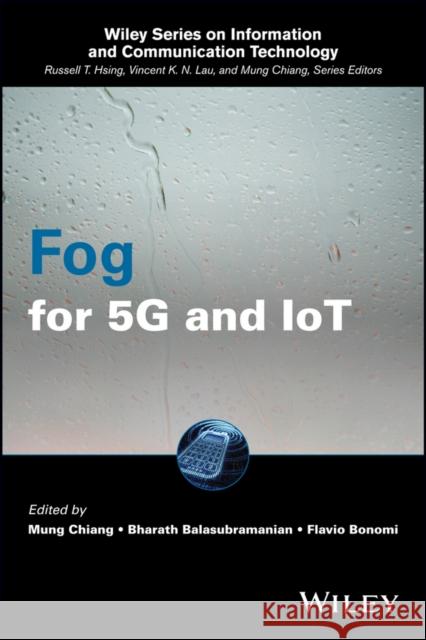
Mung Chiang; Bharath Balasubraman; Flavio Bonomi
Fog for 5g and Iot Mung Chiang Bharath Balasubraman Flavio Bonomi 9781119187134 Wiley - książkaWidoczna okładka, to zdjęcie poglądowe, a rzeczywista szata graficzna może różnić się od prezentowanej.

Fog for 5g and Iot

ISBN-13: 9781119187134 / Angielski / Twarda / 2017 / 304 str.

Mung Chiang; Bharath Balasubraman; Flavio Bonomi
cena 533,74 zł
(netto: 508,32 VAT:  5%)

Najniższa cena z 30 dni: 528,28 zł
Termin realizacji zamówienia:
ok. 30 dni roboczych
Bez gwarancji dostawy przed świętami

Darmowa dostawa!

The book examines how Fog will change the information technology industry in the next decade. Fog distributes the services of computation, communication, control and storage closer to the edge, access and users. As a computing and networking architecture, Fog enables key applications in wireless 5G, the Internet of Things, and big data. The authors cover the fundamental tradeoffs to major applications of fog. The book chapters are designed to motivate a transition from the current cloud architectures to the Fog (Chapter 1), and the necessary architectural components to support such a transition (Chapters 2-6). The rest of the book (Chapters 7-xxx) are dedicated to reviewing the various 5G and IoT applications that will benefit from Fog networking. This volume is edited by pioneers in Fog and includes contributions by active researchers in the field.

  • Covers fog technologies and describes the interaction between fog and cloud
  • Presents a view of fog and IoT (encompassing ubiquitous computing) that combines the aspects of both industry and academia
  • Discusses the various architectural and design challenges in coordinating the interactions between M2M, D2D and fog technologies
  • -Fog for 5G and IoT- serves as an introduction to the evolving Fog architecture, compiling work from different areas that collectively form this paradigm
Mung Chiang is the Arthur LeGrand Doty Professor of Electrical Engineering at Princeton University, the Director of the Keller Center for Innovations in Engineering Education, and the Chair of Princeton Entrepreneurship Advisory Committee. Dr. Chiang founded the Princeton EDGE Lab in 2009, which bridges the theory-practice gap in edge networking research by spanning from proofs to prototypes. He is the recipient of the 2013 Alan T. Waterman Award. Bharath Balasubramanian is a distributed systems researcher in the Cloud Software Research department at ATT Labs. Prior to this, he had a postdoc in the Electrical Engineering department at Princeton University working with Mung Chiang in the EDGE lab. Flavio Bonomi is a Cisco Fellow, Vice President, and is the Head of the Advanced Architecture and Research Organization at Cisco Systems.

Kategorie:
Technologie
Kategorie BISAC:
Technology & Engineering > Mobile & Wireless Communications
Computers > Internet - General
Wydawca:
Wiley
Seria wydawnicza:
Information and Communication Technology Series,
Język:
Angielski
ISBN-13:
9781119187134
Rok wydania:
2017
Numer serii:
000343903
Ilość stron:
304
Waga:
0.54 kg
Wymiary:
23.88 x 15.49 x 2.29
Oprawa:
Twarda
Wolumenów:
01
Dodatkowe informacje:
Bibliografia

CONTRIBUTORS xi

Introduction 1
Bharath Balasubramanian, Mung Chiang, and Flavio Bonomi

I.1 Summary of Chapters 5

I.2 Acknowledgments 7

References 8

I COMMUNICATION AND MANAGEMENT OF FOG 11

1 ParaDrop: An Edge Computing Platform in Home Gateways 13
Suman Banerjee, Peng Liu, Ashish Patro, and Dale Willis

1.1 Introduction 13

1.1.1 Enabling Multitenant Wireless Gateways and Applications through ParaDrop 14

1.1.2 ParaDrop Capabilities 15

1.2 Implementing Services for the ParaDrop Platform 17

1.3 Develop Services for ParaDrop 19

1.3.1 A Security Camera Service Using ParaDrop 19

1.3.2 An Environmental Sensor Service Using ParaDrop 22

References 23

2 Mind Your Own Bandwidth 24
Carlee Joe–Wong, Sangtae Ha, Zhenming Liu, Felix Ming Fai Wong, and Mung Chiang

2.1 Introduction 24

2.1.1 Leveraging the Fog 25

2.1.2 A Home Solution to a Home Problem 25

2.2 Related Work 28

2.3 Credit Distribution and Optimal Spending 28

2.3.1 Credit Distribution 29

2.3.2 Optimal Credit Spending 31

2.4 An Online Bandwidth Allocation Algorithm 32

2.4.1 Estimating Other Gateways Spending 32

2.4.2 Online Spending Decisions and App Prioritization 34

2.5 Design and Implementation 35

2.5.1 Traffic and Device Classification 37

2.5.2 Rate Limiting Engine 37

2.5.3 Traffic Prioritization Engine 38

2.6 Experimental Results 39

2.6.1 Rate Limiting 39

2.6.2 Traffic Prioritization 41

2.7 Gateway Sharing Results 41

2.8 Concluding Remarks 45

Acknowledgments 46

Appendix 2.A 46

2.A.1 Proof of Lemma 2.1 46

2.A.2 Proof of Lemma 2.2 46

2.A.3 Proof of Proposition 2.1 47

2.A.4 Proof of Proposition 2.2 48

2.A.5 Proof of Proposition 2.3 49

2.A.6 Proof of Proposition 2.4 49

References 50

3 Socially–Aware Cooperative D2D and D4D Communications toward Fog Networking 52
Xu Chen, Junshan Zhang, and Satyajayant Misra

3.1 Introduction 52

3.1.1 From Social Trust and Social Reciprocity to D2D Cooperation 54

3.1.2 Smart Grid: An IoT Case for Socially–Aware Cooperative D2D and D4D Communications 55

3.1.3 Summary of Main Results 57

3.2 Related Work 58

3.3 System Model 59

3.3.1 Physical (Communication) Graph Model 60

3.3.2 Social Graph Model 61

3.4 Socially–Aware Cooperative D2D and D4D Communications toward Fog Networking 62

3.4.1 Social Trust–Based Relay Selection 63

3.4.2 Social Reciprocity–Based Relay Selection 63

3.4.3 Social Trust and Social Reciprocity–Based Relay Selection 68

3.5 Network Assisted Relay Selection Mechanism 69

3.5.1 Reciprocal Relay Selection Cycle Finding 69

3.5.2 NARS Mechanism 70

3.5.3 Properties of NARS Mechanism 73

3.6 Simulations 75

3.6.1 Erdos Renyi Social Graph 76

3.6.2 Real Trace Based Social Graph 78

3.7 Conclusion 82

Acknowledgments 82

References 83

4 You Deserve Better Properties (From Your Smart Devices) 86
Steven Y. Ko

4.1 Why We Need to Provide Better Properties 86

4.2 Where We Need to Provide Better Properties 87

4.3 What Properties We Need to Provide and How 88

4.3.1 Transparency 88

4.3.2 Predictable Performance 93

4.3.3 Openness 99

4.4 Conclusions 102

Acknowledgment 102

References 103

II STORAGE AND COMPUTATION IN FOG 107

5 Distributed Caching for Enhancing Communications Efficiency 109
A. Salman Avestimehr and Andreas F. Molisch

5.1 Introduction 109

5.2 Femtocaching 111

5.2.1 System Model 111

5.2.2 Adaptive Streaming from Helper Stations 114

5.3 User–Caching 115

5.3.1 Cluster–Based Caching and D2D Communications 115

5.3.2 IT LinQ–Based Caching and Communications 118

5.3.3 Coded Multicast 126

5.4 Conclusions and Outlook 130

References 131

6 Wireless Video Fog: Collaborative Live Streaming with Error Recovery 133
Bo Zhang, Zhi Liu, and S.–H. Gary Chan

6.1 Introduction 133

6.2 Related Work 136

6.3 System Operation and Network Model 138

6.4 Problem Formulation and Complexity 140

6.4.1 NC Packet Selection Optimization 140

6.4.2 Broadcaster Selection Optimization 143

6.4.3 Complexity Analysis 144

6.5 VBCR: A Distributed Heuristic for Live Video with Cooperative Recovery 144

6.5.1 Initial Information Exchange 145

6.5.2 Cooperative Recovery 145

6.5.3 Updated Information Exchange 147

6.5.4 Video Packet Forwarding 147

6.6 Illustrative Simulation Results 150

6.7 Concluding Remarks 156

References 156

7 Elastic Mobile Device Clouds: Leveraging Mobile Devices to Provide Cloud Computing Services at the Edge 159
Karim Habak, Cong Shi, Ellen W. Zegura, Khaled A. Harras, and Mostafa Ammar

7.1 Introduction 159

7.2 Design Space with Examples 161

7.2.1 Mont–Blanc 162

7.2.2 Computing while Charging 163

7.2.3 FemtoCloud 164

7.2.4 Serendipity 166

7.3 FemtoCloud Performance Evaluation 168

7.3.1 Experimental Setup 168

7.3.2 FemtoCloud Simulation Results 169

7.3.3 FemtoCloud Prototype Evaluation 173

7.4 Serendipity Performance Evaluation 175

7.4.1 Experimental Setup 175

7.4.2 Serendipity s Performance Benefits 176

7.4.3 Impact of Network Environment 179

7.4.4 The Impact of the Job Properties 182

7.5 Challenges 186

References 186

III APPLICATIONS OF FOG 189

8 The Role of Fog Computing in the Future of the Automobile 191
Flavio Bonomi, Stefan Poledna, and Wilfried Steiner

8.1 Introduction 191

8.2 Current Automobile Electronic Architectures 193

8.3 Future Challenges of Automotive E/E Architectures and Solution Strategies 195

8.4 Future Automobiles as Fog Nodes on Wheels 200

8.5 Deterministic FOG Nodes on Wheels Through Real–Time Computing and Time–Triggered Technologies
203

8.5.1 Deterministic Fog Node Addressing the Scalability Challenge through Virtualization 203

8.5.2 Deterministic Fog Node Addressing the Connectivity and Security Challenges 204

8.5.3 Emerging Use Case of Deterministic Fog Nodes in Automotive Applications Vehicle–Wide
Virtualization 206

8.6 Conclusion 209

References 209

9 Geographic Addressing for Field Networks 211
Robert J. Hall

9.1 Introduction 211

9.1.1 Field Networking 211

9.1.2 Challenges of Field Networking 212

9.2 Geographic Addressing 214

9.3 SAGP: Wireless GA in the Field 215

9.3.1 SAGP Processing 216

9.3.2 SAGP Retransmission Heuristics 217

9.3.3 Example of SAGP Packet Propagation 218

9.3.4 Followcast: Efficient SAGP Streaming 219

9.3.5 Meeting the Challenges 220

9.4 Georouting: Extending GA to the Cloud 221

9.5 SGAF: A Multi–Tiered Architecture for Large–Scale GA 222

9.5.1 Bridging Between Tiers 223

9.5.2 Hybrid Security Architecture 225

9.6 The AT&T Labs Geocast System 225

9.7 Two GA Applications 226

9.7.1 PSCommander 226

9.7.2 Geocast Games 230

9.8 Conclusions 232

References 232

10 Distributed Online Learning and Stream Processing for a Smarter Planet 234
Deepak S. Turaga and Mihaela van der Schaar

10.1 Introduction: Smarter Planet 234

10.2 Illustrative Problem: Transportation 237

10.3 Stream Processing Characteristics 238

10.4 Distributed Stream Processing Systems 239

10.4.1 State of the Art 239

10.4.2 Stream Processing Systems 240

10.5 Distributed Online Learning Frameworks 244

10.5.1 State of the Art 244

10.5.2 Systematic Framework for Online Distributed Ensemble Learning 247

10.5.3 Online Learning of the Aggregation Weights 250

10.5.4 Collision Detection Application 254

10.6 What Lies Ahead 257

Acknowledgment 258

References 258

11 Securing the Internet of Things: Need for a New Paradigm and Fog Computing 261
Tao Zhang, Yi Zheng, Raymond Zheng, and Helder Antunes

11.1 Introduction 261

11.2 New IoT Security Challenges That Necessitate Fundamental Changes to the Existing Security
Paradigm 263

11.2.1 Many Things Will Have Long Life Spans but Constrained and Difficult–to–Upgrade Resources 264

11.2.2 Putting All IoT Devices Inside Firewalled Castles Will Become Infeasible or Impractical 264

11.2.3 Mission–Critical Systems Will Demand Minimal–Impact Incident Responses 265

11.2.4 The Need to Know the Security Status of a Vast Number of Devices 266

11.3 A New Security Paradigm for the Internet of Things 268

11.3.1 Help the Less Capable with Fog Computing 269

11.3.2 Scale Security Monitoring to Large Number of Devices with Crowd Attestation 272

11.3.3 Dynamic Risk Benefit–Proportional Protection with Adaptive Immune Security 277

11.4 Summary 281

Acknowledgment 281

References 281

INDEX 285

Mung Chiang is the Arthur LeGrand Doty Professor of Electrical Engineering at Princeton University, the Director of the Keller Center for Innovation in Engineering Education, and the Chair of Princeton Entrepreneurship Council, USA. Dr. Chiang founded the Princeton EDGE Lab in 2009 and a co–founder of OpenFog Consortium in 2015. He is the recipient of the 2013 Alan T. Waterman Award by US National Science Foundation.

Bharath Balasubramanian is a distributed systems researcher in the Cloud Software Research Department at ATT Labs Research, USA. Prior to this, he was a postdoc in the Electrical Engineering Department at Princeton University, working with Mung Chiang in the EDGE Lab.

Flavio Bonomi is the CEO of Nebbiolo Technologies, USA. Before that he was a Vice President and Fellow at Cisco, USA.

Fog is starting to shape the future of the balance of power in information technology

The book examines how fog will change the information technology industry in the next decade. Along the cloud–to–things continuum, fog distributes the services of computation, communication, control, and storage closer to the edge, access, and users. As a computing and networking architecture, fog enables key applications in wireless 5G, the Internet of things (IoT), and big data. The authors cover the fundamental trade–offs to major applications of fog. The book chapters are designed to motivate a transition from the current cloud architectures to the fog (Chapter 1) and the necessary architectural components to support such a transition (Chapters 2 6). The rest of the chapters (Chapters 7 11) are dedicated to reviewing various 5G and IoT applications that will benefit from fog networking. This volume is edited by pioneers in fog and includes contributions by active researchers in the field.

  • Covers fog technologies and describes the interaction between fog and cloud
  • Presents a view of fog and IoT that combines the aspects of both industry and academia
  • Discusses the various architectural and design challenges in coordinating the interactions between M2M, D2D, and fog technologies

"Fog for 5G and IoT" serves as an introduction to the evolving fog architecture, compiling work from different areas that collectively form this paradigm

Chiang, Mung Mung Chiang is a Professor of Electrical Engineeri... więcej >


Udostępnij

Facebook - konto krainaksiazek.pl


Opinie o Krainaksiazek.pl na Opineo.pl

Partner Mybenefit

Krainaksiazek.pl w programie rzetelna firma Krainaksiaze.pl - płatności przez paypal

Czytaj nas na:

Facebook - krainaksiazek.pl
  • książki na zamówienie
  • granty
  • książka na prezent
  • kontakt
  • pomoc
  • opinie
  • regulamin
  • polityka prywatności

Zobacz:

  • Księgarnia czeska

  • Wydawnictwo Książkowe Klimaty

1997-2025 DolnySlask.com Agencja Internetowa

© 1997-2022 krainaksiazek.pl
     
KONTAKT | REGULAMIN | POLITYKA PRYWATNOŚCI | USTAWIENIA PRYWATNOŚCI
Zobacz: Księgarnia Czeska | Wydawnictwo Książkowe Klimaty | Mapa strony | Lista autorów
KrainaKsiazek.PL - Księgarnia Internetowa

Polityka prywatnosci - link
Krainaksiazek.pl - płatnośc Przelewy24
Przechowalnia Przechowalnia





