Finite Element Analysis for Design Engineers, Second Edition » książka

topmenu




Finite Element Analysis for Design Engineers, Second Edition
ISBN-13: 9780768082319 / Angielski / Twarda / 2016 / 284 str.
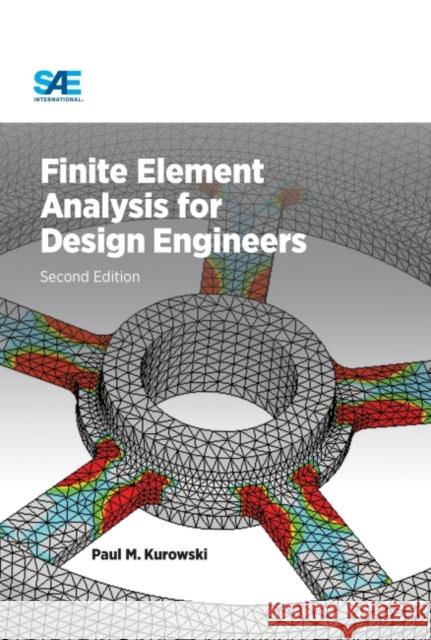
Finite Element Analysis for Design Engineers, Second Edition
ISBN-13: 9780768082319 / Angielski / Twarda / 2016 / 284 str.
cena 407,57
(netto: 388,16 VAT: 5%)
Najniższa cena z 30 dni: 398,63
(netto: 388,16 VAT: 5%)
Najniższa cena z 30 dni: 398,63
Termin realizacji zamówienia:
ok. 16-18 dni roboczych.
ok. 16-18 dni roboczych.
Darmowa dostawa!
Finite Element Analysis (FEA) has been widely implemented by the automotive industry as a productivity tool for design engineers to reduce both development time and cost. This essential work serves as a guide for FEA as a design tool and addresses the specific needs of design engineers to improve productivity.
Kategorie:
Kategorie BISAC:
Język:
Angielski
ISBN-13:
9780768082319
Rok wydania:
2016
Ilość stron:
284
Waga:
0.78 kg
Oprawa:
Twarda
Dodatkowe informacje:
Bibliografia
Wydanie ilustrowane
Wydanie ilustrowane
- Acknowledgements
- Preface
- Chapter 1:?Introduction
- 1.1 What Is Finite Element Analysis?
- 1.2 What Is the Place of Finite Element Analysis Among Other Tools of Computer-Aided Engineering?
- 1.3 Fields of Application of FEA and Mechanism Analysis; Differences Between Structures and Mechanisms
- 1.4 Fields of Application of FEA and CFD
- 1.5 What Is “FEA for Design Engineers”?
- 1.6 Importance of Hands-On Exercises
- Chapter 2:?From CAD Model to Results of Finite Element Analysis
- 2.1 Formulation of the Mathematical Model
- 2.2 Selecting Numerical Method to Solve the Mathematical Model
- 2.2.1 Selected Numerical Methods in Computer Aided Engineering
- 2.2.2 Reasons for the Dominance of Finite Element Method
- 2.3 The Finite Element Model
- 2.3.1 Meshing
- 2.3.2 Formulation of Finite-Element Equations
- 2.3.3 Errors in FEA Results
- 2.4 Verification and Validation of FEA Results
- Chapter 3:?Fundamental Concepts of Finite Element Analysis
- 3.1 Formulation of a Finite Element
- 3.1.1 Closer Look at Finite Element
- 3.1.2 Requirements to be Satisfied by Displacement Interpolation Functions
- 3.1.3 Artificial Restraints
- 3.2 The Choice of Discretization
- 3.3 Types of Finite Elements
- 3.3.1 Element Dimensionality
- 3.3.2 Element Shape
- 3.3.3 Element Order and Element Type
- 3.3.4 Summary of Commonly Used Elements
- 3.3.5 Element Modeling Capabilities
- Chapter 4:?Controlling Discretization Errors
- 4.1 Presenting Stress Results
- 4.2 Types of Convergence Process
- 4.2.1 h Convergence by Global Mesh Refinement
- 4.2.2 h Convergence Process by Local Mesh Refinement
- 4.2.3 Adaptive h Convergence Process
- 4.2.4 p Convergence Process
- 4.2.5 The Choice of Convergence Process
- 4.3 Discretization Error
- 4.3.1 Convergence Error
- 4.3.2 Solution Error
- 4.4 Problems With Convergence
- 4.4.1 Stress Singularity
- 4.4.2 Displacement Singularity
- 4.5 Hands-On Exercises
- 4.5.1 Hollow Plate (Figure 4.33)
- 4.5.2 L Bracket (Figure 4.34)
- 4.5.3 2D Beam (Figure 4.35)
- Chapter 5:?Finite Element Mesh
- 5.1 Meshing Techniques
- 5.1.1 Manual Meshing
- 5.1.2 Semiautomatic Meshing
- 5.1.3 Automeshing
- 5.2 Mesh Compatibility
- 5.2.1 Compatible Elements
- 5.2.2 Incompatible Elements
- 5.2.3 Forced Compatibility
- 5.3 Common Meshing Problems
- 5.3.1 Element Distortion
- 5.3.2 Mesh Adequacy
- 5.3.3 Element Mapping to Geometry
- 5.3.4 Incorrect Conversion to Shell Model
- 5.4 Hands-On Exercises
- 5.4.1 BRACKET01 (Figure 5.24)
- 5.4.2 Cantilever Beam (Figure 5.25)
- Chapter 6:?Modeling Process
- 6.1 Modeling Steps
- 6.1.1 Definition of the Objective of Analysis
- 6.1.2 Selection of the Units of Measurement
- 6.1.3 Geometry Preparation
- 6.1.4 Definition of Material Properties
- 6.1.5 Definition of Boundary Conditions
- 6.2 Modeling Techniques
- 6.2.1 Mirror Symmetry and Antisymmetry Boundary Conditions
- 6.2.2 Axial Symmetry
- 6.2.3 Cyclic Symmetry
- 6.2.4 Realignment of Degrees of Freedom
- 6.3 Hands-On Exercises
- 6.3.1 BRACKET02-1 (Figure 6.14)
- 6.3.2 BRACKET02-2 (Figure 6.15)
- 6.3.3 BRACKET02-3 (Figure 6.16)
- 6.3.4 Shaft (Figure 6.17)
- 6.3.5 Pressure Tank (Figure 6.18)
- 6.3.6 RING (Figure 6.19)
- 6.3.7 Link (Figure 6.20)
- Chapter 7:?Nonlinear Static Structural Analysis
- 7.1 Classification of Different Types of Nonlinearities
- 7.2 Large Displacement Analysis
- 7.3 Membrane Stress Stiffening
- 7.4 Contact
- 7.5 Hands-On Exercises
- 7.5.1 Cantilever Beam (Figure 7.1)
- 7.5.2 Torsion Shaft (Figure 7.7)
- 7.5.3 Round Plate (Figure 7.12)
- 7.5.4 LINK (Figure 7.17)
- 7.5.5 Sliding Support (Figure 7.18)
- 7.5.6 CLAMP01 (Figure 7.21)
- 7.5.7 CLAMP02 (Figure 7.26)
- 7.5.8 Shrink Fit (Figure 7.27)
- Chapter 8:?Nonlinear Material Analysis
- 8.1 Review of Nonlinear Material Models
- 8.2 Elastic–Perfectly Plastic Material Model
- 8.3 Use of Nonlinear Material to Control Stress Singularity
- 8.4 Other Types of Nonlinearities
- 8.5 Hands-On Exercises
- 8.5.1 BRACKET NL (Figure 8.3)
- 8.5.2 L BRACKET (Figure 8.7)
- Chapter 9:?Modal Analysis
- 9.1 Differences Between Modal and Static Analysis
- 9.2 Interpretation of Displacement and Stress Results in Modal Analysis
- 9.3 Modal Analysis With Rigid Body Modes
- 9.4 Importance of Supports in Modal Analysis
- 9.5 Applications of Modal Analysis
- 9.5.1 Finding Modal Frequencies and Associated Shapes of Vibration
- 9.5.2 Locating “Weak Spots” in Structure
- 9.5.3 Modal Analysis Provides Input to Vibration Analysis
- 9.6 Prestress Modal Analysis
- 9.7 Symmetry and Antisymmetry Boundary Conditions in Modal Analysis
- 9.8 Convergence of Modal Frequencies
- 9.9 Meshing Consideration for Modal Analysis
- 9.10 Hands-On Exercises
- 9.10.1 Tuning Fork (Figure 9.12)
- 9.10.2 Box (Figure 9.1)
- 9.10.3 Airplane (Figure 9.2)
- 9.10.4 Ball (Figure 9.4)
- 9.10.5 Link (Figure 9.5)
- 9.10.6 Helicopter Blade (Figure 9.7)
- 9.10.7 Column (Figure 9.8)
- 9.10.8 Bracket (Figure 9.10)
- Chapter 10:?Buckling Analysis
- 10.1 Linear Buckling Analysis
- 10.2 Convergence of Results in Linear Buckling Analysis
- 10.3 Nonlinear Buckling Analysis
- 10.4 Summary
- 10.5 Hands-On Exercises
- 10.5.1 Notched Column—Free End (Figure 10.1)
- 10.5.2 Notched Column—Sliding End (Figure 10.2)
- 10.5.3 Button (Figure 10.11)
- 10.5.4 Curved Column (Figure 10.15)
- 10.5.5 Stand (Figure 10.16)
- 10.5.6 CURVED_SHEET (Figure 10.17)
- Chapter 11:?Vibration Analysis
- 11.1 Modal Superposition Method
- 11.2 Time Response Analysis
- 11.3 Frequency Response Analysis./li>
- 11.4 Nonlinear Vibration Analysis
- 11.5 Hands-On Exercises
- 11.5.1 Hammer Impulse Load (Figure 11.2)
- 11.5.2 Hammer Beating (Figure 11.2)
- 11.5.3 ELBOW_PIPE (Figure 11.7)
- 11.5.4 Centrifuge (Figure 11.10)
- 11.5.5 PLANK (Figure 11.13)
- Chapter 12:?Thermal Analysis
- 12.1 Heat Transfer Induced by Prescribed Temperatures
- 12.2 Heat Transfer Induced by Heat Power and Convection
- 12.3 Heat Transfer by Radiation
- 12.4 Modeling Considerations in Thermal Analysis
- 12.5 Challenges in Thermal Analysis
- 12.6 Hand-On Exercises
- 12.6.1 Bracket (Figure 12.1)
- 12.6.2 Heat Sink (Figure 12.2)
- 12.6.3 Channel (Figure 12.4)
- 12.6.4 Space Heater (Figure 12.6)
- Chapter 13:?Implementation of Finite Element Analysis in the Design Process
- 13.1 Differences Between CAD and FEA Geometry
- 13.1.1 Defeaturing
- 13.1.2 Idealization
- 13.1.3 Cleanup
- 13.2 Common Meshing Problems
- 13.3 Mesh Inadequacy
- 13.4 Integration of CAD and FEA Software
- 13.4.1 Stand-Alone FEA Software
- 13.4.2 FEA Programs Integrated With CAD
- 13.4.3 Computer-Aided Engineering Programs
- 13.5 FEA Implementation
- 13.5.1 Positioning of CAD and FEA Activities
- 13.5.2 Personnel Training
- 13.5.3 FEA Program Selection
- 13.5.4 Hardware Selection
- 13.5.5 Building Confidence in the FEA
- 13.5.6 Return-On Investment
- 13.6 FEA Project
- 13.6.1 Major Steps in FEA Project
- 13.6.2 FEA Report
- 13.6.3 Importance of Documentation and Backups
- 13.6.4 Contracting Out FEA Services
- 13.6.5 Common Errors in the FEA Management
- Chapter 14:?Misconceptions and Frequently Asked Questions
- 14.1 FEA Quiz
- 14.2 Frequently Asked Questions
- Chapter 15:?FEA Resources
- References
- Chapter 16:?Glossary of Terms
- Chapter 17:?List of Exercises
- Index
- About the Author




Czytaj nas na:
1997-2026 DolnySlask.com Agencja Internetowa
Zobacz: Księgarnia Czeska | Wydawnictwo Książkowe Klimaty | Mapa strony | Lista autorów
KrainaKsiazek.PL - Księgarnia Internetowa

KrainaKsiazek.PL - Księgarnia Internetowa

