• Wyszukiwanie zaawansowane
  • Kategorie
  • Kategorie BISAC
  • Książki na zamówienie
  • Promocje
  • Granty
  • Książka na prezent
  • Opinie
  • Pomoc
  • Załóż konto
  • Zaloguj się

Fields, Flows, and Waves: An Introduction to Continuum Models » książka


zaloguj się | załóż konto
Logo Krainaksiazek.pl

koszyk

konto

szukaj
topmenu
Księgarnia internetowa
Szukaj
Książki na zamówienie
Promocje
Granty
Książka na prezent
Moje konto
Pomoc
 
 
Wyszukiwanie zaawansowane
Pusty koszyk
Bezpłatna dostawa dla zamówień powyżej 20 złBezpłatna dostawa dla zamówień powyżej 20 zł

Kategorie główne

• Nauka
 [2949965]
• Literatura piękna
 [1857847]

  więcej...
• Turystyka
 [70818]
• Informatyka
 [151303]
• Komiksy
 [35733]
• Encyklopedie
 [23180]
• Dziecięca
 [617748]
• Hobby
 [139972]
• AudioBooki
 [1650]
• Literatura faktu
 [228361]
• Muzyka CD
 [398]
• Słowniki
 [2862]
• Inne
 [444732]
• Kalendarze
 [1620]
• Podręczniki
 [167233]
• Poradniki
 [482388]
• Religia
 [509867]
• Czasopisma
 [533]
• Sport
 [61361]
• Sztuka
 [243125]
• CD, DVD, Video
 [3451]
• Technologie
 [219309]
• Zdrowie
 [101347]
• Książkowe Klimaty
 [123]
• Zabawki
 [2362]
• Puzzle, gry
 [3791]
• Literatura w języku ukraińskim
 [253]
• Art. papiernicze i szkolne
 [7933]
Kategorie szczegółowe BISAC

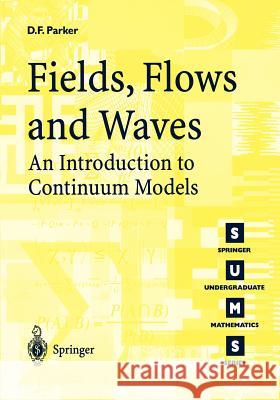
Fields, Flows, and Waves: An Introduction to Continuum Models

ISBN-13: 9781852337087 / Angielski / Miękka / 2003 / 270 str.
D. F. Parker
Fields, Flows, and Waves: An Introduction to Continuum Models Parker, David F. 9781852337087 Springer - książkaWidoczna okładka, to zdjęcie poglądowe, a rzeczywista szata graficzna może różnić się od prezentowanej.

Fields, Flows, and Waves: An Introduction to Continuum Models

ISBN-13: 9781852337087 / Angielski / Miękka / 2003 / 270 str.

D. F. Parker
cena 141,19 zł
(netto: 134,47 VAT:  5%)

Najniższa cena z 30 dni: 134,90 zł
Termin realizacji zamówienia:
ok. 22 dni roboczych
Bez gwarancji dostawy przed świętami

Darmowa dostawa!

Many phenomena in the physical and biological sciences involve the collective behaviour of (very large) numbers of individual objects. For example, the be haviour of gases ultimately concerns the interacting motions of uncountably many atoms and molecules, but to understand flow in nozzles, around aircraft and in meteorology it is best to treat velocity and density as continuous func tions of position and time and then to analyse the associated flows. Although modern electronics involves ever smaller components, even the semiconduc tor devices used widely in electronic communications and in digital processing involve collective phenomena, such as electric currents and fields, which are continuously varying functions of position and time. Diffusion and reaction between various chemical constituents, the growth and spread of biological or ganisms and the flow of traffic on major highways are all phenomena which may be described and analysed in terms of fields and flows, while sound, light and various other electromagnetic phenomena involve both fields and waves. Treating these using a continuum model, which does not attempt to trace the motion and evolution of individual objects, often gives good predictions. The mathematical concepts and techniques which underlie such treatments are the subject of this book. This book is designed as a first introduction to the use of mathematical techniques, within continuum theories."


Kategorie:
Nauka, Matematyka
Kategorie BISAC:
Science > Mechanics - General
Science > Fala mechaniczna
Science > Elektromagnetyzm
Wydawca:
Springer
Seria wydawnicza:
Springer Undergraduate Mathematics Series,
Język:
Angielski
ISBN-13:
9781852337087
Rok wydania:
2003
Wydanie:
2003
Numer serii:
000307896
Ilość stron:
270
Waga:
0.51 kg
Wymiary:
25.4 x 17.9 x 1.0
Oprawa:
Miękka
Wolumenów:
01
Dodatkowe informacje:
Bibliografia
Wydanie ilustrowane

From the reviews:

"This textbook ... is designed for undergraduates who have followed a first 'mathematical methods' course and who are ready to study in more depth the mathematics underlying phenomena ... . Each chapter includes a number of worked examples and a dozen or so exercises, with solutions collected at the end of the book. The book is aimed at students of applied mathematics, physics and engineering. The emphasis on techniques and the frequent references to applications make it particularly suitable for this audience." (S.C. Russen, The Mathematical Gazette, Vol. 89 (516), 2005)

"Fields, Flows, and Waves, is an introduction to continuum models based on the author's lectures ... . Ample illustrations and worked examples come with the exposition, and there are several exercises with varying degrees of difficulty; detailed solutions are included at the end of the text. ... I warmly recommend this book. It reads well and is in an attractive, concise format. ... It makes one yearn for a course in the curriculum where this material could be regularly taught." (SIAM Review, Vol. 46 (3), 2004)

"This book is an introduction to the mathematical methods in classical fields theory. It is designed for the second-year undergraduate in physics, mathematics and engineering. ... The presentation is excellent, numerous examples of increasing difficulties are considered with details. ... The book ends with solutions to the exercises a short bibliography and an index. In conclusion, I warmly recommend this book to any students in physics because it's well written ... interesting and very useful." (Stéphane Métens, Physicalia, Vol. 26 (1), 2004)

"This book ... is a first introduction to the mathematical description of fields, flows and waves. It shows students, early in their studies, how many of the topics they have encountered are useful ... . Designed for second-year undergraduate students in mathematics, mathematical physics, and engineering, it presumes only a limited familiarity with several variable calculus and vector fields. ... The ideas are developed through worked examples, and a range of exercises (with solutions) is provided to test understanding." (Läenseignement Mathematique, Vol. 49 (3-4), 2003)

"This is another excellent readable book in the Springer Undergraduate Mathematics Series (SUMS). It is a refreshingly modern approach to Continuum Mechanics ... . Indeed Professor Parker has written this book so that it might be used directly as an elementary course ... . This is a carefully written, well structured book which contains a wealth of examples complete with solutions. ... a carefully structured book from which a modern undergraduate applied mathematics course may be taught directly." (Sean McKee, Journal of Fluid Mechanics, Vol.504, 2004)

"Introductory books ... often struggle with the balance between the motivating physical problems and the formal mathematical structures. As the title suggests, Parker ... manages to keep the more technical mathematical structure in clear view. Particularly impressive is how carefully the author leads readers ... . the book has a completeness that makes it attractive as a self-contained resource as well as a textbook. ... complete solutions (not just answers) to all of the exercises makes the book particularly effective for independent study of this material. Summing Up: Highly recommended." (J. Feroe, CHOICE, December, 2003)

"The book is well-written and illustrated by interesting figures which make the text easy to read and attractive. Of course undergraduate students in physics and maybe in mathematics will surely benefit of a lecture and practice of this book. Each of the ten chapters indeed contains some lists of significant exercises. The more or less detailed solutions of these exercises are gathered at the end of the book." (Alain Brillard, Zentralblatt MATH, 2003)

"Continuum models ignoring the substructures of fluids are useful and widely applied for the description of fields, flows, and waves in different research works. This book gives a first introduction to the mathematical methods necessary for the solution of the resulting equations. ... Each chapter contains some examples and exercises. ... The results of the exercises are listed at the end of the book. ... the book is a useful introduction in this important branch of knowledge." (Bernd Platzer, www.zamm-journal.org, 2004)

"David Parker's book Fields, Flows and Waves: An Introduction to Continuum Models ... is a fine addition to the Springer Undergraduate Mathematics Series. ... For the subjects considered, the author provides masterly compact accounts of the physical phenomena ... and solves interesting problems. Parker takes particular care to examine the physical implications of the mathematical solutions ... . An adequate selection of student exercises is included, with solutions ... . could be used to enrich an advanced undergraduate or beginning graduate course on continuum mechanics." (James Casey, Physics today, October, 2004)

1. The Continuum Description.- 1.1 Densities and Fluxes.- 1.2 Conservation and Balance Laws in One Dimension.- 1.3 Heat Flow.- 1.4 Steady Radial Flow in Two Dimensions.- 1.5 Steady Radial Flow in Three Dimensions.- 2. Unsteady Heat Flow.- 2.1 Thermal Energy.- 2.1.1 Heat Balance in One-dimensional Problems.- 2.1.2 Some Special Solutions of Equation (2.3).- 2.2 Effects of Heat Supply.- 2.3 Unsteady, Spherically Symmetric Heat Flow.- 3. Fields and Potentials.- 3.1 Gradient of a Scalar.- 3.1.1 Some Applications.- 3.2 Gravitational Potential.- 3.2.1 Special Properties of the Function ?=r?1.- 3.3 Continuous Distributions of Mass.- 3.4 Electrostatics.- 3.4.1 Gauss’s Law of Flux.- 3.4.2 Charge-free Regions.- 3.4.3 Surface Charge Density.- 4. Laplace’s Equation and Poisson’s Equation.- 4.1 The Ubiquitous Laplacian.- 4.2 Separable Solutions.- 4.3 Poisson’s Equation.- 4.4 Dipole Solutions.- 4.4.1 Uses of Dipole Solutions to ?2?=0.- 4.4.2 Spherical Inclusions.- 5. Motion of an Elastic String.- 5.1 Tension and Extension; Kinematics and Dynamics.- 5.1.1 Dynamics.- 5.2 Planar Motions.- 5.2.1 Small Transverse Motions.- 5.2.2 Longitudinal Motions.- 5.3 Properties of the Wave Equation.- 5.3.1 Standing Waves.- 5.3.2 Superposition of Standing Waves.- 5.4 D’Alembert’s Solution, Travelling Waves and Wave Reflections.- 5.4.1 Wave Reflections.- 5.5 Other One-dimensional Waves.- 5.5.1 Acoustic Vibrations in a’ lUbe.- 5.5.2 Telegraphy and High-voltage Transmission.- 6. Fluid Flow.- 6.1 Kinematics and Streamlines.- 6.1.1 Some Important Examples of Steady Flow.- 6.2 Volume Flux and Mass Flux.- 6.2.1 Incompressible Fluids.- 6.2.2 Mass Conservation.- 6.3 Two-dimensional Flows of Incompressible Fluids.- 6.3.1 The Continuity Equation.- 6.3.2 Irrotational Flows and the Velocity Potential.- 6.3.3 The Stream Function.- 6.4 Pressure in a Fluid.- 6.4.1 Resultant Force.- 6.4.2 Hydrostatics and Archimedes’ Principle.- 6.4.3 Momentum Density and Momentum Flux.- 6.5 Bernoulli’s Equation.- 6.5.1 The Material (Advected) Derivative.- 6.5.2 Bernoulli’s Equation and Dynamic Pressure.- 6.5.3 The Principle of Aerodynamic Lift.- 6.6 Three-dimensional, Incompressible Flows.- 6.6.1 The Continuity Equation.- 6.6.2 Irrotational Flows, the Velocity Potential and Laplace’s Equation.- 7. Elastic Deformations.- 7.1 The Kinematics of Deformation.- 7.1.1 Deformation Gradient.- 7.1.2 Stretch and Rotation.- 7.2 Polar Decomposition.- 7.3 Stress.- 7.3.1 Traction Vectors.- 7.3.2 Components of Stress.- 7.3.3 Traction on a General Surface.- 7.4 Isotropic Linear Elasticity.- 7.4.1 The Constitutive Law.- 7.4.2 Stretching, Shear and Torsion.- 8. Vibrations and Waves.- 8.1 Wave Reflection and Refraction.- 8.1.1 Use of the Complex Exponential.- 8.1.2 Plane Waves.- 8.1.3 Reflection at a Rigid Wall.- 8.1.4 Refraction at an Interface.- 8.1.5 Total Internal Reflection.- 8.2 Guided Waves.- 8.2.1 Acoustic Waves in a Layer.- 8.2.2 Waveguides and Dispersion.- 8.3 Love Waves in Elasticity.- 8.4 Elastic Plane Waves.- 8.4.1 Elastic Shear Waves.- 8.4.2 Dilatational Waves.- 9. Electromagnetic VVaves and Light.- 9.1 Physical Background.- 9.1.1 The Origin of Maxwell’s Equations.- 9.1.2 Plane Electromagnetic Waves.- 9.1.3 Reflection and Refraction of Electromagnetic Waves.- 9.2 Waveguides.- 9.2.1 Rectangular Waveguides.- 9.2.2 Circular Cylindrical Waveguides.- 9.2.3 An Introduction to Fibre Optics.- 10. Chemical and Biological Models.- 10.1 Diffusion of Chemical Species.- 10.1.1 Fick’s Law of Diffusion.- 10.1.2 Self-similar Solutions.- 10.1.3 Travelling Wavefronts.- 10.2 Population Biology.- 10.2.1 Growth and Dispersal.- 10.2.2 Fisher’s Equation and Self-limitation.- 10.2.3 Population-dependent Dispersivity.- 10.2.4 Competing Species.- 10.2.5 Diffusive Instability.- 10.3 Biological Waves.- 10.3.1 The Logistic Wavefront.- 10.3.2 Travelling Pulses and Spiral Waves.- Solutions.


Udostępnij

Facebook - konto krainaksiazek.pl


Opinie o Krainaksiazek.pl na Opineo.pl

Partner Mybenefit

Krainaksiazek.pl w programie rzetelna firma Krainaksiaze.pl - płatności przez paypal

Czytaj nas na:

Facebook - krainaksiazek.pl
  • książki na zamówienie
  • granty
  • książka na prezent
  • kontakt
  • pomoc
  • opinie
  • regulamin
  • polityka prywatności

Zobacz:

  • Księgarnia czeska

  • Wydawnictwo Książkowe Klimaty

1997-2025 DolnySlask.com Agencja Internetowa

© 1997-2022 krainaksiazek.pl
     
KONTAKT | REGULAMIN | POLITYKA PRYWATNOŚCI | USTAWIENIA PRYWATNOŚCI
Zobacz: Księgarnia Czeska | Wydawnictwo Książkowe Klimaty | Mapa strony | Lista autorów
KrainaKsiazek.PL - Księgarnia Internetowa

Polityka prywatnosci - link
Krainaksiazek.pl - płatnośc Przelewy24
Przechowalnia Przechowalnia





