• Wyszukiwanie zaawansowane
  • Kategorie
  • Kategorie BISAC
  • Książki na zamówienie
  • Promocje
  • Granty
  • Książka na prezent
  • Opinie
  • Pomoc
  • Załóż konto
  • Zaloguj się

Field Environmental Philosophy: Education for Biocultural Conservation » książka


zaloguj się | załóż konto
Logo Krainaksiazek.pl

koszyk

konto

szukaj
topmenu
Księgarnia internetowa
Szukaj
Książki na zamówienie
Promocje
Granty
Książka na prezent
Moje konto
Pomoc
 
 
Wyszukiwanie zaawansowane
Pusty koszyk
Bezpłatna dostawa dla zamówień powyżej 20 złBezpłatna dostawa dla zamówień powyżej 20 zł

Kategorie główne

• Nauka
 [2949965]
• Literatura piękna
 [1857847]

  więcej...
• Turystyka
 [70818]
• Informatyka
 [151303]
• Komiksy
 [35733]
• Encyklopedie
 [23180]
• Dziecięca
 [617748]
• Hobby
 [139972]
• AudioBooki
 [1650]
• Literatura faktu
 [228361]
• Muzyka CD
 [398]
• Słowniki
 [2862]
• Inne
 [444732]
• Kalendarze
 [1620]
• Podręczniki
 [167233]
• Poradniki
 [482388]
• Religia
 [509867]
• Czasopisma
 [533]
• Sport
 [61361]
• Sztuka
 [243125]
• CD, DVD, Video
 [3451]
• Technologie
 [219309]
• Zdrowie
 [101347]
• Książkowe Klimaty
 [123]
• Zabawki
 [2362]
• Puzzle, gry
 [3791]
• Literatura w języku ukraińskim
 [253]
• Art. papiernicze i szkolne
 [7933]
Kategorie szczegółowe BISAC

Field Environmental Philosophy: Education for Biocultural Conservation

ISBN-13: 9783031233678 / Angielski / Twarda / 2023 / 586 str.
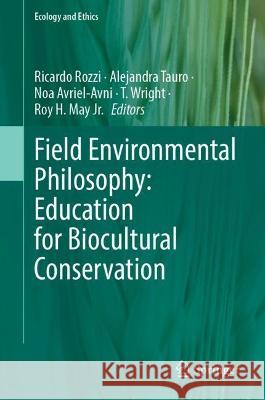
Ricardo Rozzi; Alejandra Tauro; Noa Avriel-Avni
Field Environmental Philosophy: Education for Biocultural Conservation Ricardo Rozzi Alejandra Tauro Noa Avriel-Avni 9783031233678 Springer - książkaWidoczna okładka, to zdjęcie poglądowe, a rzeczywista szata graficzna może różnić się od prezentowanej.

Field Environmental Philosophy: Education for Biocultural Conservation

ISBN-13: 9783031233678 / Angielski / Twarda / 2023 / 586 str.

Ricardo Rozzi; Alejandra Tauro; Noa Avriel-Avni
cena 726,29 zł
(netto: 691,70 VAT:  5%)

Najniższa cena z 30 dni: 693,97 zł
Termin realizacji zamówienia:
ok. 22 dni roboczych
Bez gwarancji dostawy przed świętami

Darmowa dostawa!
inne wydania

This fifth volume in the Ecology and Ethics series integrates key concepts of the previous four volumes by addressing biocultural conservation through novel educational methods. In Field Environmental Philosophy (FEP), the authors undertake two complementary tasks. First, they address a problematic facet of education as an indirect driver of a global change and biocultural homogenization. Second, they contribute to solve the former problems by introducing the FEP method as well as other educational approaches from around the world that value and foster conservation of biological and cultural diversity. A particular emphasis is therefore on the integration of sciences, arts, humanities, and ethics into educational practices that involve the participation of local communities with their diverse forms of ecological knowledge and practices. The book is divided into four parts. Part I introduces FEP concepts and practices that involve a 4-step cycle of transdisciplinary research, poetic communication through composition of metaphors, design of field activities guided with an ecological and ethical orientation, and participation in biocultural conservation activities. Part II exposes problems as well as solutions in formal education (from preschool to higher education) and non-formal education to respect biocultural diversity. Parts III & IV provide case studies developed at long-term socio-ecological research (LTSER) sites, botanical gardens, and other platforms for non-formal education that contribute to biocultural conservation.This book supports a paradigm shift addressing still understudied indirect drivers of global change to foster the conservation of biological and cultural diversity. It is a valuable asset for scientists and practitioners in science and humanities education.


This fifth volume in the Ecology and Ethics series integrates key concepts of the previous four volumes by addressing biocultural conservation through novel educational methods. In Field Environmental Philosophy (FEP), the authors undertake two complementary tasks. First, they address a problematic facet of education as an indirect driver of a global change and biocultural homogenization. Second, they contribute to solve the former problems by introducing the FEP method as well as other educational approaches from around the world that value and foster conservation of biological and cultural diversity. A particular emphasis is therefore on the integration of sciences, arts, humanities, and ethics into educational practices that involve the participation of local communities with their diverse forms of ecological knowledge and practices. The book is divided into four parts. Part I introduces FEP concepts and practices that involve a 4-step cycle of transdisciplinary research, poetic communication through composition of metaphors, design of field activities guided with an ecological and ethical orientation, and participation in biocultural conservation activities. Part II exposes problems as well as solutions in formal education (from preschool to higher education) and non-formal education to respect biocultural diversity. Parts III & IV provide case studies developed at long-term socio-ecological research (LTSER) sites, botanical gardens, and other platforms for non-formal education that contribute to biocultural conservation.This book supports a paradigm shift addressing still understudied indirect drivers of global change to foster the conservation of biological and cultural diversity. It is a valuable asset for scientists and practitioners in science and humanities education.

Kategorie:
Nauka, Biologia i przyroda
Kategorie BISAC:
Nature > Environmental Conservation & Protection - General
Education > General
Social Science > Antropologia - Kultury
Wydawca:
Springer
Seria wydawnicza:
Ecology and Ethics
Język:
Angielski
ISBN-13:
9783031233678
Rok wydania:
2023
Dostępne języki:
Numer serii:
000471637
Ilość stron:
586
Oprawa:
Twarda

​Foreword "Introduction to Field Environmental Philosophy: A new methodological approach for biocultural education and conservation"


Part I: EDUCATION - “ON THE RAZOR’S EDGE” BETWEEN BIOCULTURAL HOMOGENIZATION AND CONSERVATION
1) Introduction to Part I. Education: “on the razor’s edge” between biocultural homogenization and conservation
2) Challenging the dominant of the grand narrative in global education and culture
3) Aldo Leopold and Ecological Education
4) Responding to the Extinction of Experience of Biodiversity Loss within Formal Education: Engaging Drivers of Biocultural Heritage for Sustainability
5) Dissociation between regional biocultural diversity and the diversity presented in formal and non-formal education
6) Liberation Philosophy and Biocultural Education. A Latin American Journey
7) A material ecological ethic for biocultural

Part II: BIOCULTURAL RECONNECTION THROUGH EDUCATION 
8) Introduction to Part II. Biocultural reconnection through education
9) Leopold’s Cultural Harvest, Biocultural Tourism and Field Environmental Philosophy
10) Expanding the horizons of biocultural awareness: examples of communities of philosophical inquiry for the empowerment of ecological agency
11) Small, silent and (in)significant: childhood as an experience of education
12) Education worldwide coordinated by Satoyama Initiative
13) Long-Term Social-Ecological Research for Networked, Co-Engaged, Learning in Relation to River and Wetland Restoration in a Regional Center of Expertise context
14) Sustainable transmission of traditional environmental knowledge for biocultural conservation in Venezuela
15) Pedagogical tourism: a passage back to Nature
16) Hand-Print CARE: Clarifying the inclusion of intergenerational knowledge in school curriculum settings as plural knowledge environments

Part III: LONG-TERM RESEARCH SITES: PLATFORMS TO INTEGRATE SCIENCE, ARTS, HUMANITIES INTO PARTICIPATORY EDUCATION
17) Introduction to Part III. Long-term research sites: platforms to integrate science, arts, humanities into participatory education
18) Forest discovery at HJ Andrews Experimental Forest, Long-Term Ecological Research site: A place-based environmental science, arts, and humanities experience
19) Sense-of-Place as a social indicator for social-ecological system resilience
20) Mindfulness and reconnection with freshwater ecosystems at the Meadows Center Education Program
21) Botanical Gardens in China and Chile: Flagship species and Biocultural Conservation
22) Nature, Humans and Education: Eco-humanism as integrative guiding paradigm for teacher training
23) Biocultural education and conservation in northern hemisphere biosphere reserves: three examples from Europe facing global change

Part IV: FIELD ENVIRONMENTAL PHILOSOPHY: A NOVEL METHODOLOGICAL APPROACH TO RECONNECT EDUCATION WITH BIOCULTURAL DIVERSITY
24) Introduction to Part IV. The Field Environmental Philosophy Methodological Approach
25) Underwater with a hand-lens in the rivers of Cape Horn: ethical, ecological, and aesthetical values of freshwater ecosystems and their co-inhabitants
26) Biocultural interactions of Native American Yaghan people with seaweeds and mollusks: An ethnoecological and ethical adapting the Field Environmental Philosophy methodology
27) The eyes of the tree: perceiving, monitoring, understanding, and countering biological invasions in times of rapid biocultural homogenization
28) Sub-Antarctic Gardens: Knowledge and appreciation of High Andes flora
29) Growing a garden of names in the Miniature Forests of Cape Horn: towards an extension of biocultural conservation and ethics to under-perceived beings
30) Field Environmental Philosophy courses analysis in Omora Ethnobotanical Park, Cape Horns Biosphere Reserve, Chile
31) Biocitizen: Field Environmental Philosophy complementing the formal educational system
32) Starfishes and sky stars: A Field Environmental Philosophy education and ecotourism experiences in Baja California, México
33) Beyond Field Environmental Philosophy: Integrating science and technology

Dr. Ricardo Rozzi is a Chilean ecologist and philosopher, full professor in the Department of Philosophy and Religion at the University of North Texas, USA, and the University of Magallanes, Chile; Director of the Cape Horn International Center (CHIC), Puerto Williams, Chile, and Vice- President of the Center for Environmental Philosophy (CEP), Denton, Texas, USA.

Dr. Alejandra Tauro is a biologist, professor at the El Colegio de Puebla AC., and a researcher at the National Science and Technology Council, Mexico and at the Cape Horn International Center (CHIC), Chile.

Dr. Noa Avriel-Avni is a researcher of environmental education and human-environment relations in the desert; A member of Dead Sea & Arava Science Center R&D, the Ministry of Science and Technology of Israel.

T Wright is a doctoral candidate at the University of North Texas’ Department of Philosophy and Religion. 

Roy H May Jr is a research associate at the Departamento Ecuménico de Investigaciones in San José, Costa Rica.

This fifth volume in the Ecology and Ethics series integrates key concepts of the previous four volumes by addressing biocultural conservation through novel educational methods. In Field Environmental Philosophy (FEP), the authors undertake two complementary tasks. First, they address a problematic facet of education as an indirect driver of a global change and biocultural homogenization. Second, they contribute to solve the former problems by introducing the FEP method as well as other educational approaches from around the world that value and foster conservation of biological and cultural diversity. A particular emphasis is therefore on the integration of sciences, arts, humanities, and ethics into educational practices that involve the participation of local communities with their diverse forms of ecological knowledge and practices. The book is divided into four parts. Part I introduces FEP concepts and practices that involve a 4-step cycle of transdisciplinary research, poetic communication through composition of metaphors, design of field activities guided with an ecological and ethical orientation, and participation in biocultural conservation activities. Part II exposes problems as well as solutions in formal education (from preschool to higher education) and non-formal education to respect biocultural diversity. Parts III & IV provide case studies developed at long-term socio-ecological research (LTSER) sites, botanical gardens, and other platforms for non-formal education that contribute to biocultural conservation.

This book supports a paradigm shift addressing still understudied indirect drivers of global change to foster the conservation of biological and cultural diversity. It is a valuable asset for scientists and practitioners in science and humanities education.




Udostępnij

Facebook - konto krainaksiazek.pl


Opinie o Krainaksiazek.pl na Opineo.pl

Partner Mybenefit

Krainaksiazek.pl w programie rzetelna firma Krainaksiaze.pl - płatności przez paypal

Czytaj nas na:

Facebook - krainaksiazek.pl
  • książki na zamówienie
  • granty
  • książka na prezent
  • kontakt
  • pomoc
  • opinie
  • regulamin
  • polityka prywatności

Zobacz:

  • Księgarnia czeska

  • Wydawnictwo Książkowe Klimaty

1997-2025 DolnySlask.com Agencja Internetowa

© 1997-2022 krainaksiazek.pl
     
KONTAKT | REGULAMIN | POLITYKA PRYWATNOŚCI | USTAWIENIA PRYWATNOŚCI
Zobacz: Księgarnia Czeska | Wydawnictwo Książkowe Klimaty | Mapa strony | Lista autorów
KrainaKsiazek.PL - Księgarnia Internetowa

Polityka prywatnosci - link
Krainaksiazek.pl - płatnośc Przelewy24
Przechowalnia Przechowalnia



