• Wyszukiwanie zaawansowane
  • Kategorie
  • Kategorie BISAC
  • Książki na zamówienie
  • Promocje
  • Granty
  • Książka na prezent
  • Opinie
  • Pomoc
  • Załóż konto
  • Zaloguj się

Feynman-Kac Formulae: Genealogical and Interacting Particle Systems with Applications » książka


zaloguj się | załóż konto
Logo Krainaksiazek.pl

koszyk

konto

szukaj
topmenu
Księgarnia internetowa
Szukaj
Książki na zamówienie
Promocje
Granty
Książka na prezent
Moje konto
Pomoc
 
 
Wyszukiwanie zaawansowane
Pusty koszyk
Bezpłatna dostawa dla zamówień powyżej 20 złBezpłatna dostawa dla zamówień powyżej 20 zł

Kategorie główne

• Nauka
 [2946600]
• Literatura piękna
 [1856966]

  więcej...
• Turystyka
 [72221]
• Informatyka
 [151456]
• Komiksy
 [35826]
• Encyklopedie
 [23190]
• Dziecięca
 [619653]
• Hobby
 [140543]
• AudioBooki
 [1577]
• Literatura faktu
 [228355]
• Muzyka CD
 [410]
• Słowniki
 [2874]
• Inne
 [445822]
• Kalendarze
 [1744]
• Podręczniki
 [167141]
• Poradniki
 [482898]
• Religia
 [510455]
• Czasopisma
 [526]
• Sport
 [61590]
• Sztuka
 [243598]
• CD, DVD, Video
 [3423]
• Technologie
 [219201]
• Zdrowie
 [101638]
• Książkowe Klimaty
 [124]
• Zabawki
 [2473]
• Puzzle, gry
 [3898]
• Literatura w języku ukraińskim
 [254]
• Art. papiernicze i szkolne
 [8170]
Kategorie szczegółowe BISAC

Feynman-Kac Formulae: Genealogical and Interacting Particle Systems with Applications

ISBN-13: 9781441919021 / Angielski / Miękka / 2011 / 556 str.
Pierre Moral
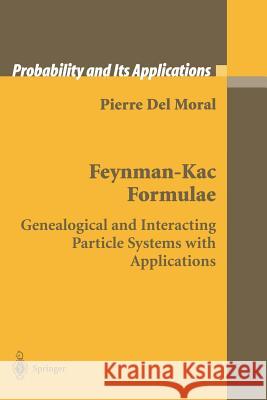
Feynman-Kac Formulae: Genealogical and Interacting Particle Systems with Applications del Moral, Pierre 9781441919021 Not Avail - książkaWidoczna okładka, to zdjęcie poglądowe, a rzeczywista szata graficzna może różnić się od prezentowanej.

Feynman-Kac Formulae: Genealogical and Interacting Particle Systems with Applications

ISBN-13: 9781441919021 / Angielski / Miękka / 2011 / 556 str.

Pierre Moral
cena 726,29 zł
(netto: 691,70 VAT:  5%)

Najniższa cena z 30 dni: 693,97 zł
Termin realizacji zamówienia:
ok. 22 dni roboczych
Bez gwarancji dostawy przed świętami

Darmowa dostawa!

The central theme of this book concerns Feynman-Kac path distributions, interacting particle systems, and genealogical tree based models. This re- cent theory has been stimulated from different directions including biology, physics, probability, and statistics, as well as from many branches in engi- neering science, such as signal processing, telecommunications, and network analysis. Over the last decade, this subject has matured in ways that make it more complete and beautiful to learn and to use. The objective of this book is to provide a detailed and self-contained discussion on these connec- tions and the different aspects of this subject. Although particle methods and Feynman-Kac models owe their origins to physics and statistical me- chanics, particularly to the kinetic theory of fluid and gases, this book can be read without any specific knowledge in these fields. I have tried to make this book accessible for senior undergraduate students having some familiarity with the theory of stochastic processes to advanced postgradu- ate students as well as researchers and engineers in mathematics, statistics, physics, biology and engineering. I have also tried to give an "expose" of the modem mathematical theory that is useful for the analysis of the asymptotic behavior of Feynman-Kac and particle models.


Kategorie:
Nauka, Matematyka
Kategorie BISAC:
Mathematics > Prawdopodobieństwo i statystyka
Mathematics > Matematyka stosowana
Science > Fizyka matematyczna
Wydawca:
Not Avail
Seria wydawnicza:
Probability and Its Applications
Język:
Angielski
ISBN-13:
9781441919021
Rok wydania:
2011
Wydanie:
Softcover Repri
Numer serii:
000047375
Ilość stron:
556
Waga:
0.84 kg
Wymiary:
23.2 x 14.4 x 3.2
Oprawa:
Miękka
Wolumenów:
01
Dodatkowe informacje:
Wydanie ilustrowane

From the reviews:

"I also recommend this book as informal reading for anyone intersted in the subject, preferably with a strong background in Markov processes; in particular, for someone also familiar with one of the many fields to which the book applies Feynman-Kac models. The book is entertaining and informative." Journal of the American Statistical Association, December 2005

"This book takes the readers in a clear and progressive format from simple to recent and advanced topics in pure and applied probability. ... With practical and easy to use references, as well as deeper and modern mathematics studies, the book will be of use to engineers and researchers in pure and applied mathematics. Also researches in statistics, physics, biology, and operation research who have a background of Probability and Markov chain theory, can benefit from the monograph." (Lucien Lemmens, Physicalia, Vol. 57 (3), 2005)

"Pierre Del Moral has produced an extraordinary research and reference book which will be of great use to a large and diverse scientific and engineering community. The book deals in detail with convergence theorems for and applications of so-called Feynman-Kac models and their interacting particle representations. ... The book's main contribution is twofold ... provides excellent models amenable to particle approximation. Del Moral is best known for his research ... . The book contains many references to this branch of his work." (Mathematical Reviews, 2005)

"Examples in engineering science, Bayesian methodology, particle and statistical physics, biology, and applied probability and statistics are given to motivate the study of the Feynman-Kac models in this book. ... can serve as the textbook for an entire course on Feynman-Kac Formulae and particle system approximation. It can also serve as a main reference for courses on topics like stochastic filtering, mathematical models for population genetics, mathematical biology, etc." (Jie Xiong, Zentralblatt MATH, Vol. 1130 (8), 2008)

1 Introduction.- 1.1 On the Origins of Feynman-Kac and Particle Models.- 1.2 Notation and Conventions.- 1.3 Feynman-Kac Path Models.- 1.3.1 Path-Space and Marginal Models.- 1.3.2 Nonlinear Equations.- 1.4 Motivating Examples.- 1.4.1 Engineering Science.- 1.4.2 Bayesian Methodology.- 1.4.3 Particle and Statistical Physics.- 1.4.4 Biology.- 1.4.5 Applied Probability and Statistics.- 1.5 Interacting Particle Systems.- 1.5.1 Discrete Time Models.- 1.5.2 Continuous Time Models.- 1.6 Sequential Monte Carlo Methodology.- 1.7 Particle Interpretations.- 1.8 A Contents Guide for the Reader.- 2 Feynman-Kac Formulae.- 2.1 Introduction.- 2.2 An Introduction to Markov Chains.- 2.2.1 Canonical Probability Spaces.- 2.2.2 Path-Space Markov Models.- 2.2.3 Stopped Markov chains.- 2.2.4 Examples.- 2.3 Description of the Models.- 2.4 Structural Stability Properties.- 2.4.1 Path Space and Marginal Models.- 2.4.2 Change of Reference Probability Measures.- 2.4.3 Updated and Prediction Flow Models.- 2.5 Distribution Flows Models.- 2.5.1 Killing Interpretation.- 2.5.2 Interacting Process Interpretation.- 2.5.3 McKean Models.- 2.5.4 Kalman-Bucy filters.- 2.6 Feynman-Kac Models in Random Media.- 2.6.1 Quenched and Annealed Feynman-Kac Flows.- 2.6.2 Feynman-Kac Models in Distribution Space.- 2.7 Feynman-Kac Semigroups.- 2.7.1 Prediction Semigroups.- 2.7.2 Updated Semigroups.- 3 Genealogical and Interacting Particle Models.- 3.1 Introduction.- 3.2 Interacting Particle Interpretations.- 3.3 Particle models with Degenerate Potential.- 3.4 Historical and Genealogical Tree Models.- 3.4.1 Introduction.- 3.4.2 A Rigorous Approach and Related Transport Problems.- 3.4.3 Complete Genealogical Tree Models.- 3.5 Particle Approximation Measures.- 3.5.1 Some Convergence Results.- 3.5.2 Regularity Conditions.- 4 Stability of Feynman-Kac Semigroups.- 4.1 Introduction.- 4.2 Contraction Properties of Markov Kernels.- 4.2.1 h-relative Entropy.- 4.2.2 Lipschitz Contractions.- 4.3 Contraction Properties of Feynman-Kac Semigroups.- 4.3.1 Functional Entropy Inequalities.- 4.3.2 Contraction Coefficients.- 4.3.3 Strong Contraction Estimates.- 4.3.4 Weak Regularity Properties.- 4.4 Updated Feynman-Kac Models.- 4.5 A Class of Stochastic Semigroups.- 5 Invariant Measures and Related Topics.- 5.1 Introduction.- 5.2 Existence and Uniqueness.- 5.3 Invariant Measures and Feynman-Kac Modeling.- 5.4 Feynman-Kac and Metropolis-Hastings Models.- 5.5 Feynman-Kac-Metropolis Models.- 5.5.1 Introduction.- 5.5.2 The Genealogical Metropolis Particle Model.- 5.5.3 Path Space Models and Restricted Markov Chains.- 5.5.4 Stability Properties.- 6 Annealing Properties.- 6.1 Introduction.- 6.2 Feynman-Kac-Metropolis Models.- 6.2.1 Description of the Model.- 6.2.2 Regularity Properties.- 6.2.3 Asymptotic Behavior.- 6.3 Feynman-Kac Trapping Models.- 6.3.1 Description of the Model.- 6.3.2 Regularity Properties.- 6.3.3 Asymptotic Behavior.- 6.3.4 Large-Deviation Analysis.- 6.3.5 Concentration Levels.- 7 Asymptotic Behavior.- 7.1 Introduction.- 7.2 Some Preliminaries.- 7.2.1 McKean Interpretations.- 7.2.2 Vanishing Potentials.- 7.3 Inequalities for Independent Random Variables.- 7.3.1 Lp and Exponential Inequalities.- 7.3.2 Empirical Processes.- 7.4 Strong Law of Large Numbers.- 7.4.1 Extinction Probabilities.- 7.4.2 Convergence of Empirical Processes.- 7.4.3 Time-Uniform Estimates.- 8 Propagation of Chaos.- 8.1 Introduction.- 8.2 Some Preliminaries.- 8.3 Outline of Results.- 8.4 Weak Propagation of Chaos.- 8.5 Relative Entropy Estimates.- 8.6 A Combinatorial Transport Equation.- 8.7 Asymptotic Properties of Boltzmann-Gibbs Distributions.- 8.8 Feynman-Kac Semigroups.- 8.8.1 Marginal Models.- 8.8.2 Path-Space Models.- 8.9 Total Variation Estimates.- 9 Central Limit Theorems.- 9.1 Introduction.- 9.2 Some Preliminaries.- 9.3 Some Local Fluctuation Results.- 9.4 Particle Density Profiles.- 9.4.1 Unnormalized Measures.- 9.4.2 Normalized Measures.- 9.4.3 Killing Interpretations and Related Comparisons.- 9.5 A Berry-Esseen Type Theorem.- 9.6 A Donsker Type Theorem.- 9.7 Path-Space Models.- 9.8 Covariance Functions.- 10 Large-Deviation Principles.- 10.1 Introduction.- 10.2 Some Preliminary Results.- 10.2.1 Topological Properties.- 10.2.2 Idempotent Analysis.- 10.2.3 Some Regularity Properties.- 10.3 Crámer’s Method.- 10.4 Laplace-Varadhan’s Integral Techniques.- 10.5 Dawson-Gärtner Projective Limits Techniques.- 10.6 Sanov’s Theorem.- 10.6.1 Introduction.- 10.6.2 Topological Preliminaries.- 10.6.3 Sanov’s Theorem in the r-Topology.- 10.7 Path-Space and Interacting Particle Models.- 10.7.1 Proof of Theorem 10.1.1.- 10.7.2 Sufficient Conditions.- 10.8 Particle Density Profile Models.- 10.8.1 Introduction.- 10.8.2 Strong Large-Deviation Principles.- 11 Feynman-Kac and Interacting Particle Recipes.- 11.1 Introduction.- 11.2 Interacting Metropolis Models.- 11.2.1 Introduction.- 11.2.2 Feynman-Kac-Metropolis and Particle Models.- 11.2.3 Interacting Metropolis and Gibbs Samplers.- 11.3 An Overview of some General Principles.- 11.4 Descendant and Ancestral Genealogies.- 11.5 Conditional Explorations.- 11.6 State-Space Enlargements and Path-Particle Models.- 11.7 Conditional Excursion Particle Models.- 11.8 Branching Selection Variants.- 11.8.1 Introduction.- 11.8.2 Description of the Models.- 11.8.3 Some Branching Selection Rules.- 11.8.4 Some L2-mean Error Estimates.- 11.8.5 Long Time Behavior.- 11.8.6 Conditional Branching Models.- 11.9 Exercises.- 12 Applications.- 12.1 Introduction.- 12.2 Random Excursion Models.- 12.2.1 Introduction.- 12.2.2 Dirichlet Problems with Boundary Conditions.- 12.2.3 Multilevel Feynman-Kac Formulae.- 12.2.4 Dirichlet Problems with Hard Boundary Conditions.- 12.2.5 Rare Event Analysis.- 12.2.6 Asymptotic Particle Analysis of Rare Events.- 12.2.7 Fluctuation Results and Some Comparisons.- 12.2.8 Exercises.- 12.3 Change of Reference Measures.- 12.3.1 Introduction.- 12.3.2 Importance Sampling.- 12.3.3 Sequential Analysis of Probability Ratio Tests.- 12.3.4 A Multisplitting Particle Approach.- 12.3.5 Exercises.- 12.4 Spectral Analysis of Feynman-Kac-Schrödinger Semigroups.- 12.4.1 Lyapunov Exponents and Spectral Radii.- 12.4.2 Feynman-Kac Asymptotic Models.- 12.4.3 Particle Lyapunov Exponents.- 12.4.4 Hard, Soft and Repulsive Obstacles.- 12.4.5 Related Spectral Quantities.- 12.4.6 Exercises.- 12.5 Directed Polymers Simulation.- 12.5.1 Feynman-Kac and Boltzmann-Gibbs Models.- 12.5.2 Evolutionary Particle Simulation Methods.- 12.5.3 Repulsive Interaction and Self-Avoiding Markov Chains.- 12.5.4 Attractive Interaction and Reinforced Markov Chains.- 12.5.5 Particle Polymerization Techniques.- 12.5.6 Exercises.- 12.6 Filtering/Smoothing and Path estimation.- 12.6.1 Introduction.- 12.6.2 Motivating Examples.- 12.6.3 Feynman-Kac Representations.- 12.6.4 Stability Properties of the Filtering Equations.- 12.6.5 Asymptotic Properties of Log-likelihood Functions.- 12.6.6 Particle Approximation Measures.- 12.6.7 A Partially Linear/Gaussian Filtering Model.- 12.6.8 Exercises.- References.

This book contains a systematic and self-contained treatment of Feynman-Kac path measures, their genealogical and interacting particle interpretations,and their applications to a variety of problems arising in statistical physics, biology, and advanced engineering sciences. Topics include spectral analysis of Feynman-Kac-Schrödinger operators, Dirichlet problems with boundary conditions, finance, molecular analysis, rare events and directed polymers simulation, genetic algorithms, Metropolis-Hastings type models, as well as filtering problems and hidden Markov chains.

This text takes readers in a clear and progressive format from simple to recent and advanced topics in pure and applied probability such as contraction and annealed properties of non linear semi-groups, functional entropy inequalities, empirical process convergence, increasing propagations of chaos, central limit,and Berry Esseen type theorems as well as large deviations principles for strong topologies on path-distribution spaces. Topics also include a body of powerful branching and interacting particle methods and worked out illustrations of the key aspect of the theory.

With practical and easy to use references as well as deeper and modern mathematics studies, the book will be of use to engineers and researchers in pure and applied mathematics, statistics, physics, biology, and operation research who have a background in probability and Markov chain theory.

Pierre Del Moral is a research fellow in mathematics at the C.N.R.S. (Centre National de la Recherche Scientifique) at the Laboratoire de Statistique et Probabilités of Paul Sabatier University in Toulouse. He received his Ph.D. in signal processing at the LAAS-CNRS (Laboratoire d'Analyse et Architecture des Systèmes) of Toulouse. He is one of the principal designers of the modern and recently developing theory on particle methods in filtering theory. He served as a research engineer in the company Steria-Digilog from 1992 to 1995 and he has been a visiting professor at Purdue University and Princeton University. He is a former associate editor of the journal Stochastic Analysis and Applications.


Udostępnij

Facebook - konto krainaksiazek.pl


Opinie o Krainaksiazek.pl na Opineo.pl

Partner Mybenefit

Krainaksiazek.pl w programie rzetelna firma Krainaksiaze.pl - płatności przez paypal

Czytaj nas na:

Facebook - krainaksiazek.pl
  • książki na zamówienie
  • granty
  • książka na prezent
  • kontakt
  • pomoc
  • opinie
  • regulamin
  • polityka prywatności

Zobacz:

  • Księgarnia czeska

  • Wydawnictwo Książkowe Klimaty

1997-2025 DolnySlask.com Agencja Internetowa

© 1997-2022 krainaksiazek.pl
     
KONTAKT | REGULAMIN | POLITYKA PRYWATNOŚCI | USTAWIENIA PRYWATNOŚCI
Zobacz: Księgarnia Czeska | Wydawnictwo Książkowe Klimaty | Mapa strony | Lista autorów
KrainaKsiazek.PL - Księgarnia Internetowa

Polityka prywatnosci - link
Krainaksiazek.pl - płatnośc Przelewy24
Przechowalnia Przechowalnia





