• Wyszukiwanie zaawansowane
  • Kategorie
  • Kategorie BISAC
  • Książki na zamówienie
  • Promocje
  • Granty
  • Książka na prezent
  • Opinie
  • Pomoc
  • Załóż konto
  • Zaloguj się

F# for Scientists » książka

zaloguj się | załóż konto
Logo Krainaksiazek.pl

koszyk

konto

szukaj
topmenu
Księgarnia internetowa
Szukaj
Książki na zamówienie
Promocje
Granty
Książka na prezent
Moje konto
Pomoc
 
 
Wyszukiwanie zaawansowane
Pusty koszyk
Bezpłatna dostawa dla zamówień powyżej 20 złBezpłatna dostawa dla zamówień powyżej 20 zł

Kategorie główne

• Nauka
 [2952079]
• Literatura piękna
 [1850969]

  więcej...
• Turystyka
 [71058]
• Informatyka
 [151066]
• Komiksy
 [35579]
• Encyklopedie
 [23181]
• Dziecięca
 [620496]
• Hobby
 [139036]
• AudioBooki
 [1646]
• Literatura faktu
 [228729]
• Muzyka CD
 [379]
• Słowniki
 [2932]
• Inne
 [445708]
• Kalendarze
 [1409]
• Podręczniki
 [164793]
• Poradniki
 [480107]
• Religia
 [510956]
• Czasopisma
 [511]
• Sport
 [61267]
• Sztuka
 [243299]
• CD, DVD, Video
 [3411]
• Technologie
 [219640]
• Zdrowie
 [100984]
• Książkowe Klimaty
 [124]
• Zabawki
 [2281]
• Puzzle, gry
 [3363]
• Literatura w języku ukraińskim
 [258]
• Art. papiernicze i szkolne
 [8020]
Kategorie szczegółowe BISAC

F# for Scientists

ISBN-13: 9780470242117 / Angielski / Twarda / 2008 / 368 str.
Jonathan D. Harrop
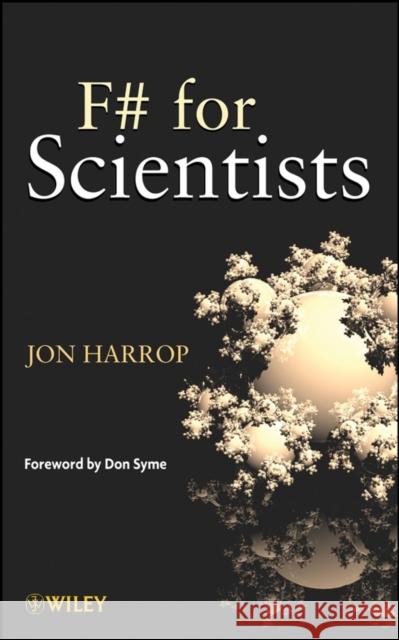
F# for Scientists Jonathan D. Harrop 9780470242117 Wiley-Interscience - książkaWidoczna okładka, to zdjęcie poglądowe, a rzeczywista szata graficzna może różnić się od prezentowanej.

F# for Scientists

ISBN-13: 9780470242117 / Angielski / Twarda / 2008 / 368 str.

Jonathan D. Harrop
cena 451,58
(netto: 430,08 VAT:  5%)

Najniższa cena z 30 dni: 446,96
Termin realizacji zamówienia:
ok. 30 dni roboczych
Dostawa w 2026 r.

Darmowa dostawa!

If you're a computationally-oriented researcher, scientist, or developer who needs to learn the basics of functional programming, .NET and scientific computing, "F# for Scientists" will bring you up to speed with basic syntax and programming language concepts. Written in a clear and concise style with practical and enlightening examples, this book is accessible and easy to understand. By reviewing the Visual Studio screen shots that illustrate compilation, debugging and interactive use, you will understand both the functional aspects of F# and the object-oriented task-based features that make F# so useful in practice.


Kategorie:
Informatyka, Programowanie
Kategorie BISAC:
Computers > Languages - General
Wydawca:
Wiley-Interscience
Język:
Angielski
ISBN-13:
9780470242117
Rok wydania:
2008
Ilość stron:
368
Waga:
0.64 kg
Wymiary:
24.13 x 15.82 x 2.31
Oprawa:
Twarda
Wolumenów:
01
Dodatkowe informacje:
Bibliografia
Glosariusz/słownik

"The hardbound book is a really solid treatment." ( Computing Reviews, February 5, 2009)

Foreword.

Preface.

Acknowledgments.

List of Figures.

List of Tables.

Acronyms.

1. Introduction.

1.1 Programming guidelines.

1.2 A brief history of F#.

1.3 Benefits of F#.

1.4 Introducing F#.

1.5 Imperative programming.

1.6 Functional programming.

2. Program Structure.

2.1 Nesting.

2.2 Factoring.

2.3 Modules.

2.4 Objects.

2.5 Functional design patterns.

2.6 F# development.

3. Data Structures.

3.1 Algorithmic complexity.

3.2 Arrays.

3.3 Lists.

3.4 Sets.

3.5 Hash tables.

3.6 Maps.

3.7 Choosing a data structure.

3.8 Sequences.

3.9 Heterogeneous containers.

3.10 Trees.

4. Numerical Analysis.

4.1 Number representation.

4.2 Algebra.

4.3 Interpolation.

4.4 Quadratic solutions.

4.5 Mean and variance.

4.6 Other forms of arithmetic.

5. Input and Output.

5.1 Printing.

5.2 Generic printing.

5.3 Reading from and writing to files.

5.4 Serialization.

5.5 Lexing and parsing.

6. Simple Examples.

6.1 Functional.

6.2 Numerical.

6.3 String related.

6.4 List related.

6.5 Array related.

6.6 Higher–order functions.

7. Visualization.

7.1 Windows Forms.

7.2 Managed DirectX.

7.3 Tesselating objects into triangles.

8. Optimization.

8.1 Timing.

8.2 Profiling.

8.3 Algorithmic optimizations.

8.4 Lower–level optimizations.

9. Libraries.

9.1 Loading .NET libraries.

9.2 Charting and graphing.

9.3 Threads.

9.4 Random numbers.

9.5 Regular expressions.

9.6 Vectors and matrices.

9.7 Downloading from the Web.

9.8 Compression.

9.9 Handling XML.

9.10 Calling native libraries.

9.11 Fourier transform.

9.12 Mataprogramming.

10. Databases.

10.1 Protein data bank.

10.2 Web services.

10.3 Relational databases.

11. Interoperability.

11.1 Excel.

11.2 MATLAB.

11.3 Mathematica.

12. Complete Examples.

12.1 Fast Fourier transform.

12.2 Semi–circle law.

12.3 Finding n th.–nearest neighbors.

12.4 Logistic map.

12.5 Real–time particle dynamics.

Appendix A: Troubleshooting.

A.1 Value restriction.

A.2 Mutable array contents.

A.3 Negative literals.

A.4 Accidental capture.

A.5 Local and non–local variable definitions.

A.6 Merging lines.

A.7 Applications that do not die.

A.8 Beware of "it".

Glossary.

Bibliography.

Index.

Jon Harrop, PhD, has taught mathematics, biology, and computer science. He founded Flying Frog Consultancy; has produced several products for computational scientists, including the book OCaml for Scientists; and has consulted for high–tech companies on the commercial use of functional programming languages.

"This work strikes a balance between the pure functional aspects of F# and the object–oriented and imperative features that make it so useful in practice, enable .NET integration, and make large–scale data processing possible."
Thore Graepel, PhD, Researcher, Microsoft Research Ltd.

Over the next five years, F# is expected to become one of the world′s most popular functional programming languages for scientists of all disciplines working on the Windows platform. F# is free and, unlike MATLAB® and other software with numerical/scientific origins, is a full–fledged programming language.

Developed in consultation with Don Syme of Microsoft Research Ltd. who wrote the language F# for Scientists explains and demonstrates the powerful features of this important new programming language. The book assumes no prior experience and guides the reader from the basics of computer programming to the implementation of state–of–the–art algorithms.

F# for Scientists begins with coverage of introductory material in the areas of functional programming, .NET, and scientific computing, and goes on to explore:

  • Program structure

  • Optimization

  • Data structures

  • Libraries

  • Numerical analysis

  • Databases

  • Input and output

  • Interoperability

  • Visualization

Screenshots of development using Visual Studio are used to illustrate compilation, debugging, and interactive use, while complete examples of a few whole programs are included to give readers a complete view of F#′s capabilities.

Written in a clear and concise style, F# for Scientists is well suited for researchers, scientists, and developers who want to program under the Windows platform. It also serves as an ideal supplemental text for advanced undergraduate and graduate students with a background in science or engineering.


Udostępnij

Facebook - konto krainaksiazek.pl


Opinie o Krainaksiazek.pl na Opineo.pl

Partner Mybenefit

Krainaksiazek.pl w programie rzetelna firma Krainaksiaze.pl - płatności przez paypal

Czytaj nas na:

Facebook - krainaksiazek.pl
  • książki na zamówienie
  • granty
  • książka na prezent
  • kontakt
  • pomoc
  • opinie
  • regulamin
  • polityka prywatności

Zobacz:

  • Księgarnia czeska

  • Wydawnictwo Książkowe Klimaty

1997-2025 DolnySlask.com Agencja Internetowa

© 1997-2022 krainaksiazek.pl
     
KONTAKT | REGULAMIN | POLITYKA PRYWATNOŚCI | USTAWIENIA PRYWATNOŚCI
Zobacz: Księgarnia Czeska | Wydawnictwo Książkowe Klimaty | Mapa strony | Lista autorów
KrainaKsiazek.PL - Księgarnia Internetowa

Polityka prywatnosci - link
Krainaksiazek.pl - płatnośc Przelewy24
Przechowalnia Przechowalnia






