• Wyszukiwanie zaawansowane
  • Kategorie
  • Kategorie BISAC
  • Książki na zamówienie
  • Promocje
  • Granty
  • Książka na prezent
  • Opinie
  • Pomoc
  • Załóż konto
  • Zaloguj się

External Voting: The Patterns and Drivers of Central European Migrants' Homeland Electoral Participation » książka


zaloguj się | załóż konto
Logo Krainaksiazek.pl

koszyk

konto

szukaj
topmenu
Księgarnia internetowa
Szukaj
Książki na zamówienie
Promocje
Granty
Książka na prezent
Moje konto
Pomoc
 
 
Wyszukiwanie zaawansowane
Pusty koszyk
Bezpłatna dostawa dla zamówień powyżej 20 złBezpłatna dostawa dla zamówień powyżej 20 zł

Kategorie główne

• Nauka
 [2946912]
• Literatura piękna
 [1852311]

  więcej...
• Turystyka
 [71421]
• Informatyka
 [150889]
• Komiksy
 [35717]
• Encyklopedie
 [23177]
• Dziecięca
 [617324]
• Hobby
 [138808]
• AudioBooki
 [1671]
• Literatura faktu
 [228371]
• Muzyka CD
 [400]
• Słowniki
 [2841]
• Inne
 [445428]
• Kalendarze
 [1545]
• Podręczniki
 [166819]
• Poradniki
 [480180]
• Religia
 [510412]
• Czasopisma
 [525]
• Sport
 [61271]
• Sztuka
 [242929]
• CD, DVD, Video
 [3371]
• Technologie
 [219258]
• Zdrowie
 [100961]
• Książkowe Klimaty
 [124]
• Zabawki
 [2341]
• Puzzle, gry
 [3766]
• Literatura w języku ukraińskim
 [255]
• Art. papiernicze i szkolne
 [7810]
Kategorie szczegółowe BISAC

External Voting: The Patterns and Drivers of Central European Migrants' Homeland Electoral Participation

ISBN-13: 9783031192456 / Angielski / Twarda / 2022 / 116 str.
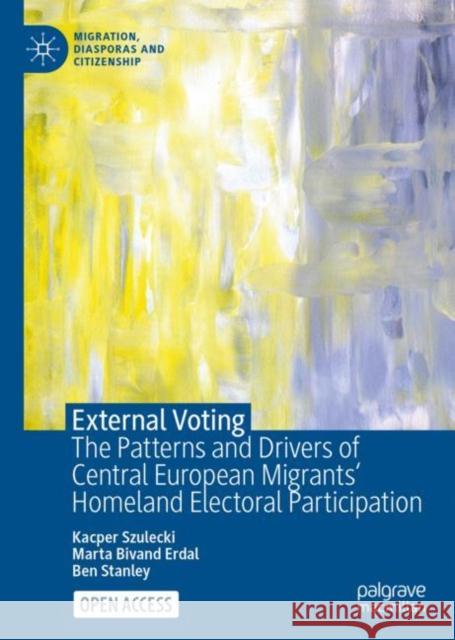
Kacper Szulecki; Marta Bivand Erdal; Ben Stanley
External Voting: The Patterns and Drivers of Central European Migrants' Homeland Electoral Participation Kacper Szulecki Marta Bivand Erdal Ben Stanley 9783031192456 Palgrave MacMillan - książkaWidoczna okładka, to zdjęcie poglądowe, a rzeczywista szata graficzna może różnić się od prezentowanej.

External Voting: The Patterns and Drivers of Central European Migrants' Homeland Electoral Participation

ISBN-13: 9783031192456 / Angielski / Twarda / 2022 / 116 str.

Kacper Szulecki; Marta Bivand Erdal; Ben Stanley
cena 201,24
(netto: 191,66 VAT:  5%)

Najniższa cena z 30 dni: 192,74
Termin realizacji zamówienia:
ok. 22 dni roboczych
Bez gwarancji dostawy przed świętami

Darmowa dostawa!

This open access book is the first monograph that brings together insights from comparative politics, political sociology, and migration studies to introduce the current state of knowledge on external voting and transnational politics. Drawing on new data gathered within the DIASPOlitic project, which created a comparative dataset of external voting results for 6 countries of origin and 17 countries of residence as well as an extensive qualitative dataset of 80 in-depth interviews with four groups of migrants, this book not only illustrates theoretical problems with empirical material, but also provides answers to previously unaddressed questions.The empirical material focuses on the European context. The Eastern Enlargement of the European Union (2004-2007) triggered a westward wave of migration from Central and Eastern European countries which faced the expansion of existing émigré communities and the emergence of new ones. As this process coincided with the expansion of migrant voting rights, the result is a large set of populous diaspora communities which can potentially have a significant impact on country electoral politics, making the study of external voting highly relevant.This book’s introduction takes stock of current research on transnational politics and external voting, presenting core puzzles. The following chapter introduces the context of intra-European migration and the political situation in Central-Eastern European sending countries. The next two sections address the empirical puzzles, drawing on new quantitative and qualitative. The conclusion takes stock of the evidence gathered, discusses the normative problem of non-resident voters enfranchisement, connects external voting to the broader debate on political remittances and finally, maps the terrain ahead for future research.This concise, empirically grounded introduction to external voting is critical reading in structuring the debate around migration and shaping research agendas for the future.


This open access book is the first monograph that brings together insights from comparative politics, political sociology, and migration studies to introduce the current state of knowledge on external voting and transnational politics. Drawing on new data gathered within the DIASPOlitic project, which created a comparative dataset of external voting results for 6 countries of origin and 17 countries of residence as well as an extensive qualitative dataset of 80 in-depth interviews with four groups of migrants, this book not only illustrates theoretical problems with empirical material, but also provides answers to previously unaddressed questions.The empirical material focuses on the European context. The Eastern Enlargement of the European Union (2004-2007) triggered a westward wave of migration from Central and Eastern European countries which faced the expansion of existing émigré communities and the emergence of new ones. As this process coincided with the expansion of migrant voting rights, the result is a large set of populous diaspora communities which can potentially have a significant impact on country electoral politics, making the study of external voting highly relevant.This book’s introduction takes stock of current research on transnational politics and external voting, presenting core puzzles. The following chapter introduces the context of intra-European migration and the political situation in Central-Eastern European sending countries. The next two sections address the empirical puzzles, drawing on new quantitative and qualitative. The conclusion takes stock of the evidence gathered, discusses the normative problem of non-resident voters enfranchisement, connects external voting to the broader debate on political remittances and finally, maps the terrain ahead for future research.This concise, empirically grounded introduction to external voting is critical reading in structuring the debate around migration and shaping research agendas for the future.

Kategorie:
Nauka, Socjologia i społeczeństwo
Kategorie BISAC:
Social Science > Emigration & Immigration
Social Science > Socjologia
Political Science > Political Ideologies - Democracy
Wydawca:
Palgrave MacMillan
Seria wydawnicza:
Migration, Diasporas and Citizenship
Język:
Angielski
ISBN-13:
9783031192456
Rok wydania:
2022
Dostępne języki:
Numer serii:
000446414
Ilość stron:
116
Waga:
0.31 kg
Wymiary:
21.01 x 14.81 x 0.97
Oprawa:
Twarda
Dodatkowe informacje:
Wydanie ilustrowane

1 Introduction.

Defining External Voting.

Expansion of Emigrant Franchise.

External Voting Landscape: Countries, Elections, Criteria, and Modalities.

What Do We Know About External Voting? Migration Studies Meet Political Science.

References.

2 Emigration and Transnational Political Practices in Central and Eastern Europe After EU Enlargement.-04–2007.

East-West Migration in Europe: Political Context and Consequences.

The DIASPOlitic Project, Data Gathering, and Methods.

Data Gathering and Method: Quantitative Analysis of External Voting Results.

Data Gathering and Method: Qualitative Study of Migrant Voting.

References.

3 External Voting Patterns: CEE Migrants in Western Europe.

The Political Contexts of the Countries of Origin.

Bulgaria.

Czechia.

Latvia.

Lithuania.

Poland.

Romania.

Data and Methods.

Results of the Analysis.

Turnout Patterns and Change Over Time.

Overall Disparity.

Ideological Disparity.

References.

4 Migrant Perspectives on External Voting.

Making Sense of the Reasons Why Migrants Vote “Back Home”.

Motivations for Voting in Country-of-Origin Elections.

The Practical Possibility of Casting the Vote in Elections.

Interacting Scales of Motivation for External Voting.

Emigration, External Voting, and Political Engagement.

Transnational Lifeworlds and Politics.

How Does the Experience of Migration Influence Political Views?.

Concluding Discussion.

References.

5 Conclusions.

What Have We Learned About External Voting? Discussion of Findings.

Differences Between Diaspora Voting and “Homeland” Results.

Ideological Differences.

What Do We Know About Turnout?.

Why Do Migrants Vote, or Not?.

Legitimacy and Normative Considerations Surrounding External Voting.

Do Migrants Desire to Be “Agents of Change”?.

Research Frontiers and Future Knowledge Needs.

Three Areas for Further Research: Empirical Knowledge Needs.

Three Areas for Further Research: Normative Dimension.

References.

Kacper Szulecki is Research Professor at the Norwegian Institute of International Affairs in Oslo. He is a political sociologist specializing in transnational and European politics. He was the Principal Investigator in the DIASPOlitic project.

Marta Bivand Erdal is Research Professor at the Peace Research Institute Oslo (PRIO), Norway, where she is also the Co-Director of PRIO Migration Centre. As a human geographer she is interested in the impacts of migration and transnationalism in both emigration and immigration contexts.

Ben Stanley is Associate Professor in the Centre for the Study of Democracy at the SWPS University of Social Sciences and Humanities in Warsaw, Poland. His primary area of research interest is the politics of populism in Central and Eastern Europe, incorporating analysis of party ideological appeals and voter behaviour.

This open access book is the first monograph that brings together insights from comparative politics, political sociology, and migration studies to introduce the current state of knowledge on external voting and transnational politics. Drawing on new data gathered within the DIASPOlitic project, which created a comparative dataset of external voting results for 6 countries of origin and 17 countries of residence as well as an extensive qualitative dataset of 80 in-depth interviews with four groups of migrants, this book not only illustrates theoretical problems with empirical material, but also provides answers to previously unaddressed questions.

This book’s introduction takes stock of current research on transnational politics and external voting, presenting core puzzles. The following chapter introduces the context of intra-European migration and the political situation in Central-Eastern European sending countries. The next two sections address the empirical puzzles, drawing on new quantitative and qualitative. The conclusion takes stock of the evidence gathered, discusses the normative problem of non-resident voters enfranchisement, connects external voting to the broader debate on political remittances and finally, maps the terrain ahead for future research.

This concise, empirically grounded introduction to external voting is critical reading in structuring the debate around migration and shaping research agendas for the future.




Udostępnij

Facebook - konto krainaksiazek.pl


Opinie o Krainaksiazek.pl na Opineo.pl

Partner Mybenefit

Krainaksiazek.pl w programie rzetelna firma Krainaksiaze.pl - płatności przez paypal

Czytaj nas na:

Facebook - krainaksiazek.pl
  • książki na zamówienie
  • granty
  • książka na prezent
  • kontakt
  • pomoc
  • opinie
  • regulamin
  • polityka prywatności

Zobacz:

  • Księgarnia czeska

  • Wydawnictwo Książkowe Klimaty

1997-2025 DolnySlask.com Agencja Internetowa

© 1997-2022 krainaksiazek.pl
     
KONTAKT | REGULAMIN | POLITYKA PRYWATNOŚCI | USTAWIENIA PRYWATNOŚCI
Zobacz: Księgarnia Czeska | Wydawnictwo Książkowe Klimaty | Mapa strony | Lista autorów
KrainaKsiazek.PL - Księgarnia Internetowa

Polityka prywatnosci - link
Krainaksiazek.pl - płatnośc Przelewy24
Przechowalnia Przechowalnia




