• Wyszukiwanie zaawansowane
  • Kategorie
  • Kategorie BISAC
  • Książki na zamówienie
  • Promocje
  • Granty
  • Książka na prezent
  • Opinie
  • Pomoc
  • Załóż konto
  • Zaloguj się

Expressive Order: Confirming Sentiments in Social Actions » książka


zaloguj się | załóż konto
Logo Krainaksiazek.pl

koszyk

konto

szukaj
topmenu
Księgarnia internetowa
Szukaj
Książki na zamówienie
Promocje
Granty
Książka na prezent
Moje konto
Pomoc
 
 
Wyszukiwanie zaawansowane
Pusty koszyk
Bezpłatna dostawa dla zamówień powyżej 20 złBezpłatna dostawa dla zamówień powyżej 20 zł

Kategorie główne

• Nauka
 [2946912]
• Literatura piękna
 [1852311]

  więcej...
• Turystyka
 [71421]
• Informatyka
 [150889]
• Komiksy
 [35717]
• Encyklopedie
 [23177]
• Dziecięca
 [617324]
• Hobby
 [138808]
• AudioBooki
 [1671]
• Literatura faktu
 [228371]
• Muzyka CD
 [400]
• Słowniki
 [2841]
• Inne
 [445428]
• Kalendarze
 [1545]
• Podręczniki
 [166819]
• Poradniki
 [480180]
• Religia
 [510412]
• Czasopisma
 [525]
• Sport
 [61271]
• Sztuka
 [242929]
• CD, DVD, Video
 [3371]
• Technologie
 [219258]
• Zdrowie
 [100961]
• Książkowe Klimaty
 [124]
• Zabawki
 [2341]
• Puzzle, gry
 [3766]
• Literatura w języku ukraińskim
 [255]
• Art. papiernicze i szkolne
 [7810]
Kategorie szczegółowe BISAC

Expressive Order: Confirming Sentiments in Social Actions

ISBN-13: 9781441942562 / Angielski / Miękka / 2010 / 164 str.
David R. Heise
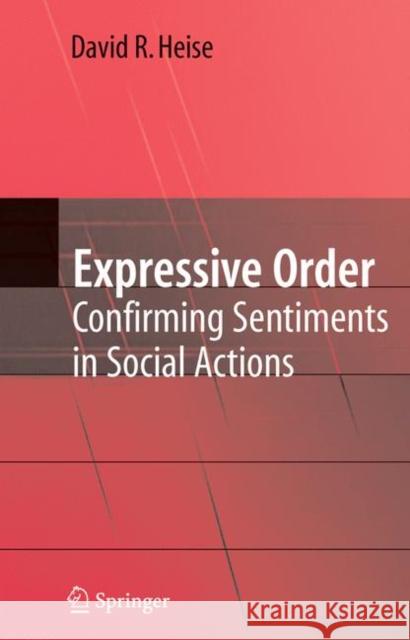
Expressive Order: Confirming Sentiments in Social Actions Heise, David R. 9781441942562 Springer - książkaWidoczna okładka, to zdjęcie poglądowe, a rzeczywista szata graficzna może różnić się od prezentowanej.

Expressive Order: Confirming Sentiments in Social Actions

ISBN-13: 9781441942562 / Angielski / Miękka / 2010 / 164 str.

David R. Heise
cena 200,77
(netto: 191,21 VAT:  5%)

Najniższa cena z 30 dni: 192,74
Termin realizacji zamówienia:
ok. 22 dni roboczych
Dostawa w 2026 r.

Darmowa dostawa!

Expressive Order introduces affect control theory to lay readers of sociology, and additionally guides sociology specialists into the theory's deep structure. Briefly, affect control theory proposes that individuals shape their social interactions so that emerging impressions reinforce sentiments about salient identities, behaviors, and settings. Emotions signal how the process of confirming sentiments is going for each individual. The theory explains behaviors, emotions, social labeling, and personality attributions in a wide variety of social contexts including intimate relations, work-world interactions, courtrooms, and international relations. Part 1 of the book provides a plain-language exposition of the theory, along with numerous interpretive analyses of everyday situations. This is engaging and provocative reading for anyone interested in social relations, including undergraduates in and out of the social sciences. Part 2 presents the mathematical derivations that define sentiment-confirming behavior, labeling, attribution, and emotion. The mathematical solutions, conjoined with understandings about social institutions, are the basis of the theory's explanations. The derivations clarify the theory's assumptions and reasoning, as only mathematics can. Part 3 of Expressive Order describes the research program associated with the theory and the computer simulation software that is used in research. This part of the book offers a jump start for individuals wishing to use affect control theory in their own research."


Kategorie:
Nauka, Pedagogika i oświata
Kategorie BISAC:
Social Science > Socjologia
Wydawca:
Springer
Język:
Angielski
ISBN-13:
9781441942562
Rok wydania:
2010
Ilość stron:
164
Waga:
0.26 kg
Wymiary:
23.39 x 15.6 x 0.97
Oprawa:
Miękka
Wolumenów:
01

Preface.- Part I Affect Control Theory, Plainly Told.- Introduction .- Affect control theory.- Utility of the Theory .- Overview of the Book.- Further Readings.- Sentiments.- Evaluation, Potency, and Activity (EPA).-Measuring EPA .- Universality of EPA.- Further Readings.- Culture.- Consensus.- Individuality Versus Norms.- Measurement Implications.- Cultural Stability.- Instability or Unreliability? .- Variations Across Cultures.- Further Readings .- Sub-Cultures.- Gender.- A Pseudo-Sub-Culture.- Gendered Traits.- Gay Christians .- Deviance Sub-Cultures.- Non-Normalized Deviants .- Occupations.- Further Readings.- Defining Situations.- Identities.- Institutions.- Cues to Institutions.- Selves.- Multiple Identities.- Identity Modifiers.- Further Readings.- Interpreting Actions.- Action Frames.- Institutional Coherence.- Affective Processing .- Impression Formation.- Stability.-  Behavior Effects.- Diminishment.- Consistencies.- Congruencies.- Balance.- States of Being .- Cross-Cultural Variations.- Versus Sentiments—Deflection.- Identifying Behaviors .- Further Readings .- Building Actions.-Selecting a Behavior.- Social Interaction.- Groups .- Avoiding Diminishment .- Social Roles .- Medicine.- Law .- Work Roles .- Macroactions .- Informal Roles.- Deviance.-  Interactions With Deviants.-  Interactions Among Deviants.- Further Readings .- Emotions .-  Emotions as Signals.- Impressions and Emotions .- Characteristic and Structural Emotions .- Solidarity .- Emotions and Motivation .- Stress .- Self-Sentiments and Stress .- Emotions and Stress .- Emotions of Deviants.- Further Readings.- Changing Sentiments.- Re-identification .- Identity Filtering.- Labeling Deviants .- Attribution .- Inferences From Emotionality.- Identity Fluctuation.-  Sentiment Change.- New Sentiments .- Enculturation.- Turning Points.- Further Readings.- Selves.- Salient Identities.- Commitment and Alienation.- Deviance Forays .-  Deviants .- Self-Repugnance .-  Patterns of Deviance .- Self-Fluctuation.- Cultural Shifts in Self .- Further Readings.- Part II Mathematics of Affect Control Theory .- Event Likelihood.- Optimal Behavior.- Incorporating Settings.- Self-Directed Action .- Optimal Identity.- Re-identifying Actors.-  Re-identifying Object Persons .- Modifiers .- Emotions.- Characteristic Emotion.- Attributes.- Emotions and Re-identification .- Inferences From Mood.- Elaborations.- Self and Identities.- Minimizing Inauthenticity.- Illustrative Analyses.- Optimal Behavior.- Optimal Re-identifications.- Emotions and Re-identification.- Programming the Model.- Organization of Analyses.- Emotionality Constraints .-  Impression-Formation Equations.- Selection .- Algorithms.- Part III Researching Affect Control Theory.- Growth of Affect Control Theory.- Chronology .- Branches.- Measurement of Affective Dimensions.- Impression Formation.- Theory and Mathematics.- Self.- Computer Programming.- Experiments.- Emotions.- Sub-Cultures, Gender, Ideology.- Life Course.- Social Structure, Social Change.- Politics .- Deviance .- Language and Arts.- Business .- Simulations.- Conducting Simulations.- Define Interactants Form.- Define Situation Form.- Define Events Form.- Analyze Events Form.- View Report Form .- Other Capabilities .-  Errors.- Different Versions of Interact .- Further Readings .-  Basic Concepts in Affect Control Theory.- References .- Index

Expressive Order introduces affect control theory to lay readers of sociology, and additionally guides sociology specialists into the theory's deep structure.

Briefly, affect control theory proposes that individuals shape their social interactions so that emerging impressions reinforce sentiments about salient identities, behaviors, and settings. Emotions signal how the process of confirming sentiments is going for each individual. The theory explains behaviors, emotions, social labeling, and personality attributions in a wide variety of social contexts—including intimate relations, work-world interactions, courtrooms, and international relations.

Part 1 of the book provides a plain-language exposition of the theory, along with numerous interpretive analyses of everyday situations. This is engaging and provocative reading for anyone interested in social relations, including undergraduates in and out of the social sciences.

Part 2 presents the mathematical derivations that define sentiment-confirming behavior, labeling, attribution, and emotion. The mathematical solutions, conjoined with understandings about social institutions, are the basis of the theory's explanations. The derivations clarify the theory's assumptions and reasoning, as only mathematics can.

Part 3 of Expressive Order describes the research program associated with the theory and the computer simulation software that is used in research. This part of the book offers a jump start for individuals wishing to use affect control theory in their own research.

Heise, David R. Heise is Rudy Professor of Sociology in the Depart... więcej >


Udostępnij

Facebook - konto krainaksiazek.pl


Opinie o Krainaksiazek.pl na Opineo.pl

Partner Mybenefit

Krainaksiazek.pl w programie rzetelna firma Krainaksiaze.pl - płatności przez paypal

Czytaj nas na:

Facebook - krainaksiazek.pl
  • książki na zamówienie
  • granty
  • książka na prezent
  • kontakt
  • pomoc
  • opinie
  • regulamin
  • polityka prywatności

Zobacz:

  • Księgarnia czeska

  • Wydawnictwo Książkowe Klimaty

1997-2025 DolnySlask.com Agencja Internetowa

© 1997-2022 krainaksiazek.pl
     
KONTAKT | REGULAMIN | POLITYKA PRYWATNOŚCI | USTAWIENIA PRYWATNOŚCI
Zobacz: Księgarnia Czeska | Wydawnictwo Książkowe Klimaty | Mapa strony | Lista autorów
KrainaKsiazek.PL - Księgarnia Internetowa

Polityka prywatnosci - link
Krainaksiazek.pl - płatnośc Przelewy24
Przechowalnia Przechowalnia





