• Wyszukiwanie zaawansowane
  • Kategorie
  • Kategorie BISAC
  • Książki na zamówienie
  • Promocje
  • Granty
  • Książka na prezent
  • Opinie
  • Pomoc
  • Załóż konto
  • Zaloguj się

Exploring Abstract Algebra with Mathematica(r) » książka


zaloguj się | załóż konto
Logo Krainaksiazek.pl

koszyk

konto

szukaj
topmenu
Księgarnia internetowa
Szukaj
Książki na zamówienie
Promocje
Granty
Książka na prezent
Moje konto
Pomoc
 
 
Wyszukiwanie zaawansowane
Pusty koszyk
Bezpłatna dostawa dla zamówień powyżej 20 złBezpłatna dostawa dla zamówień powyżej 20 zł

Kategorie główne

• Nauka
 [2950560]
• Literatura piękna
 [1849509]

  więcej...
• Turystyka
 [71097]
• Informatyka
 [151150]
• Komiksy
 [35848]
• Encyklopedie
 [23178]
• Dziecięca
 [617388]
• Hobby
 [139064]
• AudioBooki
 [1657]
• Literatura faktu
 [228597]
• Muzyka CD
 [383]
• Słowniki
 [2855]
• Inne
 [445295]
• Kalendarze
 [1464]
• Podręczniki
 [167547]
• Poradniki
 [480102]
• Religia
 [510749]
• Czasopisma
 [516]
• Sport
 [61293]
• Sztuka
 [243352]
• CD, DVD, Video
 [3414]
• Technologie
 [219456]
• Zdrowie
 [101002]
• Książkowe Klimaty
 [124]
• Zabawki
 [2311]
• Puzzle, gry
 [3459]
• Literatura w języku ukraińskim
 [254]
• Art. papiernicze i szkolne
 [8079]
Kategorie szczegółowe BISAC

Exploring Abstract Algebra with Mathematica(r)

ISBN-13: 9780387986197 / Angielski / Miękka / 1999 / 467 str.
Allen C. Hibbard; K. Levvasseur; A. Hibbard
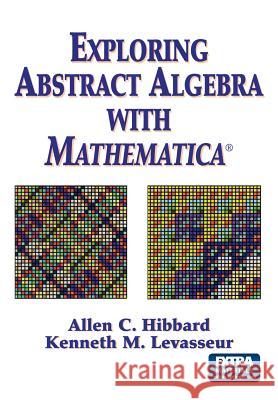
Exploring Abstract Algebra with Mathematica(r) Hibbard, Allen C. 9780387986197 Springer - książkaWidoczna okładka, to zdjęcie poglądowe, a rzeczywista szata graficzna może różnić się od prezentowanej.

Exploring Abstract Algebra with Mathematica(r)

ISBN-13: 9780387986197 / Angielski / Miękka / 1999 / 467 str.

Allen C. Hibbard; K. Levvasseur; A. Hibbard
cena 201,24
(netto: 191,66 VAT:  5%)

Najniższa cena z 30 dni: 192,74
Termin realizacji zamówienia:
ok. 22 dni roboczych
Dostawa w 2026 r.

Darmowa dostawa!

What is Exploring Abstract Algebra with Mathematica? Exploring Abstract Algebra with Mathematica is a learning environment for introductory abstract algebra built around a suite of Mathematica packages enti tled AbstractAlgebra. These packages are a foundation for this collection of twenty-seven interactive labs on group and ring theory. The lab portion of this book reflects the contents of the Mathematica-based electronic notebooks con tained in the accompanying CD-ROM. Students can interact with both the printed and electronic versions of the material in the laboratory and look up details and reference information in the User's Guide. Exercises occur in the stream of the text of labs, providing a context in which to answer. The notebooks are designed so that the answers to the questions can either be entered into the electronic notebook or written on paper, whichever the instructor prefers. The notebooks support versions 2. 2 and 3. 0-4. 0 and are compatible with all platforms that run Mathematica. This work can be used to supplement any introductory abstract algebra text and is not dependent on any particular text. The group and ring labs have been cross referenced against some of the more popular texts. This information can be found on our web site at http: //www . central. edu/eaarn. htrnl (which is also mirrored at http: //www . urnl. edu/Dept/Math/eaarn/eaarn. htrnl). If your favorite text isn't on our list, it can be added upon request by contacting either author."


Kategorie:
Nauka, Matematyka
Kategorie BISAC:
Mathematics > Matematyka dyskretna
Mathematics > Algebra - General
Mathematics > Mathematical Analysis
Wydawca:
Springer
Język:
Angielski
ISBN-13:
9780387986197
Rok wydania:
1999
Ilość stron:
467
Waga:
0.78 kg
Wymiary:
23.39 x 17.93 x 2.51
Oprawa:
Miękka
Wolumenów:
01
Dodatkowe informacje:
Wydanie ilustrowane

I Group Labs.- 1 Using Symmetry to Uncover a Group.- Getting started? Begin here.- A symmetry of an equilateral triangle.- Are there other symmetries?.- Multiplying the transformations.- Are there any commuters?.- Is it always bad to be closed-minded?.- We should try to find our identity.- Is it perverse to not have an inverse?.- Should we associate together?.- What else?.- Let’s group it all together.- 2 Determining the Symmetry Group of a Given Figure.- Symmetries and how to find them.- Your turn.- 3 Is This a Group?.- When do we have a group?.- Your turn.- 4 Let’s Get These Orders Straight.- Order of g and its inverse.- Distribution of the orders of elements in ?n.- Another look at orders.- What is P( \ g.- More questions about Un.- 5 Subversively Grouping Our Elements.- When do we have a subgroup?.- Subgroups of ?n.- P(H < G) for a random subset H ofG = ?n.- Necessary elements for full closure.- Subgroups of Un.- 6 Cycling Through the Groups.- What, when, how, and why about cyclic groups.- Cyclicity of ?m ? ?n.- Structure of intersections of subgroups of ?.- 7 Permutations.- What is a permutation?.- Computations with permutations.- Applications of permutations.- Questions about permutations.- 8 Isomorphisms.- What is an isomorphism?.- Creating Morphoids.- Seeing isomorphisms.- 9 Automorphisms.- Automorphisms on ?n.- Inner automorphisms.- 10 Direct Products.- What is a direct product?.- Order of an element in a direct product.- When is a direct product of cyclic groups cyclic?.- Isomorphisms among Un groups.- 11 Cosets.- Cosets, left and right.- Properties of cosets.- 12 Normality and Factor Groups.- Normal subgroups.- Making a new group.- Factor groups.- 13 Group Homomorphisms.- What is a group homomorphism?.- The kernel and image.- Properties that are preserved by homomorphisms.- The kernel is normal.- The First Homomorphism Theorem.- The alternating group—parity as a morphism.- 14 Rotational Groups of Regular Polyhedra.- The rotational group of the tetrahedron.- Further exercises.- II Ring Labs.- 1 Introduction to Rings and Ringoids.- Getting started? Begin here.- Ringoids and rings.- Properties of rings.- Additional exercises.- 2 Introduction to Rings, Part 2.- Units and zero divisors.- Integral domains.- Fields.- Additional exercises.- 3 An Ideal Part of Rings.- What is the ideal part of a ring?.- Ideals factor into other ring properties.- 4 What Does ?[i](a + b i) Look Like?.- Example 1.- Example 2.- 5 Ring Homomorphisms.- Morphoids on rings.- Ring homomorphisms.- The kernel and image.- The kernel is an ideal.- One-rule Morphoids.- The Chinese Remainder Theorem.- 6 Polynomial Rings.- to polynomials.- Divide and conquer.- 7 Factoring and Irreducibility.- to factoring and irreducibility.- Some techniques on testing the irreducibility of polynomials.- More polynomials for practice.- Toolbox of theorems.- Final perspective.- 8 Roots of Unity.- A closer look—graphically.- Another look—algebraically.- 9 Cyclotomic Polynomials.- Search for gn(x).- Some properties of ?x(x).- 10 Quotient Rings of Polynomials.- Polynomials over a field.- A homomorphism based on PolynomialRemainder.- Defining a quotient ring of polynomials.- The PolynomialRemainder function ? is indeed a homomorphism.- Is V a field?.- Is V what we claimed?.- 11 Quadratic Field Extensions.- The general problem.- An extension of ?3 using Mathematica.- Theorems motivated from this lab.- 12 Factoring in ?[?d].- to divisibility.- Associates, irreducibility, and norms.- Units in?[?d].- Factoring 46 in ?[?5].- Is ?[?6] a UFD?.- 13 Finite Fields.- Creation of finite fields.- Finite field theorems and illustrations.- III User’s Guide.- 1 Introduction to Abstract Algebra.- Packages in AbstractAlgebra.- Basic structures used in AbstractAlgebra.- How to use a Mode.- Using Visual mode with “large” elements.- How to change the Structure.- 2 Groupolds.- Forming Groupoids.- Structure of Groupoids.- Testing the defining properties of a group.- Built-in groupoids.- Uses of the Cayley table.- Building other structures.- Other group properties.- 3 Ringoids.- Forming Ringoids.- Structure of Ringoids.- Testing properties of a ring.- Built-in Ringoids.- Using Cayley tables.- Building other structures.- Extension ringoids.- Polynomials over a ringoid.- Matrices over a ringoid.- Functions on a ringoid.- Finite fields.- 4 Morphoids.- Forming Morphoids.- Structure of Morphoids.- Built–in Morphoids.- Properties.- Kernel, Image, and InverseImage.- Automorphisms.- Visualizing Morphoids.- 5 Additional Functionality.- Global variables and options.- Working with permutations and cycles.- Working in ?[?d].- Miscellaneous functions.


Udostępnij

Facebook - konto krainaksiazek.pl


Opinie o Krainaksiazek.pl na Opineo.pl

Partner Mybenefit

Krainaksiazek.pl w programie rzetelna firma Krainaksiaze.pl - płatności przez paypal

Czytaj nas na:

Facebook - krainaksiazek.pl
  • książki na zamówienie
  • granty
  • książka na prezent
  • kontakt
  • pomoc
  • opinie
  • regulamin
  • polityka prywatności

Zobacz:

  • Księgarnia czeska

  • Wydawnictwo Książkowe Klimaty

1997-2025 DolnySlask.com Agencja Internetowa

© 1997-2022 krainaksiazek.pl
     
KONTAKT | REGULAMIN | POLITYKA PRYWATNOŚCI | USTAWIENIA PRYWATNOŚCI
Zobacz: Księgarnia Czeska | Wydawnictwo Książkowe Klimaty | Mapa strony | Lista autorów
KrainaKsiazek.PL - Księgarnia Internetowa

Polityka prywatnosci - link
Krainaksiazek.pl - płatnośc Przelewy24
Przechowalnia Przechowalnia





