• Wyszukiwanie zaawansowane
  • Kategorie
  • Kategorie BISAC
  • Książki na zamówienie
  • Promocje
  • Granty
  • Książka na prezent
  • Opinie
  • Pomoc
  • Załóż konto
  • Zaloguj się

Explanatory Item Response Models: A Generalized Linear and Nonlinear Approach » książka


zaloguj się | załóż konto
Logo Krainaksiazek.pl

koszyk

konto

szukaj
topmenu
Księgarnia internetowa
Szukaj
Książki na zamówienie
Promocje
Granty
Książka na prezent
Moje konto
Pomoc
 
 
Wyszukiwanie zaawansowane
Pusty koszyk
Bezpłatna dostawa dla zamówień powyżej 20 złBezpłatna dostawa dla zamówień powyżej 20 zł

Kategorie główne

• Nauka
 [2946350]
• Literatura piękna
 [1816154]

  więcej...
• Turystyka
 [70666]
• Informatyka
 [151172]
• Komiksy
 [35576]
• Encyklopedie
 [23172]
• Dziecięca
 [611458]
• Hobby
 [135995]
• AudioBooki
 [1726]
• Literatura faktu
 [225763]
• Muzyka CD
 [378]
• Słowniki
 [2917]
• Inne
 [444280]
• Kalendarze
 [1179]
• Podręczniki
 [166508]
• Poradniki
 [469467]
• Religia
 [507199]
• Czasopisma
 [496]
• Sport
 [61352]
• Sztuka
 [242330]
• CD, DVD, Video
 [3348]
• Technologie
 [219391]
• Zdrowie
 [98638]
• Książkowe Klimaty
 [124]
• Zabawki
 [2382]
• Puzzle, gry
 [3525]
• Literatura w języku ukraińskim
 [259]
• Art. papiernicze i szkolne
 [7107]
Kategorie szczegółowe BISAC

Explanatory Item Response Models: A Generalized Linear and Nonlinear Approach

ISBN-13: 9781441923233 / Angielski / Miękka / 2011 / 382 str.
Paul De Boeck; Mark Wilson
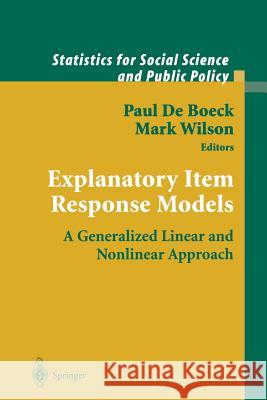
Explanatory Item Response Models: A Generalized Linear and Nonlinear Approach de Boeck, Paul 9781441923233 Not Avail - książkaWidoczna okładka, to zdjęcie poglądowe, a rzeczywista szata graficzna może różnić się od prezentowanej.

Explanatory Item Response Models: A Generalized Linear and Nonlinear Approach

ISBN-13: 9781441923233 / Angielski / Miękka / 2011 / 382 str.

Paul De Boeck; Mark Wilson
cena 805,10
(netto: 766,76 VAT:  5%)

Najniższa cena z 30 dni: 771,08
Termin realizacji zamówienia:
ok. 16-18 dni roboczych.

Darmowa dostawa!

This edited volume gives a new and integrated introduction to item re- sponse models (predominantly used in measurement applications in psy- chology, education, and other social science areas) from the viewpoint of the statistical theory of generalized linear and nonlinear mixed models. Moreover, this new framework aHows the domain of item response mod- els to be co-ordinated and broadened to emphasize their explanatory uses beyond their standard descriptive uses. The basic explanatory principle is that item responses can be modeled as a function of predictors of various kinds. The predictors can be (a) char- acteristics of items, of persons, and of combinations of persons and items; they can be (b) observed or latent (of either items or persons); and they can be (c) latent continuous or latent categorical. Thus, a broad range of models can be generated, including a wide range of extant item response models as weH as some new ones. Within this range, models with explana- tory predictors are given special attention, but we also discuss descriptive models. Note that the 'item responses' that we are referring to are not just the traditional 'test data, ' but are broadly conceived as categorical data from a repeated observations design. Hence, data from studies with repeated-observations experimental designs, or with longitudinal designs, mayaIso be modeled. The intended audience for this volume is rather broad.


Kategorie:
Nauka, Socjologia i społeczeństwo
Kategorie BISAC:
Mathematics > Prawdopodobieństwo i statystyka
Social Science > Statistics
Education > Testing & Measurement
Wydawca:
Not Avail
Seria wydawnicza:
Statistics for Social and Behavioral Sciences
Język:
Angielski
ISBN-13:
9781441923233
Rok wydania:
2011
Wydanie:
Softcover Repri
Numer serii:
000351227
Ilość stron:
382
Waga:
0.62 kg
Wymiary:
23.5 x 15.5
Oprawa:
Miękka
Wolumenów:
01

From the reviews:

"[It is] full of nice features to make it widely useable by practitioners and applied statisticians alike, and it does a wonderful job connecting psychometrics to the field of statisitcs." Deniz Senturk for Technometrics, November 2006

"This book seeks to generalize the typical perspective on item response models, putting the ideas into a broader statistical context. ... The authors have made a good job of integrating the various contributions, and I believe the book will help in increasing awareness of the potential of these types of models." (D.J.Hand, Short Book Reviews Publication of the International Statistical Institute, Vol. 25 (1), 2005)

"This edited book, with 20 contributors, gives an integrated introduction to various item response theory models ... . Each chapter is provided with helpful software, discussion and exercises. ... all chapters are well prepared and the book seems to be extremely well edited. ... this book presents state-of-the-art models and techniques ... . will be an essential text for advanced graduate students in psychometrics and applied statistics as well as researchers in testing fields. All libraries of research universities should have copies of this book." (Seock-Ho Kim, Journal of Applied Statistics, Vol. 33 (5), June, 2006)

"The general focus ... is to provide an integrative framework for the disparate set of models existing in psychometrics, econometrics, biometrics, and statistics. ... EIRM, as is clearly advertised in the title of the book, deals with models that fit in the IRT framework. ... The wealth of citations to be found in the book means that its purpose as a reference is served. ... could be used in its entirety as a seminar for advanced students in statistics, biostatistics, quantitative psychology, or educational measurement." (Jay Verkuilen, Psychometrika, Vol. 71 (2), 2006)

1 A framework for item response models.- 2 Descriptive and explanatory item response models.- 3 Models for polytomous data.- 4 An Introduction to (Generalized (Non)Linear Mixed Models.- 5 Person regression models.- 6 Models with item and item group predictors.- 7 Person-by-item predictors.- 8 Multiple person dimensions and latent item predictors.- 9 Latent item predictors with fixed effects.- 10 Models for residual dependencies.- 11 Mixture Models.- 12 Estimation and software.- Afterword.

This edited volume gives a new and integrated introduction to item response models (predominantly used in measurement applications in psychology, education, and other social science areas) from the viewpoint of the statistical theory of generalized linear and nonlinear mixed models. The new framework allows the domain of item response models to be co-ordinated and broadened to emphasize their explanatory uses beyond their standard descriptive uses.


The basic explanatory principle is that item responses can be modeled as a function of predictors of various kinds. The predictors can be (a) characteristics of items, of persons, and of combinations of persons and items; (b) observed or latent (of either items or persons); and they can be (c) latent continuous or latent categorical. In this way a broad range of models is generated, including a wide range of extant item response models as well as some new ones. Within this range, models with explanatory predictors are given special attention in this book, but we also discuss descriptive models. Note that the term "item responses" does not just refer to the traditional "test data," but are broadly conceived as categorical data from a repeated observations design. Hence, data from studies with repeated observations experimental designs, or with longitudinal designs, may also be modelled.

The book starts with a four-chapter section containing an introduction to the framework. The remaining chapters describe models for ordered-category data, multilevel models, models for differential item functioning, multidimensional models, models for local item dependency, and mixture models. It also includes a chapter on the statistical background and one on useful software. In order to make the task easier for the reader, a unified approach to notation and model description is followed throughout the chapters, and a single data set is used in most examples to make it easier to see how the many models are related. For all major examples, computer commands from the SAS package are provided that can be used to estimate the results for each model. In addition, sample commands are provided for other major computer packages.


Paul De Boeck is Professor of Psychology at K.U. Leuven (Belgium), and Mark Wilson is Professor of Education at UC Berkeley (USA). They are also co-editors (along with Pamela Moss) of a new journal entitled Measurement: Interdisciplinary Research and Perspectives. The chapter authors are members of a collaborative group of psychometricians and statisticians centered on K.U. Leuven and UC Berkeley.

Wilson, Mark Wilson works for an international consulting compa... więcej >


Udostępnij

Facebook - konto krainaksiazek.pl


Opinie o Krainaksiazek.pl na Opineo.pl

Partner Mybenefit

Krainaksiazek.pl w programie rzetelna firma Krainaksiaze.pl - płatności przez paypal

Czytaj nas na:

Facebook - krainaksiazek.pl
  • książki na zamówienie
  • granty
  • książka na prezent
  • kontakt
  • pomoc
  • opinie
  • regulamin
  • polityka prywatności

Zobacz:

  • Księgarnia czeska

  • Wydawnictwo Książkowe Klimaty

1997-2026 DolnySlask.com Agencja Internetowa

© 1997-2022 krainaksiazek.pl
     
KONTAKT | REGULAMIN | POLITYKA PRYWATNOŚCI | USTAWIENIA PRYWATNOŚCI
Zobacz: Księgarnia Czeska | Wydawnictwo Książkowe Klimaty | Mapa strony | Lista autorów
KrainaKsiazek.PL - Księgarnia Internetowa

Polityka prywatnosci - link
Krainaksiazek.pl - płatnośc Przelewy24
Przechowalnia Przechowalnia






