• Wyszukiwanie zaawansowane
  • Kategorie
  • Kategorie BISAC
  • Książki na zamówienie
  • Promocje
  • Granty
  • Książka na prezent
  • Opinie
  • Pomoc
  • Załóż konto
  • Zaloguj się

Experimental Design: A Handbook and Dictionary for Medical and Behavioral Research Volume 14 » książka

zaloguj się | załóż konto
Logo Krainaksiazek.pl

koszyk

konto

szukaj
topmenu
Księgarnia internetowa
Szukaj
Książki na zamówienie
Promocje
Granty
Książka na prezent
Moje konto
Pomoc
 
 
Wyszukiwanie zaawansowane
Pusty koszyk
Bezpłatna dostawa dla zamówień powyżej 20 złBezpłatna dostawa dla zamówień powyżej 20 zł

Kategorie główne

• Nauka
 [2946912]
• Literatura piękna
 [1852311]

  więcej...
• Turystyka
 [71421]
• Informatyka
 [150889]
• Komiksy
 [35717]
• Encyklopedie
 [23177]
• Dziecięca
 [617324]
• Hobby
 [138808]
• AudioBooki
 [1671]
• Literatura faktu
 [228371]
• Muzyka CD
 [400]
• Słowniki
 [2841]
• Inne
 [445428]
• Kalendarze
 [1545]
• Podręczniki
 [166819]
• Poradniki
 [480180]
• Religia
 [510412]
• Czasopisma
 [525]
• Sport
 [61271]
• Sztuka
 [242929]
• CD, DVD, Video
 [3371]
• Technologie
 [219258]
• Zdrowie
 [100961]
• Książkowe Klimaty
 [124]
• Zabawki
 [2341]
• Puzzle, gry
 [3766]
• Literatura w języku ukraińskim
 [255]
• Art. papiernicze i szkolne
 [7810]
Kategorie szczegółowe BISAC

Experimental Design: A Handbook and Dictionary for Medical and Behavioral Research Volume 14

ISBN-13: 9780444506375 / Angielski / Twarda / 2000 / 296 str.
Joachim Krauth; J. Krauth;Krauth
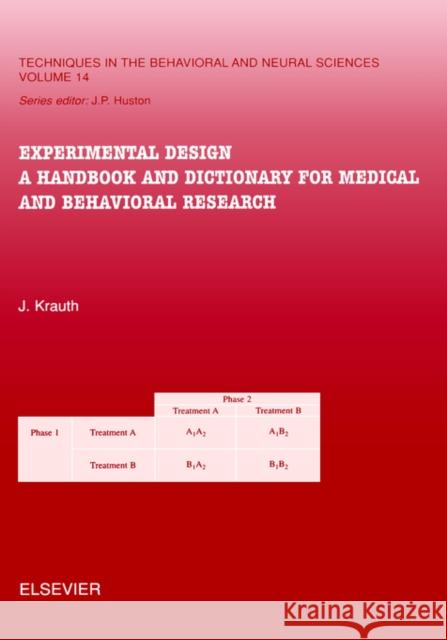
Experimental Design: A Handbook and Dictionary for Medical and Behavioral Research Volume 14 Krauth, J. 9780444506375 Elsevier Science - książkaWidoczna okładka, to zdjęcie poglądowe, a rzeczywista szata graficzna może różnić się od prezentowanej.

Experimental Design: A Handbook and Dictionary for Medical and Behavioral Research Volume 14

ISBN-13: 9780444506375 / Angielski / Twarda / 2000 / 296 str.

Joachim Krauth; J. Krauth;Krauth
cena 1019,88
(netto: 971,31 VAT:  5%)

Najniższa cena z 30 dni: 1025,49
Termin realizacji zamówienia:
ok. 16-18 dni roboczych
Bez gwarancji dostawy przed świętami

Darmowa dostawa!

Scientists planning experiments in medical and behavioral research will find this handbook and dictionary an invaluable desk reference tool. Also recommended as a textbook for students of Experimental Design or accompanying courses in Statistics.
Principles of experimental design are introduced, techniques of experimental design are described, and advantages and disadvantages of often used designs are discussed. This two-part volume, a handbook of experimental design and a dictionary providing short explanations for many terms related to experimental design, contains information that will not quickly become outdated.


Kategorie:
Nauka, Medycyna
Kategorie BISAC:
Medical > Research
Medical > Neurologia i neurofizjologia kliniczna
Medical > Neuroscience
Wydawca:
Elsevier Science
Seria wydawnicza:
Techniques in the Behavioral and Neural Sciences,
Język:
Angielski
ISBN-13:
9780444506375
Rok wydania:
2000
Numer serii:
000186843
Ilość stron:
296
Waga:
0.73 kg
Wymiary:
25.4 x 17.78 x 1.75
Oprawa:
Twarda
Wolumenów:
01
Dodatkowe informacje:
Bibliografia
Wydanie ilustrowane

Preface. A. Handbook of Experimental Design. 1. Historical remarks. 1.1 The diet experiment of the prophet Daniel. 1.2 The lemon experiment of an Egyptian judge. 1.3 Drug research in the 11th century. 1.4 John Stuart Mill and the foundations of experimental research. 1.5 Wilhelm Wundt and the experiment in psychology. 1.6 The invention of randomization. 1.7 Sir Ronald Fisher and randomization. Summary. Questions. 2. The object of experimental design. 2.1 Dependent and independent variables. 2.2 Selection of factor levels. 2.3 Causal relations and intervening variables. 2.4 Ockham's razor. 2.5 Constructs. 2.6 Causal and correlative relations. Summary. Questions. 3. A case for experimental design. 3.1 Threats to statistical conclusion validity. 3.1.1 Low statistical power. 3.1.2 Violated assumptions of statistical tests. 3.1.3 Multiple tests. 3.1.4 Reliability of the dependent variables. 3.1.5 Reliability of the independent variables. 3.1.6 Random disturbance of the experimental situation. 3.1.7 Random differences between subjects. 3.2 Threats to internal validity. 3.2.1 History. 3.2.2 Maturation 3.2.3 Testing. 3.2.4 Instrumentation 3.2.5 Statistical regression. 3.2.6 Selection. 3.2.7 Experimental mortality. 3.2.8 Direction of the causal conclusion. 3.2.9 Exchange of information. 3.3 Threats to construct validity. 3.3.1 Inexact definitions of constructs. 3.3.2 Mono-operation bias. 3.3.3 Mono-method bias. 3.3.4 Hypothesis guessing. 3.3.5 Social desirability responding. 3.3.6 Experimenter expectancies. 3.3.7 Clever Hans and his friends. 3.3.8 Omitting relevant levels of constructs. 3.3.9 Effects of more than one independent variable. 3.3.10 Interaction of testing and treatment. 3.3.11 Restricted generalizability over the constructs. 3.4 Threats to external validity. 3.4.1 Interaction between selection and treatment. 3.4.2 Interaction between setting and treatment. 3.4.3 Interaction between history and treatment. Summary. Questions. 4. Control of extraneous variables. 4.1 Randomization 4.1.1 Randomization and external validity. 4.1.2 Randomization and internal validity. 4.1.3 Randomization in factorial designs. 4.1.4 Multiple treatments. 4.1.5 Randomization and ethics. 4.2 Elimination and blocking off. 4.3 Constancy and covering. 4.4 Matching and blocking. 4.5 Extraneous variables as independent variables. 4.6 Replication. 4.7 Balancing. 4.8 Counterbalancing. 4.9 Blinding. 4.10 Control groups and control conditions. 4.10.1 Control groups for detecting effects. 4.10.2 Placebo control groups. 4.10.3 Control groups for the case that no effects can be detected. 4.10.4 Yoked control groups. 4.10.5 Expectancy control groups. 4.10.6 Solomon design. 4.10.7 Comparison groups. 4.10.8 Historical controls. 4.11 Conservative arrangement of the levels of extraneous variables. 4.12 Repeated measures. 4.13 Statistical adjustment. Summary. Questions. 5. Preliminary experiments and pilot studies. Summary. Questions. 6. Designs which had better be avoided. 6.1 Designs without randomization. 6.2 Designs without a control group. 6.3 Designs with repeated measures. 6.4 Crossover designs. 6.5 Designs with more than two factors. Summary. Questions. 7. Designs without repeated measures. 7.1 Designs with one independent variable. 7.2 Designs with two independent variables. 7.3 Designs with more than two independent variables. Summary. Questions. 8. Designs with repeated measures. 8.1 Designs with one independent variable. 8.2 Designs with more than one independent variable. Summary. Questions. 9. Single-case experimental designs. 9.1 Basic principles of single-case experimental designs. 9.2 Selected single-case experimental designs. 9.2.1 Design with only one factor with only two levels. 9.2.2 Interrupted time-series design. 9.3 An alternative principle of single-case experimental designs. 9.4 Combination of the results of several independent single-case experimental designs. Summary. Questions. Answers to the Questions (with References). B. Dictionary of Experimental Design. References. Author Index. Subject Index.


Udostępnij

Facebook - konto krainaksiazek.pl


Opinie o Krainaksiazek.pl na Opineo.pl

Partner Mybenefit

Krainaksiazek.pl w programie rzetelna firma Krainaksiaze.pl - płatności przez paypal

Czytaj nas na:

Facebook - krainaksiazek.pl
  • książki na zamówienie
  • granty
  • książka na prezent
  • kontakt
  • pomoc
  • opinie
  • regulamin
  • polityka prywatności

Zobacz:

  • Księgarnia czeska

  • Wydawnictwo Książkowe Klimaty

1997-2025 DolnySlask.com Agencja Internetowa

© 1997-2022 krainaksiazek.pl
     
KONTAKT | REGULAMIN | POLITYKA PRYWATNOŚCI | USTAWIENIA PRYWATNOŚCI
Zobacz: Księgarnia Czeska | Wydawnictwo Książkowe Klimaty | Mapa strony | Lista autorów
KrainaKsiazek.PL - Księgarnia Internetowa

Polityka prywatnosci - link
Krainaksiazek.pl - płatnośc Przelewy24
Przechowalnia Przechowalnia







