• Wyszukiwanie zaawansowane
  • Kategorie
  • Kategorie BISAC
  • Książki na zamówienie
  • Promocje
  • Granty
  • Książka na prezent
  • Opinie
  • Pomoc
  • Załóż konto
  • Zaloguj się

Evolutionary Computation: Toward a New Philosophy of Machine Intelligence » książka


zaloguj się | załóż konto
Logo Krainaksiazek.pl

koszyk

konto

szukaj
topmenu
Księgarnia internetowa
Szukaj
Książki na zamówienie
Promocje
Granty
Książka na prezent
Moje konto
Pomoc
 
 
Wyszukiwanie zaawansowane
Pusty koszyk
Bezpłatna dostawa dla zamówień powyżej 20 złBezpłatna dostawa dla zamówień powyżej 20 zł

Kategorie główne

• Nauka
 [2946600]
• Literatura piękna
 [1856966]

  więcej...
• Turystyka
 [72221]
• Informatyka
 [151456]
• Komiksy
 [35826]
• Encyklopedie
 [23190]
• Dziecięca
 [619653]
• Hobby
 [140543]
• AudioBooki
 [1577]
• Literatura faktu
 [228355]
• Muzyka CD
 [410]
• Słowniki
 [2874]
• Inne
 [445822]
• Kalendarze
 [1744]
• Podręczniki
 [167141]
• Poradniki
 [482898]
• Religia
 [510455]
• Czasopisma
 [526]
• Sport
 [61590]
• Sztuka
 [243598]
• CD, DVD, Video
 [3423]
• Technologie
 [219201]
• Zdrowie
 [101638]
• Książkowe Klimaty
 [124]
• Zabawki
 [2473]
• Puzzle, gry
 [3898]
• Literatura w języku ukraińskim
 [254]
• Art. papiernicze i szkolne
 [8170]
Kategorie szczegółowe BISAC

Evolutionary Computation: Toward a New Philosophy of Machine Intelligence

ISBN-13: 9780471669517 / Angielski / Twarda / 2006 / 296 str.
David B. Fogel
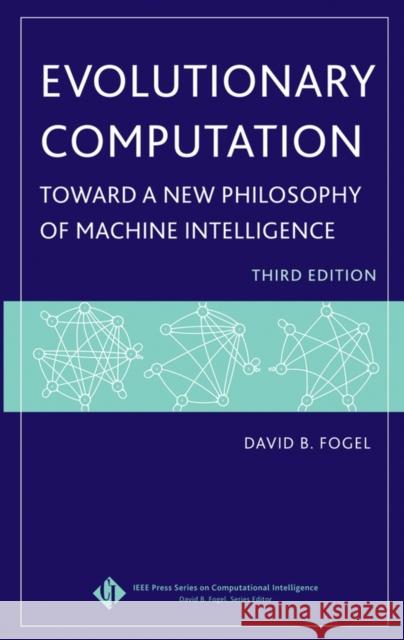
Evolutionary Computation: Toward a New Philosophy of Machine Intelligence Fogel, David B. 9780471669517 IEEE Computer Society Press - książkaWidoczna okładka, to zdjęcie poglądowe, a rzeczywista szata graficzna może różnić się od prezentowanej.

Evolutionary Computation: Toward a New Philosophy of Machine Intelligence

ISBN-13: 9780471669517 / Angielski / Twarda / 2006 / 296 str.

David B. Fogel
cena 573,64 zł
(netto: 546,32 VAT:  5%)

Najniższa cena z 30 dni: 568,93 zł
Termin realizacji zamówienia:
ok. 30 dni roboczych
Bez gwarancji dostawy przed świętami

Darmowa dostawa!

This Third Edition provides the latest tools and techniques that enable computers to learn

The Third Edition of this internationally acclaimed publication provides the latest theory and techniques for using simulated evolution to achieve machine intelligence. As a leading advocate for evolutionary computation, the author has successfully challenged the traditional notion of artificial intelligence, which essentially programs human knowledge fact by fact, but does not have the capacity to learn or adapt as evolutionary computation does.

Readers gain an understanding of the history of evolutionary computation, which provides a foundation for the author's thorough presentation of the latest theories shaping current research. Balancing theory with practice, the author provides readers with the skills they need to apply evolutionary algorithms that can solve many of today's intransigent problems by adapting to new challenges and learning from experience. Several examples are provided that demonstrate how these evolutionary algorithms learn to solve problems. In particular, the author provides a detailed example of how an algorithm is used to evolve strategies for playing chess and checkers.

As readers progress through the publication, they gain an increasing appreciation and understanding of the relationship between learning and intelligence. Readers familiar with the previous editions will discover much new and revised material that brings the publication thoroughly up to date with the latest research, including the latest theories and empirical properties of evolutionary computation.

The Third Edition also features new knowledge-building aids. Readers will find a host of new and revised examples. New questions at the end of each chapter enable readers to test their knowledge. Intriguing assignments that prepare readers to manage challenges in industry and research have been added to the end of each chapter as well.

This is a must-have reference for professionals in computer and electrical engineering; it provides them with the very latest techniques and applications in machine intelligence. With its question sets and assignments, the publication is also recommended as a graduate-level textbook.


Kategorie:
Technologie
Kategorie BISAC:
Technology & Engineering > Electronics - General
Wydawca:
IEEE Computer Society Press
Seria wydawnicza:
IEEE Press Series on Computational Intelligence
Język:
Angielski
ISBN-13:
9780471669517
Rok wydania:
2006
Numer serii:
000319384
Ilość stron:
296
Waga:
0.52 kg
Wymiary:
23.88 x 17.42 x 1.85
Oprawa:
Twarda
Wolumenów:
01
Dodatkowe informacje:
Glosariusz/słownik
Wydanie ilustrowane

"...a major contribution to the evolutionary computation literature...recommended reading for experienced researchers, as well as novice students…" ( Computing Reviews.com, May 26, 2006)

Preface to the Third Edition.

Preface to the Second Edition.

Preface to the First Edition.

1 Defining Artificial Intelligence.

1.1 Background.

1.2 The Turing Test.

1.3 Simulation of Human Expertise.

1.3.1 Samuel’s Checker Program.

1.3.2 Chess Programs.

1.3.3 Expert Systems.

1.3.4 A Criticism of the Expert Systems or Knowledge–Based Approach.

1.3.5 Fuzzy Systems.

1.3.6 Perspective on Methods Employing Specific Heuristics.

1.4 Neural Networks.

1.5 Definition of Intelligence.

1.6 Intelligence, the Scientific Method, and Evolution.

1.7 Evolving Artificial Intelligence.

References.

Chapter 1 Exercises.

2 Natural Evolution.

2.1 The Neo–Darwinian Paradigm.

2.2 The Genotype and the Phenotype: The Optimization of Behavior.

2.3 Implications of Wright’s Adaptive Topography: Optimization Is Extensive Yet Incomplete.

2.4 The Evolution of Complexity: Minimizing Surprise.

2.5 Sexual Reproduction.

2.6 Sexual Selection.

2.7 Assessing the Beneficiary of Evolutionary Optimization.

2.8 Challenges to Neo–Darwinism.

2.8.1 Neutral Mutations and the Neo–Darwinian Paradigm.

2.8.2 Punctuated Equilibrium.

2.9 Summary.

References.

Chapter 2 Exercises.

3 Computer Simulation of Natural Evolution.

3.1 Early Speculations and Specific Attempts.

3.1.1 Evolutionary Operation.

3.1.2 A Learning Machine.

3.2 Artificial Life.

3.3 Evolutionary Programming.

3.4 Evolution Strategies.

3.5 Genetic Algorithms.

3.6 The Evolution of Evolutionary Computation.

References.

Chapter 3 Exercises.

4 Theoretical and Empirical Properties of Evolutionary Computation.

4.1 The Challenge.

4.2 Theoretical Analysis of Evolutionary Computation.

4.2.1 The Framework for Analysis.

4.2.2 Convergence in the Limit.

4.2.3 The Error of Minimizing Expected Losses in Schema Processing.

4.2.3.1 The Two–Armed Bandit Problem.

4.2.3.2 Extending the Analysis for “Optimally” Allocating Trials.

4.2.3.3 Limitations of the Analysis.

4.2.4 Misallocating Trials and the Schema Theorem in the Presence of Noise.

4.2.5 Analyzing Selection.

4.2.6 Convergence Rates for Evolutionary Algorithms.

4.2.7 Does a Best Evolutionary Algorithm Exist?

4.3 Empirical Analysis.

4.3.1 Variations of Crossover.

4.3.2 Dynamic Parameter Encoding.

4.3.3 Comparing Crossover to Mutation.

4.3.4 Crossover as a Macromutation.

4.3.5 Self–Adaptation in Evolutionary Algorithms.

4.3.6 Fitness Distributions of Search Operators.

4.4 Discussion.

References.

Chapter 4 Exercises.

5 Intelligent Behavior.

5.1 Intelligence in Static and Dynamic Environments.

5.2 General Problem Solving: Experiments with Tic–Tac–Toe.

5.3 The Prisoner’s Dilemma: Coevolutionary Adaptation.

5.3.1 Background.

5.3.2 Evolving Finite–State Representations.

5.4 Learning How to Play Checkers without Relying on Expert Knowledge.

5.5 Evolving a Self–Learning Chess Player.

5.6 Discussion.

References.

Chapter 5 Exercises.

6 Perspective.

6.1 Evolution as a Unifying Principle of Intelligence.

6.2 Prediction and the Languagelike Nature of Intelligence.

6.3 The Misplaced Emphasis on Emulating Genetic Mechanisms.

6.4 Bottom–Up Versus Top–Down.

6.5 Toward a New Philosophy of Machine Intelligence.

References.

Chapter 6 Exercises.

Glossary.

Index.

About the Author.

David B. Fogel is chief executive officer of Natural Selection, Inc. in La Jolla, CA—a small business focused on solving difficult problems in industry, medicine, and defense using evolutionary computation, neural networks, fuzzy systems, and other methods of computational intelligence. Dr. Fogel’s experience in evolutionary computation spans 20 years and includes applications in pharmaceutical design, computer–assisted mammography, data mining, factory scheduling, financial forecasting, traffic flow optimization, agent–based adaptive combat systems, and many other areas. Prior to cofounding Natural Selection, Inc. in 1993, Dr. Fogel was a systems analyst at Titan Systems, Inc. (1984–1988), and a senior principal engineer at ORINCON Corporation (1988–1993).
Dr. Fogel received his Ph.D. degree in engineering sciences (systems science) from the University of California at San Diego (UCSD) in 1992. He earned an M.S. degree in engineering sciences (systems science) from UCSD in 1990, and a B.S. in mathematical sciences (probability and statistics) from the University of California at Santa Barbara in 1985. He has taught university courses at the graduate and undergraduate level in stochastic processes, probability and statistics, and evolutionary computation. Dr. Fogel is a prolific author in evolutionary computation, having published over 50 journal papers, as well as 100 conference publications, 20 contributions in book chapters, two videos, four computer games, and six books—most recently, Blondie24: Playing at the Edge of AI (Morgan Kaufmann, 2002). In addition, Dr. Fogel is coeditor in chief of the Handbook of Evolutionary Computation (Oxford, 1997) and was the founding editor–in–chief of the IEEE Transactions on Evolutionary Computation (1996–2002). He serves as editor–in–chief for the journal BioSystems and is a member of the editorial board of several other international technical journals.
Dr. Fogel served as a Visiting Fellow of the Australian Defence Force Academy in November 1997, and is a member of many professional societies including the American Association for the Advancement of Science, the American Association for Artificial Intelligence, Sigma Xi, and the New York Academy of Sciences. He was the founding president of the Evolutionary Programming Society in 1991 and is a Fellow of the IEEE, as well as an associate member of the Center for the Study of Evolution and the Origin of Life (CSEOL) at the University of California at Los Angeles. Dr. Fogel is a frequently invited lecturer at international conferences and a guest for television and radio broadcasts. His honors and awards include the 2001 Sigma Xi Southwest Region Young Investigator Award, the 2003 Sigma Xi San Diego Section Distinguished Scientist Award, the 2003 SPIE Computational Intelligence Pioneer Award, and the 2004 IEEE Kiyo Tomiyasu Technical Field Award.

This Third Edition provides the latest tools and techniques that enable computers to learn

The Third Edition of this internationally acclaimed publication provides the latest theory and techniques for using simulated evolution to achieve machine intelligence. As a leading advocate for evolutionary computation, the author has successfully challenged the traditional notion of artificial intelligence, which essentially programs human knowledge fact by fact, but does not have the capacity to learn or adapt as evolutionary computation does.

Readers gain an understanding of the history of evolutionary computation, which provides a foundation for the author′s thorough presentation of the latest theories shaping current research. Balancing theory with practice, the author provides readers with the skills they need to apply evolutionary algorithms that can solve many of today′s intransigent problems by adapting to new challenges and learning from experience. Several examples are provided that demonstrate how these evolutionary algorithms learn to solve problems. In particular, the author provides a detailed example of how an algorithm is used to evolve strategies for playing chess and checkers.

As readers progress through the publication, they gain an increasing appreciation and understanding of the relationship between learning and intelligence. Readers familiar with the previous editions will discover much new and revised material that brings the publication thoroughly up to date with the latest research, including the latest theories and empirical properties of evolutionary computation.

The Third Edition also features new knowledge–building aids. Readers will find a host of new and revised examples. New questions at the end of each chapter enable readers to test their knowledge. Intriguing assignments that prepare readers to manage challenges in industry and research have been added to the end of each chapter as well.

This is a must–have reference for professionals in computer and electrical engineering; it provides them with the very latest techniques and applications in machine intelligence. With its question sets and assignments, the publication is also recommended as a graduate–level textbook.

Fogel, David B. David B. Fogel is chief executive officer of Natur... więcej >


Udostępnij

Facebook - konto krainaksiazek.pl


Opinie o Krainaksiazek.pl na Opineo.pl

Partner Mybenefit

Krainaksiazek.pl w programie rzetelna firma Krainaksiaze.pl - płatności przez paypal

Czytaj nas na:

Facebook - krainaksiazek.pl
  • książki na zamówienie
  • granty
  • książka na prezent
  • kontakt
  • pomoc
  • opinie
  • regulamin
  • polityka prywatności

Zobacz:

  • Księgarnia czeska

  • Wydawnictwo Książkowe Klimaty

1997-2025 DolnySlask.com Agencja Internetowa

© 1997-2022 krainaksiazek.pl
     
KONTAKT | REGULAMIN | POLITYKA PRYWATNOŚCI | USTAWIENIA PRYWATNOŚCI
Zobacz: Księgarnia Czeska | Wydawnictwo Książkowe Klimaty | Mapa strony | Lista autorów
KrainaKsiazek.PL - Księgarnia Internetowa

Polityka prywatnosci - link
Krainaksiazek.pl - płatnośc Przelewy24
Przechowalnia Przechowalnia





