• Wyszukiwanie zaawansowane
  • Kategorie
  • Kategorie BISAC
  • Książki na zamówienie
  • Promocje
  • Granty
  • Książka na prezent
  • Opinie
  • Pomoc
  • Załóż konto
  • Zaloguj się

Everyday Enterprise Architecture: Sense-making, Strategy, Structures, and Solutions » książka


zaloguj się | załóż konto
Logo Krainaksiazek.pl

koszyk

konto

szukaj
topmenu
Księgarnia internetowa
Szukaj
Książki na zamówienie
Promocje
Granty
Książka na prezent
Moje konto
Pomoc
 
 
Wyszukiwanie zaawansowane
Pusty koszyk
Bezpłatna dostawa dla zamówień powyżej 20 złBezpłatna dostawa dla zamówień powyżej 20 zł

Kategorie główne

• Nauka
 [2949965]
• Literatura piękna
 [1857847]

  więcej...
• Turystyka
 [70818]
• Informatyka
 [151303]
• Komiksy
 [35733]
• Encyklopedie
 [23180]
• Dziecięca
 [617748]
• Hobby
 [139972]
• AudioBooki
 [1650]
• Literatura faktu
 [228361]
• Muzyka CD
 [398]
• Słowniki
 [2862]
• Inne
 [444732]
• Kalendarze
 [1620]
• Podręczniki
 [167233]
• Poradniki
 [482388]
• Religia
 [509867]
• Czasopisma
 [533]
• Sport
 [61361]
• Sztuka
 [243125]
• CD, DVD, Video
 [3451]
• Technologie
 [219309]
• Zdrowie
 [101347]
• Książkowe Klimaty
 [123]
• Zabawki
 [2362]
• Puzzle, gry
 [3791]
• Literatura w języku ukraińskim
 [253]
• Art. papiernicze i szkolne
 [7933]
Kategorie szczegółowe BISAC

Everyday Enterprise Architecture: Sense-making, Strategy, Structures, and Solutions

ISBN-13: 9781484289037 / Angielski / Miękka / 2022 / 221 str.
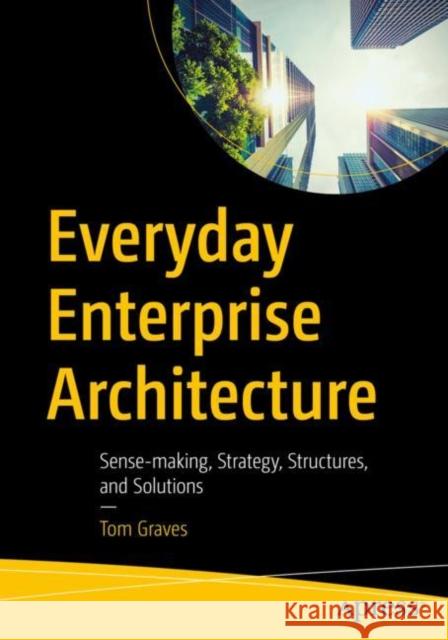
Tom Graves
Everyday Enterprise Architecture: Sense-making, Strategy, Structures, and Solutions Tom Graves 9781484289037 Apress - książkaWidoczna okładka, to zdjęcie poglądowe, a rzeczywista szata graficzna może różnić się od prezentowanej.

Everyday Enterprise Architecture: Sense-making, Strategy, Structures, and Solutions

ISBN-13: 9781484289037 / Angielski / Miękka / 2022 / 221 str.

Tom Graves
cena 229,28
(netto: 218,36 VAT:  5%)

Najniższa cena z 30 dni: 229,28
Termin realizacji zamówienia:
ok. 16-18 dni roboczych
Bez gwarancji dostawy przed świętami

Darmowa dostawa!

Discover what needs to happen in enterprise-architecture practice—and not just its outcomes, but also the activities from which those outcomes would arise. This book reveals how business and enterprise architects can deliver fast solutions to an always-on-the-go business world.To begin, you'll review a new technique called "context-space mapping," which provides a structured method for sense-making across the entire context of an enterprise. Throughout the book, you'll concentrate on the routine practicesthat underpin each of the architecture disciplines.Working step-by-step through a real 10-day architecture project, this book explores the activities that underpin the strategy, structures and solutions in the real-time turmoil of an enterprise architect’s everyday work. You'll explore how and why and when the various documents, artefacts and items of ‘theory-stuff’ come into the practice – all those mainstream methods, frameworks, models, metamodels and other information sources.In the end,Everyday Enterprise Architecturewill help you develop the skills, judgment, and awareness to keep enhancing the value of your architectural projects.What You'll LearnWork on architectures at "business-speed"Adapt architectures for different tasksGather, use, and manage architectural informationWho This Book Is ForEnterprise and business architects.

Discover what needs to happen in enterprise-architecture practice—and not just its outcomes, but also the activities from which those outcomes would arise. This book reveals how business and enterprise architects can deliver fast solutions to an always-on-the-go business world.To begin, you'll review a new technique called "context-space mapping," which provides a structured method for sense-making across the entire context of an enterprise. Throughout the book, you'll concentrate on the routine practices that underpin each of the architecture disciplines. Working step-by-step through a real 10-day architecture project, this book explores the activities that underpin the strategy, structures and solutions in the real-time turmoil of an enterprise architect’s everyday work. You'll explore how and why and when the various documents, artefacts and items of ‘theory-stuff’ come into the practice – all those mainstream methods, frameworks, models, metamodels and other information sources. In the end, Everyday Enterprise Architecture will help you develop the skills, judgment, and awareness to keep enhancing the value of your architectural projects.  
What You'll Learn

  • Work on architectures at "business-speed"
  • Adapt architectures for different tasks
  • Gather, use, and manage architectural information

  • Who This Book Is ForEnterprise and business architects.

    Kategorie:
    Informatyka
    Kategorie BISAC:
    Computers > Data Science - General
    Computers > Computer Science
    Computers > Business & Productivity Software - General
    Wydawca:
    Apress
    Język:
    Angielski
    ISBN-13:
    9781484289037
    Rok wydania:
    2022
    Dostępne języki:
    Ilość stron:
    221
    Waga:
    0.42 kg
    Wymiary:
    25.4 x 17.78 x 1.3
    Oprawa:
    Miękka
    Dodatkowe informacje:
    Wydanie ilustrowane

     Chapter 1: Introduction 

    Chapter Goal: Describe the purpose of the book, how to use it, and what the various elements are

    No of pages    4

    Sub -Topics

    1.      Main project: How to use architecture ideas and activities to describe what actually happens in a real enterprise-architecture project, and the business-reasons and business-value for each of those activities

    2.      Secondary project: Worked-example

    3.      Application: How to adapt each chapter’s content to our own work


    Chapter 2:  Day 1: Get Started

    Chapter Goal: Show how to get started on a project, and summarise how the allocated ten days will be used

    No of pages    16

    Sub -Topics

    1        Do an initial assessment

    2        Show how to use the project-diary and other tools

    3        Show how to do an initial assessment

    4        Show how to apply any ‘lessons-learned’ in our own projects

    Chapter 3:  Day 2: Purpose, scope and context

    Chapter Goal: Set up and start the main and secondary projects

    No of pages: 16

    Sub - Topics  

    1      Introduce the main project as exploring ‘the architecture of architecture’

    2      Show how to use the step-by-step action-task sequence

    3      Introduce the secondary project: customer-breakdown at a bank

    4      Show how to use the same step-by-step-step sequence for the bank content


    Chapter 4: Day 3: What’s going on?

    Chapter Goal: Learn how to do an architecture-assessment

    No of pages : 18

    Sub - Topics: 

    1      Explore how to do a ‘to-be’ (futures) assessment

    2      Explore how to do an ‘as-was’ (past) assessment

    3      Explore how to identify issues that need to be addressed

    4      Learn how to cope with the challenges and stresses of the work


    Chapter 5: Day 4: What do we want?

    Chapter Goal: Learn how to establish a baseline

    No of pages: 12

    Sub - Topics:

    1      Explore how to do an ‘as-is’ (present) assessment

    2      How to do social-enquiry with stakeholders

    3      How to tackle the politics of architecture

    4      Architecture as decision-support for stakeholders, not decision-making


    Chapter 6:  Day 5: What’s the difference?

    Chapter Goal: How to identify gaps where change is needed

    No of pages    14

    Sub -Topics

    1      Identify and build the skillsets needed for comparison-assessments

    2      How to do comparisons to identify gaps (including hidden-gaps)

    3      How to prioritise gaps and derive requirements

    4      How and why to avoid the temptation to rush to ‘solutions’


    Chapter 7:  Day 6: How do we get from here to there?

    Chapter Goal: Guiding the transition to solution-design

    No of pages    10

    Sub -Topics

    1      How to identify the roles and specialisms needed for solution-design

    2      How to identify, work with and hand over to the change-team

    3      How to refine and simplify change-requirements

    4      Politics reminder: architecture is decision-support, not decision-making


    Chapter 8:  Day 7: Step-by-step details

    Chapter Goal: Learn the relative roles and relations between architecture and design

    No of pages    12

    Sub -Topics

    1      Role of architect as generalist, to connect specialists together

    2      How to develop and use sense-making skills

    3      Role of architect to assist in finding missing-detail

    4      How to identify common missing-detail (system-failure, timescale, decommission)


    Chapter 9:  Day 8: Putting it into practice

    Chapter Goal: What to do when the stakeholders themselves are the solutions

    No of pages    14

    Sub -Topics

    1      How to design a change-programme for stakeholders

    2      How to deliver and guide a change-programme for stakeholders

    3      How to guide stakeholders in sensemaking and decision-making

    4      Introduce sense-making tools such as context-space mapping


    Chapter 10:  Day 9: What did we achieve?

    Chapter Goal: How to do and use an after-action review

    No of pages    12

    Sub -Topics

    1      Purpose and value of an after-action review

    2      Elements of an after-action review

    3      How to do and document an after-action review

    4      How to derive new change-tasks from an after-action review


    Chapter 11:  Day 10: How To Review and Learn 

    Chapter Goal: How to review and learn from our own projects

    No of pages    10

    Sub -Topics

    1      Reprise on how to do and assess an after-action review

    2      How to derive our own insights from work done with others

    3      How to apply and test those insights for our own architecture-practice

    4      How to derive and enact change-tasks for our own continuous-improvement


    Appendix 1:  The architecture information-stores

    Chapter Goal: How to capture, retrieve and reuse architectural information

    No of pages    6

    Sub -Topics

    1      Identify types, roles and uses of architecture-information

    2      Identify how and why to store each type of architectural information

    3      Identify how to retrieve and reuse each type of architectural information

    4      Identify how and when to delete architectural information


    Appendix 2:  More on context-space mapping

    Chapter Goal: Present context-space mapping as a sensemaking tool for architecture

    No of pages    18

    Sub -Topics

    1      Describe purpose and underlying principles for context-space mapping

    2      Explore how context-space mapping works as a sensemaking method

    3      Provide detailed worked-examples of context-space mapping

    4      Show outcomes and value of context-space mapping in sensemaking


    Appendix 3: Resources

    Chapter Goal: Provide additional support for the practices in this book

    No of pages    2

    Sub -Topics

    1      Example books and other publications

    2      Websites and other online resources

    Tom Graves has been an independent consultant for more than four decades, in business transformation, enterprise architecture and knowledge management. His clients in Europe, Australasia and the Americas cover a broad range of industries including banking, utilities, manufacturing, logistics, engineering, media telecoms, research, defence and government. He has a special interest in architectures beyond IT, and integration between IT-based and non-IT-based services. 

    Discover what needs to happen in enterprise-architecture practice—and not just its outcomes, but also the activities from which those outcomes would arise. This book reveals how business and enterprise architects can deliver fast solutions to an always-on-the-go business world.

    To begin, you'll review a new technique called "context-space mapping," which provides a structured method for sense-making across the entire context of an enterprise. Throughout the book, you'll concentrate on the routine practices that underpin each of the architecture disciplines. 

    Working step-by-step through a real 10-day architecture project, this book explores the activities that underpin the strategy, structures and solutions in the real-time turmoil of an enterprise architect’s everyday work. You'll explore how and why and when the various documents, artefacts and items of ‘theory-stuff’ come into the practice – all those mainstream methods, frameworks, models, metamodels and other information sources. 

    In the end, Everyday Enterprise Architecture will help you develop the skills, judgment, and awareness to keep enhancing the value of your architectural projects.  


    Udostępnij

    Facebook - konto krainaksiazek.pl


    Opinie o Krainaksiazek.pl na Opineo.pl

    Partner Mybenefit

    Krainaksiazek.pl w programie rzetelna firma Krainaksiaze.pl - płatności przez paypal

    Czytaj nas na:

    Facebook - krainaksiazek.pl
    • książki na zamówienie
    • granty
    • książka na prezent
    • kontakt
    • pomoc
    • opinie
    • regulamin
    • polityka prywatności

    Zobacz:

    • Księgarnia czeska

    • Wydawnictwo Książkowe Klimaty

    1997-2025 DolnySlask.com Agencja Internetowa

    © 1997-2022 krainaksiazek.pl
         
    KONTAKT | REGULAMIN | POLITYKA PRYWATNOŚCI | USTAWIENIA PRYWATNOŚCI
    Zobacz: Księgarnia Czeska | Wydawnictwo Książkowe Klimaty | Mapa strony | Lista autorów
    KrainaKsiazek.PL - Księgarnia Internetowa

    Polityka prywatnosci - link
    Krainaksiazek.pl - płatnośc Przelewy24
    Przechowalnia Przechowalnia






