• Wyszukiwanie zaawansowane
  • Kategorie
  • Kategorie BISAC
  • Książki na zamówienie
  • Promocje
  • Granty
  • Książka na prezent
  • Opinie
  • Pomoc
  • Załóż konto
  • Zaloguj się

Evaluating Sustainable Development in the Built Environment » książka


zaloguj się | załóż konto
Logo Krainaksiazek.pl

koszyk

konto

szukaj
topmenu
Księgarnia internetowa
Szukaj
Książki na zamówienie
Promocje
Granty
Książka na prezent
Moje konto
Pomoc
 
 
Wyszukiwanie zaawansowane
Pusty koszyk
Bezpłatna dostawa dla zamówień powyżej 20 złBezpłatna dostawa dla zamówień powyżej 20 zł

Kategorie główne

• Nauka
 [2946600]
• Literatura piękna
 [1856966]

  więcej...
• Turystyka
 [72221]
• Informatyka
 [151456]
• Komiksy
 [35826]
• Encyklopedie
 [23190]
• Dziecięca
 [619653]
• Hobby
 [140543]
• AudioBooki
 [1577]
• Literatura faktu
 [228355]
• Muzyka CD
 [410]
• Słowniki
 [2874]
• Inne
 [445822]
• Kalendarze
 [1744]
• Podręczniki
 [167141]
• Poradniki
 [482898]
• Religia
 [510455]
• Czasopisma
 [526]
• Sport
 [61590]
• Sztuka
 [243598]
• CD, DVD, Video
 [3423]
• Technologie
 [219201]
• Zdrowie
 [101638]
• Książkowe Klimaty
 [124]
• Zabawki
 [2473]
• Puzzle, gry
 [3898]
• Literatura w języku ukraińskim
 [254]
• Art. papiernicze i szkolne
 [8170]
Kategorie szczegółowe BISAC

Evaluating Sustainable Development in the Built Environment

ISBN-13: 9781405192583 / Angielski / Twarda / 2010 / 280 str.
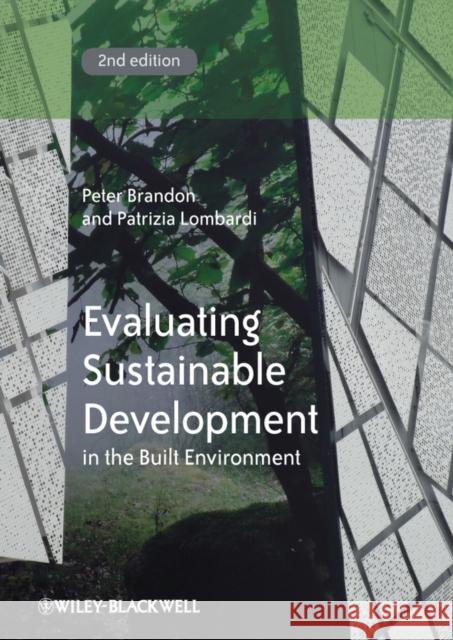
Peter Brandon;Patrizia Lombardi;¬Abar
Evaluating Sustainable Development in the Built Environment Peter Brandon Patrizia Lombardi  9781405192583  - książkaWidoczna okładka, to zdjęcie poglądowe, a rzeczywista szata graficzna może różnić się od prezentowanej.

Evaluating Sustainable Development in the Built Environment

ISBN-13: 9781405192583 / Angielski / Twarda / 2010 / 280 str.

Peter Brandon;Patrizia Lombardi;¬Abar
cena 410,51 zł
(netto: 390,96 VAT:  5%)

Najniższa cena z 30 dni: 406,31 zł
Termin realizacji zamówienia:
ok. 30 dni roboczych
Bez gwarancji dostawy przed świętami

Darmowa dostawa!

The first edition was extremely well received, providing an introduction and insight to this important topic in a comprehensive yet easy to read form. It was chosen to be issued to the representatives of the organizations from the G8 and G20 countries attending the University Summit held in Turin in 2009 which addressed the issue of how education and research can assist sustainable development. The second edition, completely updated to reflect the significant advances and new insights that have been made since publication of the first edition, focuses on two main issues:

  • Facilitating a dialogue between all stakeholders so that the complexity of the problem can be exposed, structured and communicated
  • Understanding how to assess progress in sustainable development
It continues to provide coherent guidance on the techniques that can be used to assess sustainable development in a rigorous manner. The approach is introduced using illustrations and case studies, together with follow-up references. It remains the ideal starting point for those trying to get a handle on the subject and for those who wish to examine a structured and systematic approach to the evaluation of sustainable development in the built environment.

"This is a truly remarkable book that successfully fuses together disparate authors, ideas and techniques into a coherent body of theory and practice for assessing the various plans and processes that collectively contribute to achieving sustainability in the built environment. Not only has it become a standard textbook in the ever expanding academic world of sustainable development programmes, but it is now also commonly accepted as an essential handbook for those in  the professional practice of implementing sustainable urban development policy. Above all, it helps demonstrate that sustainability is not only the responsible and ethical thing to do, it′s the economic and profitable thing too."
John Ratcliffe, Emeritus Professor and Former Director of Dublin Institute of Technology,
President of The Futures Academy, and Fellow of The Henley Business SchoolPraise for the first edition:“...thought provoking...a landmark in the theory on sustainable urban development planning”.
Professor Peter Nijkamp  Department of Economics free University of AmsterdamSustainable development is one of the most important challenges facing all stakeholders in the built environment. Since the first edition of Evaluating Sustainable Development was published, sustainable development has become prominent and behaviour around the globe is beginning to change. Yet few have addressed the question of measurement. If sustainable development cannot be measured then how can progress be assessed? This question is fundamental.The first edition was extremely well received, providing an introduction and insight to this important topic in a comprehensive yet easy to read form. It was chosen to be issued to the representatives of the organizations from the G8 and G20 countries attending the University Summit held in Turin in 2009 which addressed the issue of how education and research can assist sustainable development. The second edition, completely updated to reflect the significant advances and new insights that have been made since publication of the first edition, focuses on two main issues:
• Facilitating a dialogue between all stakeholders so that the complexity of the problem can be exposed, structured and communicated
• Understanding how to assess progress in sustainable developmentIt continues to provide a coherent structure and guidance on the techniques that can be used to assess sustainable development in a rigorous manner. The approach is introduced using illustrations and case studies, together with follow–up references. It remains the ideal starting point for those trying to get a handle on the subject and for those who wish to examine a structured and systematic approach to the evaluation of sustainable development in the built environment.Also Available
Designing Sustainable Cities
Rachel Cooper, Graeme Evans & Christopher T Boyko
Hardcover, 978 1 4051 7915 7, 336 pagesVirtual Futures for Design, Construction and Procurement
Peter S. Brandon & Tuba Kocatürk 
Hardcover, 978 1 4051 7024 6, 344 pagesClients Driving Innovation
Peter S. Brandon & Shu–Ling Lu
Hardcover, 978 1 4051 7566 1, 296 pages 

Kategorie:
Technologie
Kategorie BISAC:
Business & Economics > Development - Sustainable Development
Social Science > Sociology - Urban
Język:
Angielski
ISBN-13:
9781405192583
Rok wydania:
2010
Ilość stron:
280
Waga:
0.77 kg
Wymiary:
24.64 x 17.53 x 2.03
Oprawa:
Twarda
Wolumenów:
01
Dodatkowe informacje:
Bibliografia
Wydanie ilustrowane

About the Authors.

Preface.

Acknowledgements.

1 Setting the Context for Evaluating Sustainable Development.

The environmental perspective.

The international policy debates.

Extension of the debate.

The impact of the built environment.

The current response of the built environment community.

Sustainability: a definition.

Seeking a shared set of values.

Striving for a common framework and classification system.

The characteristics of assessment and measurement for sustainable development.

Management and intervention for sustainable development.

Implementing management decisions.

Summary.

2 Time and Sustainability.

Innovation and stability.

Perceptions of sustainable development.

Critical failure points.

Time in evaluation.

Future aversion.

Clever or wise?

Practical assessment of ′time′.

The luxury of the ′time′ horizon.

3 Approaches to Evaluation.

The Natural Step.

The concept of community capital.

The ecological footprint.

Monetary (capital) approach.

The driving force–state–response model.

Issues or theme–based frameworks.

Accounting frameworks.

Frameworks of assessment methods′ tool kits.

Summary and conclusions.

4 Indicators and Measures.

Why evaluate?

Traditional versus sustainable development indicators.

Generic and specific questions.

International indicators.

Aggregated indicators.

Discussion.

Summary.

5 Assessment Methods.

A directory of assessment methods.

An outline summary of the main assessment methods, tools and procedures in use.

Summary and conclusions.

6 A Proposed Framework for Evaluating Sustainable Development.

The need for a holistic and integrated framework.

The theoretical underpinning of the framework.

The built environment explained by the modalities.

The 15 modalities for understanding sustainable development in the built environment.

Development of the multi–modal framework for decision–making.

Key questions for examining sustainable development within each modality.

Synthesis of results.

Summary.

7 The Framework as a Structuring Tool: Case Studies.

Case study 1: selection of a municipal waste treatment system.

Case study 2: evaluation of sustainable redevelopment scenarios for an urban area.

Case study 3: multi–stakeholder urban regeneration decision–making.

Case study 4: social reporting of Modena City strategic plan.

Summary and conclusion.

8 Towards Management Systems and Protocols.

Who manages?

The planning framework.

Management in a learning organisation.

Soft system methodology.

Wicked problems.

Process protocols.

A possible approach.

The Vancouver study.

The conclusions of the Vancouver study.

Follow through on the Vancouver study.

Resilience.

9 Education and Research.

A research agenda.

In conclusion.

Appendix A: The Philosophy of the ′Cosmonomic Idea of Reality′.

References.

Websites.

Bibliography.

Index.

Peter Brandon was Pro–Vice Chancellor for Research and Postgraduate Studies at the University of Salford and Director of the University Think Lab. He is now Director of Strategic Programmes and Professor Emeritus in the School of the Built Environment.

Patrizia Lombardi is Associate Professor in the City and Housing Department at the Politecnico di Torino. She has coordinated or served as lead partner in several pan–European projects on topics related to sustainable urban development.

"This is a truly remarkable book that successfully fuses together disparate authors, ideas and techniques into a coherent body of theory and practice for assessing the various plans and processes that collectively contribute to achieving sustainability in the built environment. Not only has it become a standard textbook in the ever expanding academic world of sustainable development programmes, but it is now also commonly accepted as an essential handbook for those in the professional practice of implementing sustainable urban development policy. Above all, it helps demonstrate that sustainability is not only the responsible and ethical thing to do, it′s the economic and profitable thing too."
John Ratcliffe, Emeritus Professor and Former Director of Dublin Institute of Technology, President of The Futures Academy, and Fellow of The Henley Business School

Praise for the first edition:

"...thought provoking...a landmark in the theory on sustainable urban development planning."
Professor Peter Nijkamp, Department of Economics free University of Amsterdam

Sustainable development is one of the most important challenges facing all stakeholders in the built environment. Since the first edition of Evaluating Sustainable Development was published, sustainable development has become prominent and behaviour around the globe is beginning to change. Yet few have addressed the question of measurement. If sustainable development cannot be measured then how can progress be assessed? This question is fundamental.

The first edition was extremely well received, providing an introduction and insight to this important topic in a comprehensive yet easy to read form. It was chosen to be issued to the representatives of the organizations from the G8 and G20 countries attending the University Summit held in Turin in 2009 which addressed the issue of how education and research can assist sustainable development.

The second edition, completely updated to reflect the significant advances and new insights that have been made since publication of the first edition, focuses on two main issues:

  • Facilitating a dialogue between all stakeholders so that the complexity of the problem can be exposed, structured and communicated
  • Understanding how to assess progress in sustainable development

It continues to provide a coherent structure and guidance on the techniques that can be used to assess sustainable development in a rigorous manner. The approach is introduced using illustrations and case studies, together with follow–up references. It remains the ideal starting point for those trying to get a handle on the subject and for those who wish to examine a structured and systematic approach to the evaluation of sustainable development in the built environment.

Also Available
Designing Sustainable Cities
Rachel Cooper, Graeme Evans & Christopher T Boyko
Hardcover, 978 1 4051 7915 7, 336 pages

Virtual Futures for Design, Construction and Procurement
Peter S. Brandon & Tuba Kocatürk 
Hardcover, 978 1 4051 7024 6, 344 pages

Clients Driving Innovation
Peter S. Brandon & Shu–Ling Lu
Hardcover, 978 1 4051 7566 1, 296 pages




Udostępnij

Facebook - konto krainaksiazek.pl


Opinie o Krainaksiazek.pl na Opineo.pl

Partner Mybenefit

Krainaksiazek.pl w programie rzetelna firma Krainaksiaze.pl - płatności przez paypal

Czytaj nas na:

Facebook - krainaksiazek.pl
  • książki na zamówienie
  • granty
  • książka na prezent
  • kontakt
  • pomoc
  • opinie
  • regulamin
  • polityka prywatności

Zobacz:

  • Księgarnia czeska

  • Wydawnictwo Książkowe Klimaty

1997-2025 DolnySlask.com Agencja Internetowa

© 1997-2022 krainaksiazek.pl
     
KONTAKT | REGULAMIN | POLITYKA PRYWATNOŚCI | USTAWIENIA PRYWATNOŚCI
Zobacz: Księgarnia Czeska | Wydawnictwo Książkowe Klimaty | Mapa strony | Lista autorów
KrainaKsiazek.PL - Księgarnia Internetowa

Polityka prywatnosci - link
Krainaksiazek.pl - płatnośc Przelewy24
Przechowalnia Przechowalnia




