• Wyszukiwanie zaawansowane
  • Kategorie
  • Kategorie BISAC
  • Książki na zamówienie
  • Promocje
  • Granty
  • Książka na prezent
  • Opinie
  • Pomoc
  • Załóż konto
  • Zaloguj się

Evaluating Measurement Accuracy: A Practical Approach » książka


zaloguj się | załóż konto
Logo Krainaksiazek.pl

koszyk

konto

szukaj
topmenu
Księgarnia internetowa
Szukaj
Książki na zamówienie
Promocje
Granty
Książka na prezent
Moje konto
Pomoc
 
 
Wyszukiwanie zaawansowane
Pusty koszyk
Bezpłatna dostawa dla zamówień powyżej 20 złBezpłatna dostawa dla zamówień powyżej 20 zł

Kategorie główne

• Nauka
 [2946600]
• Literatura piękna
 [1856966]

  więcej...
• Turystyka
 [72221]
• Informatyka
 [151456]
• Komiksy
 [35826]
• Encyklopedie
 [23190]
• Dziecięca
 [619653]
• Hobby
 [140543]
• AudioBooki
 [1577]
• Literatura faktu
 [228355]
• Muzyka CD
 [410]
• Słowniki
 [2874]
• Inne
 [445822]
• Kalendarze
 [1744]
• Podręczniki
 [167141]
• Poradniki
 [482898]
• Religia
 [510455]
• Czasopisma
 [526]
• Sport
 [61590]
• Sztuka
 [243598]
• CD, DVD, Video
 [3423]
• Technologie
 [219201]
• Zdrowie
 [101638]
• Książkowe Klimaty
 [124]
• Zabawki
 [2473]
• Puzzle, gry
 [3898]
• Literatura w języku ukraińskim
 [254]
• Art. papiernicze i szkolne
 [8170]
Kategorie szczegółowe BISAC

Evaluating Measurement Accuracy: A Practical Approach

ISBN-13: 9781461467168 / Angielski / Twarda / 2013 / 313 str.
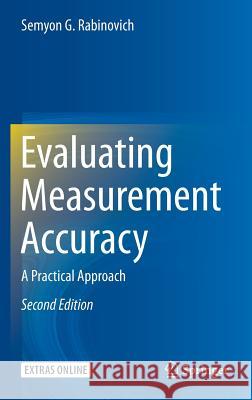
Semyon G. Rabinovich
Evaluating Measurement Accuracy: A Practical Approach Rabinovich, Semyon G. 9781461467168 Springer - książkaWidoczna okładka, to zdjęcie poglądowe, a rzeczywista szata graficzna może różnić się od prezentowanej.

Evaluating Measurement Accuracy: A Practical Approach

ISBN-13: 9781461467168 / Angielski / Twarda / 2013 / 313 str.

Semyon G. Rabinovich
cena 403,47 zł
(netto: 384,26 VAT:  5%)

Najniższa cena z 30 dni: 385,52 zł
Termin realizacji zamówienia:
ok. 22 dni roboczych
Bez gwarancji dostawy przed świętami

Darmowa dostawa!

"Evaluating Measurement Accuracy, 2nd Edition" is intended for those who are concerned with measurements in any field of science or technology. It reflects the latest developments in metrology and offers new results, but is designed to be accessible to readers at different levels: scientists who advance the field of metrology, engineers and experimental scientists who use measurements as tool in their professions, students and graduate students in natural sciences and engineering, and, in parts describing practical recommendations, technicians performing mass measurements in industry, quality control, and trade. This book presents material from the practical perspective and offers solutions and recommendations for problems that arise in conducting real-life measurements.

This new edition adds a method for estimating accuracy of indirect measurements with independent arguments, whose development Dr. Rabinovich was able to complete very recently. This method, which is called the Method of Enumeration, produces estimates that are no longer approximate, similar to the way the method of reduction described in the first edition removed approximation in estimating uncertainty of indirect measurements with dependent arguments. The method of enumeration completes addressing the range of problems whose solutions signify the emergence of the new theory of accuracy of measurements. A new method is added for building a composition of histograms, and this method forms a theoretical basis for the method of enumeration.


Kategorie:
Technologie
Kategorie BISAC:
Science > Weights & Measures
Technology & Engineering > Materials Science - General
Technology & Engineering > Quality Control
Wydawca:
Springer
Język:
Angielski
ISBN-13:
9781461467168
Rok wydania:
2013
Wydanie:
2013
Ilość stron:
313
Waga:
0.64 kg
Wymiary:
23.7 x 16.5 x 2.4
Oprawa:
Twarda
Wolumenów:
01
Dodatkowe informacje:
Bibliografia
Glosariusz/słownik
Wydanie ilustrowane

Preface

Chapter 1 General Concepts in the Theory of Measurement

1.1  Basic Concepts and Terms

1.2  The Basic Metrological Problems

1.3  New Forms of International Cooperation in Metrology

1.4  Postulates of the Theory of Measurements

1.5  Classification of Measurements

1.6  Classification of Measurement Errors

1.7  General Approach to Evaluation of Measurement Inaccuracy

1.8  Presentation of Measurement Results


Chapter 2 Measuring Instruments and Their Properties

2.1 Types of Measuring Instruments

2.2 Metrological Characteristics of Measuring Instruments

2.3 Rating of the Errors of Measuring Instruments

2.4 Dynamic Characteristics of Measuring Instruments

2.5 Calibration and Verification of Measuring Instruments

2.6 Designing a Calibration Scheme

2.7 Statistical Analysis of Measuring Instrument Errors


Chapter 3 Statistical Methods for Experimental Data Processing

3.1 Methods for Describing Random Quantities

3.2 Requirements for Statistical Estimates

3.3 Evaluation of the Parameters of Normal Distribution

3.4 Elimination of Outlying Data

3.5 Construction of Confidence Intervals

3.6 Reliability of Estimation of the Variance of a Sample from a Normal Distribution

3.7 Reliability of Estimation of the Standard Deviation of the Mean of a Sample from a Normal Distribution

3.8 Testing Hypotheses About the Form

of the Distribution Function

3.9 Testing for Homogeneity of Samples

3.10 Robust Estimates

3.11 Application of the Bayes’ Theorem


Chapter 4 Direct Measurements

4.1 Relation Between Single and Direct Measurements

4.2 Classification of Elementary Errors

4.3 Modeling of Elementary Errors

4.3.1 Absolutely Constant Errors

4.3.2 Conditionally Constant Errors

4.3.3 Purely Random Errors

4.3.4 Quasirandom Errors

4.4 Composition of Uniform Distributions

4.5 Methods for Precise Measurements

4.6 Accuracy of Single Measurements Using a Measuring Instrument Under Reference Conditions

4.7 Accuracy of Single Measurements Using a Measuring Instrument Under Rated Conditions

4.8 Accuracy of Multiple Measurements Having Only Random Errors

4.9 Accuracy of Multiple Measurements Having Both Random and Systematic Errors

4.10 Analysis of the Accuracy of the Weighted Summation of Systematic and Random Errors

4.11 Comparison of Different Methods for Combining Systematic and Random Errors


Chapter 5 Indirect Measurements

5.1 Terminology and Classification

5.2  Correlation Coefficient and Its Calculation

5.3 Method for Constructing the Composition of Histograms

5.4 The Traditional Method

5.5 Merits and Shortcomings of the Traditional Method

5.6 The Method of Reduction

5.7 The Method of Transformation

5.8 The Method of Enumera

tion

5.9 Total Uncertainty of Indirect Measurements

5.10 Accuracy of Single Indirect Measurements

5.11 Accuracy of a Single Measurement with a Chain of Instruments

5.12 The Monte Carlo Method


Chapter 6 Combined and Simultaneous Measurements

6.1 General Remarks About the Method of Least Squares

6.2 Measurements with Linear Equally Accurate Conditional Equations

6.3 Measurements with Linear Unequally Accurate Conditional Equations

6.4 Linearization of Nonlinear Conditional Equations

6.5 Examples of the Application of the Method of Least Squares

6.6 General Remarks on Determination of the Parameters in Formulas from Empirical Data

6.7 Construction of Transfer Functions of Meaning Transducers


Chapter 7 Combining The Results of Measurements

7.1 Introductory Remarks

7.2 Theoretical Principles

7.3 Effect of the Error of the Weights on the Error of the Weighted Mean

7.4 Combining the Results of Measurements with Predominately Random Errors

7.5 Combining the Results of Measurements with Both Systematic and Random Errors

7.6 Combining the Results of Single Measurements


Chapter 8 Examples of Measurements and Measurement Data Processing

8.1 Voltage Measurement with a Pointer-Type Voltmeter

            8.1.1 A Priori Estimation of Measurement Inaccuracy

            8.1.2 Universal Estimation of Measurement Inaccuracy


        8.1.3 Individual Estimation of Measurement Inaccuracy

8.2 Voltage Measurement with a Potentiometer and a Voltage Divider

8.3 Comparison of Mass Measures

8.4 Measurement of Electric Power at High Frequency

8.5 An Indirect Measurement of the Electrical Resistance of a Resistor

            8.5.1 Application of the Traditional Method

            8.5.2 Application of the Method of Reduction

8.6 Measurement of the Density of a Solid Body

            8.6.1 Application of the Traditional Method

8.6.2 Application of the Method of Transformation

8.6.3 Application of the Method of Enumeration

8.7 Measurement of Ionization Current

8.8 Measurement of the Activity of a Radioactive Source


Chapter 9 The International Vocabulary of Metrology and the Guide to the Expression of Uncertainty in Measurement: Analysis, Criticism, and Recommendations

9.1 Introduction

9.2 Comparison of Standard Deviation and Confidence Interval as Measurement Accuracy Indicators

9.3 Critique of the International Vocabulary of Metrology

9.4 Critique of the Guide to the Expression of Uncertainty in Measurement

9.4.1 Scope of GUM

9.4.2 Philosophy of GUM

9.4.3 Terminology of the GUM

9.4.4 Evaluation of the Uncertainty in the GUM

9.5 Roots of the Drawbacks of GUM and VIM

9.6 Perspectives on Fixing GUM and VIM

Conclusion Measuremen

t Data Processing: Past, Present and Next Steps


Glossary


Index

The goal of Evaluating Measurement Accuracy: A Practical Approach is to present methods for estimating the accuracy of measurements performed in industry, trade, and scientific research. From developing the theory of indirect measurements to proposing new methods of reduction, transformation, and enumeration, this work encompasses the full range of measurement data processing. It includes many examples that illustrate the application of general theory to typical problems encountered in measurement practice. As a result, the book serves as an inclusive reference work for data processing of all types of measurements: single and multiple, combined and simultaneous, direct (both linear and nonlinear), and indirect (both dependent and independent). It is a working tool for experimental scientists and engineers of all disciplines who work with instrumentation. It is also a good resource for natural science and engineering students and for technicians performing measurements in industry.

A key feature of the book is a new general theory of measurements that is both well-grounded and oriented towards real-life needs of measurement practitioners. Although the traditional theory focuses on multiple measurements, single measurements are the ones most commonly used. This book presents methods for evaluating accuracy of single measurements and answers other fundamental questions not addressed adequately by the traditional theory, such as how to combine various components o

f measurement inaccuracy when evaluating the complete uncertainty of a measurement result.

For its second edition, the book adds significant new material to incorporate recent metrological developments and expand coverage, including:

 ·         The new method of enumeration of experimental data processing for independent indirect multiple measurements which is precise and does not rely on questionable assumptions.

·         The analysis of reliability of estimates of statistical parameters of samples from a normal distribution.

·          A significantly expanded analysis of two fundamental documents in modern metrology, the International Vocabulary of Metrology and the Guide to the Expression of Uncertainty in Measurement.

·         Completely rewritten sections devoted to accuracy of a single measurement taken with a chain of instruments and the Monte Carlo method.

The goal of Evaluating Measurement Accuracy: A Practical Approach is to present methods for estimating the accuracy of measurements performed in industry, trade, and scientific research. From developing the theory of indirect measurements to proposing new methods of reduction, transformation, and enumeration, this work encompasses the full range of measurement data processing. It includes many examples that illustrate the application of general theory to typical problems encountered in measurement practice. As a result, the book serves as an inclusive reference work for data processing of all types of measurements: single and multiple, combined and simultaneous, direct (both linear and nonlinear), and indirect (both dependent and independent). It is a working tool for experimental scientists and engineers of all disciplines who work with instrumentation. It is also a good resource for natural science and engineering students and for technicians performing measurements in industry.

A key feature of the book is a new general theory of measurements that is both well-grounded and oriented towards real-life needs of measurement practitioners. Although the traditional theory focuses on multiple measurements, single measurements are the ones most commonly used. This book presents methods for evaluating accuracy of single measurements and answers other fundamental questions not addressed adequately by the traditional theory, such as how to combine various components o

f measurement inaccuracy when evaluating the complete uncertainty of a measurement result.

For its second edition, the book adds significant new material to incorporate recent metrological developments and expand coverage, including:


·         The new method of enumeration of experimental data processing for independent indirect multiple measurements which is precise and does not rely on questionable assumptions.

·         The analysis of reliability of estimates of statistical parameters of samples from a normal distribution.

·          A significantly expanded analysis of two fundamental documents in modern metrology, the International Vocabulary of Metrology and the Guide to the Expression of Uncertainty in Measurement.

·         Completely rewritten sections devoted to accuracy of a single measurement taken with a chain of instruments and the Monte Carlo method.

Rabinovich, Semyon G. Rabinovich was head of the Laboratory of Theoretic... więcej >


Udostępnij

Facebook - konto krainaksiazek.pl


Opinie o Krainaksiazek.pl na Opineo.pl

Partner Mybenefit

Krainaksiazek.pl w programie rzetelna firma Krainaksiaze.pl - płatności przez paypal

Czytaj nas na:

Facebook - krainaksiazek.pl
  • książki na zamówienie
  • granty
  • książka na prezent
  • kontakt
  • pomoc
  • opinie
  • regulamin
  • polityka prywatności

Zobacz:

  • Księgarnia czeska

  • Wydawnictwo Książkowe Klimaty

1997-2025 DolnySlask.com Agencja Internetowa

© 1997-2022 krainaksiazek.pl
     
KONTAKT | REGULAMIN | POLITYKA PRYWATNOŚCI | USTAWIENIA PRYWATNOŚCI
Zobacz: Księgarnia Czeska | Wydawnictwo Książkowe Klimaty | Mapa strony | Lista autorów
KrainaKsiazek.PL - Księgarnia Internetowa

Polityka prywatnosci - link
Krainaksiazek.pl - płatnośc Przelewy24
Przechowalnia Przechowalnia




