• Wyszukiwanie zaawansowane
  • Kategorie
  • Kategorie BISAC
  • Książki na zamówienie
  • Promocje
  • Granty
  • Książka na prezent
  • Opinie
  • Pomoc
  • Załóż konto
  • Zaloguj się

Ethics and Sustainable Agriculture: Bridging the Ecological Gaps » książka

zaloguj się | załóż konto
Logo Krainaksiazek.pl

koszyk

konto

szukaj
topmenu
Księgarnia internetowa
Szukaj
Książki na zamówienie
Promocje
Granty
Książka na prezent
Moje konto
Pomoc
 
 
Wyszukiwanie zaawansowane
Pusty koszyk
Bezpłatna dostawa dla zamówień powyżej 20 złBezpłatna dostawa dla zamówień powyżej 20 zł

Kategorie główne

• Nauka
 [2946600]
• Literatura piękna
 [1856966]

  więcej...
• Turystyka
 [72221]
• Informatyka
 [151456]
• Komiksy
 [35826]
• Encyklopedie
 [23190]
• Dziecięca
 [619653]
• Hobby
 [140543]
• AudioBooki
 [1577]
• Literatura faktu
 [228355]
• Muzyka CD
 [410]
• Słowniki
 [2874]
• Inne
 [445822]
• Kalendarze
 [1744]
• Podręczniki
 [167141]
• Poradniki
 [482898]
• Religia
 [510455]
• Czasopisma
 [526]
• Sport
 [61590]
• Sztuka
 [243598]
• CD, DVD, Video
 [3423]
• Technologie
 [219201]
• Zdrowie
 [101638]
• Książkowe Klimaty
 [124]
• Zabawki
 [2473]
• Puzzle, gry
 [3898]
• Literatura w języku ukraińskim
 [254]
• Art. papiernicze i szkolne
 [8170]
Kategorie szczegółowe BISAC

Ethics and Sustainable Agriculture: Bridging the Ecological Gaps

ISBN-13: 9783030766856 / Angielski / Miękka / 2022
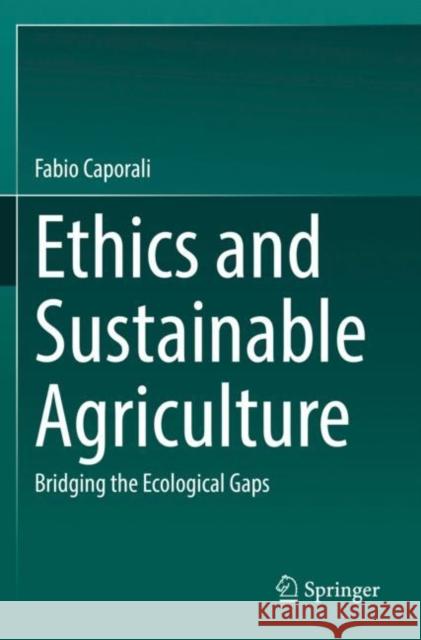
Fabio Caporali
Ethics and Sustainable Agriculture: Bridging the Ecological Gaps Caporali, Fabio 9783030766856 Springer International Publishing - książkaWidoczna okładka, to zdjęcie poglądowe, a rzeczywista szata graficzna może różnić się od prezentowanej.

Ethics and Sustainable Agriculture: Bridging the Ecological Gaps

ISBN-13: 9783030766856 / Angielski / Miękka / 2022

Fabio Caporali
cena 524,53 zł
(netto: 499,55 VAT:  5%)

Najniższa cena z 30 dni: 501,19 zł
Termin realizacji zamówienia:
ok. 22 dni roboczych
Bez gwarancji dostawy przed świętami

Darmowa dostawa!
inne wydania

This book describes the alarming condition of agriculture in the Anthropocene, when the ethical conception of agriculture as a service of common utility for both society and environment has progressively been marginalized. The ethical utility of agriculture has been sidetracked with the increasing industrialisation of society, the involvement of agriculture in the business-as-usual economy, and the consequential environmental and societal impacts it has had. Thus, re-establishing a meaningful bridge between ethics and agriculture is necessary. A relatively new science (ecology) with both a new epistemological tool (that of the ecosystem concept), and a unique narrative of sustainable development, can help bridge this gap. 

This book focuses on ethics as a lever for raising scientific, technical, social, economic and political solutions to adopt in agriculture as a model of symbiotic relationships between man and nature. It provides a detailed discussion of the ecological intensification practices in order to maximize ecological and ethical services, wherein agroecosystems will follow.


Kategorie:
Nauka, Biologia i przyroda
Kategorie BISAC:
Science > Life Sciences - Ecology
Technology & Engineering > Agriculture - General
Philosophy > Ethics & Moral Philosophy
Wydawca:
Springer International Publishing
Język:
Angielski
ISBN-13:
9783030766856
Rok wydania:
2022
Waga:
0.44 kg
Wymiary:
23.5 x 15.5
Oprawa:
Miękka
Dodatkowe informacje:
Wydanie ilustrowane

​Preface


1. Introduction

2. Ethics structure and goals

3. The emergence of ecological awareness

4. Development of ecological awareness
4.1 The emergence of ecosystem theory
4.1.1 The ecosystem concept 
4.2 The establishment of the ecosystem theory
4.2.1 Research and education
4.2.2 International policy and ecological economics
4.3 Ethics of sustainable development
4.3.1     Natural capital, ecosystem services and ecological footprint
4.3.2     The role of education

5. Agriculture and sustainable development
5.1 Agroecosystem epistemology and ontology
5.1.1 Energetics
5.1.2 Matter cycling
5.1.3 Biodiversity

6. Sustainable agriculture
6.1 Site-specificity and tradition
6.1.1 Domestication and adaptation
6.1.2 Terracing for ecosystem domestication
6.2 Sustainable agriculture as a turning point of the human predicament
6.3 Agroecology as a transdisciplinary field of cooperation
6.4 Ecological intensification principles and practices
6.4.1 Ecological intensification through planned biodiversity
6.4.2 Ecological intensification: the role of hedgerows
6.4.3 Valuing the performances of agroecosystem ecological intensification
6.5 Institutional patterns of agriculture ecological intensification in Europe: the role of Universities
6.5.1      Indicators of ecological intensification in contrasting farming systems
6.5.2      Ecological intensification in animal husbandry
6.5.3      Ecological intensification of human diet
6.6  Ecological intensification in theology of creation and food ethics

7. Conclusions

References  
Index

Fabio Caporali is 77 years old. He graduated in Agricultural Sciences at the University of Pisa and retired as Full Professor of Agricultural Ecology at the University of Tuscia, Viterbo, Italy. He still cooperates with DAFNE (Department of Agricultural Sciences and Forestry, University of Tuscia) in local institutions (bio-districts and eco-regions) for sustainable land use. He has more than 45 year experience in teaching and research both in Ecology and Agroecology, earlier at the University of Pisa and then at the University of Tuscia. His scientific and cultural activity is documented in more than one hundred papers published in national and international journals. He is author or co-author of University textbooks for both Ecology and Agroecology. He was both local and national coordinator of agroecological research projects in the Internationalization Programme of Italian Universities funded by the Ministry of University and Research, such as “Indicators of Agroecosystem Sustainability” and “Potential use of self-reseeding annual legumes in Mediterranean cropping systems”, in which several Italian Universities were engaged with other European Universities.  He was Institutional Coordinator of the University of Tuscia for the European Socrates Programme for 15 years. He coordinated teacher and student mobility in Europe and was actively involved as curriculum developer in several partnerships among European Universities concerning Agroecology at undergraduate, graduate and doctoral levels. He was for 5 years the local coordinator of the Degree Course in “Agroecology” (Msc level) shared with other European Universities. His activities concerning university partnership extended to Italian-Russian Universities within the “Italian-Russian Institute for Ecological Research and Teaching”, a project still alive with rotational summer Intensive Programme Courses on selected topics. Even his current activity provides relevant occasions for international collaboration, such as that carried out in organic farms of the Biodistrict “Via Amerina e delle Forre” within the FAO’s project TAPE (Tools for Agroecology Performance Evaluation). He is currently a member of the executive Board of IN.N.E.R (International Network of Eco-Regions).

This book describes the alarming condition of agriculture in the Anthropocene, when the ethical conception of agriculture as a service of common utility for both society and environment has progressively been marginalized. The ethical utility of agriculture has been sidetracked with the increasing industrialisation of society, the involvement of agriculture in the business-as-usual economy, and the consequential environmental and societal impacts it has had. Thus, re-establishing a meaningful bridge between ethics and agriculture is necessary. A relatively new science (ecology) with both a new epistemological tool (that of the ecosystem concept), and a unique narrative of sustainable development, can help bridge this gap. 


This book focuses on ethics as a lever for raising scientific, technical, social, economic and political solutions to adopt in agriculture as a model of symbiotic relationships between man and nature. It provides a detailed discussion of the ecological intensification practices in order to maximize ecological and ethical services, wherein agroecosystems will follow.




Udostępnij

Facebook - konto krainaksiazek.pl


Opinie o Krainaksiazek.pl na Opineo.pl

Partner Mybenefit

Krainaksiazek.pl w programie rzetelna firma Krainaksiaze.pl - płatności przez paypal

Czytaj nas na:

Facebook - krainaksiazek.pl
  • książki na zamówienie
  • granty
  • książka na prezent
  • kontakt
  • pomoc
  • opinie
  • regulamin
  • polityka prywatności

Zobacz:

  • Księgarnia czeska

  • Wydawnictwo Książkowe Klimaty

1997-2025 DolnySlask.com Agencja Internetowa

© 1997-2022 krainaksiazek.pl
     
KONTAKT | REGULAMIN | POLITYKA PRYWATNOŚCI | USTAWIENIA PRYWATNOŚCI
Zobacz: Księgarnia Czeska | Wydawnictwo Książkowe Klimaty | Mapa strony | Lista autorów
KrainaKsiazek.PL - Księgarnia Internetowa

Polityka prywatnosci - link
Krainaksiazek.pl - płatnośc Przelewy24
Przechowalnia Przechowalnia





