• Wyszukiwanie zaawansowane
  • Kategorie
  • Kategorie BISAC
  • Książki na zamówienie
  • Promocje
  • Granty
  • Książka na prezent
  • Opinie
  • Pomoc
  • Załóż konto
  • Zaloguj się

Estimation in Surveys with Nonresponse » książka


zaloguj się | załóż konto
Logo Krainaksiazek.pl

koszyk

konto

szukaj
topmenu
Księgarnia internetowa
Szukaj
Książki na zamówienie
Promocje
Granty
Książka na prezent
Moje konto
Pomoc
 
 
Wyszukiwanie zaawansowane
Pusty koszyk
Bezpłatna dostawa dla zamówień powyżej 20 złBezpłatna dostawa dla zamówień powyżej 20 zł

Kategorie główne

• Nauka
 [2949965]
• Literatura piękna
 [1857847]

  więcej...
• Turystyka
 [70818]
• Informatyka
 [151303]
• Komiksy
 [35733]
• Encyklopedie
 [23180]
• Dziecięca
 [617748]
• Hobby
 [139972]
• AudioBooki
 [1650]
• Literatura faktu
 [228361]
• Muzyka CD
 [398]
• Słowniki
 [2862]
• Inne
 [444732]
• Kalendarze
 [1620]
• Podręczniki
 [167233]
• Poradniki
 [482388]
• Religia
 [509867]
• Czasopisma
 [533]
• Sport
 [61361]
• Sztuka
 [243125]
• CD, DVD, Video
 [3451]
• Technologie
 [219309]
• Zdrowie
 [101347]
• Książkowe Klimaty
 [123]
• Zabawki
 [2362]
• Puzzle, gry
 [3791]
• Literatura w języku ukraińskim
 [253]
• Art. papiernicze i szkolne
 [7933]
Kategorie szczegółowe BISAC

Estimation in Surveys with Nonresponse

ISBN-13: 9780470011331 / Angielski / Twarda / 2005 / 216 str.
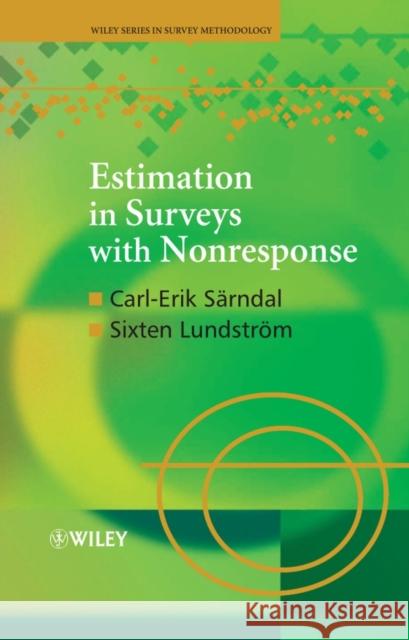
Carl-Erik Sarndal; Sixten Lundstrom; Carl-Erik Sdrndal
Estimation in Surveys with Nonresponse Carl-Erik Sarndal Sixten Lundstrom Carl-Erik Sdrndal 9780470011331 John Wiley & Sons - książkaWidoczna okładka, to zdjęcie poglądowe, a rzeczywista szata graficzna może różnić się od prezentowanej.

Estimation in Surveys with Nonresponse

ISBN-13: 9780470011331 / Angielski / Twarda / 2005 / 216 str.

Carl-Erik Sarndal; Sixten Lundstrom; Carl-Erik Sdrndal
cena 446,45 zł
(netto: 425,19 VAT:  5%)

Najniższa cena z 30 dni: 441,88 zł
Termin realizacji zamówienia:
ok. 30 dni roboczych
Bez gwarancji dostawy przed świętami

Darmowa dostawa!

There is increasing interest in the study of nonresponse in statistical surveys, as there is a need to reduce the level of nonresponse in order to increase the validity of the results, and to deal with the problem of nonresponse once it has arisen. It is possible to reduce the amount of nonresponse in a survey, but not possible to avoid it completely. Therefore there is a need for techniques that enable the survey statistician to estimate the level of nonresponse, and adjust for it accordingly in order to improve the results. This book presents a practical overview of techniques for estimating nonresponse in statistical surveys, and for adjusting for it once it has occurred. It also covers the related topics of frame imperfections and coverage errors in surveys, featuring many worked examples and implementation of the methods in a number of statistical software packages. The text is based upon a manual developed at Statistics Sweden, and used extensively by government statisticians working with data from real surveys. Features: Provides an overview of methods for the estimation of nonresponse in statistical surveys. reweighting and imputation. Includes guidelines for dealing with frame imperfections and coverage errors. Features worked examples throughout using real data. Includes implementation of the methods in a range of statistical software It will appeal to researchers and practitioners analyzing data from statistical surveys. Also suitable as supplementary reading for graduate students of survey statistics.


Kategorie:
Nauka, Matematyka
Kategorie BISAC:
Mathematics > Prawdopodobieństwo i statystyka
Mathematics > Research
Wydawca:
John Wiley & Sons
Seria wydawnicza:
Wiley Series in Survey Methodology
Język:
Angielski
ISBN-13:
9780470011331
Rok wydania:
2005
Numer serii:
000247621
Ilość stron:
216
Waga:
0.43 kg
Wymiary:
23.32 x 15.77 x 1.75
Oprawa:
Twarda
Wolumenów:
01
Dodatkowe informacje:
Bibliografia
Wydanie ilustrowane

" useful for the theoretically inclined survey statistician " ( Technometrics , May 2007) "This impressive piece of work can be thoroughly recommended to anyone" ( Zentralblatt MATH Volume 1079)

Preface.

Chapter 1: Introduction.

Chapter 2: The Survey and Its Imperfections.

2.1 The survey objective.

2.2 Sources of error in a survey.

Chapter 3: General Principles to Assist Estimation.

3.1 Introduction.

3.2 The importance of auxiliary information.

3.3 Desirable features of an auxiliary vector.

Chapter 4: The Use of Auxiliary Information under Ideal Conditions.

4.1 Introduction.

4.2 The Horvitz Thompson estimator.

4.3 The generalized regression estimator.

4.4 Variance and variance estimation.

4.5 Examples of the generalized regression estimator.

Chapter 5: Introduction to Estimation in the Presence of Nonresponse.

5.1 General background.

5.2 Errors caused by sampling and nonresponse.

Appendix: Variance and mean squared error under nonresponse.

Chapter 6: Weighting of Data in the Presence of Nonresponse.

6.1 Traditional approaches to weighting.

6.2 Auxiliary vectors and auxiliary information.

6.3 The calibration approach: some terminology.

6.4 Point estimation under the calibration approach.

6.5 Calibration estimators for domains.

6.6 Comments on the calibration approach.

6.7 Alternative sets of calibrated weights.

6.8 Properties of the calibrated weights.

Chapter 7: Examples of Calibration Estimators.

7.1 Examples of familiar estimators for data with nonresponse.

7.2 The simplest auxiliary vector.

7.3 One–way classification.

7.4 A single quantitative auxiliary variable.

7.5 One–way classification combined with a quantitative variable.

7.6 Two–way classification.

7.7 A Monte Carlo simulation study.

Chapter 8 The Combined Use of Sample Information and Population Information.

8.1 Options for the combined use of information.

8.2 An example of calibration with information at both levels.

8.3 A Monte Carlo simulation study of alternative calibration procedures.

8.4 Two–step procedures in practice.

Chapter 9 Analysing the Bias due to Nonresponse.

9.1 Simple estimators and their nonresponse bias.

9.2 Finding an efficient grouping.

9.3 Further illustrations of the nonresponse bias.

9.4 A general expression for the bias of the calibration estimator.

9.5 Conditions for near–unbiasedness.

9.6 A review of concepts, terms and ideas.

Appendix: Proof of Proposition 9.1.

Chapter 10: Selecting the Most Relevant Auxiliary Information.

10.1 Discussion.

10.2 Guidelines for the construction of an auxiliary vector.

10.3 The prospects for near–zero bias with traditional estimators.

10.4 Further avenues towards a zero bias.

10.5 A further tool for reducing the bias.

10.6 The search for a powerful auxiliary vector.

10.7 Empirical illustrations of the indicators.

10.8 Literature review.

Chapter 11: Variance and Variance Estimation.

11.1 Variance estimation for the calibration estimator.

11.2 An estimator for ideal conditions.

11.3 A useful relationship.

11.4 Variance estimation for the two–step A and two–step B procedures.

11.5 A simulation study of the variance estimation technique.

11.6 Computational aspects of point and variance estimation.

Appendix: Properties of two–phase GREG estimator.

Chapter 12: Imputation.

12.1 What is imputation?

12.2 Terminology.

12.3 Multiple study variables.

12.4 The full imputation approach.

12.5 The combined approach.

12.6 The full weighting approach.

12.7 Imputation by statistical rules.

12.8 Imputation by expert judgement or historical data.

Chapter 13: Variance Estimation in the Presence of Imputation.

13.1 Issues in variance estimation under the full imputation approach.

13.2 An identity of combined and fully weighted approaches.

13.3 More on the risk of underestimating the variance.

13.4 A broader view of variance estimation for the combined approach.

13.5 Other issues arising with regard to item nonresponse.

13.6 Further comments on imputation.

Appendix: Proof of Proposition 13.1.

Chapter 14: Estimation Under Nonresponse and Frame Imperfections.

14.1 Introduction.

14.2 Estimation of the persister total.

14.3 Direct estimation of the target population total.

14.4 A case study.

References.

Index.

Carl–Erik Särndal, Ph.D., is Consultant to National Statistical Agencies and was formerly Professor, Université de Montréal. He is the author, or a co–author, of many articles on survey sampling theory and applications.

Sixten Lundström, Ph.D., is Senior Methodological Adviser, Department of Population and Welfare Statistics, Statistics Sweden. He has extensive experience of survey practice, especially in the production of official statistics.

Around the world a multitude of surveys are conducted every day, on a variety of subjects, and consequently surveys have become an accepted part of modern life. However, in recent years survey estimates have been increasingly affected by rising trends in nonresponse, with loss of accuracy as an undesirable result. Whilst it is possible to reduce nonresponse to some degree, it cannot be completely eliminated. Estimation techniques that account systematically for nonresponse and at the same time succeed in delivering acceptable accuracy are much needed.

Estimation in Surveys with Nonresponse provides an overview of these techniques, presenting the view of nonresponse as a normal (albeit undesirable) feature of a sample survey, one whose potentially harmful effects are to be minimised.

  • Builds in the nonresponse feature of survey data collection as an integral part of the theory, both for point estimation and for variance estimation.
  • Promotes weighting through calibration as a new and powerful technique for surveys with nonresponse.
  • Highlights the analysis of nonresponse bias in estimates and methods to minimize this bias.
  • Includes computational tools to help identify the best variables for calibration.
  • Discusses the use of imputation as a complement to weighting by calibration.
  • Contains guidelines for dealing with frame imperfections and coverage errors.
  • Features worked examples throughout the text, using real data.

The accessible style of Estimation in Surveys with Nonresponse will make this an invaluable tool for survey methodologists in national statistics agencies and private survey agencies. Researchers, teachers, and students of statistics, social sciences and economics will benefit from the clear presentation and numerous examples.

Sarndal, Carl-Erik Carl-Erik Sarndal, Ph.D., is Consultant to Nationa... więcej >


Udostępnij

Facebook - konto krainaksiazek.pl


Opinie o Krainaksiazek.pl na Opineo.pl

Partner Mybenefit

Krainaksiazek.pl w programie rzetelna firma Krainaksiaze.pl - płatności przez paypal

Czytaj nas na:

Facebook - krainaksiazek.pl
  • książki na zamówienie
  • granty
  • książka na prezent
  • kontakt
  • pomoc
  • opinie
  • regulamin
  • polityka prywatności

Zobacz:

  • Księgarnia czeska

  • Wydawnictwo Książkowe Klimaty

1997-2025 DolnySlask.com Agencja Internetowa

© 1997-2022 krainaksiazek.pl
     
KONTAKT | REGULAMIN | POLITYKA PRYWATNOŚCI | USTAWIENIA PRYWATNOŚCI
Zobacz: Księgarnia Czeska | Wydawnictwo Książkowe Klimaty | Mapa strony | Lista autorów
KrainaKsiazek.PL - Księgarnia Internetowa

Polityka prywatnosci - link
Krainaksiazek.pl - płatnośc Przelewy24
Przechowalnia Przechowalnia





