• Wyszukiwanie zaawansowane
  • Kategorie
  • Kategorie BISAC
  • Książki na zamówienie
  • Promocje
  • Granty
  • Książka na prezent
  • Opinie
  • Pomoc
  • Załóż konto
  • Zaloguj się

Essential Statistics for Economics, Business and Management » książka

zaloguj się | załóż konto
Logo Krainaksiazek.pl

koszyk

konto

szukaj
topmenu
Księgarnia internetowa
Szukaj
Książki na zamówienie
Promocje
Granty
Książka na prezent
Moje konto
Pomoc
 
 
Wyszukiwanie zaawansowane
Pusty koszyk
Bezpłatna dostawa dla zamówień powyżej 20 złBezpłatna dostawa dla zamówień powyżej 20 zł

Kategorie główne

• Nauka
 [2949965]
• Literatura piękna
 [1857847]

  więcej...
• Turystyka
 [70818]
• Informatyka
 [151303]
• Komiksy
 [35733]
• Encyklopedie
 [23180]
• Dziecięca
 [617748]
• Hobby
 [139972]
• AudioBooki
 [1650]
• Literatura faktu
 [228361]
• Muzyka CD
 [398]
• Słowniki
 [2862]
• Inne
 [444732]
• Kalendarze
 [1620]
• Podręczniki
 [167233]
• Poradniki
 [482388]
• Religia
 [509867]
• Czasopisma
 [533]
• Sport
 [61361]
• Sztuka
 [243125]
• CD, DVD, Video
 [3451]
• Technologie
 [219309]
• Zdrowie
 [101347]
• Książkowe Klimaty
 [123]
• Zabawki
 [2362]
• Puzzle, gry
 [3791]
• Literatura w języku ukraińskim
 [253]
• Art. papiernicze i szkolne
 [7933]
Kategorie szczegółowe BISAC

Essential Statistics for Economics, Business and Management

ISBN-13: 9780470850794 / Angielski / Miękka / 2007 / 680 str.
Teresa Bradley
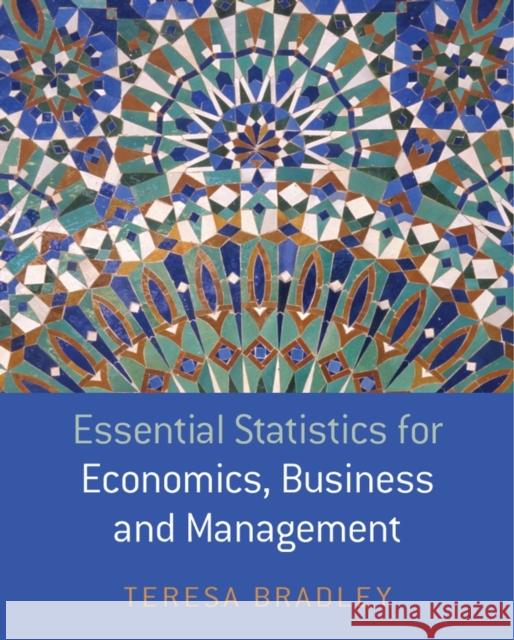
Essential Statistics for Economics, Business and Management Teresa Bradley 9780470850794 John Wiley & Sons - książkaWidoczna okładka, to zdjęcie poglądowe, a rzeczywista szata graficzna może różnić się od prezentowanej.

Essential Statistics for Economics, Business and Management

ISBN-13: 9780470850794 / Angielski / Miękka / 2007 / 680 str.

Teresa Bradley
cena 292,41 zł
(netto: 278,49 VAT:  5%)

Najniższa cena z 30 dni: 286,28 zł
Termin realizacji zamówienia:
ok. 30 dni roboczych
Bez gwarancji dostawy przed świętami

Darmowa dostawa!

Essential Statistics for Economics, Business and Management assumes no prior knowledge of statistics. It will also be highly relevant for the statistics component of courses in quantitative methods. The style of the book is similar to that of the highly successful Essential Mathematics for Economics and Business by Teresa Bradley and Paul Patton, with many worked examples integrated throughout.

  • Emphasis is placed on verbalising concepts, problems and results of statistical analysis. This will help students learn how to start a problem, complete the calculations, and report the results in a way that makes sense to a non-statistician.
  • Each concept is introduced with a brief but plausible explanation followed by Worked Examples. The Worked Examples will provide students with the necessary practice that they need in order to succeed at the subject.
  • Emphasis is also placed on ?learning through doing? problems. Excel is used to encourage students in doing problems and to enhance understanding (with links to datasets online). Minitab printouts are also included in the text.
  • Skills Development Exercises with brief solutions are included within the chapters, and Progress Exercises on theory and applications are provided at the end of each chapter. Solutions to all the worked examples and progress exercises are available as an appendix.
  • Web-based supplementary materials will be provided for lecturers adopting the text, including additonal exercises and solutions, excel datasets and exercises, powerpoint slides with key formula, figures and tables. Students can access an online glossary and weblinks.


Kategorie:
Nauka, Ekonomia i biznes
Kategorie BISAC:
Business & Economics > Statystyka gospodarcza
Business & Economics > Economics - General
Wydawca:
John Wiley & Sons
Język:
Angielski
ISBN-13:
9780470850794
Rok wydania:
2007
Ilość stron:
680
Waga:
1.43 kg
Wymiary:
24.36 x 19.02 x 3.2
Oprawa:
Miękka
Wolumenów:
01
Dodatkowe informacje:
Bibliografia
Glosariusz/słownik

Introduction 1

CHAPTER 1: Data Collection and its Graphical Presentation 5

1.1 Introduction to statistics 6

1.2 Data collection: Samples, surveys and experiments 8

1.3 Some sources of statistical data 16

1.4 Sorting and classifying data 18

1.5 Charts: Bar charts, pie charts and plotting in Excel 23

1.6 Graphs: Histograms and Ogives. Graphs in Excel 42

1.7 Line and Lorenz graphs 52

1.8 Misleading graphs 59

CHAPTER 2: Descriptive Statistics 63

2.1 Summary statistics for raw data: Mean, quartiles and mode 64

2.2 Summary statistics for grouped data: Mean, quartiles and mode 72

2.3 Measures of dispersion for raw data. Variance, QD, IQR 85

2.4 Measures of dispersion for grouped data. Variance, QD, IQR 92

2.5 Use of calculator for descriptive statistics 94

2.6 Other descriptive statistics. CV, skewness and box plots 96

2.7 Descriptive statistics in Excel 101

CHAPTER 3: Regression and Correlation: Introduction 113

3.1 Introduction to regression: Scatter plots and lines 114

3.2 The least–squares line. Criteria and equation for the best fit line 118

3.3 Excel: XY (scatter) plots, the least–squares lines and formulae 127

3.4 Coefficient of determination and correlation 133

3.5 Rank correlation. Calculate and interpret rank correlation 144

3.6 Use the calculator for linear regression and correlation 146

3.7 Why bother with formulae? 154

CHAPTER 4: Probability 159

4.1 Introduction to probability 159

4.2 Multiplication and addition rules for probability 170

4.3 Joint, marginal and conditional probability 184

4.4 Bayes′ Rule 192

CHAPTER 5: Introduction to Probability Distributions 205

5.1 Introduction to probability distributions and random variables 206

5.2 The Binomial probability distribution 212

5.3 The Poisson probability distribution 228

5.4 The Normal probability distribution 236

5.5 Expected values (mathematical expectation) 253

CHAPTER 6: Sampling Distributions for Means and Proportions 265

6.1 Statistical inference and the sampling distribution of the mean 265

6.2 Sampling distribution of proportions 275

6.3 Some desirable properties of estimators 282

CHAPTER 7: Confidence Intervals for Means and Proportions 287

7.1 Confidence intervals for the mean 287

7.2 Confidence intervals for proportions 297

7.3 The precision of confidence intervals for the mean 300

7.4 Confidence intervals for differences between means and proportions 304

CHAPTER 8: Tests of Hypothesis for Means and Proportions 319

8.1 Hypothesis tests for means 319

8.2 Hypothesis tests for proportions 334

8.3 Hypothesis tests for the difference between means and proportions 337

8.4 Minitab and Excel for confidence intervals and tests of hypothesis 349

CHAPTER 9: Inference from Small Samples. Confidence Intervals and Tests of Hypothesis 359

9.1 Inference from small samples: Normal populations, s known 360

9.2 The Student′s t distribution 362

9.3 Inference from small samples: Normal populations, s NOT known 365

9.4 Difference between means. Small independent samples 370

9.5 F–test for equality of two variances 378

9.6 Difference between means, paired samples 382

CHAPTER 10: Analysis of Variance 393

10.1 The rationale behind one–way analysis of variance 393

10.2 One–way analysis of variance 397

10.3 Two–way ANOVA 419

10.4 ANOVA and design of experiment 430

10.5 Excel and Minitab for ANOVA 435

CHAPTER 11: Chi–squared Tests 453

11.1 Introduction 454

11.2 The ?2 probability distribution 454

11.3 Contingency tables 455

11.4 ?2 tests for independence (no association) 456

11.5 ?2 test for homogeneous populations 464

11.6 ?2 tests for the equality of several proportions 466

11.7 Goodness of fit tests 478

11.8 ?2 tests in Minitab and Excel 490

CHAPTER 12: Regression Analysis 499

12.1 The simple linear regression model 499

12.2 Inference about the population slope (rate of change) 504

12.3 Confidence intervals and prediction intervals at x = x0 513

12.4 Checks on the model assumptions based on residuals plots 518

12.5 Regression analysis in Minitab and Excel 521

12.6 Multiple regression 534

APPENDIX A: Technicalities and Conventions for Defining Class Intervals, Mid–Interval, Widths, Limits, Boundaries 545

APPENDIX B: Formulae for Calculating the Quartiles for Grouped Data 547

APPENDIX C: Outline of Derivation of Formulae (3.2) and (3.3) for the Slope and Intercept of the Least–Squares Line, Y = a + bX 549

APPENDIX D: Brief Review of the Mathematics for the Binomial 551

APPENDIX E: The Number e 555

APPENDIX F: Calculation of Mean and Variance of Proportions by Expected Values 557

APPENDIX G: Confidence Intervals for Means and Proportions 559

APPENDIX H: Degrees of Freedom 561

APPENDIX I: Notes on Summations and Double Summations 563

APPENDIX J: Expressing the Estimates of Variance as Sums of Squares Divided by Degrees of Freedom in Their Simplest Form 567

APPENDIX K: Sums of Squares for the One–Way ANOVA 571

APPENDIX L: Fitted Values and Residuals 573

APPENDIX M: Sums of Squares Identity for Two–Way ANOVA 575

Chapter Solutions 577

Tables 637

Table 1 Cumulative Binomial Probability tables 637

Table 2 Cumulative Poisson Probabilities 639

Table 3 Normal probability Distribution 641

Table 4 Percentage point for the Normal probability distribution 642

Table 5 Percentage points of the Student s t–distribution 643

Table 6 0.5% points of the F–distribution 644

Table 7 Percentage points for the Chi–squared distribution 648

Table 8 Table of random numbers 649

Glossary 651

Index 653

Essential Statistics for Economics, Business and Management is an indispensable text for students taking an introductory undergraduate course in statistics, as well as being highly relevant for the statistics component of courses in quantitative methods.

Key Features:

  • Assumes no prior knowledge of statistics
  • Emphasis is placed on verbalising concepts, problems and results of statistical analysis, thereby helping students to learn how to start a problem, complete calculations and report results in a way that will make sense to a non–statistician.
  • Each concept is introduced with a brief and plausible explanation followed by worked examples. The worked examples provide students with the necessary practice that they need in order to succeed at the subject.
  • Excel and Minitab are used throughout the text to introduce students to statistical software and enhance understanding.
  • Progress exercises on theory and applications are provided at the end of each section for students to test their knowledge.

The accessible style of the text is consistent with that of the highly successful Essential Mathematics for Economics and Business, also by Teresa Bradley and published by John Wiley & Sons, Ltd.

 A comprehensive website to support the book has been produced and includes: PowerPoint slides, datasets, further worked examples, a testbank for lecturers, and additional test exercises for students.

Bradley, Teresa Teresa Bradley lectures in mathematics at Limerick... więcej >


Udostępnij

Facebook - konto krainaksiazek.pl


Opinie o Krainaksiazek.pl na Opineo.pl

Partner Mybenefit

Krainaksiazek.pl w programie rzetelna firma Krainaksiaze.pl - płatności przez paypal

Czytaj nas na:

Facebook - krainaksiazek.pl
  • książki na zamówienie
  • granty
  • książka na prezent
  • kontakt
  • pomoc
  • opinie
  • regulamin
  • polityka prywatności

Zobacz:

  • Księgarnia czeska

  • Wydawnictwo Książkowe Klimaty

1997-2025 DolnySlask.com Agencja Internetowa

© 1997-2022 krainaksiazek.pl
     
KONTAKT | REGULAMIN | POLITYKA PRYWATNOŚCI | USTAWIENIA PRYWATNOŚCI
Zobacz: Księgarnia Czeska | Wydawnictwo Książkowe Klimaty | Mapa strony | Lista autorów
KrainaKsiazek.PL - Księgarnia Internetowa

Polityka prywatnosci - link
Krainaksiazek.pl - płatnośc Przelewy24
Przechowalnia Przechowalnia






