• Wyszukiwanie zaawansowane
  • Kategorie
  • Kategorie BISAC
  • Książki na zamówienie
  • Promocje
  • Granty
  • Książka na prezent
  • Opinie
  • Pomoc
  • Załóż konto
  • Zaloguj się

Epistemology and Probability: Bohr, Heisenberg, Schrödinger, and the Nature of Quantum-Theoretical Thinking » książka


zaloguj się | załóż konto
Logo Krainaksiazek.pl

koszyk

konto

szukaj
topmenu
Księgarnia internetowa
Szukaj
Książki na zamówienie
Promocje
Granty
Książka na prezent
Moje konto
Pomoc
 
 
Wyszukiwanie zaawansowane
Pusty koszyk
Bezpłatna dostawa dla zamówień powyżej 20 złBezpłatna dostawa dla zamówień powyżej 20 zł

Kategorie główne

• Nauka
 [2949965]
• Literatura piękna
 [1857847]

  więcej...
• Turystyka
 [70818]
• Informatyka
 [151303]
• Komiksy
 [35733]
• Encyklopedie
 [23180]
• Dziecięca
 [617748]
• Hobby
 [139972]
• AudioBooki
 [1650]
• Literatura faktu
 [228361]
• Muzyka CD
 [398]
• Słowniki
 [2862]
• Inne
 [444732]
• Kalendarze
 [1620]
• Podręczniki
 [167233]
• Poradniki
 [482388]
• Religia
 [509867]
• Czasopisma
 [533]
• Sport
 [61361]
• Sztuka
 [243125]
• CD, DVD, Video
 [3451]
• Technologie
 [219309]
• Zdrowie
 [101347]
• Książkowe Klimaty
 [123]
• Zabawki
 [2362]
• Puzzle, gry
 [3791]
• Literatura w języku ukraińskim
 [253]
• Art. papiernicze i szkolne
 [7933]
Kategorie szczegółowe BISAC

Epistemology and Probability: Bohr, Heisenberg, Schrödinger, and the Nature of Quantum-Theoretical Thinking

ISBN-13: 9780387853338 / Angielski / Twarda / 2009 / 402 str.
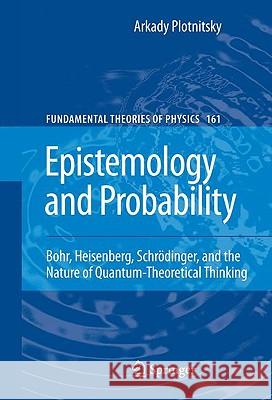
Arkady Plotnitsky
Epistemology and Probability: Bohr, Heisenberg, Schrödinger, and the Nature of Quantum-Theoretical Thinking Plotnitsky, Arkady 9780387853338 Springer - książkaWidoczna okładka, to zdjęcie poglądowe, a rzeczywista szata graficzna może różnić się od prezentowanej.

Epistemology and Probability: Bohr, Heisenberg, Schrödinger, and the Nature of Quantum-Theoretical Thinking

ISBN-13: 9780387853338 / Angielski / Twarda / 2009 / 402 str.

Arkady Plotnitsky
cena 806,99
(netto: 768,56 VAT:  5%)

Najniższa cena z 30 dni: 771,08
Termin realizacji zamówienia:
ok. 22 dni roboczych
Bez gwarancji dostawy przed świętami

Darmowa dostawa!
inne wydania

This book offers an exploration of the relationships between epistemology and probability in the work of Niels Bohr, Werner Heisenberg, and Erwin Schro- ] dinger, and in quantum mechanics and in modern physics as a whole. It also considers the implications of these relationships and of quantum theory itself for our understanding of the nature of human thinking and knowledge in general, or the epistemological lesson of quantum mechanics, as Bohr liked 1 to say. These implications are radical and controversial. While they have been seen as scientifically productive and intellectually liberating to some, Bohr and Heisenberg among them, they have been troublesome to many others, such as Schro] dinger and, most prominently, Albert Einstein. Einstein famously refused to believe that God would resort to playing dice or rather to playing with nature in the way quantum mechanics appeared to suggest, which is indeed quite different from playing dice. According to his later (sometime around 1953) remark, a lesser known or commented upon but arguably more important one: That the Lord should play dice], all right; but that He should gamble according to definite rules i. e., according to the rules of quantum mechanics, rather than 2 by merely throwing dice], that is beyond me. Although Einstein s invocation of God is taken literally sometimes, he was not talking about God but about the way nature works. Bohr s reply on an earlier occasion to Einstein s question 1 Cf."


Kategorie:
Nauka, Fizyka
Kategorie BISAC:
Science > Fizyka kwantowa
Philosophy > Epistemology
Science > Philosophy & Social Aspects
Wydawca:
Springer
Seria wydawnicza:
Fundamental Theories of Physics
Język:
Angielski
ISBN-13:
9780387853338
Rok wydania:
2009
Wydanie:
2010
Numer serii:
000036058
Ilość stron:
402
Waga:
1.74 kg
Wymiary:
23.5 x 15.5
Oprawa:
Twarda
Wolumenów:
01
Dodatkowe informacje:
Bibliografia
Wydanie ilustrowane

From the reviews:

"Plotnitsky (theory and cultural studies, Purdue Univ.) analyzes the discussions and disagreements among the principals (mentioned in the title), and offers his insightful comments on the questions. ... The discussions on probability and epistemology remind readers of 18th-century debates on the topic in which d'Alembert participated. This book should interest anyone seeking a deeper understanding of the epistemology of quantum mechanics, especially the issues thrashed out in the early phases. ... Summing Up: Highly recommended. Academic libraries serving graduate students, researchers, and faculty." (V. V. Raman, Choice, Vol. 47 (10), June, 2010)

"This is an exposition of what the author calls 'non-classical epistemology' in close relationship with the emergence and development of quantum mechanics. ... Plotnitsky unfolds a nuanced presentation of the so-called 'Copenhagen spirit' or, more precisely, of the ideas of his central hero, Niels Bohr, taken to their logical conclusion. ... Plotnitsky's narrative makes fascinating reading, and not only for those who are sympathetic to his views. ... the book represents a challenge and motivation for the opponents of such views, particularly scientific realists." (Vassilis Sakellariou, Metascience, Vol. 21, 2012)

Introduction—Epistemology and Probability in Quantum Theory: Physics, Mathematics, and Philosophy.- Quantum Phenomena and the Double-Slit Experiment.- Heisenberg’s Revolutions: New Kinematics, New Mathematics, and New Philosophy.- From Geometry to Algebra in Physics, with Heisenberg.- Schrödinger’s Waves: Propagation and Probability.- Bohr’s Como Argument: Complementarity and the Problem of Causality.- From Como to Copenhagen: Renunciations.- Can Quantum-Mechanical Description of Physical Reality Be Considered both Complete and Local?.- Essential Ambiguity and Essential Influence: Reading Bohr’s Reply to EPR.- Mysteries Without Mysticism, Correlations Without Correlata, Epistemology Without Ontology, and Probability Without Causality.- 11 Conclusion: “The Mere Touch of Cold Philosophy”.

Quantum mechanics, discovered by Werner Heisenberg and Erwin Schrödinger in 1925-1926, is famous for its radical implications for our conception of physics and for our view of human knowledge in general. While these implications have been seen as scientifically productive and intellectually liberating to some, Niels Bohr and Heisenberg, among them, they have been troublesome to many others, including Schrödinger and, most famously, Albert Einstein. The situation led to the intense debate that started in the wake of its discovery and has continued into our own time, with no end appearing to be in sight.

Epistemology and Probability aims to contribute to our understanding of quantum mechanics and of the reasons for its extraordinary impact by reconsidering, under the rubric of "nonclassical epistemology," the nature of epistemology and probability, and their relationships in quantum theory. The book brings together the thought of the three figures most responsible for the rise of quantum mechanics—Heisenberg and Schrödinger, on the physical side, and Bohr, on the philosophical side—in order to develop a deeper sense of the physical, mathematical, and philosophical workings of quantum-theoretical thinking. Reciprocally, giving a special emphasis on probability and specifically to the Bayesian concept of probability allows the book to gain new insights into the thought of these figures. The book reconsiders, from this perspective, the Bohr-Einstein debate on the epistemology of quantum physics and, in particular, offers a new treatment of the famous experiment of Einstein, Podolsky, and Rosen (EPR), and of the Bohr-Einstein exchange concerning the subject. It also addresses the relevant aspects of quantum information theory and considers the implications of its epistemological argument for higher-level quantum theories, such as quantum field theory and string and brane theories. One of the main contributions of the book is its analysis of the role of mathematics in quantum theory and in the thinking of Bohr, Heisenberg, and Schrödinger, in particular an examination of the new (vis-à-vis classical physics and relativity) type of the relationships between mathematics and physics introduced by Heisenberg in the course of his discovery of quantum mechanics.

Although Epistemology and Probability is aimed at physicists, philosophers and historians of science, and graduate and advanced undergraduate students in these fields, it is also written with a broader audience in mind and is accessible to readers unfamiliar with the higher-level mathematics used in quantum theory.

Plotnitsky, Arkady Arkady Plotnitsky holds degrees in Mathematics fro... więcej >


Udostępnij

Facebook - konto krainaksiazek.pl


Opinie o Krainaksiazek.pl na Opineo.pl

Partner Mybenefit

Krainaksiazek.pl w programie rzetelna firma Krainaksiaze.pl - płatności przez paypal

Czytaj nas na:

Facebook - krainaksiazek.pl
  • książki na zamówienie
  • granty
  • książka na prezent
  • kontakt
  • pomoc
  • opinie
  • regulamin
  • polityka prywatności

Zobacz:

  • Księgarnia czeska

  • Wydawnictwo Książkowe Klimaty

1997-2025 DolnySlask.com Agencja Internetowa

© 1997-2022 krainaksiazek.pl
     
KONTAKT | REGULAMIN | POLITYKA PRYWATNOŚCI | USTAWIENIA PRYWATNOŚCI
Zobacz: Księgarnia Czeska | Wydawnictwo Książkowe Klimaty | Mapa strony | Lista autorów
KrainaKsiazek.PL - Księgarnia Internetowa

Polityka prywatnosci - link
Krainaksiazek.pl - płatnośc Przelewy24
Przechowalnia Przechowalnia






