• Wyszukiwanie zaawansowane
  • Kategorie
  • Kategorie BISAC
  • Książki na zamówienie
  • Promocje
  • Granty
  • Książka na prezent
  • Opinie
  • Pomoc
  • Załóż konto
  • Zaloguj się

Epistemic Processes: A Basis for Statistics and Quantum Theory » książka


zaloguj się | załóż konto
Logo Krainaksiazek.pl

koszyk

konto

szukaj
topmenu
Księgarnia internetowa
Szukaj
Książki na zamówienie
Promocje
Granty
Książka na prezent
Moje konto
Pomoc
 
 
Wyszukiwanie zaawansowane
Pusty koszyk
Bezpłatna dostawa dla zamówień powyżej 20 złBezpłatna dostawa dla zamówień powyżej 20 zł

Kategorie główne

• Nauka
 [2952079]
• Literatura piękna
 [1850969]

  więcej...
• Turystyka
 [71058]
• Informatyka
 [151066]
• Komiksy
 [35579]
• Encyklopedie
 [23181]
• Dziecięca
 [620496]
• Hobby
 [139036]
• AudioBooki
 [1646]
• Literatura faktu
 [228729]
• Muzyka CD
 [379]
• Słowniki
 [2932]
• Inne
 [445708]
• Kalendarze
 [1409]
• Podręczniki
 [164793]
• Poradniki
 [480107]
• Religia
 [510956]
• Czasopisma
 [511]
• Sport
 [61267]
• Sztuka
 [243299]
• CD, DVD, Video
 [3411]
• Technologie
 [219640]
• Zdrowie
 [100984]
• Książkowe Klimaty
 [124]
• Zabawki
 [2281]
• Puzzle, gry
 [3363]
• Literatura w języku ukraińskim
 [258]
• Art. papiernicze i szkolne
 [8020]
Kategorie szczegółowe BISAC

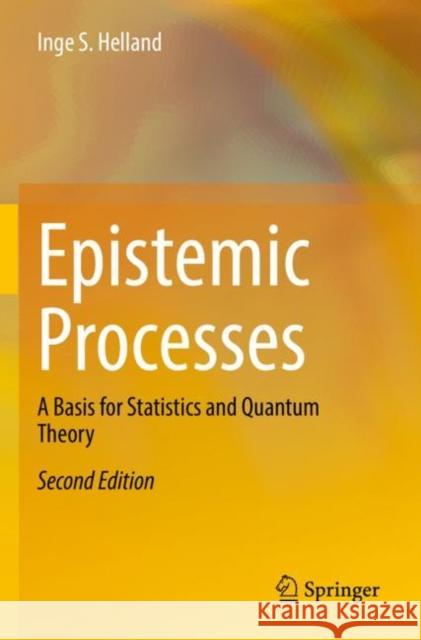
Epistemic Processes: A Basis for Statistics and Quantum Theory

ISBN-13: 9783030819255 / Angielski / Miękka / 2022
Inge S. Helland
Epistemic Processes: A Basis for Statistics and Quantum Theory Inge S. Helland 9783030819255 Springer International Publishing - książkaWidoczna okładka, to zdjęcie poglądowe, a rzeczywista szata graficzna może różnić się od prezentowanej.

Epistemic Processes: A Basis for Statistics and Quantum Theory

ISBN-13: 9783030819255 / Angielski / Miękka / 2022

Inge S. Helland
cena 523,30
(netto: 498,38 VAT:  5%)

Najniższa cena z 30 dni: 501,19
Termin realizacji zamówienia:
ok. 22 dni roboczych
Dostawa w 2026 r.

Darmowa dostawa!
inne wydania

This book discusses a link between statistical theory and quantum theory based on the concept of epistemic processes. The latter are processes, such as statistical investigations or quantum mechanical measurements, that can be used to obtain knowledge about something. Various topics in quantum theory are addressed, including the construction of a Hilbert space from reasonable assumptions and an interpretation of quantum states. Separate derivations of the Born formula and the one-dimensional Schrödinger equation are given.In concrete terms, a Hilbert space can be constructed under some technical assumptions associated with situations where there are two conceptual variables that can be seen as maximally accessible. Then to every accessible conceptual variable there corresponds an operator on this Hilbert space, and if the variables take a finite number of values, the eigenspaces/eigenvectors of these operators correspond to specific questions in nature together with sharp answers to these questions. This paves a new way to the foundations of quantum theory.The resulting interpretation of quantum mechanics is related to Hervé Zwirn's recent Convivial Solipsism, but it also has some relations to Quantum Bayesianism and to Rovelli's relational quantum mechanics. Niels Bohr's concept of complementarity plays an important role. Philosophical implications of this approach to quantum theory are discussed, including consequences for macroscopic settings.



The book will benefit a broad readership, including physicists and statisticians interested in the foundations of their disciplines, philosophers of science and graduate students, and anyone with a reasonably good background in mathematics and an open mind.

Kategorie:
Nauka, Matematyka
Kategorie BISAC:
Mathematics > Prawdopodobieństwo i statystyka
Science > Philosophy & Social Aspects
Science > Fizyka kwantowa
Wydawca:
Springer International Publishing
Język:
Angielski
ISBN-13:
9783030819255
Rok wydania:
2022
Waga:
0.41 kg
Wymiary:
23.5 x 15.5
Oprawa:
Miękka
Dodatkowe informacje:
Wydanie ilustrowane

1. The epistemic view upon science.- 2. Statistical inference.- 3. Inference in an epistemic process.- 4. Towards quantum theory.- 5. Aspects of quantum theory.- 6. Macroscopic consequences.

Inge S. Helland completed his cand.mag (B.S.) in mathematics and physics at the University of Bergen in 1970. After a research fellowship at The Niels Bohr Institute, Copenhagen in fall 1971, he turned to statistics, and completed his cand.real. (M.S.) at the University of Bergen in 1973. He was a fellow at the University of Bergen from 1973 to1978, including a research stay at the University of California, Berkeley in 1977 and 1978. He was then an Associate Professor of Statistics at the Agricultural University of Norway, later Norwegian University of Life Sciences, from 1978 to 1983, and Professor at the same university from 1983 to 1996. 

He obtained his dr. philos. degree on limit theorems for stochastic processes from the University of Oslo in 1980, and was Professor of Statistics at the University of Oslo from 1996 to 2012, when he went took on an emeritus position. His research covers a large area of theoretical and applied statistics, including proposing a statistical model connected to the chemometricians’ partial least squares algorithm.

This book discusses a link between statistical theory and quantum theory based on the concept of epistemic processes. The latter are processes, such as statistical investigations or quantum mechanical measurements, that can be used to obtain knowledge about something. Various topics in quantum theory are addressed, including the construction of a Hilbert space from reasonable assumptions and an interpretation of quantum states. Separate derivations of the Born formula and the one-dimensional Schrödinger equation are given.

In concrete terms, a Hilbert space can be constructed under some technical assumptions associated with situations where there are two conceptual variables that can be seen as maximally accessible. Then to every accessible conceptual variable there corresponds an operator on this Hilbert space, and if the variables take a finite number of values, the eigenspaces/eigenvectors of these operators correspond to specific questions in nature together with sharp answers to these questions. This paves a new way to the foundations of quantum theory.

The resulting interpretation of quantum mechanics is related to Hervé Zwirn's recent Convivial Solipsism, but it also has some relations to Quantum Bayesianism and to Rovelli's relational quantum mechanics. Niels Bohr's concept of complementarity plays an important role. Philosophical implications of this approach to quantum theory are discussed, including consequences for macroscopic settings.


The book will benefit a broad readership, including physicists and statisticians interested in the foundations of their disciplines, philosophers of science and graduate students, and anyone with a reasonably good background in mathematics and an open mind.


Udostępnij

Facebook - konto krainaksiazek.pl


Opinie o Krainaksiazek.pl na Opineo.pl

Partner Mybenefit

Krainaksiazek.pl w programie rzetelna firma Krainaksiaze.pl - płatności przez paypal

Czytaj nas na:

Facebook - krainaksiazek.pl
  • książki na zamówienie
  • granty
  • książka na prezent
  • kontakt
  • pomoc
  • opinie
  • regulamin
  • polityka prywatności

Zobacz:

  • Księgarnia czeska

  • Wydawnictwo Książkowe Klimaty

1997-2025 DolnySlask.com Agencja Internetowa

© 1997-2022 krainaksiazek.pl
     
KONTAKT | REGULAMIN | POLITYKA PRYWATNOŚCI | USTAWIENIA PRYWATNOŚCI
Zobacz: Księgarnia Czeska | Wydawnictwo Książkowe Klimaty | Mapa strony | Lista autorów
KrainaKsiazek.PL - Księgarnia Internetowa

Polityka prywatnosci - link
Krainaksiazek.pl - płatnośc Przelewy24
Przechowalnia Przechowalnia



