• Wyszukiwanie zaawansowane
  • Kategorie
  • Kategorie BISAC
  • Książki na zamówienie
  • Promocje
  • Granty
  • Książka na prezent
  • Opinie
  • Pomoc
  • Załóż konto
  • Zaloguj się

Environmental Statistics: Methods and Applications » książka


zaloguj się | załóż konto
Logo Krainaksiazek.pl

koszyk

konto

szukaj
topmenu
Księgarnia internetowa
Szukaj
Książki na zamówienie
Promocje
Granty
Książka na prezent
Moje konto
Pomoc
 
 
Wyszukiwanie zaawansowane
Pusty koszyk
Bezpłatna dostawa dla zamówień powyżej 20 złBezpłatna dostawa dla zamówień powyżej 20 zł

Kategorie główne

• Nauka
 [2949965]
• Literatura piękna
 [1857847]

  więcej...
• Turystyka
 [70818]
• Informatyka
 [151303]
• Komiksy
 [35733]
• Encyklopedie
 [23180]
• Dziecięca
 [617748]
• Hobby
 [139972]
• AudioBooki
 [1650]
• Literatura faktu
 [228361]
• Muzyka CD
 [398]
• Słowniki
 [2862]
• Inne
 [444732]
• Kalendarze
 [1620]
• Podręczniki
 [167233]
• Poradniki
 [482388]
• Religia
 [509867]
• Czasopisma
 [533]
• Sport
 [61361]
• Sztuka
 [243125]
• CD, DVD, Video
 [3451]
• Technologie
 [219309]
• Zdrowie
 [101347]
• Książkowe Klimaty
 [123]
• Zabawki
 [2362]
• Puzzle, gry
 [3791]
• Literatura w języku ukraińskim
 [253]
• Art. papiernicze i szkolne
 [7933]
Kategorie szczegółowe BISAC

Environmental Statistics: Methods and Applications

ISBN-13: 9780471489719 / Angielski / Twarda / 2004 / 320 str.
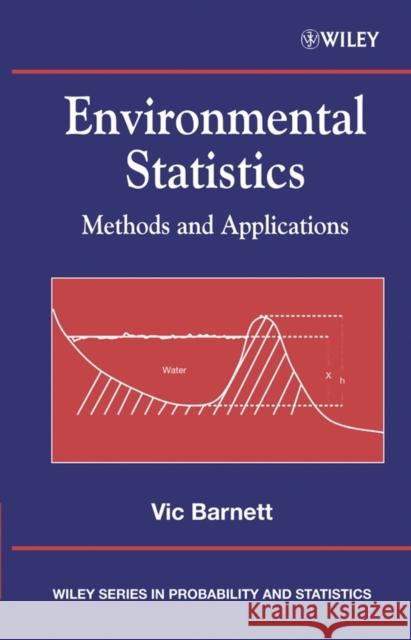
Vic Barnett
Environmental Statistics: Methods and Applications Barnett, Vic 9780471489719 John Wiley & Sons - książkaWidoczna okładka, to zdjęcie poglądowe, a rzeczywista szata graficzna może różnić się od prezentowanej.

Environmental Statistics: Methods and Applications

ISBN-13: 9780471489719 / Angielski / Twarda / 2004 / 320 str.

Vic Barnett
cena 574,81 zł
(netto: 547,44 VAT:  5%)

Najniższa cena z 30 dni: 568,93 zł
Termin realizacji zamówienia:
ok. 30 dni roboczych
Bez gwarancji dostawy przed świętami

Darmowa dostawa!

In modern society, we are ever more aware of the environmental issues we face, whether these relate to global warming, depletion of rivers and oceans, despoliation of forests, pollution of land, poor air quality, environmental health issues, etc. At the most fundamental level it is necessary to monitor what is happening in the environment -- collecting data to describe the changing scene. More importantly, it is crucial to formally describe the environment with sound and validated models, and to analyse and interpret the data we obtain in order to take action. Environmental Statistics provides a broad overview of the statistical methodology used in the study of the environment, written in an accessible style by a leading authority on the subject. It serves as both a textbook for students of environmental statistics, as well as a comprehensive source of reference for anyone working in statistical investigation of environmental issues. Provides broad coverage of the methodology used in the statistical investigation of environmental issues. Covers a wide range of key topics, including sampling, methods for extreme data, outliers and robustness, relationship models and methods, time se


Kategorie:
Nauka, Matematyka
Kategorie BISAC:
Mathematics > Prawdopodobieństwo i statystyka
Science > Environmental Science (see also Chemistry - Environmental)
Wydawca:
John Wiley & Sons
Seria wydawnicza:
Wiley Series in Probability and Statistics
Język:
Angielski
ISBN-13:
9780471489719
Rok wydania:
2004
Numer serii:
000033279
Ilość stron:
320
Waga:
0.59 kg
Wymiary:
23.62 x 16.15 x 2.26
Oprawa:
Twarda
Wolumenów:
01
Dodatkowe informacje:
Bibliografia
Wydanie ilustrowane

"Inspired by the Encyclopedia of Statistical Sciences, Second Edition (ESS2e), this volume presents a concise, well–rounded focus on the statistical concepts and applications that are essential for understanding gathered data in the fields of engineering, quality control, and the physical sciences. The book successfully upholds the goals of ESS2e by combining both previously–published and newly developed contributions written by over 100 leading academics, researchers, and practitioner in a comprehensive, approachable format. The result is a succinct reference that unveils modern, cutting–edge approaches to acquiring and analyzing data across diverse subject areas within these three disciplines, including operations research, chemistry, physics, the earth sciences, electrical engineering, and quality assurance." (Finwin, 7 September 2011)


"In this book, Vic Barnett, a distinguished environmental statistician, provides an overview of statistical methods that have been used on such problems in the environmental sciences." (Journal of the American Statistical Association, September 2006)

"...combines sound fundamentals and their applications." (European Journal of Soil Science, No.56, April 2005)

"Many tables, graphs and figures illustrate the environmental applications of the statistical methods that are described." (Journal of the Royal Statistical Society, Series A, Vol.168, No.2, March 2005)

"...well written...methods are illustrated with interesting examples...a comprehensive reference source for anyone working on environmental issues..." (Short Book Reviews, Vol.24, No.3, December 2004)

"Statisticians should enjoy the book. The author is an extremely knowledgeable statistician, and he is writing about an application domain that he clearly knows." (Technometrics, November 2004)

"An excellent book. Highly recommended." (Choice, July 2004)

"...this provides an excellent sketch of the current state of development for new statistical methodologies...a valuable resource..." (Statistics in Medicine, 15th August 2005)

Preface.

Chapter 1: Introduction.

1.1 Tomorrow is too Late!

1.2 Environmental Statistics.

1.3 Some Examples.

1.3.1 Getting it all together .

1.3.2 In time and space .

1.3.3 Keep it simple .

1.3.4 How much can we take?

1.3.5 Over the top .

1.4 Fundamentals.

1.5 Bibliography.

PART I: EXTREMAL STRESSES: EXTREMES, OUTLIERS, ROBUSTNESS.

Chapter 2: Ordering and Extremes: Applications, models, inference.

2.1 Ordering the Sample.

2.1.1 Order statistics.

2.2 Order–based Inference.

2.3 Extremes and Extremal Processes.

2.3.1 Practical study and empirical models; generalized extreme–value distributions.

2.4 Peaks over Thresholds and the Generalized Pareto Distribution.

Chapter 3: Outliers and Robustness.

3.1 What is an Outlier?

3.2 Outlier Aims and Objectives.

3.3 Outlier–Generating Models.

3.3.1 Discordancy and models for outlier generation.

3.3.2 Tests of discordancy for specific distributions.

3.4 Multiple Outliers: Masking and Swamping.

3.5 Accommodation: Outlier–Robust Methods.

3.6 A Possible New Approach to Outliers.

3.7 Multivariate Outliers.

3.8 Detecting Multivariate Outliers.

3.8.1 Principles.

3.8.2 Informal methods.

3.9 Tests of Discordancy.

3.10 Accommodation.

3.11 Outliers in linear models.

3.12 Robustness in General.

PART II: COLLECTING ENVIRONMENTAL DATA: SAMPLING AND MONITORING.

Chapter 4: Finite–Population Sampling.

4.1 A Probabilistic Sampling Scheme.

4.2 Simple Random Sampling.

4.2.1 Estimating the mean, &Xmacr;.

4.2.2 Estimating the variance, S2.

4.2.3 Choice of sample size, n.

4.2.4 Estimating the population total, XT.

4.2.5 Estimating a proportion, P.

4.3 Ratios and Ratio Estimators.

4.3.1 The estimation of a ratio.

4.3.2 Ratio estimator of a population total or mean.

4.4 Stratified (simple) Random Sampling.

4.4.1 Comparing the simple random sample mean and the stratified sample mean.

4.4.2 Choice of sample sizes.

4.4.3 Comparison of proportional allocation and optimum allocation.

4.4.4 Optimum allocation for estimating proportions.

4.5 Developments of Survey Sampling.

Chapter 5: Inaccessible and Sensitive Data.

5.1 Encountered Data.

5.2 Length–Biased or Size–Biased Sampling and Weighted Distributions.

5.2.1 Weighted distribution methods.

5.3 Composite Sampling.

5.3.1 Attribute Sampling.

5.3.2 Continuous variables.

5.3.3 Estimating mean and variance.

5.4 Ranked–Set Sampling.

5.4.1 The ranked–set sample mean.

5.4.2 Optimal estimation.

5.4.3 Ranked–set sampling for normal and exponential distributions.

5.4.4 Imperfect ordering.

Chapter 6: Sampling in the Wild.

6.1 Quadrat Sampling.

6.2 Recapture Sampling.

6.2.1 The Petersen and Chapman estimators.

6.2.2 Capture recapture methods in open populations.

6.3 Transect Sampling.

6.3.1 The simplest case: strip transects.

6.3.2 Using a detectability function.

6.3.3 Estimating f (y).

6.3.4 Modifications of approach.

6.3.5 Point transects or variable circular plots.

6.4 Adaptive Sampling.

6.4.1 Simple models for adaptive sampling.

Part III: EXAMINING ENVIRONMENTAL EFFECTS: STIMULUS RESPONSE RELATIONSHIPS.

Chapter 7: Relationship: regression–type models and methods.

7.1 Linear Models.

7.1.1 The linear model.

7.1.2 The extended linear model.

7.1.3 The normal linear model.

7.2 Transformations.

7.2.1 Looking at the data.

7.2.2 Simple transformations.

7.2.3 General transformations.

7.3 The Generalized Linear Model.

Chapter 8: Special Relationship Models, Including Quantal Response and Repeated Measures.

8.1 Toxicology Concerns.

8.2 Quantal Response.

8.3 Bioassay.

8.4 Repeated Measures.

Part IV: STANDARDS AND REGULATIONS.

Chapter 9: Environmental Standards.

9.1 Introduction.

9.2 The Statistically Verifiable Ideal Standard.

9.2.1 Other sampling methods.

9.3 Guard Point Standards.

9.4 Standards Along the Cause Effect Chain.

Part V: A MANY–DIMENSIONAL ENVIRONMENT: SPATIAL AND TEMPORAL PROCESSES.

Chapter 10: Time–Series Methods.

10.1 Space and Time Effects.

10.2 Time Series.

10.3 Basic Issues.

10.4 Descriptive Methods.

10.4.1 Estimating or eliminating trend.

10.4.2 Periodicities.

10.4.3 Stationary time series.

10.5 Time–Domain Models and Methods.

10.6 Frequency–Domain Models and Methods.

10.6.1 Properties of the spectral representation.

10.6.2 Outliers in time series.

10.7 Point Processes.

10.7.1 The Poisson process.

10.7.2 Other point processes.

Chapter 11: Spatial Methods for Environmental Processes.

11.1 Spatial Point Process Models and Methods.

11.2 The General Spatial Process.

11.2.1 Predication, interpolation and kriging.

11.2.2 Estimation of the variogram.

11.2.3 Other forms of kriging.

11.3 More about Standards Over Space and Time.

11.4 Relationship.

11.5 More about Spatial Models.

11.5.1 Types of spatial model.

11.5.2 Harmonic analysis of spatial processes.

11.6 Spatial Sampling and Spatial Design.

11.6.1 Spatial sampling.

11.6.2 Spatial design.

11.7 Spatial–Temporal Models and Methods.

References.

Index.

In modern society, we are ever more aware of the environmental issues we face, whether these relate to global warming, depletion of rivers and oceans, despoliation of forests, pollution of land, poor air quality, environmental health issues, etc. At the most fundamental level it is necessary to monitor what is happening in the environment collecting data to describe the changing scene. More importantly, it is crucial to formally describe the environment with sound and validated models, and to analyse and interpret the data we obtain in order to take action.

Environmental Statistics provides a broad overview of the statistical methodology used in the study of the environment, written in an accessible style by a leading authority on the subject. It serves as both a textbook for students of environmental statistics, as well as a comprehensive source of reference for anyone working in statistical investigation of environmental issues.

  • Provides broad coverage of the methodology used in the statistical investigation of environmental issues.
  • Covers a wide range of key topics, including sampling, methods for extreme data, outliers and robustness, relationship models and methods, time series, spatial analysis, and environmental standards.
  • Includes many detailed practical and worked examples that illustrate the applications of statistical methods in environmental issues.
  • Authored by a leading authority on environmental statistics.


Udostępnij

Facebook - konto krainaksiazek.pl


Opinie o Krainaksiazek.pl na Opineo.pl

Partner Mybenefit

Krainaksiazek.pl w programie rzetelna firma Krainaksiaze.pl - płatności przez paypal

Czytaj nas na:

Facebook - krainaksiazek.pl
  • książki na zamówienie
  • granty
  • książka na prezent
  • kontakt
  • pomoc
  • opinie
  • regulamin
  • polityka prywatności

Zobacz:

  • Księgarnia czeska

  • Wydawnictwo Książkowe Klimaty

1997-2025 DolnySlask.com Agencja Internetowa

© 1997-2022 krainaksiazek.pl
     
KONTAKT | REGULAMIN | POLITYKA PRYWATNOŚCI | USTAWIENIA PRYWATNOŚCI
Zobacz: Księgarnia Czeska | Wydawnictwo Książkowe Klimaty | Mapa strony | Lista autorów
KrainaKsiazek.PL - Księgarnia Internetowa

Polityka prywatnosci - link
Krainaksiazek.pl - płatnośc Przelewy24
Przechowalnia Przechowalnia






