• Wyszukiwanie zaawansowane
  • Kategorie
  • Kategorie BISAC
  • Książki na zamówienie
  • Promocje
  • Granty
  • Książka na prezent
  • Opinie
  • Pomoc
  • Załóż konto
  • Zaloguj się

Environmental Governance in Indonesia » książka


zaloguj się | załóż konto
Logo Krainaksiazek.pl

koszyk

konto

szukaj
topmenu
Księgarnia internetowa
Szukaj
Książki na zamówienie
Promocje
Granty
Książka na prezent
Moje konto
Pomoc
 
 
Wyszukiwanie zaawansowane
Pusty koszyk
Bezpłatna dostawa dla zamówień powyżej 20 złBezpłatna dostawa dla zamówień powyżej 20 zł

Kategorie główne

• Nauka
 [2952079]
• Literatura piękna
 [1850969]

  więcej...
• Turystyka
 [71058]
• Informatyka
 [151066]
• Komiksy
 [35579]
• Encyklopedie
 [23181]
• Dziecięca
 [620496]
• Hobby
 [139036]
• AudioBooki
 [1646]
• Literatura faktu
 [228729]
• Muzyka CD
 [379]
• Słowniki
 [2932]
• Inne
 [445708]
• Kalendarze
 [1409]
• Podręczniki
 [164793]
• Poradniki
 [480107]
• Religia
 [510956]
• Czasopisma
 [511]
• Sport
 [61267]
• Sztuka
 [243299]
• CD, DVD, Video
 [3411]
• Technologie
 [219640]
• Zdrowie
 [100984]
• Książkowe Klimaty
 [124]
• Zabawki
 [2281]
• Puzzle, gry
 [3363]
• Literatura w języku ukraińskim
 [258]
• Art. papiernicze i szkolne
 [8020]
Kategorie szczegółowe BISAC

Environmental Governance in Indonesia

ISBN-13: 9783031159039 / Angielski / Twarda / 2023 / 550 str.
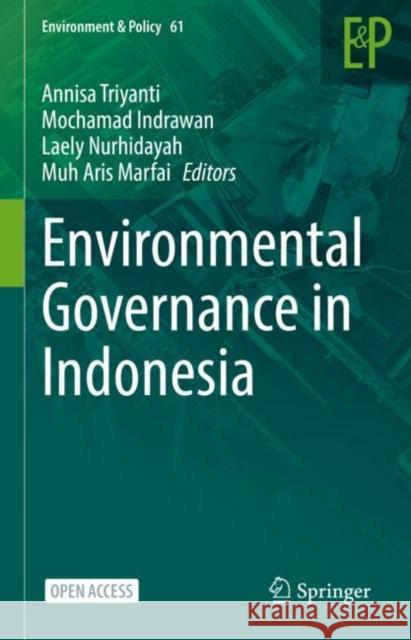
Annisa Triyanti; Mochamad Indrawan; Laely Nurhidayah
Environmental Governance in Indonesia Annisa Triyanti Mochamad Indrawan Laely Nurhidayah 9783031159039 Springer - książkaWidoczna okładka, to zdjęcie poglądowe, a rzeczywista szata graficzna może różnić się od prezentowanej.

Environmental Governance in Indonesia

ISBN-13: 9783031159039 / Angielski / Twarda / 2023 / 550 str.

Annisa Triyanti; Mochamad Indrawan; Laely Nurhidayah
cena 524,53
(netto: 499,55 VAT:  5%)

Najniższa cena z 30 dni: 501,19
Termin realizacji zamówienia:
ok. 22 dni roboczych
Dostawa w 2026 r.

Darmowa dostawa!

This open access book presents the state-of-the-art environmental governance research and practices in Indonesia. It offers a wide scope, covering different sectors (e.g., forestry, mining) and geographical landscapes (e.g., inland and coastal areas). This book engages with existing theories and frameworks, including Earth System Governance, Adaptive and Interactive Governance, among others to trigger a debate regarding the operationalization of such concepts, which are mostly developed for the Global North context. It is also our ambition to incorporate more empirical knowledge from local contexts to indicate research gaps and future directions for environmental governance research agenda to be more diverse, inclusive, and facilitate the incorporation of inter-and transdisciplinary knowledge. This book will be useful for researchers, students, practitioners, and policymakers who are interested in the field of environmental governance, especially in Indonesia.Indonesia is one of the countries with the fastest-growing economies in Asia. Indonesia is rich in natural resources but also suffers from overexploitation and environmental threats exacerbated by climate and human pressures. Along with the growing global ambitions for achieving sustainable development and capacity to adapt to current and future threats, including climate change impacts and disaster risk, Indonesia's commitments to balance development while safeguarding a good environmental status are also increasing. The challenge is on how to govern complex and systemic natural, social and governance systems while adhering to the principle of equity and justice? As it will require more than traditional hierarchical modes of governance and current regulatory instruments (i.e., law and regulations).This is an open access book.

This open access book presents the state-of-the-art environmental governance research and practices in Indonesia. It offers a wide scope, covering different sectors (e.g., forestry, mining) and geographical landscapes (e.g., inland and coastal areas). This book engages with existing theories and frameworks, including Earth System Governance, Adaptive and Interactive Governance, among others to trigger a debate regarding the operationalization of such concepts, which are mostly developed for the Global North context. It is also our ambition to incorporate more empirical knowledge from local contexts to indicate research gaps and future directions for environmental governance research agenda to be more diverse, inclusive, and facilitate the incorporation of inter-and transdisciplinary knowledge. This book will be useful for researchers, students, practitioners, and policymakers who are interested in the field of environmental governance, especially in Indonesia. Indonesia is one of the countries with the fastest-growing economies in Asia. Indonesia is rich in natural resources but also suffers from overexploitation and environmental threats exacerbated by climate and human pressures. Along with the growing global ambitions for achieving sustainable development and capacity to adapt to current and future threats, including climate change impacts and disaster risk, Indonesia's commitments to balance development while safeguarding a good environmental status are also increasing. The challenge is on how to govern complex and systemic natural, social and governance systems while adhering to the principle of equity and justice? As it will require more than traditional hierarchical modes of governance and current regulatory instruments (i.e., law and regulations).
This is an open access book.


Kategorie:
Nauka, Socjologia i społeczeństwo
Kategorie BISAC:
Political Science > Public Policy - Environmental Policy
Science > Environmental Science (see also Chemistry - Environmental)
Law > Civil Law
Wydawca:
Springer
Seria wydawnicza:
Environment & Policy
Język:
Angielski
ISBN-13:
9783031159039
Rok wydania:
2023
Dostępne języki:
Numer serii:
000246288
Ilość stron:
550
Oprawa:
Twarda
Dodatkowe informacje:
Wydanie ilustrowane

Table of content


Foreword

Dodik Ridho Nurrochmat, Arun Agrawal


Chapter 1 Introduction

Annisa Triyanti, Mochamad Indrawan, Laely Nurhidayah, Muh Aris Marfai


PART I: emerging concepts and perspectives


Chapter 2 Introducing the Pluriverse of the Anthropocene: Toward an Ontological Politics of Environmental Governance in Indonesia

Rangga Kala Mahaswa and Min Seong Kim


Chapter 3 Earth System Governance in Indonesia: An Initial Investigation

Erwin Nugraha, Mahesti Okitasari, Annisa Triyanti, Yanuardi Yanuardi


Chapter 4 Post-politicizing the Environment: Local Government Performance Assessments in Indonesia

Yogi Setya Permana, Septi Satriani, Imam Syafi’i, Pandu Yuhsina Adaba, Sari Seftiani, and Dini Suryani


PART II:  Wetlands


Chapter 5 Gender and Climate Change Vulnerability: A Case Study of a Coastal Community in Pramuka Island, The Seribu Islands

Tri Saputro and Priya Kurian


Chapter 6 Coastal Forest Re-Grabbing: A Case from Langkat, North Sumatera, Indonesia

Dedi S. Adhuri, Imam Syafi’i, Atika Zahra Rahmayanti, Intan Adhi Perdana Putri, and Mochammad Nadjib


Chapter 7 Towards Sustainable Lake Ecosystem-Based Management– Lessons Learned from Interdisciplinary Research of Cage Aquaculture Management in Lake Maninjau

Ivana Yuniarti, Clare Barnes, Klaus Glenk, and Alistair McVittie


PART III: Land and forest


Chapter 8 Community-Based Fire Management and Peatland Restoration in Indonesia

Laely Nurhidayah, Rini Astuti, Herman Hidayat, and Robert Siburian


Chapter 9 Assessing the Governance Modes of Indonesia’s Forest Management Unit

Ramli Ramadhan, Sutrisno Karim, Micah Fisher, Harsanto Mursyid, Mochamad Indrawan


Chapter 10 Biofuels Development and Indirect Deforestation

Rizky Ramadhan, Akihisa Mori, and Oekan S. Abdoellah


Chapter 11 The Dynamics of the Green Policies in Papua Land: A Political Economy Study

Yulia Indrawati Sari


Chapter 12 Environmental Governance as Knowledge Co-Production: the Emergence of Permaculture Movements in Indonesia

Maharani Hapsari


Chapter 13 Aggregation and Representation in Knowledge Coproduction: Lesson Learned from the Indonesian Sustainable Palm Oil Scheme

Faris Salman and Akihisa Mori


Part IV: Urban


Chapter 14 The Conceptual Models of Dynamic Governance Toward Sustainable Urban Water Management in Metropolitan Area

Wahyu Mulyana, Eko Prasojo, Emirhadi Suganda, dan Setyo Sarwanto Moersidik


Chapter 15 Governance by Accident:The Role of Civil Society in Shaping Urban Environmental Governance

Benny D. Setianto and Budi Widianarko


Chapter 16 Water Resources Governance in Indonesia Towards Environmental Sustainability Along with Social and Economic Development

Andi Setyo Pambudi and Trikurnianti Kusumanto


Chapter 17 Coordination Challenges Facing Effective Flood Governance in the Ciliwung River Basin

Georgina Clegg, Richard Haigh, Dilanthi Amaratunga, and Harkunti Rahayu


Chapter 18 Transformative Solutions in the Global South: Addressing Solid Waste Management Challenges in Jakarta through Participation by Civil Society Organizations?

Abeer Abdulnabi Ali, Yuliya Golbert, Abdul Fikri Angga Reksa, Michael M. Kretzer, and Stefan Schweiger


PART V: Climate


Chapter 19 Should Climate Actions Stay Amidst the Covid-19 Pandemic? A Crisis Management Governance Perspective

Nur Firdaus and Atika Zahra Rahmayanti


Chapter 20 Climate Action in a Far-Flung Archipelagic Nation: Outlining Challenges in Capacity-Building

Mahawan Karuniasa, Mochamad Indrawan, Joko Triharyanto, Dudi Ruliadi, Dicky Edwin Hindarto, Emilia Bassar, Alin Halimatussadiah, Impron, Edvin Aldrian, and Andre Wahyudi Atmoko


Chapter 21 Strategy for Sustainable Urban Climate Mitigation: Kupang City Climate Risk Assessment

Muhammad Ridwansyah, Christopher Bennett, Franky. M. S. Telupere, Philiphi de Rozari, Fadwa. R. Asfahani, Utari N. Qalbi, Achmad. F. Kanzil


Chapter 22 Local resource governance: Strategies for adapting to change

Skye-Turner Walker


Part VI: Social and technological Interventions


Chapter 23 Local Governance of Sustainability Transition in Community-scale Solar Water Pumping Systems in Indonesia

Sita Rahmani, Takehiko Murayama, Shigeo Nishikizawa, and Muhammad Sani Roychansyah


Chapter 24 Building a Sustainable Photovoltaic Innovation System in Indonesia Through Network Governance Perspective

Anugerah Yuka Asmara, AR. Rohman Taufiq Hidayat, Badrudin Kurniawan, Hideaki Ohgaki, Toshio Mitsufuji, and Jordi Cravioto Caballero


Chapter 25 Conceptual Design of Sustainable Governance by VIDEL (Virtual Dashboard of Environmentally Logistics-Port-City): a Case Study of Jakarta and Tanjung-Priok Port

M. Iman Santoso, Djoko Santoso Abi Suroso, Muhammad S. Fitriyanto, Muhammad S.P.A. Suroso, Klaus Krumme, Ani Melkonyan-Gottschalk, and Bernd Noche

Annisa Triyanti is an assistant professor at the Environmental Governance Group, Copernicus Institute of Sustainable Development, Utrecht University. Annisa holds a PhD in coastal disaster risk governance (University of Amsterdam, 2019). In her PhD research, she focused on interactive governance and governability of ecosystem-based disaster risk reduction in Indonesia and India. Annisa has 4 years of experience as a Human Geography lecturer at Universitas Gadjah Mada, Indonesia. She has conducted research on inclusive governance systems in communities at risk of facing water-related disasters in the coastal and delta areas. She has also been a global youth advocate with years of experience in youth, civil society, and young scientist engagement as a stakeholder group representative on the intergovernmental level.


Mochamad Indrawan is a researcher at the Research Center for Climate Change, Universitas Indonesia. He is a trained ecologist and conservation biologist with more than 3 decades of field experience. Indrawan's voluntary rainforest conservation work since 2007 included continuous facilitation of indigenous peoples and local communities whose joint endeavor is focused on the establishment of community conservation areas.


Laely Nurhidayah is a researcher at the Research Center for Law, the National Research and Innovation Agency (BRIN), Jakarta Indonesia. She leads the environment law and natural resources (marine and forest) research portfolios in her research centre. She was awarded her PhD in Law from Macquarie University, Australia. She published her work in many books, journals and working papers and has attended and presented papers in various international conferences.


Muh Aris Marfai is a professor in geomorphological hazard and currently serves as the Head of the Indonesian Geospatial Information Authority (Badan Informasi Geospasial-BIG). Prior to his current appointment, he was the Dean of the Faculty of Geography, Universitas Gadjah Mada (UGM) Indonesia. He received his doctoral degree in Geography with magna cum laude from Justus-Liebig- Universität, Giessen, Germany and an M.Sc in Earth System Analysis from the International Institute for Geo-Information Science and Earth Observation (ITC), The Netherlands.


This open access book presents the state-of-the-art environmental governance research and practices in Indonesia. It offers a wide scope, covering different sectors (e.g., forestry, mining) and geographical landscapes (e.g., inland and coastal areas). This book engages with existing theories and frameworks, including Earth System Governance, Adaptive and Interactive Governance, among others to trigger a debate regarding the operationalization of such concepts, which are mostly developed for the Global North context. It is also our ambition to incorporate more empirical knowledge from local contexts to indicate research gaps and future directions for environmental governance research agenda to be more diverse, inclusive, and facilitate the incorporation of inter-and transdisciplinary knowledge. This book will be useful for researchers, students, practitioners, and policymakers who are interested in the field of environmental governance, especially in Indonesia.


Indonesia is one of the countries with the fastest-growing economies in Asia. Indonesia is rich in natural resources but also suffers from overexploitation and environmental threats exacerbated by climate and human pressures. Along with the growing global ambitions for achieving sustainable development and capacity to adapt to current and future threats, including climate change impacts and disaster risk, Indonesia's commitments to balance development while safeguarding a good environmental status are also increasing. The challenge is on how to govern complex and systemic natural, social and governance systems while adhering to the principle of equity and justice? As it will require more than traditional hierarchical modes of governance and current regulatory instruments (i.e., law and regulations).


Udostępnij

Facebook - konto krainaksiazek.pl


Opinie o Krainaksiazek.pl na Opineo.pl

Partner Mybenefit

Krainaksiazek.pl w programie rzetelna firma Krainaksiaze.pl - płatności przez paypal

Czytaj nas na:

Facebook - krainaksiazek.pl
  • książki na zamówienie
  • granty
  • książka na prezent
  • kontakt
  • pomoc
  • opinie
  • regulamin
  • polityka prywatności

Zobacz:

  • Księgarnia czeska

  • Wydawnictwo Książkowe Klimaty

1997-2025 DolnySlask.com Agencja Internetowa

© 1997-2022 krainaksiazek.pl
     
KONTAKT | REGULAMIN | POLITYKA PRYWATNOŚCI | USTAWIENIA PRYWATNOŚCI
Zobacz: Księgarnia Czeska | Wydawnictwo Książkowe Klimaty | Mapa strony | Lista autorów
KrainaKsiazek.PL - Księgarnia Internetowa

Polityka prywatnosci - link
Krainaksiazek.pl - płatnośc Przelewy24
Przechowalnia Przechowalnia






