• Wyszukiwanie zaawansowane
  • Kategorie
  • Kategorie BISAC
  • Książki na zamówienie
  • Promocje
  • Granty
  • Książka na prezent
  • Opinie
  • Pomoc
  • Załóż konto
  • Zaloguj się

Enterprising Psychometrics and Poverty Reduction » książka


zaloguj się | załóż konto
Logo Krainaksiazek.pl

koszyk

konto

szukaj
topmenu
Księgarnia internetowa
Szukaj
Książki na zamówienie
Promocje
Granty
Książka na prezent
Moje konto
Pomoc
 
 
Wyszukiwanie zaawansowane
Pusty koszyk
Bezpłatna dostawa dla zamówień powyżej 20 złBezpłatna dostawa dla zamówień powyżej 20 zł

Kategorie główne

• Nauka
 [2949965]
• Literatura piękna
 [1857847]

  więcej...
• Turystyka
 [70818]
• Informatyka
 [151303]
• Komiksy
 [35733]
• Encyklopedie
 [23180]
• Dziecięca
 [617748]
• Hobby
 [139972]
• AudioBooki
 [1650]
• Literatura faktu
 [228361]
• Muzyka CD
 [398]
• Słowniki
 [2862]
• Inne
 [444732]
• Kalendarze
 [1620]
• Podręczniki
 [167233]
• Poradniki
 [482388]
• Religia
 [509867]
• Czasopisma
 [533]
• Sport
 [61361]
• Sztuka
 [243125]
• CD, DVD, Video
 [3451]
• Technologie
 [219309]
• Zdrowie
 [101347]
• Książkowe Klimaty
 [123]
• Zabawki
 [2362]
• Puzzle, gry
 [3791]
• Literatura w języku ukraińskim
 [253]
• Art. papiernicze i szkolne
 [7933]
Kategorie szczegółowe BISAC

Enterprising Psychometrics and Poverty Reduction

ISBN-13: 9781461472261 / Angielski / Miękka / 2013 / 66 str.
Bailey Klinger; Asim Khwaja; Carlos Del Carpio
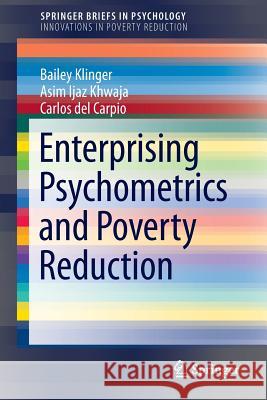
Enterprising Psychometrics and Poverty Reduction Bailey Klinger Asim Khwaja Carlos De 9781461472261 Springer - książkaWidoczna okładka, to zdjęcie poglądowe, a rzeczywista szata graficzna może różnić się od prezentowanej.

Enterprising Psychometrics and Poverty Reduction

ISBN-13: 9781461472261 / Angielski / Miękka / 2013 / 66 str.

Bailey Klinger; Asim Khwaja; Carlos Del Carpio
cena 201,72
(netto: 192,11 VAT:  5%)

Najniższa cena z 30 dni: 192,74
Termin realizacji zamówienia:
ok. 22 dni roboczych
Bez gwarancji dostawy przed świętami

Darmowa dostawa!

This book uses newly collected data with nearly 2000 observations across Africa and Latin America of SME owner/operators to examine if psychometric tools can distinguish the good ones from the bad ones. This book fully describes the development problem and how psychometric tools can help solve it. Moreover, it presents and develops the unique statistical methodologies to deploy psychometric tools for credit screening. This will be the single complete publication of the work to date by the entrepreneurial finance lab, created by Klinger & Khwaja. This work started as a research project at Harvard University's center for international development, with funding from Google.org. This work is very high profile, winning the G-20 SME Finance Challenge in 2010 (global open competition to identify the best scalable solutions to unlocking SME finance- winners honored at the G-20 summit in Seoul Korea and receiving significant funding from G-20 countries for the implementation of their models).


Kategorie:
Nauka, Psychologia
Kategorie BISAC:
Psychology > Industrial & Organizational Psychology
Business & Economics > Finance - General
Psychology > Research & Methodology
Wydawca:
Springer
Seria wydawnicza:
Springerbriefs in Psychology / Springerbriefs in Innovations
Język:
Angielski
ISBN-13:
9781461472261
Rok wydania:
2013
Wydanie:
2013
Numer serii:
000465334
Ilość stron:
66
Waga:
0.14 kg
Wymiary:
23.39 x 15.6 x 0.51
Oprawa:
Miękka
Wolumenów:
01
Dodatkowe informacje:
Bibliografia
Wydanie ilustrowane

"This book is of particularly importance for all those who are interested in the question how micro-credits can be given to individual micro-entrepreneurs in developing countries. The problem for the bank is that there is no credit-history of the micro-entrepreneur and the amount of credit is too small to warrant a detailed evaluation of a business plan. Most often there will also not be a business plan that can be evaluated.

What to do? The three economists provide a very sensible and important answer: Evaluate the person him- or herself by psychological tests. Two issues are important for paying back the loan: First the person must be able to build a good enterprise and make enough money to pay back the loan. Second, the person must be willing to pay back the loan.

Psychological research on entrepreneurship has made enough headway to provide good data for understanding which person characteristics lead to good entrepreneurial success. Moreover, there has been a long tradition to evaluate a person's integrity to understand whether somebody is willing to cheat others by not paying back a loan. The authors take these issues as their starting point and describe how they produce the results. This is practical and useful. Recently the New York Times has written a long piece on the company build by these three authors and how successful they have been in helping banks to help micro-entrepreneurs to get the resources to be able to succeed.

This is a "must-read" book for anybody who is interested to advance sustainable credits for micro-entrepreneurs."

Prof. Michael Frese, NUS Business School, Singapore

Innovations in Poverty Reduction: An Introduction.- The Development Problem.- A Psychology-Enabled Solution to small and medium-sized enterprise finance.- Methodology.- Results and Discussions.

Bailey Klinger is CEO & co-founder of the Entrepreneurial Finance Lab. He is the original co-inventor of the EFL technology, and has led both the research and business initiatives to bring that technology to the market. His previous research has centered on entrepreneurship, structural transformation, and private sector growth in developing countries, and he has been published in leading Journals such as Science and the Journal of the Economics of Transition. Bailey has performed extensive field research throughout Latin America, Africa and Asia, and consulted for the World Bank, United Nations and Inter-American Development Bank as well as various other national governments and international organizations. Bailey has a Masters in Public Administration in International Development from the Kennedy School of Government, and a PhD in Public Policy from Harvard University. 

Asim Khwaja is co-founder of EFL and Chairman of the Board. He is also professor of Public Policy at the Harvard Kennedy School of Government. His areas if interest include economic development, finance, education, political economy, institutions, and contract theory/mechanism design. His research has been published in the leading economics journals, such as the American Economic Review and the Quarterly Journal of Economics, and has received coverage media outlets such as the Economist, NY Times, Washington Post, Al-Jazeera, BBC, and CNN. Asim received BS degrees in economics and mathematics with computer science from MIT and PhD in economics from Harvard. 

Carlos del Carpio is Head of Analytics in EFL's Lima office, responsible for data quality control, analysis, and model building. Prior to joining EFL, Carlos worked for the largest commercial bank in Perú where he developed credit risk models for corporate clients using a variety of credit scoring technologies. Carlos has research experience in credit and market risk modeling, as well specialized training in financial economics and applied econometrics. He holds a B.A. in economics from Pontificia Universidad Católica del Perú.

As the deadline for the Millennium Development Goals draws near, one of the most critical--global poverty reduction--remains at best a work in progress. But as emerging markets beckon millions of aspiring business owners to set up shop, age-old barriers to funding prevent them from getting started. One answer lies in psychometrics, which  enables lenders to assess applicants' potential for success in developing their enterprises when traditional credit applications fall short.  

Enterprising Psychometrics and Poverty Reduction sets out in accessible detail this innovative approach to risk evaluation, which uses methods similar to psychometric tools used in corporate hiring. The book evaluates this approach in six financial organizations in Kenya, Colombia, Peru, and South Africa, with extensive charts and tables breaking down each program's profitability and effectiveness. Especially by eliminating disparities that prevent women from accessing credit, this assistance fuels long-range economic growth and general well-being. This concise volume: 

  • Explains the psychometric approach to credit and its methodologies.
  • Identifies core characteristics shared by successful small business owners.
  • Outlines a novel approach to credit scoring models for small businesses.
  • Reviews the relevant literature on personality and personality testing.
  • Features representative success stories.
  • Discusses implications for implementing psychometric loan technologies in banks worldwide, and its potential relationship to training programs.

Enterprising Psychometrics and Poverty Reduction offers message and methods to professionals and researchers in psychology, economics, development, and finance, especially those involved in global development, the psychology of poverty reduction, banking in emerging markets, and NGOs.


Udostępnij

Facebook - konto krainaksiazek.pl


Opinie o Krainaksiazek.pl na Opineo.pl

Partner Mybenefit

Krainaksiazek.pl w programie rzetelna firma Krainaksiaze.pl - płatności przez paypal

Czytaj nas na:

Facebook - krainaksiazek.pl
  • książki na zamówienie
  • granty
  • książka na prezent
  • kontakt
  • pomoc
  • opinie
  • regulamin
  • polityka prywatności

Zobacz:

  • Księgarnia czeska

  • Wydawnictwo Książkowe Klimaty

1997-2025 DolnySlask.com Agencja Internetowa

© 1997-2022 krainaksiazek.pl
     
KONTAKT | REGULAMIN | POLITYKA PRYWATNOŚCI | USTAWIENIA PRYWATNOŚCI
Zobacz: Księgarnia Czeska | Wydawnictwo Książkowe Klimaty | Mapa strony | Lista autorów
KrainaKsiazek.PL - Księgarnia Internetowa

Polityka prywatnosci - link
Krainaksiazek.pl - płatnośc Przelewy24
Przechowalnia Przechowalnia






