1.3 Conquest, Resistance and Translation as Conquest and Resistance
1.3.1 Conquest and Translation as Conquest
1.3.2 Resistance as an Established Term of Translation Studies
1.3.3 Redefining Resistance
1.3.4 Translation as Resistance
1.4 Translation as Conquest and Resistance: An Analytical Model
1.4.1 The Causes of Translation History
1.4.2 Aristotle’s Four Causes
1.4.3 An Analytical Model Based on Aristotle’s Four Causes
References
2 TRANSLATION AS CONQUEST AND RESISTANCE: A HISTORICAL OVERVIEW
2.1 Research on Translation as Conquest
2.2 Research on Translation as Resistance
2.3 Summary
References
3 E-C TRANSLATION AS CONQUEST IN THE LATE QING 1811-1911
3.1 Introduction
3.2 Bible Translation
3.2.1 Bible: “the Word of God”
3.2.2 “Preach the Gospel to Every Creature”
3.2.3 Terms of God: Tianzhu, Shangdi or Shen?
3.2.4 Competitive Style
3.3 Translation of Unequal Treaties 1842-1860
3.3.1 Unequal Treaties: Covenants between “Conqueror and Vanquished”
3.3.2 Translating Tributary System into Treaty System
3.3.3 Deceiving Translation of the Sino-British Unequal Treaties
3.3.3.1 Translation of the Treaty of Nanking
3.3.3.2 Translation of the Anglo-Chinese Treaty of Tientsin
3.3.4 Courteous Style 91
3.4 Summary
References
4 E-C TRANSLATION AS RESISTANCE IN THE LATE QING 1811-1911
4.1 Introduction
4.2 Translation of Western Humanities
4.2.1 Western Humanities: Key to China’s “Wealth and Power”
4.2.2 Tianyanlun: Towards “Self-Strengthening and Race Preservation”
4.2.3 Yan Fu’s Strategy: Making Shifts
4.2.3.1 Shift to “The Weak are often Devoured by the Strong”
4.2.3.2 Shift to “The People Who are United Tend to Survive”
4.2.4 Elegant Style
4.3 Translation of Western Fiction
4.3.1 Fiction: “An Incredible Power to Dominate the Way of Man”
4.3.2 Rendering Uncle Tom’s Cabin for “Our Race is on the Verge of being Slaved”
4.3.3 Lin Shu’s Strategies: De-Christianization and Subjectivation
4.3.3.1 De-Christianization
4.3.3.2 Subjectivation
4.3.4 Gracious Style
4.4 Summary
References:
5 CONCLUSIONS
References
Xiaojia Huang is Associate Professor and Chair of Department of Translation Studies, South China Normal University. He holds a Ph.D. in translatology from Guangdong University of Foreign Studies. His research interests include literary translation, translation history and Western translation theory. He is a member of the editorial board of English Language Teaching and the author of Translating the Style of the Adventures of Huckleberry Finn: A Functionalist Approach. He has published in journals such as Chinese Translators Journal and East Journal of Translation. He has coauthored a paper in Chinese Translators Journal (January 2016), which has drawn increasing attention to the importance of constructing case base for translation studies.
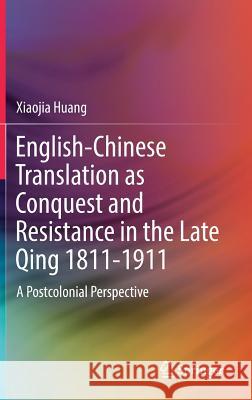
This book examines how translation facilitated the Western conquest of China and how it was in turn employed by the Chinese as a weapon to resist the invasion in the late Qing 1811-1911. It brings out the question on the role of translation as part of the Western conquest of Late Qing China, with special attention drawn to the deceptions and manipulations in the translation of the Sino-foreign unequal treaties signed during 1840-1911. The readers will benefit from the assertion that translation did not remain innocent, but rather became intermingled with power abuses in the Chinese milieu as well.