Engineering Physics of High-Temperature Materials: Metals, Ice, Rocks, and Ceramics » książka





Engineering Physics of High-Temperature Materials: Metals, Ice, Rocks, and Ceramics
ISBN-13: 9781119420484 / Angielski / Twarda / 2022 / 432 str.
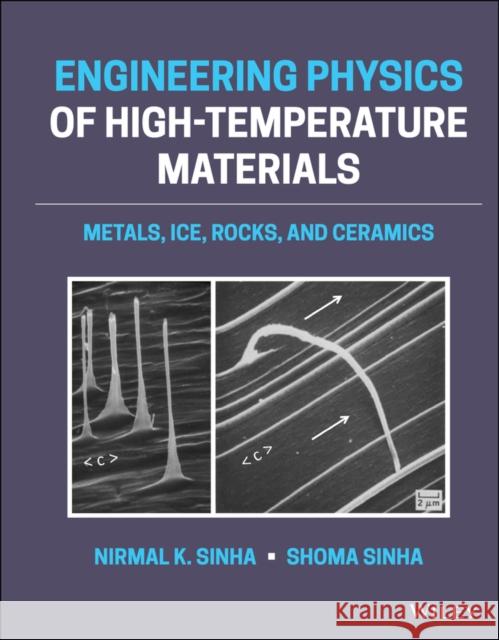
Engineering Physics of High-Temperature Materials: Metals, Ice, Rocks, and Ceramics
ISBN-13: 9781119420484 / Angielski / Twarda / 2022 / 432 str.
(netto: 811,50 VAT: 5%)
Najniższa cena z 30 dni: 843,36
ok. 30 dni roboczych
Dostawa w 2026 r.
Darmowa dostawa!
Acknowledgments xiiiEngineering Physics of High-Temperature Materials xv1 Importance of a Unified Model of High-Temperature Material Behavior 11.1 The World's Kitchens - The Innovation Centers for Materials Development 11.1.1 Defining High Temperature Based on Cracking Characteristics 41.2 Trinities of Earth's Structure and Cryosphere 71.2.1 Trinity of Earth's Structure 71.2.2 Trinity of Earth's Cryospheric Regions 71.3 Earth's Natural Materials (Rocks and Ice) 81.3.1 Ice: A High-Temperature Material 91.3.2 Ice: An Analog to Understand High-Temperature Properties of Solids 101.4 Rationalization of Temperature: Low and High 121.5 Deglaciation and Earth's Response 121.6 High-Temperature Deformation: Time Dependency 131.6.1 Issues with Terminology: Elastic, Plastic, and Viscous Deformation 131.6.2 Elastic, Delayed Elastic, and Viscous Deformation 131.7 Strength of Materials 161.8 Paradigm Shifts 181.8.1 Paradigm Shift in Experimental Approach 181.8.2 Breaking Tradition for Creep Testing 191.8.3 Exemplification the Novel Approach 191.8.4 Romanticism for a Constant-Structure Creep Test 23References 252 Nature of Crystalline Substances for Engineering Applications 292.1 Basic Materials Classification 302.2 Solid-state Materials 312.2.1 Structure of Crystalline Solids 312.2.2 Structure of Amorphous Solids 332.3 General Physical Principles 342.3.1 Solidification of Materials 342.3.2 Phase Diagrams 352.3.3 Crystal Imperfections 372.4 Glass and Glassy Phase 402.4.1 Glass Transition 402.4.2 Structure of Real Glass 412.4.3 Composition of Standard Glass 412.4.4 Thermal Tempering 422.4.5 Material Characteristics 432.5 Rocks: The Most Abundant Natural Polycrystalline Material 442.5.1 Sedimentary Rocks 442.5.2 Metamorphic Rocks 452.5.3 Igneous Rocks 452.6 Ice: The Second Most Abundant Natural Polycrystalline Material 452.7 Ceramics 472.8 Metals and Alloys 482.8.1 Iron-base Alloys 482.8.2 Nickel-base Alloys 502.8.3 Titanium-base Alloys 532.8.4 Mechanical Metallurgy 542.9 Classification of Solids Based on Mechanical Response at High Temperatures 55References 563 Forensic Physical Materialogy 593.1 Introduction 593.1.1 Material Characterization 603.2 Polycrystalline Solids and Crystal Defects 613.2.1 Etch-Pitting Technique - A Powerful Tool 633.3 Structure and Texture of Natural Hexagonal Ice, Ih 673.4 Section Preparation for Microstructural Analysis 693.4.1 Thin Sectioning of Ice 693.4.2 Large 300mm Diameter Polariscope 693.4.3 Sectioning for Forensic Analysis of Compression Failure 703.5 Etching of Prepared Section Surfaces 713.5.1 Surface Etching 723.6 Sublimation Etch Pits in Ice, Ih 723.7 Etch-Pitting Technique for Dislocations 753.7.1 Simultaneous Etching and Replicating 763.7.2 Etching Processes and Their Applications 773.8 Chemical Etching and Replicating of Ice Surfaces 793.9 Displaying Dislocation Climb by Etching 813.10 Thermal Etching: An Unexploited Materialogy Tool 82References 884 Test Techniques and Test Systems 914.1 On the Strength of Materials and Test Techniques 914.1.1 Issues with Stress-Strain (sigma-epsilon) Diagrams at High Temperatures 934.1.2 Fundamentals of Displacement Rate, Strain Rate, and Stress Rate Tests 954.1.3 Time - An Important Parameter at High Temperatures 964.2 Static Modulus and Dynamic Elastic Modulus 974.3 Thermal Expansion Over a Wide Range of Temperature 974.4 Creep and Fracture Strength 984.5 Bending Tests 994.5.1 Three-Point Bending 994.5.2 Four-Point Bending 994.5.3 Cantilever Beam Bending 1024.6 Compression Tests - Uniaxial, Biaxial, and Triaxial 1034.6.1 Uniaxial Compression Tests 1034.6.2 Biaxial or Confined Compression Tests 1034.6.3 Triaxial or Multiaxial Compression and Tension Tests 1034.7 Tensile and/or Compression Test System 1044.7.1 Tests with Single Top-Lever Loading Frame 1044.7.2 Universal Testing Machine and Systems: Introduction to SRRT Methodology 1054.8 Stress Relaxation Tests (SRTs) 1074.8.1 Necessity for Stress Relaxation Properties 1084.8.2 Basic Principle of SRTs 1094.9 Cyclic Fatigue 1104.9.1 Low-Cycle Fatigue (LCF) and High-Cycle Fatigue (HCF Tests) 1104.9.2 Uncharted Characteristics of Delayed Elasticity in Cyclic Loading 1124.9.3 Cyclic Loading of Snow and Thermal Cycling on Asphalt Concrete 1134.10 Acoustic Emission (AE) and/or Microseismic Activity (MA) 1144.11 Tempering of Structural and Automotive Glasses 1164.12 Specimen Size and Geometry: Depending on Material Grain Structure 1194.13 In Situ Borehole Tests: Inspirations from Rock Mechanics 119References 1235 Creep Fundamentals 1295.1 Overview 1305.2 On Rheology and Rheological Terminology 1325.3 Forms of Creep and Deformation Maps 1325.3.1 Generalization for Polycrystalline Materials 1325.3.2 Nabarro-Herring Creep 1335.3.3 Coble Creep 1335.3.4 Harper-Dorn Creep 1335.3.5 Ashby-Verrall Creep 1335.3.6 Deformation Mechanism Maps 1345.4 Grain-Boundary Shearing or Sliding 1345.5 Creep Curves - Classical Primary, Secondary, and Tertiary Descriptions 1355.5.1 Elasticity and Annealing of Glass 1365.5.2 Phenomenological Rheology of Glass 1375.5.3 Normalized Creep - Another Presentation of Rheology of Glass 1405.6 Phenomenology of Primary Creep in Metals, Ceramics, and Rocks 1445.7 Primary Creep in Ice: Launching SRRT Technique and EDEV Model 1485.8 Grain-Boundary Shearing (gbs) and Grain-Size Dependent Delayed Elasticity 1515.9 Generalization of EDEV Model: Introduction of Grain-Size Effect 1535.10 Logarithmic Primary Creep: An Alternative Form of the EDEV Model 1575.11 Shifting Paradigms: Emphasizing Primary Creep of Polycrystalline Materials 1585.12 SRRT for Primary Creep and EDEV Model of a Titanium-Base Superalloy (Ti-6246) 1585.13 SRRT for Primary Creep and EDEV Model for a Nickel-Base Superalloy (Waspaloy) 1625.14 SRRT for Primary Creep of a Nickel-Rich Iron-Base Alloy (Discaloy) 1695.15 SRRTs for Primary Creep and EDEV Model of a Nickel-Base Superalloy (IN-738LC) 1705.16 EDEV-Based Strain-Rate Sensitivity of High-Temperature Yield Strength 1755.16.1 Constant Strain-Rate Yield 1765.16.2 Yield Strength of Ti-6246 at 873 K (0.45 Tm) 1785.16.3 Yield Strength of Waspaloy at 1005 K (0.62 Tm) 1785.17 Single-Crystal (SX) Superalloy Delayed Elasticity and gamma/gamma Interface Shearing 1855.18 Creep, Steady-State Tertiary Stage, and Elasto-Viscous (EV) Model for Single Crystals 1915.19 Creep Fracture and EV Model for CMSX-10 SXs 1945.20 Fracture and Inhomogeneous Deformation 1985.21 Dynamic Steady-State Tertiary Creep of Several Nickel-Base SXs 2005.21.1 MAR-M-247 Single Crystal 2005.21.2 CMSX-3 Single Crystal 2015.21.3 CMSX-4 Single Crystal with Rhenium 2025.21.4 CMSX-4 Single Crystal 2025.21.5 TMS-75 Single Crystal 2035.21.6 SRR99 Single Crystal 205References 2056 Phenomenological Creep Failure Models 2156.1 Creep and Creep Failure 2156.2 Steady-State Creep 2166.3 Commonly Used Creep Experiments and Strength Tests 2176.3.1 Constant Stress and Constant Deformation (CD) Rate Tests 2176.3.2 A Short Glimpse of Creep Tests 2206.3.3 Power Law for Creep 2206.3.4 Larsen and Miller Concept 2236.3.5 Monkman and Grant (M-G) Relationship 2236.3.6 Rabotnov-Kachanov Concept for Creep Fracture 2246.3.7 Breaking Tradition - theta-Projection Concept 2246.4 Modeling Very Long-Term Creep Rupture from Short-Term Tests 2256.4.1 Traditional Approaches for Power-Generation Operations 2256.4.2 Captivating and Entrenched Focus on Minimum Creep Rate 2266.5 High-Temperature Low-Cycle Fatigue (HT-LCF) and Dwell Fatigue 2266.6 Crucial Tests on Rate Sensitivity of High-Temperature Strength 2276.7 Rational Approach Inspired by the Principle of "Hindsight 20/20" 232References 2337 High-Temperature Grain-Boundary Embrittlement and Creep 2377.1 Fracture and Material Failure 2377.1.1 Griffith's Model for Crack Propagation 2397.1.2 Crack Nucleation Mechanisms at Low Homologous Temperatures 2407.1.3 Acoustic Emissions and Cracks 2417.1.4 A Novel Treatment of AE and Cracks in Ice Engineering 2427.2 Grain Size Effects on Strength 2457.2.1 Popular Low-Temperature Concept of Strength 2457.2.2 Problems with Estimating Grain Size 2457.2.3 Inapplicability of the Hall-Petch Relation at High Temperatures 2467.3 Grain-Boundary Shearing (gbs) Induced Crack Initiation 2467.3.1 Groundwork for a High-Temperature Crack-Initiation Hypothesis 2487.3.2 Gold's Classic Studies on Creep Cracking by Visual Observations 2497.3.3 Forensic Microstructural Examinations of First Creep Cracks 2517.3.4 First Grain-Facet-Sized Cracks and Critical Delayed Elastic Criterion 2527.3.5 Critical Time and Stress for Onset of Creep Fracture 2547.3.6 Critical Strain for First Cracks (or Fracture Failure) 2557.3.7 Apparent Activation Energy for First Cracks and Fracture 2577.3.8 Kinetics of Creep Cracking 258References 2608 Microstructure and Crack-Enhanced Elasto - Delayed-Elastic - Viscous Models 2658.1 Physics-Based Holistic Model Approach 2658.1.1 On Transient Creep and the Shape of Creep Curves 2668.1.2 On "Limiting Transient Creep Strain" (epsilonT) 2678.1.3 On the Traditions of Creep Testing and Shifting Paradigms 2688.2 Kinetics of Microcracking and Structural Damage 2718.3 Microcrack-Enhanced EDEV Model 2718.4 EDEV-Based Algorithm for Constant Strain Rate, Encompassing Cracking 2738.4.1 EDEV-Based Stress-Strain Diagrams 2758.5 Constant Stress, Crack-Enhanced Creep: EDEV Predictions 2798.5.1 Apparent Brittle-Ductile Transition in Constant Stress Creep 2818.5.2 Power-Law Breakdown for Minimum Creep Rate 2838.5.3 Grain-Size Effects on Creep with Crack Formation 2848.5.4 Creep Dilatation in Polycrystalline Columnar-Grained and Equiaxed Solids 2878.5.5 Crack Damage at Minimum Creep Rate and Upper Yield 2918.5.6 Strain-Rate Sensitivity of Initial Deformation, Dilatancy, and Residual Strength 2938.6 Cyclic Fatigue 2938.6.1 Low-Cycle Constant Strain Rate Loading 2948.6.2 Low-Cycle, High-Strain Fatigue: Repeated Constant Load 2958.7 Crack Healing or Closure of w-Type Voids Generating r-Type Cavities 295References 2989 Stress Relaxation at High Temperatures 3039.1 The Role of Stress Relaxation Tests at High Temperatures 3039.1.1 Traditional SRTs 3049.1.2 Phenomenology of Stress Relaxation 3069.1.3 Capabilities and Inadequacies of SRT for Creep Estimation 3089.1.4 Rationalization of SRT Processes 3099.1.5 SRT on Coarse-Grained Materials 3109.1.6 New Approaches for Examining Applicability of SRT for Fine-Grained Materials 3139.1.7 Grain-Size-Based Optimization of Initial Strain, epsilon0, for SRT 3179.2 Constitutive Equations without Effect of Grain Size 3189.2.1 Constitutive Equation for Uniaxial Creep at High Temperatures 3189.2.2 SR Based on Constitutive Equation 3219.2.3 Type-A Engineering Prediction for SRT 3219.3 Temperature and Grain-Size Effects on SR 3279.3.1 EDEV Constitutive Equation Incorporating Grain Size and Temperature 3279.3.2 EDEV-Based SRT Algorithm for Grain-Size and Temperature Dependency 3289.3.3 Lack of Grain-Size-Dependent Data on Primary Creep of Engineering Materials 3289.4 Forecasting Grain-Size Effects on SR in Pure Ice Based on EDEV Equation 3289.4.1 Basis of Calculation for Ice 3299.4.2 Effect of Strain, epsilon0 (Constant Temperature and Grain Size) 3299.4.3 Effect of Temperature (Constant Strain and Grain Size) 3319.4.4 Effect of Grain Size (Constant Strain and Temperature) 3319.4.5 Strain (epsilon0) Dependence of Strain Components (Constant Temperature and Grain Size) 3329.4.6 Grain-Size Effect on Strain Components During SRT (Constant Strain and Temperature) 3329.4.7 Comments on SRTs Related to Ice and Field Experience 3329.5 High-Temperature Forming, Delayed Spring-Back, and Grain-Size Effects on SR in Metals 335References 33910 Ice Age and Intraglacial Depression and Postglacial Rebound of Earth's Crust 34310.1 Tectonic Plates, Lake Ice, and High-Temperature Materials: What Is the Connection? 34310.2 On Glaciers and Oceanic Ice Cover: Past and Present 34510.2.1 Rise of Canada - Postglacial Uplift 34610.2.2 Postglacial Adjustments of North America's Landscape 34610.3 Dow's Lake Studies 34710.3.1 Dow's Lake Ice Sheet: Crowd Load/Unload During Winter of 1985 34710.3.2 Swimming Pool Loading Experiment on Dow's Lake Ice in 1986 35110.4 Elasto - Delayed-Elastic (EDE) Theory for Plates 356References 36211 Plate Tectonics and Polar Sea Ice 36511.1 Retrospective Introduction 36511.2 Earth and Plate Tectonics 36811.2.1 On Sea Ice: Analog for Tectonic Plates 36911.2.2 Trinity of Tectonic Plates 37111.2.3 Trinity of Tectonic Plate Boundaries 37111.3 Scale of Observations 37211.3.1 Messengers of Earth Below and Sky Above 37611.4 Vertical Temperature Profiles of Earth and Ice Sheet 37811.5 Time-Temperature Shift Function 38111.6 Nonlinear, Grain-Size-Dependent Delayed Elasticity (Anelasticity) of Mantle 38211.7 Stress Field of Earth's Crust 38511.8 Koyna and Warna Dams in India and Reservoir-Triggered Seismicity (RTS) 38611.9 Movement of Tectonic Plates, Indentation, and Fracture 39111.10 Looking Forward 394References 395Index 401
Nirmal K. Sinha, Retired, Institute for Aerospace Research, National Research Council of Canada, Ottawa, Ontario, Canada.Shoma Sinha, Queen's Partnerships and Innovation, Queen's University, Kingston, Ontario, Canada.




Czytaj nas na:
1997-2025 DolnySlask.com Agencja Internetowa
KrainaKsiazek.PL - Księgarnia Internetowa


