• Wyszukiwanie zaawansowane
  • Kategorie
  • Kategorie BISAC
  • Książki na zamówienie
  • Promocje
  • Granty
  • Książka na prezent
  • Opinie
  • Pomoc
  • Załóż konto
  • Zaloguj się

Engineering Haptic Devices » książka


zaloguj się | załóż konto
Logo Krainaksiazek.pl

koszyk

konto

szukaj
topmenu
Księgarnia internetowa
Szukaj
Książki na zamówienie
Promocje
Granty
Książka na prezent
Moje konto
Pomoc
 
 
Wyszukiwanie zaawansowane
Pusty koszyk
Bezpłatna dostawa dla zamówień powyżej 20 złBezpłatna dostawa dla zamówień powyżej 20 zł

Kategorie główne

• Nauka
 [2946600]
• Literatura piękna
 [1856966]

  więcej...
• Turystyka
 [72221]
• Informatyka
 [151456]
• Komiksy
 [35826]
• Encyklopedie
 [23190]
• Dziecięca
 [619653]
• Hobby
 [140543]
• AudioBooki
 [1577]
• Literatura faktu
 [228355]
• Muzyka CD
 [410]
• Słowniki
 [2874]
• Inne
 [445822]
• Kalendarze
 [1744]
• Podręczniki
 [167141]
• Poradniki
 [482898]
• Religia
 [510455]
• Czasopisma
 [526]
• Sport
 [61590]
• Sztuka
 [243598]
• CD, DVD, Video
 [3423]
• Technologie
 [219201]
• Zdrowie
 [101638]
• Książkowe Klimaty
 [124]
• Zabawki
 [2473]
• Puzzle, gry
 [3898]
• Literatura w języku ukraińskim
 [254]
• Art. papiernicze i szkolne
 [8170]
Kategorie szczegółowe BISAC

Engineering Haptic Devices

ISBN-13: 9783031045387 / Angielski / Miękka / 2022 / 687 str.
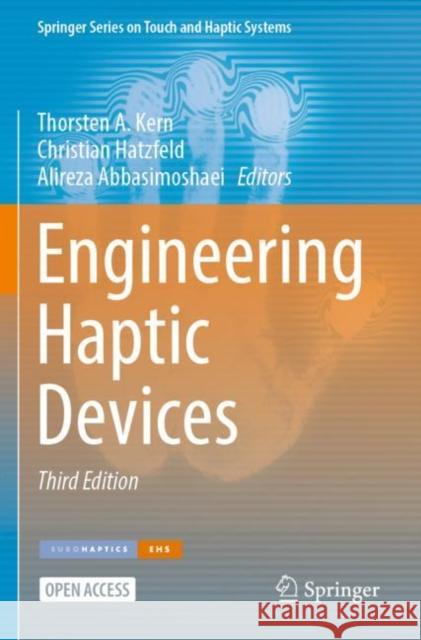
Thorsten A. Kern; Christian Hatzfeld; Alireza Abbasimoshaei
Engineering Haptic Devices Thorsten A. Kern Christian Hatzfeld Alireza Abbasimoshaei 9783031045387 Springer - książkaWidoczna okładka, to zdjęcie poglądowe, a rzeczywista szata graficzna może różnić się od prezentowanej.

Engineering Haptic Devices

ISBN-13: 9783031045387 / Angielski / Miękka / 2022 / 687 str.

Thorsten A. Kern; Christian Hatzfeld; Alireza Abbasimoshaei
cena 161,36 zł
(netto: 153,68 VAT:  5%)

Najniższa cena z 30 dni: 154,18 zł
Termin realizacji zamówienia:
ok. 22 dni roboczych
Bez gwarancji dostawy przed świętami

Darmowa dostawa!
inne wydania

This is an open access book.In this third edition ofEngineering Haptic Devicesthe software part was rewritten from scratch and now includes even more details on tactile and texture interaction modalities. The kinematics section was improved to extend beyond a pure knowledge explanation to a comprehensive guideline on how to actually do and implement haptic kinematic functions. The control section was reworked incorporating some hands-on experience on control implementation on haptic systems. The system, actuator and sensor design chapters were updated to allow easier access to the content.This book is written for students and engineers faced with the development of a task-specific haptic system. Now 14 years after its first edition, it is still a reference for the basics of haptic interaction and existing haptic systems and methods as well as an excellent source of information for technical questions arising in the design process of systems and components.Following a system engineering approach, it is divided into two parts with Part I containing background and reference information as a knowledge basis. Typical application areas of haptic systems and a thorough analysis of haptics as an interaction modality are introduced. The role of users in the design of haptic systems is discussed and relevant design and development stages are outlined. Part II presents all related challenges in the design of haptic systems including general system architecture and control structures, kinematics, actuator principles and all types of sensors you may encounter doing haptic device development. Beside these hardware and mechanical topics, further chapters examine state-of-the-art interfaces to operate the devices, and hardware and software development to push haptic systems to their limits.


This is an open access book.In this third edition of Engineering Haptic Devices the software part was rewritten from scratch and now includes even more details on tactile and texture interaction modalities. The kinematics section was improved to extend beyond a pure knowledge explanation to a comprehensive guideline on how to actually do and implement haptic kinematic functions. The control section was reworked incorporating some hands-on experience on control implementation on haptic systems. The system, actuator and sensor design chapters were updated to allow easier access to the content.This book is written for students and engineers faced with the development of a task-specific haptic system. Now 14 years after its first edition, it is still a reference for the basics of haptic interaction and existing haptic systems and methods as well as an excellent source of information for technical questions arising in the design process of systems and components. Following a system engineering approach, it is divided into two parts with Part I containing background and reference information as a knowledge basis. Typical application areas of haptic systems and a thorough analysis of haptics as an interaction modality are introduced. The role of users in the design of haptic systems is discussed and relevant design and development stages are outlined. Part II presents all related challenges in the design of haptic systems including general system architecture and control structures, kinematics, actuator principles and all types of sensors you may encounter doing haptic device development. Beside these hardware and mechanical topics, further chapters examine state-of-the-art interfaces to operate the devices, and hardware and software development to push haptic systems to their limits.

Kategorie:
Informatyka
Kategorie BISAC:
Computers > User Interfaces
Technology & Engineering > Automation
Computers > Artificial Intelligence - Expert Systems
Wydawca:
Springer
Seria wydawnicza:
Springer Touch and Haptic Systems
Język:
Angielski
ISBN-13:
9783031045387
Rok wydania:
2022
Dostępne języki:
Numer serii:
000904315
Ilość stron:
687
Oprawa:
Miękka

Foreword.- Preface.- List of Contributors.- Part I Basics.- Motivation and Application of Haptic Systems.- Haptics as an Interaction Modality.- The User’s Role in Haptic System Design.- Development of Haptic Systems.- Part II Designing Haptic Systems.- Identification of Requirements.- General System Structures.- Control of Haptic Systems.- Kinematic Design.- Actuator Design.- Sensor Design.- Interface Design.- Haptic Software Design.- Evaluation of Haptic Systems.- Examples of Haptic Systems Development.- Conclusion.- Impedance Values of Grasps.- Appendix.

Thorsten A. Kern received his Dipl.-Ing. and Dr.-Ing. degrees from Darmstadt University of Technology (TUDA), Germany in the fields of actuator and sensor development for medical human-machine-interfaces (HMIs) in applications like minimally-invasive surgery and catheterizations. He is currently a director at Hamburg University of Technology, Germany, of the Institute for Mechatronics in Mechanics. He previously worked in Automotive Industry at Continental as a R&D manager for interior components, leading a team of 300 engineers worldwide. He joined Continental in 2008 covering various functions with increasing range of responsibility in actuator development, motor-development and active haptic device development before shifting towards R&D management and product-management on Head-Up-Displays. Between 2006 and 2008 he was working in parallel in a startup focussing on medical interventions and was finalizing the 1st edition of „Engineering Haptic Devices“. He joined Hamburg University in January 2019. His interests are specifically focussed on all types of electromagnetic sensors and actuators and their system-integration towards larger motor- or sensor-systems in high-dynamic applications.


Christian Hatzfeld joined the Institute of Electromechanical Design of Technische Universität Darmstadt as a research and teaching assistant in 2008 working in the group of (Measurement and Sensor Technologies) of Prof. Dr.-Ing. habil Roland Wertschützky. He received his doctoral degree in 2013 for a work about the perception of vibrotactile forces. Then he was the leader of the “Haptic Systems” group until his death in 2018. His research interests included development and design methods for task-specific haptic systems and the utilization of human perception properties to alleviate the technical design. He was the main editor of edition 2 of Engineering Haptic Devices and contributed significantly to a large number of chapters specifically focussing on psychophysical topics.

Alireza Abbasimoshaei is currently a researcher assistant at the Institute for Mechatronics in Mechanics at the Hamburg University of Technology in Germany. Before joining iMEK, he designed and built four robots and controlled them. The last one was at the Technical University of Braunschweig in Germany. He filed two patents for rehabilitation devices and sold a finger rehabilitation robot he developed to a hospital partner. He also developed a new control system for rehabilitation robots in the field of control. He is an expert in mechatronic system design with special emphasis on mechanical and control system design.


This is an open access book.

In this third edition of Engineering Haptic Devices the software part was rewritten from scratch and now includes even more details on tactile and texture interaction modalities. The kinematics section was improved to extend beyond a pure knowledge explanation to a comprehensive guideline on how to actually do and implement haptic kinematic functions. The control section was reworked incorporating some hands-on experience on control implementation on haptic systems. The system, actuator and sensor design chapters were updated to allow easier access to the content.

This book is written for students and engineers faced with the development of a task-specific haptic system. Now 14 years after its first edition, it is still a reference for the basics of haptic interaction and existing haptic systems and methods as well as an excellent source of information for technical questions arising in the design process of systems and components.

Following a system engineering approach, it is divided into two parts with Part I containing background and reference information as a knowledge basis. Typical application areas of haptic systems and a thorough analysis of haptics as an interaction modality are introduced. The role of users in the design of haptic systems is discussed and relevant design and development stages are outlined. Part II presents all related challenges in the design of haptic systems including general system architecture and control structures, kinematics, actuator principles and all types of sensors you may encounter doing haptic device development. Beside these hardware and mechanical topics, further chapters examine state-of-the-art interfaces to operate the devices, and hardware and software development to push haptic systems to their limits.




Udostępnij

Facebook - konto krainaksiazek.pl


Opinie o Krainaksiazek.pl na Opineo.pl

Partner Mybenefit

Krainaksiazek.pl w programie rzetelna firma Krainaksiaze.pl - płatności przez paypal

Czytaj nas na:

Facebook - krainaksiazek.pl
  • książki na zamówienie
  • granty
  • książka na prezent
  • kontakt
  • pomoc
  • opinie
  • regulamin
  • polityka prywatności

Zobacz:

  • Księgarnia czeska

  • Wydawnictwo Książkowe Klimaty

1997-2025 DolnySlask.com Agencja Internetowa

© 1997-2022 krainaksiazek.pl
     
KONTAKT | REGULAMIN | POLITYKA PRYWATNOŚCI | USTAWIENIA PRYWATNOŚCI
Zobacz: Księgarnia Czeska | Wydawnictwo Książkowe Klimaty | Mapa strony | Lista autorów
KrainaKsiazek.PL - Księgarnia Internetowa

Polityka prywatnosci - link
Krainaksiazek.pl - płatnośc Przelewy24
Przechowalnia Przechowalnia



