• Wyszukiwanie zaawansowane
  • Kategorie
  • Kategorie BISAC
  • Książki na zamówienie
  • Promocje
  • Granty
  • Książka na prezent
  • Opinie
  • Pomoc
  • Załóż konto
  • Zaloguj się

Energy Scavenging for Wireless Sensor Networks: With Special Focus on Vibrations » książka


zaloguj się | załóż konto
Logo Krainaksiazek.pl

koszyk

konto

szukaj
topmenu
Księgarnia internetowa
Szukaj
Książki na zamówienie
Promocje
Granty
Książka na prezent
Moje konto
Pomoc
 
 
Wyszukiwanie zaawansowane
Pusty koszyk
Bezpłatna dostawa dla zamówień powyżej 20 złBezpłatna dostawa dla zamówień powyżej 20 zł

Kategorie główne

• Nauka
 [2946600]
• Literatura piękna
 [1856966]

  więcej...
• Turystyka
 [72221]
• Informatyka
 [151456]
• Komiksy
 [35826]
• Encyklopedie
 [23190]
• Dziecięca
 [619653]
• Hobby
 [140543]
• AudioBooki
 [1577]
• Literatura faktu
 [228355]
• Muzyka CD
 [410]
• Słowniki
 [2874]
• Inne
 [445822]
• Kalendarze
 [1744]
• Podręczniki
 [167141]
• Poradniki
 [482898]
• Religia
 [510455]
• Czasopisma
 [526]
• Sport
 [61590]
• Sztuka
 [243598]
• CD, DVD, Video
 [3423]
• Technologie
 [219201]
• Zdrowie
 [101638]
• Książkowe Klimaty
 [124]
• Zabawki
 [2473]
• Puzzle, gry
 [3898]
• Literatura w języku ukraińskim
 [254]
• Art. papiernicze i szkolne
 [8170]
Kategorie szczegółowe BISAC

Energy Scavenging for Wireless Sensor Networks: With Special Focus on Vibrations

ISBN-13: 9781402076633 / Angielski / Twarda / 2003 / 212 str.
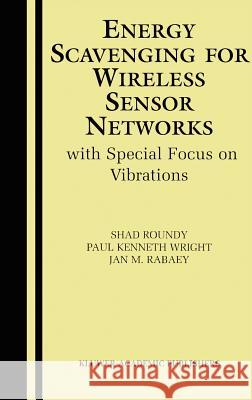
Shad Roundy; Paul Kenneth Wright; Jan M. Rabaey
Energy Scavenging for Wireless Sensor Networks: With Special Focus on Vibrations Roundy, Shad 9781402076633 Springer - książkaWidoczna okładka, to zdjęcie poglądowe, a rzeczywista szata graficzna może różnić się od prezentowanej.

Energy Scavenging for Wireless Sensor Networks: With Special Focus on Vibrations

ISBN-13: 9781402076633 / Angielski / Twarda / 2003 / 212 str.

Shad Roundy; Paul Kenneth Wright; Jan M. Rabaey
cena 806,99 zł
(netto: 768,56 VAT:  5%)

Najniższa cena z 30 dni: 771,08 zł
Termin realizacji zamówienia:
ok. 22 dni roboczych
Bez gwarancji dostawy przed świętami

Darmowa dostawa!
inne wydania

The vast reduction in size and power consumption of CMOS circuitry has led to a large research effort based around the vision of wireless sensor networks. The proposed networks will be comprised of thousands of small wireless nodes that operate in a multi-hop fashion, replacing long transmission distances with many low power, low cost wireless devices. The result will be the creation of an intelligent environment responding to its inhabitants and ambient conditions. Wireless devices currently being designed and built for use in such environments typically run on batteries. However, as the networks increase in number and the devices decrease in size, the replacement of depleted batteries will not be practical. The cost of replacing batteries in a few devices that make up a small network about once per year is modest. However, the cost of replacing thousands of devices in a single building annually, some of which are in areas difficult to access, is simply not practical. Another approach would be to use a battery that is large enough to last the entire lifetime of the wireless sensor device. However, a battery large enough to last the lifetime of the device would dominate the overall system size and cost, and thus is not very attractive. Alternative methods of powering the devices that will make up the wireless networks are desperately needed.


Kategorie:
Technologie
Kategorie BISAC:
Computers > Logic Design
Technology & Engineering > Electronics - General
Technology & Engineering > Engineering (General)
Wydawca:
Springer
Język:
Angielski
ISBN-13:
9781402076633
Rok wydania:
2003
Wydanie:
2004
Ilość stron:
212
Waga:
0.52 kg
Oprawa:
Twarda
Wolumenów:
01
Dodatkowe informacje:
Bibliografia
Wydanie ilustrowane

1 Introduction.- 1. Energy Storage.- 2. Power Distribution.- 3. Power scavenging.- 4. Summary of potential power sources.- 5. Overview of Vibration-to-Electricity Conversion Research.- 2 Vibration Sources and Conversion Model.- 1. Types of Vibrations Considered.- 2. Characteristics of Vibrations Measured.- 3. Generic Vibration-to-Electricity Conversion Model.- 4. Efficiency of Vibration-to-Electricity Conversion.- 3 Comparison of Methods.- 1. Electromagnetic (Inductive) Power Conversion.- 2. Electrostatic (Capacitive) Power Conversion.- 3. Piezoelectric Power Conversion.- 4. Comparison of Energy Density of Converters.- 5. Summary of Conversion Mechanisms.- 4 Piezoelectric Converter Design.- 1. Basic Design Configuration.- 2. Material Selection.- 3. Analytical Model for Piezoelectric Generators.- 4. Discussion of Analytical Model for Piezoelectric Generators.- 5. Initial Prototype and Model Verification.- 6. Design Optimization.- 7. Analytical Model Adjusted for a Capacitive Load.- 8. Discussion of Analytical Model Changes for Capacitive Load.- 9. Optimization for a Capacitive Load.- 10. Conclusions.- 5 Piezoelectric Converter Test Results.- 1. Implementation of Optimized Converters.- 2. Resistive load tests.- 3. Discussion of resistive load tests.- 4. Capacitive load tests.- 5. Discussion of capacitive load test.- 6. Results from testing with a custom designed RF transceiver.- 7. Discussion of results from custom RF transceiver test.- 8. Results from test of complete wireless sensor node.- 9. Discussion of results from complete wireless sensor node.- 10. Conclusions.- 6 Electrostatic Converter Design.- 1. Explanation of concept and principle of operation.- 2. Electrostatic Conversion Model.- 3. Exploration of design concepts and device specific models.- 4. Comparison of design concepts.- 5. Design Optimization.- 6. Flexure design.- 7. Discussion of design and conclusions.- 7 Fabrication of Electrostatic Converters.- 1. Choice of process and wafer technology.- 2. Basic process flow.- 3. Specific processes used.- 4. Conclusions.- 8 Electrostatic Converter Test Results.- 1. Macro-scale prototype and results.- 2. Results from fluidic self-assembly process prototypes.- 3. Results from integrated process prototypes.- 4. Results from simplified custom process prototypes.- 5. Discussion of Results and Conclusions.- 9 Conclusions.- 1. Justification for focus on vibrations as a power source.- 2. Piezoelectric vibration to electricity converters.- 3. Design considerations for piezoelectric converters.- 4. Electrostatic vibration to electricity converters.- 5. Design considerations for electrostatic converters.- 6. Summary of conclusions.- 7. Recommendations for future work.- Acknowledgments.- Appendix A: Analytical Model of a Piezoelectric Generator.- 1. Geometric terms for bimorph mounted as a cantilever.- 2. Basic dynamic model of piezoelectric generator.- 3. Expressions of interest from basic dynamic model.- 4. Alterations to the basic dynamic model.- Appendix B: Analytical Model of an Electrostatic Generator.- 1. Derivation of electrical and geometric expressions.- 2. Derivation of mechanical dynamics and electrostatic forces.- 3. Simulation of the in-plane gap closing converter.- References.

Wright, Paul Kenneth PAUL KENNETH WRIGHT'S research work and teaching h... więcej >


Udostępnij

Facebook - konto krainaksiazek.pl


Opinie o Krainaksiazek.pl na Opineo.pl

Partner Mybenefit

Krainaksiazek.pl w programie rzetelna firma Krainaksiaze.pl - płatności przez paypal

Czytaj nas na:

Facebook - krainaksiazek.pl
  • książki na zamówienie
  • granty
  • książka na prezent
  • kontakt
  • pomoc
  • opinie
  • regulamin
  • polityka prywatności

Zobacz:

  • Księgarnia czeska

  • Wydawnictwo Książkowe Klimaty

1997-2025 DolnySlask.com Agencja Internetowa

© 1997-2022 krainaksiazek.pl
     
KONTAKT | REGULAMIN | POLITYKA PRYWATNOŚCI | USTAWIENIA PRYWATNOŚCI
Zobacz: Księgarnia Czeska | Wydawnictwo Książkowe Klimaty | Mapa strony | Lista autorów
KrainaKsiazek.PL - Księgarnia Internetowa

Polityka prywatnosci - link
Krainaksiazek.pl - płatnośc Przelewy24
Przechowalnia Przechowalnia






