• Wyszukiwanie zaawansowane
  • Kategorie
  • Kategorie BISAC
  • Książki na zamówienie
  • Promocje
  • Granty
  • Książka na prezent
  • Opinie
  • Pomoc
  • Załóż konto
  • Zaloguj się

Emerging Research, Practice, and Policy on Computational Thinking » książka

zaloguj się | załóż konto
Logo Krainaksiazek.pl

koszyk

konto

szukaj
topmenu
Księgarnia internetowa
Szukaj
Książki na zamówienie
Promocje
Granty
Książka na prezent
Moje konto
Pomoc
 
 
Wyszukiwanie zaawansowane
Pusty koszyk
Bezpłatna dostawa dla zamówień powyżej 20 złBezpłatna dostawa dla zamówień powyżej 20 zł

Kategorie główne

• Nauka
 [2946600]
• Literatura piękna
 [1856966]

  więcej...
• Turystyka
 [72221]
• Informatyka
 [151456]
• Komiksy
 [35826]
• Encyklopedie
 [23190]
• Dziecięca
 [619653]
• Hobby
 [140543]
• AudioBooki
 [1577]
• Literatura faktu
 [228355]
• Muzyka CD
 [410]
• Słowniki
 [2874]
• Inne
 [445822]
• Kalendarze
 [1744]
• Podręczniki
 [167141]
• Poradniki
 [482898]
• Religia
 [510455]
• Czasopisma
 [526]
• Sport
 [61590]
• Sztuka
 [243598]
• CD, DVD, Video
 [3423]
• Technologie
 [219201]
• Zdrowie
 [101638]
• Książkowe Klimaty
 [124]
• Zabawki
 [2473]
• Puzzle, gry
 [3898]
• Literatura w języku ukraińskim
 [254]
• Art. papiernicze i szkolne
 [8170]
Kategorie szczegółowe BISAC

Emerging Research, Practice, and Policy on Computational Thinking

ISBN-13: 9783319526904 / Angielski / Twarda / 2017 / 413 str.
Peter Rich; Charles Hodges
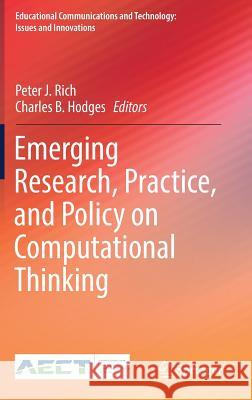
Emerging Research, Practice, and Policy on Computational Thinking Peter Rich Charles Hodges 9783319526904 Springer - książkaWidoczna okładka, to zdjęcie poglądowe, a rzeczywista szata graficzna może różnić się od prezentowanej.

Emerging Research, Practice, and Policy on Computational Thinking

ISBN-13: 9783319526904 / Angielski / Twarda / 2017 / 413 str.

Peter Rich; Charles Hodges
cena 645,58 zł
(netto: 614,84 VAT:  5%)

Najniższa cena z 30 dni: 616,85 zł
Termin realizacji zamówienia:
ok. 22 dni roboczych
Bez gwarancji dostawy przed świętami

Darmowa dostawa!

This book reports on research and practice on computational thinking and the effect it is having on education worldwide, both inside and outside of formal schooling. With coding becoming a required skill in an increasing number of national curricula (e.g., the United Kingdom, Israel, Estonia, Finland), the ability to think computationally is quickly becoming a primary 21st century -basic- domain of knowledge. The authors of this book investigate how this skill can be taught and its resultant effects on learning throughout a student's education, from elementary school to adult learning.


Kategorie:
Podręczniki
Kategorie BISAC:
Education > Computers & Technology
Education > Educational Psychology
Education > Administration - General
Wydawca:
Springer
Seria wydawnicza:
Educational Communications and Technology: Issues and Innova
Język:
Angielski
ISBN-13:
9783319526904
Rok wydania:
2017
Wydanie:
2017
Numer serii:
000469150
Ilość stron:
413
Waga:
0.79 kg
Wymiary:
23.39 x 15.6 x 2.54
Oprawa:
Twarda
Wolumenów:
01
Dodatkowe informacje:
Wydanie ilustrowane

Part1. K-12 Education.- Chapter1. Learning computational skills in ucode@uwg:challenges and recommendations.- Chapter2. Making computer science attractive to high school girls with computational thinking approaches:a case study. - Chapter3. Understanding african-american students’ problem-solving ability in the pre-calculus and advanced placement computer science classroom.- Chapter4. Computational thinking as an interdisciplinary approach to computer science school curricula:computer scientific reasoning in the medical curriculum.- Chapter5. Proto-computational Thinking: the Uncomfortable Underpinnings.- Part2. Higher Education.- Chapter6. Medical computational thinking: computer scientific reasoning in the medical curriculum.- Chapter7. Integrating computational thinking in discrete structures.- Chapter8. A computational approach to learning programming using visual programming in a developing country university.- Chapter9. Creating and evaluating a visual programming course based on student experience.- Chapter10. Using model-based learning to promote computational thinking education.- Part3. Teacher Development.- Chapter11. Teaching computational thinking patterns in rural communities.- Chapter12. Teacher transformations in developing computational thinking gaming and robotics use in after-school settings.- Chapter13. Computational thinking in teacher education.- Chapter14. Computational thinking conceptions and misconceptions:progression of preservice teacher thinking during computer science lesson planning.- Chapter15. The code abc mooc experiences from a coding and computational thinking mooc for finnish primary school teachers.- Chapter16. Assessing computational thinking across the curriculum.- Chapter17. Assessing algorithmic & computational thinking in k-12 lessons from a middle school classroom.- Chapter18. Principles of computational thinking tools.- Chapter19. Exploring strengths and weaknesses in middle school students’ computational thinking in scratch.- Chapter20. Measuring computational thinking development with the fun! Tool.- Chapter21. Reenergizing cs0 in china.- Chapter22. Computational thinking:efforts in korea.- Chapter23. A future-focused education:designed to create the innovators of tomorrow.- Chapter24. Computational participation teaching kids to create and connect through code.

Dr. Peter Rich is an Associate Professor of Instructional Psychology and Technology at Brigham Young University in Provo, Utah, USA.  Dr. Rich earned a B.S. in Spanish with a minor in TESOL, after which he went on to earn a PhD in Instructional Technology from the University of Georgia at Athens.  Dr. Rich researches convergent cognition, the synergistic effect that occurs when learners study complementary subjects, such as first and second language and mathematics and computer programming.  His current efforts focus on teaching younger students to learn computing and engineering  and to apply these thinking processes to complementary subjects.  He has taught students from 1st to 8th grade how to code computers and robots.  Over the past 12 years, Dr. Rich has worked with teachers in professional development to refine and reform their teaching practices.  Dr. Rich has published over 2 dozen articles and book chapters, and an edited book on digital video analysis in teacher education.

Dr. Charles B. Hodges is an Associate Professor of Instructional Technology at Georgia Southern University and is currently the Editor-in-Chief of the journal,  TechTrends: Linking Research and Practice to Improve Learning. Dr. Hodges earned a B.S. degree in Mathematics with a minor in Computer Science from Fairmont State University, a M.S. degree in Mathematics from West Virginia University, and a Ph.D. from the Learning Sciences and Technologies program at Virginia Tech.  Prior to joining the faculty at Georgia Southern University he was a member of the mathematics faculty at Virginia Tech for 15 years. His research has focused mainly on self-efficacy in technology intensive mathematics courses and the professional development of STEM teachers.  He has published over 30 scholarly works and delivered numerous conference presentations.  He has worked on multiple federally-funded grants and contracts as principal investigator or co-principal investigator.  Most recently he was funded by the National Youth at Risk Center of Georgia Southern University to study Computer Science education rural schools.

This book reports on research and practice on computational thinking and the effect it is having on education worldwide, both inside and outside of formal schooling. With coding becoming a required skill in an increasing number of national curricula (e.g., the United Kingdom, Israel, Estonia, Finland), the ability to think computationally is quickly becoming a primary 21st century “basic” domain of knowledge. The authors of this book investigate how this skill can be taught and its resultant effects on learning throughout a student's education, from elementary school to adult learning.




Udostępnij

Facebook - konto krainaksiazek.pl


Opinie o Krainaksiazek.pl na Opineo.pl

Partner Mybenefit

Krainaksiazek.pl w programie rzetelna firma Krainaksiaze.pl - płatności przez paypal

Czytaj nas na:

Facebook - krainaksiazek.pl
  • książki na zamówienie
  • granty
  • książka na prezent
  • kontakt
  • pomoc
  • opinie
  • regulamin
  • polityka prywatności

Zobacz:

  • Księgarnia czeska

  • Wydawnictwo Książkowe Klimaty

1997-2025 DolnySlask.com Agencja Internetowa

© 1997-2022 krainaksiazek.pl
     
KONTAKT | REGULAMIN | POLITYKA PRYWATNOŚCI | USTAWIENIA PRYWATNOŚCI
Zobacz: Księgarnia Czeska | Wydawnictwo Książkowe Klimaty | Mapa strony | Lista autorów
KrainaKsiazek.PL - Księgarnia Internetowa

Polityka prywatnosci - link
Krainaksiazek.pl - płatnośc Przelewy24
Przechowalnia Przechowalnia




