• Wyszukiwanie zaawansowane
  • Kategorie
  • Kategorie BISAC
  • Książki na zamówienie
  • Promocje
  • Granty
  • Książka na prezent
  • Opinie
  • Pomoc
  • Załóż konto
  • Zaloguj się

Elucidation of Abiotic Stress Signaling in Plants: Functional Genomics Perspectives, Volume 1 » książka


zaloguj się | załóż konto
Logo Krainaksiazek.pl

koszyk

konto

szukaj
topmenu
Księgarnia internetowa
Szukaj
Książki na zamówienie
Promocje
Granty
Książka na prezent
Moje konto
Pomoc
 
 
Wyszukiwanie zaawansowane
Pusty koszyk
Bezpłatna dostawa dla zamówień powyżej 20 złBezpłatna dostawa dla zamówień powyżej 20 zł

Kategorie główne

• Nauka
 [2949965]
• Literatura piękna
 [1857847]

  więcej...
• Turystyka
 [70818]
• Informatyka
 [151303]
• Komiksy
 [35733]
• Encyklopedie
 [23180]
• Dziecięca
 [617748]
• Hobby
 [139972]
• AudioBooki
 [1650]
• Literatura faktu
 [228361]
• Muzyka CD
 [398]
• Słowniki
 [2862]
• Inne
 [444732]
• Kalendarze
 [1620]
• Podręczniki
 [167233]
• Poradniki
 [482388]
• Religia
 [509867]
• Czasopisma
 [533]
• Sport
 [61361]
• Sztuka
 [243125]
• CD, DVD, Video
 [3451]
• Technologie
 [219309]
• Zdrowie
 [101347]
• Książkowe Klimaty
 [123]
• Zabawki
 [2362]
• Puzzle, gry
 [3791]
• Literatura w języku ukraińskim
 [253]
• Art. papiernicze i szkolne
 [7933]
Kategorie szczegółowe BISAC

Elucidation of Abiotic Stress Signaling in Plants: Functional Genomics Perspectives, Volume 1

ISBN-13: 9781493955527 / Angielski / Miękka / 2016 / 404 str.
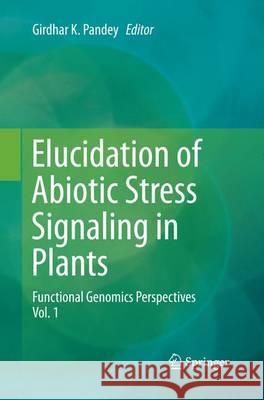
Girdhar K. Pandey
Elucidation of Abiotic Stress Signaling in Plants: Functional Genomics Perspectives, Volume 1 Pandey, Girdhar K. 9781493955527 Springer - książkaWidoczna okładka, to zdjęcie poglądowe, a rzeczywista szata graficzna może różnić się od prezentowanej.

Elucidation of Abiotic Stress Signaling in Plants: Functional Genomics Perspectives, Volume 1

ISBN-13: 9781493955527 / Angielski / Miękka / 2016 / 404 str.

Girdhar K. Pandey
cena 605,23 zł
(netto: 576,41 VAT:  5%)

Najniższa cena z 30 dni: 578,30 zł
Termin realizacji zamówienia:
ok. 22 dni roboczych
Bez gwarancji dostawy przed świętami

Darmowa dostawa!

​Abiotic stresses such as high temperature, low-temperature, drought, and salinity limit crop productivity worldwide. Understanding plant responses to these stresses is essential for rational engineering of crop plants. In Arabidopsis, the signal transduction pathways for abiotic stresses, light, several phytohormones and pathogenesis have been elucidated. A significant portion of plant genomes (most studies are Arabidopsis and rice genome) encodes for proteins involves in signaling such as receptor, sensors, kinases, phosphatases, transcription factors and transporters/channels. Despite decades of physiological and molecular effort, knowledge pertaining to how plants sense and transduce low and high temperature, low-water availability (drought), water-submergence and salinity signals is still a major question before plant biologists. One major constraint hampering our understanding of these signal transduction processes in plants has been the lack or slow pace of application of molecular genomic and genetics knowledge in the form of gene function. In the post-genomic era, one of the major challenges is investigation and understanding of multiple genes and gene families regulating a particular physiological and developmental aspect of plant life cycle. One of the important physiological processes is regulation of stress response, which leads to adaptation or adjustment in response to adverse stimuli. With the holistic understanding of the signaling pathways involving not only one gene family but multiple genes or gene families, plant biologists can lay a foundation for designing and generating future crops that can withstand the higher degree of environmental stresses (especially abiotic stresses, which are the major cause of crop loss throughout the world) without losing crop yield and productivity.


Kategorie:
Nauka, Biologia i przyroda
Kategorie BISAC:
Science > Botanika
Science > Biologia molekularna
Technology & Engineering > Agriculture - General
Wydawca:
Springer
Język:
Angielski
ISBN-13:
9781493955527
Rok wydania:
2016
Wydanie:
Softcover Repri
Ilość stron:
404
Oprawa:
Miękka
Wolumenów:
01

Section 1: Functional Genomics approaches in signal transduction


Chapter1: Towards understanding abiotic stress signaling in plants: convergence of genomics, transcriptomics, proteomics and metabolomics approaches

Praveen Soni, Kamlesh Kant Nutan, Neelam Soda, Ramsong C Nongpiur, Suchismita Roy, Sneh L Singla-Pareek and Ashwani Pareek


Chapter 2: Molecular approaches in deciphering abiotic stress signaling mechanisms in plants

Swati Singh, Nisha Khatri, Arpana Katiyar and Yashwanti Mudgil

Chapter 3: Investigation of plant abiotic stress tolerance by proteomics and phosphoproteomics

Maik Böhmer


Section 2: Components of Signal Transduction


Chapter4: Role of cation/proton exchangers in abiotic stress signaling and stress tolerance in plants

Peter D. Bickerton and Jon K. Pittman

Chapter 5: Decrypting Calcium Signaling in Plants: The Kinase Way

Swatismita Dhar Ray


Chapter 6: CBL-mediated calcium signaling pathways in higher plants

Joo Hyuk Cho and Kyung-Nam Kim


Chapter 7: Redox regulated mechanisms: Implications for enhancing plant stress tolerance and crop yield

Ashish Kumar Srivastava, Penna Suprasanna


Chapter 8: Role of Mitogen activated Protein Kinase Cascade in Combating Abiotic Stress in Plants

Hussain Ara and Alok Krishna Sinha


Chapter 9: Small and large G proteins in biotic and abiotic stress response

Amita Pandey, Manisha Sharma, Girdhar K. Pandey

Chapter 10: ABA Receptors: Prospects for Enhancing Biotic and Abiotic Stress Tolerance of Crops

Monika Dalal and Viswanathan Chinnusamy


Chapter 11: Emerging Roles of Auxin in Abiotic Stress Responses

Eshan Sharma, Raghvendra Sharma, Pratikshya Borah, Mukesh Jain and Jitendra P. Khurana


Chapter 12: Biotic and Abiotic Stress Signaling Mediated by Salicylic Acid

Dhirendra Kumar, Danda Chapagai, Phillip Dean, Mackenzie Davenport 


Chapter 13: Methylglyoxal, Triose phosphate isomerase and Glyoxalase pathway: Implications in abiotic stress and signaling in plants

Charanpreet Kaur, Shweta Sharma, Sneh Lata Singla-Pareek, Sudhir Kumar Sopory


Chapter 14: Plant immunophilins: A protein family with diverse functions beyond protein folding activity

Aigen Fu

Section 3- Gene expression regulation of stress signaling


Chapter 15: Role of Plant Mediator Complex in Stress Response

Subhasis Samanta, Jitendra Kumar Thakur

Chapter 16: Towards understanding the transcriptional control of abiotic stress tolerance mechanisms in food legumes

Rebecca Ford, Saleem Khan and Nitin Mantri


Chapter 17: Insights into the small RNA mediated networks in response to abiotic stress in plants

Sonia C. Balyan, Roseeta D. Mutum, Shivani Kansal, Santosh Kumar, Saloni Mathur and Saurabh Raghuvanshi 


Chapter 18: The Role of Long Non-coding RNAs in abiotic stress tolerance in plants

Swati Megha, Urmila Basu, Muhammad H. Rahman and Nat N. V. Kav 


Section 4- Diverse Stress Signaling Networks


Chapter 19: Molecular physiology of heat Stress Responses in Plants

Homa Hemmati, Dinesh Gupta and Chhandak Basu


Chapter 20: The Omics of cold stress responses in plants

Somya Sinha, Bharti Kukreja, Priyanka Arora, Manisha Sharma, Girdhar K. Pandey, Manu Agarwal, and Viswanathan Chinnusamy


Chapter 21: Drought stress responses and signal transduction in plants

Charu Lata, Mehanathan Muthamilarasan and Manoj Prasad


Chapter 22: Physiological and molecular mechanisms of flooding tolerance in plants

Lekshmy S, Shailendra Kumar Jha, Raj Kumar Sairam


Chapter 23: Salt Adaptation Mechanisms of Halophytes: Improvement of Salt Tolerance in Crop Plants

Rohit Joshi, Whitney Pilcher, Mangu Venkata Ramanarao, Renesh Bedre, Luis Sanchez and Niranjan Baisakh


Chapter 24: UV-B Photoreceptors, their role in photosignaling, physiological responses and abiotic stress in plants

Priyanka  Choudhury, Sindhu Kandoth Veetil and Suneel Kateriya


Chapter 25: Analysis of signaling pathways during heavy metal toxicity: A functional genomic perspective

Gyana Ranjan Rout and  Jogeswar Panigrahi


Chapter 26: Nitrogen and Stress

Annie P. Jangam and N. Raghuram


Chapter 27: Signaling pathways in eukaryotic stress, aging and senescence: Common and distinct pathways

Ritika Das, Amita Pandey, and Girdhar K. Pandey


Section 5- Manifestation of Stress tolerance


Chapter 28: Designing climate smart future crops employing signal transduction components

Brijesh Gupta, Amit K. Tripathi, Rohit Joshi, Ashwani Pareek, Sneh L. Singla-Pareek 


Chapter 29: Abiotic Stress in Crops: Candidate Genes, Osmolytes, Polyamines and Biotechnological Intervention

Autar K. Mattoo, Rakesh K. Upadhyay, and Sairam Rudrabhatla


Chapter 30: Abiotic stress tolerance and sustainable agriculture: A functional genomic perspective

Sarvajeet Singh Gill, Naser A Anjum, Monika Mahajan, Ritu Gill, Narendra Tuteja

Dr. Girdhar Pandey serves as Associate Professor for the Department of Plant Molecular Biology at the University of Delhi South Campus. Dr. Pandey has published and contributed to widely praised books on plant genetics and genomics, including GTPases: Versatile Regulators of Signal Transduction in Plants (Springer, 2015), Abiotic Stress Adaptation in Plants: Physiological, Molecular and Genomic Foundation (Springer, 2010), and Biotechnology in Sustainable Biodiversity and Food Security (Science Publishers, Inc., 2003).

In this volume, several world leaders in plant biology provide insight into ‘Stress Signaling’ in plants with a special emphasis on functional genomics aspects. This book utilizes state-of-the-art research in the field of  stress mediated signaling to develop a better and holistic understanding of stress perception, its transduction followed by the generation of response.

In spite of the advent of different approaches to devise strategies for developing stress tolerant crops towards multiple stress conditions in the field, the success in achieving this goal is still unsatisfactory. Stress tolerance is a very complex process-involving plethora of components starting from stress sensing to generation of final adaptive response. There are several factors, which act as nodes and hubs in the signaling pathways, also serving as master-control switches in regulating a myriad of stress signaling pathways by affecting diverse target genes or gene products to finally bring-about a stress tolerance response. Therefore, in-depth understanding of these master-control switches and key-components in signal transduction pathway will be highly beneficial for designing crop plants tolerant to multiple stresses in the field.


Udostępnij

Facebook - konto krainaksiazek.pl


Opinie o Krainaksiazek.pl na Opineo.pl

Partner Mybenefit

Krainaksiazek.pl w programie rzetelna firma Krainaksiaze.pl - płatności przez paypal

Czytaj nas na:

Facebook - krainaksiazek.pl
  • książki na zamówienie
  • granty
  • książka na prezent
  • kontakt
  • pomoc
  • opinie
  • regulamin
  • polityka prywatności

Zobacz:

  • Księgarnia czeska

  • Wydawnictwo Książkowe Klimaty

1997-2025 DolnySlask.com Agencja Internetowa

© 1997-2022 krainaksiazek.pl
     
KONTAKT | REGULAMIN | POLITYKA PRYWATNOŚCI | USTAWIENIA PRYWATNOŚCI
Zobacz: Księgarnia Czeska | Wydawnictwo Książkowe Klimaty | Mapa strony | Lista autorów
KrainaKsiazek.PL - Księgarnia Internetowa

Polityka prywatnosci - link
Krainaksiazek.pl - płatnośc Przelewy24
Przechowalnia Przechowalnia






