• Wyszukiwanie zaawansowane
  • Kategorie
  • Kategorie BISAC
  • Książki na zamówienie
  • Promocje
  • Granty
  • Książka na prezent
  • Opinie
  • Pomoc
  • Załóż konto
  • Zaloguj się

Electromagnetic Anechoic Chambers: A Fundamental Design and Specification Guide » książka


zaloguj się | załóż konto
Logo Krainaksiazek.pl

koszyk

konto

szukaj
topmenu
Księgarnia internetowa
Szukaj
Książki na zamówienie
Promocje
Granty
Książka na prezent
Moje konto
Pomoc
 
 
Wyszukiwanie zaawansowane
Pusty koszyk
Bezpłatna dostawa dla zamówień powyżej 20 złBezpłatna dostawa dla zamówień powyżej 20 zł

Kategorie główne

• Nauka
 [2949965]
• Literatura piękna
 [1857847]

  więcej...
• Turystyka
 [70818]
• Informatyka
 [151303]
• Komiksy
 [35733]
• Encyklopedie
 [23180]
• Dziecięca
 [617748]
• Hobby
 [139972]
• AudioBooki
 [1650]
• Literatura faktu
 [228361]
• Muzyka CD
 [398]
• Słowniki
 [2862]
• Inne
 [444732]
• Kalendarze
 [1620]
• Podręczniki
 [167233]
• Poradniki
 [482388]
• Religia
 [509867]
• Czasopisma
 [533]
• Sport
 [61361]
• Sztuka
 [243125]
• CD, DVD, Video
 [3451]
• Technologie
 [219309]
• Zdrowie
 [101347]
• Książkowe Klimaty
 [123]
• Zabawki
 [2362]
• Puzzle, gry
 [3791]
• Literatura w języku ukraińskim
 [253]
• Art. papiernicze i szkolne
 [7933]
Kategorie szczegółowe BISAC

Electromagnetic Anechoic Chambers: A Fundamental Design and Specification Guide

ISBN-13: 9780471208105 / Angielski / Twarda / 2002 / 240 str.
Leland H. Hemming;Hemming
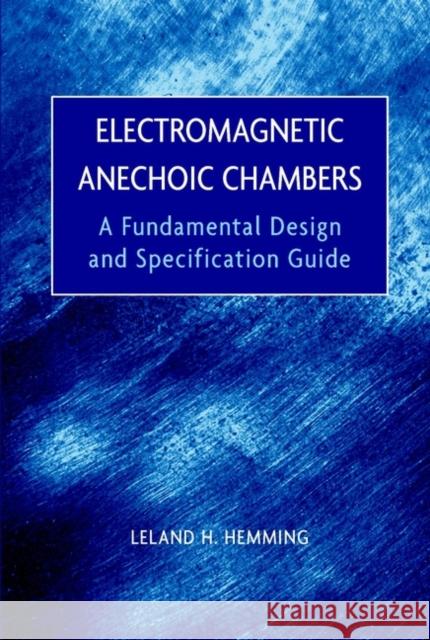
Electromagnetic Anechoic Chambers: A Fundamental Design and Specification Guide Hemming, Leland H. 9780471208105 IEEE Computer Society Press - książkaWidoczna okładka, to zdjęcie poglądowe, a rzeczywista szata graficzna może różnić się od prezentowanej.

Electromagnetic Anechoic Chambers: A Fundamental Design and Specification Guide

ISBN-13: 9780471208105 / Angielski / Twarda / 2002 / 240 str.

Leland H. Hemming;Hemming
cena 846,94 zł
(netto: 806,61 VAT:  5%)

Najniższa cena z 30 dni: 838,28 zł
Termin realizacji zamówienia:
ok. 30 dni roboczych
Bez gwarancji dostawy przed świętami

Darmowa dostawa!

A practical one-volume guide to anechoic chamber designs for electromagnetic measurements

The electromagnetic anechoic chamber has been with us since it was invented at the Naval Research Laboratory in Washington, DC, in the early 1950s. Just about every major aerospace company has large numbers of them located throughout the United States and the world. Now, because of the stringent electromagnetic interference requirements that must be considered in the development of all new electronic products, these facilities are appearing in the automotive, telecommunications, aerospace, computer, and other industries.

This handbook provides the designer/procurer of electromagnetic chambers with a single source of practical information on the full range of anechoic chamber designs. It reviews the current state of the art in indoor electromagnetic testing facilities and their design and specifications. You'll find information on a large variety of anechoic chambers used for a broad range of electromagnetic measurements that are commonly conducted in indoor test facilities as well as details on:
* Measurement theory to support the chamber design procedures provided in each of the specific chamber designs
* Test facilities for the measurement of antennas, scattering (RCS), and electromagnetic compatibility
* An extensive set of photographs, including a special color section highlighting some of the more interesting anechoic test facilities that have been built to solve various measurement problems
* Design/procurement checklists


Kategorie:
Technologie
Kategorie BISAC:
Technology & Engineering > Electrical
Science > Elektromagnetyzm
Technology & Engineering > Telecommunications
Wydawca:
IEEE Computer Society Press
Język:
Angielski
ISBN-13:
9780471208105
Rok wydania:
2002
Ilość stron:
240
Waga:
0.64 kg
Wymiary:
26.09 x 18.41 x 1.85
Oprawa:
Twarda
Wolumenów:
01
Dodatkowe informacje:
Bibliografia
Glosariusz/słownik
Wydanie ilustrowane

"...a comprehensive, thorough text...that will not sit on the shelf...it is a text that will be referenced often by those individuals committed to ensuring?the highest quality of test results." ( IEEE Instrumentation & Measurement Magazine, March 2003)

Foreword.

Preface.

1 Introduction.

1.1 The Text Organization.

References.

2 Measurement Principles Pertaining to Anechoic Chamber Design.

2.1 Introduction.

2.2 Measurement of Electromagnetic Fields.

2.2.1 Introduction.

2.2.2 Antennas.

2.2.3 Radiated Emissions.

2.2.4 Radiated Susceptibility.

2.2.5 Military Electromagnetic Compatibility.

2.2.6 Antenna System Isolation.

2.2.7 Radar Cross Section.

2.3 Free–Space Test Requirements.

2.3.1 Introduction.

2.3.2 Phase.

2.3.3 Amplitude.

2.3.4 Polarization.

2.3.5 The Friis Transmission Formula.

2.4 Supporting Measurement Concepts.

2.4.1 Introduction.

2.4.2 Coordinate Systems and Device Positioners.

2.4.3 Decibels.

2.4.4 Effects of Reflected Energy.

2.4.5 Effects of Antenna Coupling.

2.5 Outdoor Measurement Facilities.

2.5.1 Introduction.

2.5.2 Electromagnetic Design Considerations and Criteria.

2.5.3 Elevated Outdoor Antenna Range.

2.5.4 Ground Reflection Antenna Range.

2.5.5 Open–Area Test Sites (OATS).

References.

3 Electromagnetic Absorbing Materials.

3.1 Introduction.

3.2 Microwave Absorbing Materials.

3.2.1 Pyramidal Absorber.

3.2.2 Wedge Absorber.

3.2.3 Convoluted Microwave Absorber.

3.2.4 Multilayer Dielectric Absorber.

3.2.5 Hybrid Dielectric Absorber.

3.2.6 Walkway Absorber.

3.3 Low–Frequency Absorbing Material.

3.3.1 Introduction.

3.3.2 Ferrite Absorbers.

3.3.3 Hybrid Absorbers.

3.4 Absorber Modeling.

3.5 Absorber Testing.

References.

4 The Chamber Enclosure.

4.1 Introduction.

4.2 Electromagnetic Interference.

4.3 Controlling the Environment.

4.4 Electromagnetic Shielding.

4.4.1 Introduction.

4.4.2 The Welded Shield.

4.4.3 The Clamped Seam or Prefabricated Shield.

4.4.4 The Single–Shield Systems.

4.5 Penetrations.

4.6 Performance Verification.

4.7 Shielded Enclosure Grounding.

4.8 Fire Protection.

References.

5 Anechoic Chamber Design Techniques.

5.1 Introduction.

5.2 Practical Design Procedures.

5.2.1 Introduction.

5.2.2 Quick Estimate of Chamber Performance.

5.2.3 Detailed Ray–Tracing Design Procedure.

5.3 Computer Modeling.

5.3.1 Introduction.

5.3.2 Ray Tracing.

5.3.3 Finite–Difference Time–Domain Model.

5.4 Other Techniques.

5.5 Antennas Used In Anechoic Chambers.

5.5.1 Introduction.

5.5.2 Rectangular Chamber Antennas.

5.5.3 Antennas for Tapered Chambers.

5.5.4 EMI Chambers.

References.

6 The Rectangular Chamber.

6.1 Introduction.

6.2 Antenna Testing.

6.2.1 Introduction.

6.2.2 Design Considerations.

6.2.3 Design Example.

6.2.4 Acceptance Test Procedures.

6.3 Radar Cross–Section Testing.

6.3.1 Design Considerations.

6.3.2 Design Example.

6.3.3 Acceptance Test Procedures.

6.4 Near–Field Testing.

6.4.1 Introduction.

6.4.2 Chamber Design Considerations.

6.4.3 Design Example.

6.4.4 Acceptance Test Procedure.

6.5 Electromagnetic Compatibility Testing.

6.5.1 Introduction.

6.5.2 Chamber Design Considerations.

6.5.3 Design Examples.

6.5.4 Acceptance Test Procedures.

6.6 Immunity Testing.

6.6.1 Introduction.

6.6.2 Mode–Stirred Test Facility.

6.7 EM System Compatibility Testing.

6.7.1 Design Considerations.

6.7.2 Acceptance Testing.

References.

7 The Compact Range Chamber.

7.1 Introduction.

7.2 Antenna Testing.

7.2.1 Prime Focus Compact Range.

7.2.2 Dual Reflector Compact Range.

7.2.3 Shaped Reflector Compact Range.

7.2.4 Compact Antenna Range Absorber Layout.

7.2.5 Acceptance Testing of the Compact Antenna Anechoic Chamber.

7.3 Compact RCS Ranges.

7.3.1 Introduction.

7.3.2 Design Example.

7.3.3 Acceptance Testing.

References.

8 Incorporating Geometry in Anechoic Chamber Design.

8.1 Introduction.

8.2 The Tapered Chamber.

8.2.1 Introduction.

8.2.2 Antenna Testing.

8.2.3 Radar Cross–Section Measurements.

8.3 The Double Horn Chamber.

8.3.1 Introduction.

8.3.2 Antenna Testing.

8.3.3 Emissions and Immunity Testing.

8.4 The Missile Hardware–in–the–Loop Chamber.

8.4.1 Introduction.

8.4.2 Design Considerations.

8.4.3 Design Example.

8.4.4 Acceptance Test Procedures.

8.5 Consolidated Facilities.

8.5.1 Introduction.

8.5.2 Design Considerations.

8.5.3 Design Examples.

8.5.4 Acceptance Test Procedures.

8.6 The TEM Cell.

8.6.1 Introduction.

8.6.2 TEM Principles of Operation.

8.6.3 Typical Performance.

References.

9 Test Procedures.

9.1 Introduction.

9.2 Absorber Testing.

9.2.1 Introduction.

9.2.2 Testing of Microwave Absorber.

9.2.3 Low–Frequency Testing.

9.2.4 Compact Range Reflector Testing.

9.2.5 Fire–Retardant Testing.

9.3 Microwave Anechoic Chamber Test Procedures.

9.3.1 Introduction.

9.3.2 Free–Space VSWR Method.

9.3.3 Pattern Comparison Method.

9.3.4 X Y Scanner Method.

9.3.5 RCS Chamber Evaluation.

9.4 EMC Chamber Acceptance Test Procedures.

9.4.1 Introduction.

9.4.2 Volumetric Site Attenuation.

9.4.3 Field Uniformity.

9.5 Shielding Effectiveness.

References.

10 Examples of Indoor Electromagnetic Test Facilities.

10.1 Introduction.

10.2 Antenna Testing.

10.2.1 Introduction.

10.2.2 Rectangular Test Chamber.

10.2.3 Tapered Anechoic Chamber.

10.2.4 Compact Range Test Chamber.

10.2.5 Near–Field Test Chamber.

10.3 Radar Cross–Section Testing.

10.3.1 Introduction.

10.3.2 Compact Range Radar Cross–Section Facilities.

10.4 EMC Test Chambers.

10.4.1 Introduction.

10.4.2 Emission Test Chambers.

10.5 Electromagnetic System Compatibility Testing.

10.5.1 Introduction.

10.5.2 Aircraft Systems.

10.5.3 Spacecraft Test Facilities.

References.

Appendix A: Procedure for Determining the Area of Specular Absorber Treatment.

A.1 Introduction.

A.2 Fresnel Zone Analysis.

Appendix B :Test Region Amplitude Taper.

B.1 Introduction.

B.2 Antenna Data.

Appendix C: Design/Specification Checklists.

C.1 Introduction.

C.2 The Rectangular Chamber.

C.2.1 Introduction.

C.2.2 Antenna Testing.

C.2.3 RCS Testing.

C.2.4 Near–Field Testing.

C.2.5 EMI Testing.

C.2.6 Isolation Testing.

C.2.7 Impedance Testing.

C.3 Compact Range.

C.3.1 Introduction.

C.3.2 Antenna/Radome Testing.

C.3.3 RCS Testing.

C.4 Shaped Chambers.

C.4.1 Introduction

C.4.2 Tapered Chamber.

C.4.3 Double Horn Chamber.

C.4.4 Hardware–in–the–Loop Testing.

C.5 Shielding Design Checklist.

C.5.1 Introduction.

C.5.2 Checklist for Prefabricated Shielding.

C.5.3 Checklist for Welded Enclosures.

C.5.4 Checklist for Architectural Shielding.

C.5.5 Conventional Construction.

C.5.6 Fire Protection.

References.

Glossary.

Selected Bibliography.

Index.

About the Author.

LELAND H. HEMMING is a member of the technical staff of the Signature Development and Applications Group, Phantom Works, a design and development division of the Boeing Company located in Mesa, Arizona. He obtained a BS in physics from San Diego State University in 1963 and an MBA from National University, San Diego, California, in 1977. He has been an active member of the IEEE since 1963 and a Senior Life member since 2001. He is also the author of Architectural Electromagnetic Shielding Handbook.

A practical one–volume guide to anechoic chamber designs for electromagnetic measurements

The electromagnetic anechoic chamber has been with us since it was invented at the Naval Research Laboratory in Washington, DC, in the early 1950s. Just about every major aerospace company has large numbers of them located throughout the United States and the world. Now, because of the stringent electromagnetic interference requirements that must be considered in the development of all new electronic products, these facilities are appearing in the automotive, telecommunications, aerospace, computer, and other industries.

This handbook provides the designer/procurer of electromagnetic chambers with a single source of practical information on the full range of anechoic chamber designs. It reviews the current state of the art in indoor electromagnetic testing facilities and their design and specifications. You’ll find information on a large variety of anechoic chambers used for a broad range of electromagnetic measurements that are commonly conducted in indoor test facilities as well as details on:

  • Measurement theory to support the chamber design procedures provided in each of the specific chamber designs
  • Test facilities for the measurement of antennas, scattering (RCS), and electromagnetic compatibility
  • An extensive set of photographs, including a special color section highlighting some of the more interesting anechoic test facilities that have been built to solve various measurement problems
  • Design/procurement checklists

Hemming, Leland H. LELAND H. HEMMING is a member of the technical sta... więcej >


Udostępnij

Facebook - konto krainaksiazek.pl


Opinie o Krainaksiazek.pl na Opineo.pl

Partner Mybenefit

Krainaksiazek.pl w programie rzetelna firma Krainaksiaze.pl - płatności przez paypal

Czytaj nas na:

Facebook - krainaksiazek.pl
  • książki na zamówienie
  • granty
  • książka na prezent
  • kontakt
  • pomoc
  • opinie
  • regulamin
  • polityka prywatności

Zobacz:

  • Księgarnia czeska

  • Wydawnictwo Książkowe Klimaty

1997-2025 DolnySlask.com Agencja Internetowa

© 1997-2022 krainaksiazek.pl
     
KONTAKT | REGULAMIN | POLITYKA PRYWATNOŚCI | USTAWIENIA PRYWATNOŚCI
Zobacz: Księgarnia Czeska | Wydawnictwo Książkowe Klimaty | Mapa strony | Lista autorów
KrainaKsiazek.PL - Księgarnia Internetowa

Polityka prywatnosci - link
Krainaksiazek.pl - płatnośc Przelewy24
Przechowalnia Przechowalnia





