• Wyszukiwanie zaawansowane
  • Kategorie
  • Kategorie BISAC
  • Książki na zamówienie
  • Promocje
  • Granty
  • Książka na prezent
  • Opinie
  • Pomoc
  • Załóż konto
  • Zaloguj się

Electro-Optical Systems 2e » książka


zaloguj się | załóż konto
Logo Krainaksiazek.pl

koszyk

konto

szukaj
topmenu
Księgarnia internetowa
Szukaj
Książki na zamówienie
Promocje
Granty
Książka na prezent
Moje konto
Pomoc
 
 
Wyszukiwanie zaawansowane
Pusty koszyk
Bezpłatna dostawa dla zamówień powyżej 20 złBezpłatna dostawa dla zamówień powyżej 20 zł

Kategorie główne

• Nauka
 [2946600]
• Literatura piękna
 [1856966]

  więcej...
• Turystyka
 [72221]
• Informatyka
 [151456]
• Komiksy
 [35826]
• Encyklopedie
 [23190]
• Dziecięca
 [619653]
• Hobby
 [140543]
• AudioBooki
 [1577]
• Literatura faktu
 [228355]
• Muzyka CD
 [410]
• Słowniki
 [2874]
• Inne
 [445822]
• Kalendarze
 [1744]
• Podręczniki
 [167141]
• Poradniki
 [482898]
• Religia
 [510455]
• Czasopisma
 [526]
• Sport
 [61590]
• Sztuka
 [243598]
• CD, DVD, Video
 [3423]
• Technologie
 [219201]
• Zdrowie
 [101638]
• Książkowe Klimaty
 [124]
• Zabawki
 [2473]
• Puzzle, gry
 [3898]
• Literatura w języku ukraińskim
 [254]
• Art. papiernicze i szkolne
 [8170]
Kategorie szczegółowe BISAC

Electro-Optical Systems 2e

ISBN-13: 9780470402290 / Angielski / Twarda / 2009 / 820 str.
Philip C. D. Hobbs
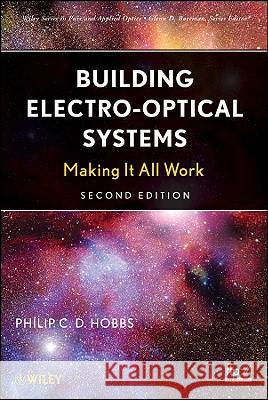
Electro-Optical Systems 2e Hobbs, Philip C. D. 9780470402290 John Wiley & Sons - książkaWidoczna okładka, to zdjęcie poglądowe, a rzeczywista szata graficzna może różnić się od prezentowanej.

Electro-Optical Systems 2e

ISBN-13: 9780470402290 / Angielski / Twarda / 2009 / 820 str.

Philip C. D. Hobbs
cena 753,23 zł
(netto: 717,36 VAT:  5%)

Najniższa cena z 30 dni: 747,05 zł
Termin realizacji zamówienia:
ok. 30 dni roboczych
Bez gwarancji dostawy przed świętami

Darmowa dostawa!

Praise for the First Edition "Now a new laboratory bible for optics researchers has joined the list: it is Phil Hobbs's Building Electro-Optical Systems: Making It All Work."
--Tony Siegman, Optics & Photonics News Building a modern electro-optical instrument may be the most interdisciplinary job in all of engineering. Be it a DVD player or a laboratory one-off, it involves physics, electrical engineering, optical engineering, and computer science interacting in complex ways. This book will help all kinds of technical people sort through the complexity and build electro-optical systems that just work, with maximum insight and minimum trial and error. Written in an engaging and conversational style, this Second Edition has been updated and expanded over the previous edition to reflect technical advances and a great many conversations with working designers. Key features of this new edition include:

  • Expanded coverage of detectors, lasers, photon budgets, signal processing scheme planning, and front ends
  • Coverage of everything from basic theory and measurement principles to design debugging and integration of optical and electronic systems
  • Supplementary material is available on an ftp site, including an additional chapter on thermal Control and Chapter problems highly relevant to real-world design
  • Extensive coverage of high performance optical detection and laser noise cancellation
Each chapter is full of useful lore from the author's years of experience building advanced instruments. For more background, an appendix lists 100 good books in all relevant areas, introductory as well as advanced. Building Electro-Optical Systems: Making It All Work, Second Edition is essential reading for researchers, students, and professionals who have systems to build.

Kategorie:
Technologie
Kategorie BISAC:
Technology & Engineering > Optics
Technology & Engineering > Lasers & Photonics
Technology & Engineering > Electronics - Optoelectronics
Wydawca:
John Wiley & Sons
Seria wydawnicza:
Wiley Series in Pure and Applied Optics
Język:
Angielski
ISBN-13:
9780470402290
Rok wydania:
2009
Numer serii:
000211295
Ilość stron:
820
Waga:
1.53 kg
Wymiary:
25.4 x 17.78 x 4.06
Oprawa:
Twarda
Wolumenów:
01

Preface.

Acknowledgments.

1. Basic Optical Calculations.

1.1 Introduction.

1.2 Wave Propagation.

1.3 Calculating Wave Propagation in Real Life.

1.4 Detection.

1.5 Coherent Detection.

1.6 Interferometers.

1.7 Photon Budgets and Operating Specifications.

1.8 Signal Processing Strategy.

2. Sources and Illuminators.

2.1 Introduction.

2.2 The Spectrum.

2.3 Radiometry.

2.4 Continuum Sources.

2.5 Interlude: Coherence.

2.6 More Sources.

2.7 Incoherent Line Sources.

2.8 Using Low Coherence Sources: Condensers.

2.9 Lasers.

2.10 Gas Lasers.

2.11 Solid State Lasers.

2.12 Diode Lasers.

2.13 Laser Noise.

2.14 Diode Laser Coherence Control.

3. Optical Detection.

3.1 Introduction.

3.2 Photodetection in Semiconductors.

3.3 Signal to Noise Ratios.

3.4 Detector Figures of Merit.

3.5 Quantum Detectors.

3.6 Quantum Detectors with Gain.

3.7 Thermal Detectors.

3.8 Image Intensifiers.

3.9 Silicon Array Sensors.

3.10 How Do I Know Which Noise Source Dominates?

3.11 Hacks.

4. Lenses, Prisms, and Mirrors.

4.1 Introduction.

4.2 Optical Materials.

4.3 Light Transmission.

4.4 Surface Quality.

4.5 Windows.

4.6 Pathologies of Optical Elements.

4.7 Fringes.

4.8 Mirrors.

4.9 Glass Prisms.

4.10 Prism Pathologies.

4.11 Lenses.

4.12 Complex Lenses.

4.13 Other Lens–like Devices.

5. Coatings, Filters, and Surface Finishes.

5.1 Introduction.

5.2 Metal Mirrors.

5.3 Transmissive Optical Coatings.

5.4 Simple Coating Theory.

5.5 Absorptive Filters.

5.6 Beam Dumps and Baffles.

5.7 White Surfaces and Diffusers.

6. Polarization.

6.1 Introduction.

6.2 Polarization of Light.

6.3 Interaction of Polarization with Materials.

6.4 Absorption Polarizers.

6.5 Brewster Polarizers.

6.6 Birefringent Polarizers.

6.7 Double–Refraction Polarizers.

6.8 TIR Polarizers.

6.9 Retarders.

6.10 Polarization Control.

7. Exotic Optical Components.

7.1 Introduction.

7.2 Gratings.

7.3 Grating Pathologies.

7.4 Types of Gratings.

7.5 Resolution of Grating Instruments.

7.6 Fine Points of Gratings.

7.7 Holographic Optical Elements.

7.8 Retroreflective Materials.

7.9 Scanners.

7.10 Modulators.

8. Fiber Optics.

8.1 Introduction.

8.2 Fiber Characteristics.

8.3 Fiber Theory.

8.4 Fiber Types.

8.5 Other Fiber Properties.

8.6 Working with Fibers.

8.7 Fiber Devices.

8.8 Diode Lasers and Fiber Optics.

8.9 Fiber Optic Sensors.

8.10 Intensity Sensors.

8.11 Spectrally Encoded Sensors.

8.12 Polarimetric Sensors.

8.13 Fiber Interferometers.

8.14 Two–Beam Fiber Interferometers.

8.15 Multiple–Beam Fiber Interferometers.

8.16 Phase and Polarization Stabilization.

8.17 Multiplexing and Smart Structures.

8.18 Fiber Sensor Hype.

9. Optical Systems.

9.1 Introduction.

9.2 What, Exactly, Does a Lens Do?

9.3 Diffraction.

9.4 Aberrations.

9.5 Representing Aberrations.

9.6 Optical Design Advice.

9.7 Practical Applications.

9.8 Illuminators.

10. Optical Measurements.

10.1 Introduction.

10.2 Grass on the Empire State Building.

10.3 Detection Issues: When Exactly Is Background Bad?

10.4 Measure the Right Thing.

10.5 Getting More Signal Photons.

10.6 Reducing the Background Fluctuations.

10.7 Optically Zero Background Measurements.

10.8 Electronically Zero Background Measurements.

10.9 Labelling Signal Photons.

10.10 Closure.

11. Designing Electro–Optical Systems.

11.1 Introduction.

11.2 Do You Really Want To Do This?

11.3 Very Basic Marketing.

11.4 Classes of Measurement.

11.5 Technical Taste.

11.6 Instrument Design.

11.7 Guiding Principles.

11.8 Design for Alignment.

11.9 Turning a Prototype into a Product.

12. Building Optical Systems.

12.1 Introduction.

12.2 Build What You Designed.

12.3 Assembling Lab Systems.

12.4 Alignment and Testing.

12.5 Optical Assembly and Alignment Philosophy.

12.6 Collimating Beams.

12.7 Focusing.

12.8 Aligning Beams with Other Beams.

12.9 Advanced Tweaking.

12.10 Aligning Laser Systems.

12.11 Adhesives.

12.12 Cleaning.

12.13 Environmental Considerations.

13. Signal Processing.

13.1 Introduction.

13.2 Analogue Signal Processing Theory.

13.3 Modulation and Demodulation.

13.4 Amplifiers.

13.5 Departures from Linearity.

13.6 Noise and Interference.

13.7 Frequency Conversion.

13.8 Filtering.

13.9 Signal Detection.

13.10 Reducing Interference and Noise.

13.11 Data Acquisition and Control.

14. Electronic Building Blocks.

14.1 Introduction.

14.2 Resistors.

14.3 Capacitors.

14.4 Transmission Lines.

14.5 Transmission Line Devices.

14.6 Diodes and Transistors.

14.7 Signal Processing Components.

14.8 Digitizers.

14.9 Analogue Behaviour of Digital Circuits.

15. Electronic Subsystem Design.

15.1 Introduction.

15.2 Design Approaches.

15.3 Perfection.

15.4 Feedback Loops.

15.5 Signal Detectors.

15.6 Phase–Locked Loops.

15.7 Calibration.

15.8 Filters.

15.9 Other Stuff.

15.10 More Advanced Feedback Techniques.

15.11 Hints.

15.12 Linearizing.

15.13 Digital Control and Communication.

15.14 Miscellaneous Tricks.

15.15 Bulletproofing.

16. Electronic Construction Techniques.

16.1 Introduction.

16.2 Circuit Strays.

16.3 Stray Coupling.

16.4 Ground Plane Construction.

16.5 Technical Noise and Interference.

16.6 Product Construction.

16.7 Getting Ready.

16.8 Prototyping.

16.9 Surface Mount Prototypes.

16.10 Prototyping Filters.

16.11 Tuning, or, You Can t Optimize What You Can t See.

17. Digital Post Processing.

17.1 Introduction.

17.2 Elementary Post Processing.

17.3 Dead Time Correction.

17.4 Fourier Domain Techniques.

17.5 Power Spectrum Estimation.

17.6 Digital Filtering.

17.7 Deconvolution.

17.8 Resampling.

17.9 Fixing Space–Variant Instrument Functions.

17.10 Finite Precision Effects.

17.11 Pulling Data Out of Noise.

17.12 Phase Recovery Techniques.

18. Front Ends.

18.1 Introduction.

18.2 Photodiode Front Ends.

18.3 Key Idea: Reduce the Swing Across CD.

18.4 Transimpedance Amplifiers.

18.5 How to Go faster.

18.6 Advanced Photodiode Front Ends.

18.7 Other Types of Front End.

18.8 Hints.

19. Bringing Up The System.

19.1 Introduction.

19.2 Avoiding Catastrophe.

19.3 Debugging and Troubleshooting.

19.4 Getting Ready.

19.5 Indispensable Equipment.

19.6 Analogue Electronic Troubleshooting.

19.7 Oscillations.

19.8 Other Common Problems.

19.9 Debugging and Troubleshooting Optical Subsystems.

19.10 Localizing the Problem.

Appendix A: Good Books.

Topic Index.

Philip C. D. Hobbs, PhD, is Principal of ElectroOptical Innovations, a consultancy in Briarcliff Manor, New York.

Praise for the First Edition

"Now a new laboratory bible for optics researchers has joined the list: it is Phil Hobbs′s Building Electro–Optical Systems: Making It All Work."
Tony Siegman, Optics & Photonics News

Building a modern electro–optical instrument may be the most interdisciplinary job in all of engineering. Be it a DVD player or a laboratory one–off, it involves physics, electrical engineering, optical engineering, and computer science interacting in complex ways. This book will help all kinds of technical people sort through the complexity and build electro–optical systems that just work, with maximum insight and minimum trial and error.

Written in an engaging and conversational style, this Second Edition has been updated and expanded over the previous edition to reflect technical advances and a great many conversations with working designers. Key features of this new edition include:

  • Expanded coverage of detectors, lasers, photon budgets, signal processing scheme planning, and front ends
  • Coverage of everything from basic theory and measurement principles to design debugging and integration of optical and electronic systems
  • Supplementary material is available on an ftp site, including an additional chapter on thermal Control and Chapter problems highly relevant to real–world design
  • Extensive coverage of high performance optical detection and laser noise cancellation

Each chapter is full of useful lore from the author′s years of experience building advanced instruments. For more background, an appendix lists 100 good books in all relevant areas, introductory as well as advanced. Building Electro–Optical Systems: Making It All Work, Second Edition is essential reading for researchers, students, and professionals who have systems to build.


Udostępnij

Facebook - konto krainaksiazek.pl


Opinie o Krainaksiazek.pl na Opineo.pl

Partner Mybenefit

Krainaksiazek.pl w programie rzetelna firma Krainaksiaze.pl - płatności przez paypal

Czytaj nas na:

Facebook - krainaksiazek.pl
  • książki na zamówienie
  • granty
  • książka na prezent
  • kontakt
  • pomoc
  • opinie
  • regulamin
  • polityka prywatności

Zobacz:

  • Księgarnia czeska

  • Wydawnictwo Książkowe Klimaty

1997-2025 DolnySlask.com Agencja Internetowa

© 1997-2022 krainaksiazek.pl
     
KONTAKT | REGULAMIN | POLITYKA PRYWATNOŚCI | USTAWIENIA PRYWATNOŚCI
Zobacz: Księgarnia Czeska | Wydawnictwo Książkowe Klimaty | Mapa strony | Lista autorów
KrainaKsiazek.PL - Księgarnia Internetowa

Polityka prywatnosci - link
Krainaksiazek.pl - płatnośc Przelewy24
Przechowalnia Przechowalnia






