Eight Non-Classical Problems of Fracture Mechanics » książka





Eight Non-Classical Problems of Fracture Mechanics
ISBN-13: 9783030775032 / Angielski / Miękka / 2022
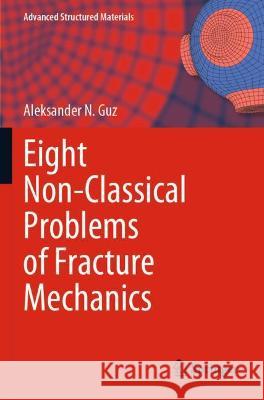
Eight Non-Classical Problems of Fracture Mechanics
ISBN-13: 9783030775032 / Angielski / Miękka / 2022
(netto: 690,08 VAT: 5%)
Najniższa cena z 30 dni: 655,41
ok. 16-18 dni roboczych.
Darmowa dostawa!
This book presents an analysis of eight non-classical problems of fracture and failure mechanics mainly obtained by research in the department of dynamics and stability of continuum of the S. P. Timoshenko Institute of Mechanics of the National Academy of Sciences of Ukraine (NAS of Ukraine). It focusses on the application of the 3D (three-dimensional) theories of stability, dynamics, and statics of solid mechanics to the investigation of non-classical problems of fracture and failure mechanics.
Foreword.............................................................................................................................................. 7
Introduction...................................................................................................................................... 11
Part I. General problems
Chapter 1. Division into classical and non-classical problemsof fracture mechanics........................................................................ 15
1.1 Classical problems of fracture mechanics.............................................................................. 15
1.2. Non-classical problems of fracture mechanics..................................................................... 16
1.3. Eight non-classical problems of fracture mechanics........................................................... 17
1.4. Additional discussion of non-classical problems of
fracture mechanics.................................................................................................................... 20
1.4.1. A brief discussion of models and approaches in non-classical
problems of fracture mechanics. Problems 1 to 8 (21). 1.4.2. On
consideration of non-classical problems of fracture mechanics in
terms of classic problems of fracture mechanics (24). 1.4.3. About
some other publications (26).
Chapter 2. Brief statement of foundations of three-dimensional linearized
theory of the deformable bodies stability (TLTDBS).............................. 27
2.1 On the formation of TLTDBS ……………………………………………………. 27
2.2. Classification of approaches (variants of theory) in TLTDBS ………………. 31
2.2.1. Theory of large (fiinite) sub-critical deformations (31).
2.2.2. The first variant of the theory of small sub-critical deformations (33).
2.2.3. The second variant of the theory of small sub-critical deformations (34).
2.2.4. About linearized theory of stability for small deformations
and small averaged angles of rotation (35). 2.2.5. On theory of incremental
deformations (36). 2.2.6. Approximate approach to TLTDBS(37). 2.2.7.
Notes (39).
2.3. On criteria of stability in TLTDBS........................................................................................ 41
2.3.1. Elastic bodies (42). 2.3.2. Plastic Bodies (43) 2.3.3. Bodies with rheological
properties (46).
2.4. General problems of TLTDBS................................................................................................ 49
2.4.1. The general formulation of TLTDBS for different models of
deformed bodies (49). Sufficient conditions for applicability of Euler’s method
(statical method) (51). 2.4.3. Sufficient conditions of stability (53).
2.5. On the variational principles of TLTDBS for elastic and plastic bodies......................... 54
2.5.1. Hu-Vashitsu variation principle in TLTDBS for incompressible bodies
under "dead" external load. Unified form for theories 1, 2, and 3 (55).
2.5.2. Variational principle of TLTDBS for compressible bodies under
"following" load. Results for theory 3 (57).
2.6. General solutions for TLTDBS in homogeneous sub-critical conditions........................ 59
2.6.1. General solutions for compressible bodies (60). 2.6.2. General
Solutions of TLTDBS for incompressible bodies (62). 2.6.3. Complex
potentials in the plane problems of TLTDBS. Preliminary discussion (64).
2.6.4. Main relations and general solutions of TLTDBS in coordinates of
initial state (65). 2.6.5. Complex potentials in plane linearized problems
in coordinates of initial state (68). 2.6.6. Complex potentials in dynamic
plane linearized problems in coordinates of initial state for moving cracks
and loads (73).
Part II. Fracture in composite materials under compression
Chapter 3. Problem 1. Fracture in composite materials under compression
along the reinforcing elements…………………………………………………..79
3.1. General concept and main directions of research................................................................ 79
3.1.1. General concept (79). 3.1.2. The first direction (very approximate
approaches) (82). 3.1.3. The second direction (strict sequential approaches
based on TLTDBS) (84).
3.1.3.1. Internal fracture (loss of stability in the internal structure) (84).
3.1.3.2. Surface fracture (loss of stability in the near-the-surface layers
of composite) (85).
3.2. Analysis of experimental results for compression of composites ……………………. 87
3.2.1. Experimental results on the loss of stability in the internal structure
of composites under compression (87). 3.2.2. Experimental results on
fracture of composites under compression along the reinforcing elements (90).
3.2.3. About the study of the phenomenon of "kinking" (95).
3.3. Main results of the second direction (strict sequential approaches
on the base of TLTDBS)…………………………………………………….. 97
3.3.1. Introductory information............................................................................................... 97
3.3.2. Continuum theory of fracture....................................................................................... 99
3.3.2.1. Internal fracture (99). 3.3.2.2. Near-the-surface fracture (103).
3.3.3. Layered composites. Model of piece-wise medium............................................... 104
3.3.3.1. Internal fracture (105). 3.3.3.2. Near-the-surface fracture (107).
3.3.3.3. Additional information to the fracture mechanics of layered
composite materials (108).3.3.3.3.1. Analysis of continuum fracture mechanics of composites
(108). 3.3.3.3.2. On stability of layered composites (112). 3.3.3.3.3.
Conclusions from the sequential analysis of the Daw-Grunfest-Rosen-
Schurtz theory (113).
3.3.4. Fibrous one-directional composites. Model of piece-wise homogeneous
medium………………………………………………………………… 116
3.3.4.1. Internal fracture (117). 3.3.4.2. Near-the-surface fracture (121).
3.3.4.3. On constructing a research method for complex modes of loss of
stability of fibrous unidirectional composites (121).
3.4. Conclusion to chapter 3......................................................................................................... 123
CHAPTER 4. Problem 2. Model of short fibers in the theory of stability and fracture mechanics of composite materials under compression ………………………..… 125
4.1. Experimental results for loss of stability in the internal structure of composites under compression. Case of short fibers………………………………………………….. 125
4.2. Statement of the problems..................................................................................................... 126
4.3. Classification of design schemes. About Analogies......................................................... 132
4.3.1. Model of infinitely long fibers and layers within the first direction
of research (132). 4.3.2. Model of infinitely long fibers and layers within
the second direction of research (133). 4.3.3. Model of short fibers and
layers within the second direction of research (134).
4.4. Statement of plane problems of mechanics of brittle fracture of
composites with short reinforcing elements under compression…………………136
4.4.1. On statement of problems (136). 4.4.2. About the method
of numerical study of problems of section 4.4. (137).
4.5. Results of studies of the plane problems of mechanics of brittle
fracture of composites with short fibers under compression …………………….138
4.5.1. Asymptotic transition to the model of "infinitely long fibers" (139).4.5.2. Results for single fiber under compression along fibers (140).
4.5.3. Results for sequentially located two fibers under compression along
the fibers (143).
4.5.4 Results for parallel located two fibers under compression along the fibers (145).
4.5.5. Results for one periodic row of consistently located fibers under
compression along the fibers (146). 4.5.6. Results for one periodic roe of parallel
located fibers under compression along the fibers (149). 4.5.7 Results for
a single fiber located near surface under compression along the fiber
(analysis of the surface instability) (151).
4.6. Conclusion to chapter 4 ……………………………………………….………..155
Chapter 5. Problem 3. Fracture in the form of crumpling of ends
under compression of composite materials…………………………….. 157
5.1. Introduction.............................................................................................................................. 157
5.2. Experimental researches........................................................................................................ 157
5.3. Theoretical researches............................................................................................................ 1595.3.1. General concept (159). 5.3.2. Researches within the framework
of the model of piece-wise homogeneous medium (160). 5.3.3. On
researches within the framework of the model of continuum medium
(continuum approach)(164).
Part III. Other nonclassical problems of fracture mechanics
Chapter 6. Problem 4. Brittle fracture of materials with cracks taking
into account the actions of the initial (residual) stresses along the cracks……………168
6.1. Introduction.............................................................................................................................. 168
6.2. Preliminary discussion. Statement of problems................................................................. 170
6.3. Plane and anti-plane statical problems. Criteria of fracture............................................ 173
6.3.1. Order of singularity (173). 6.3.2. Effects of resonant character (174).
6.3.3. Criteria of fracture (175).
6.4. Spatial statical problems........................................................................................................ 177
6.4.1. To statement of spatial static problems of mechanics of brittle fracture
of materials with initial (residual) stresses acting along cracks (177). 6.4.2. To
the method of research of spatial statical problems (178). 6.4.3. Concrete
results (both accurate and using the computer) obtained for 11 design
schemes (178). 6.4.4. On the phenomena of resonance character for spatial
static problems of non-classical Problem 4 of fracture mechanics (179).
6.5. On the dynamical plane and anti-plane problems of mechanics
of brittle fracture of materials with initial (residual) stresses along cracks………………179
6.6. Repeating the results............................................................................................................... 180
6.7. On improving the objectivity of citation............................................................................. 184
Chapter 7. Problem 5. Brittle fracture in the form of “brooming” under tension
and compression of composite materials along the reinforcing elements… 186
7.1. Introduction.............................................................................................................................. 186
7.2. Experimental researches........................................................................................................ 187
7.3. Explanation of mechanism of fracture in the form of “brooming”................................ 189
7.4. On development of mechanics of composites with curved structures ………….. 192
7.4.1. Introduction (192). 7.4.2. Continuum theories and results on their basis(193). 7.4.3. Model of piece-wise medium and results on their basis (196).
Chapter 8. Problem 6. Fracture under compression along the parallel cracks 202
8.1. Introduction.............................................................................................................................. 202
8.2. General statement of problems. General concept. General approaches........................ 203
8.2.1. General statement of problems.................................................................................. 203
8.2.2. General concept............................................................................................................ 206
8.2.3. General approaches...................................................................................................... 2078.2.3.1. First general approach. Beam approximation or beam
approach (207). 8.2.3.2. Second general approach.
Application of TLTDBS (209).
8.3. Results for homogeneous materials with cracks under brittle
and plastic fracture. Second general approach ………………………………………… 212
8.3.1. Results for brittle and plastic fracture of homogeneous materials
with cracks, located in one plane. Second general approach. Exact
solutions (212). 8.3.2. Results for brittle and plastic fracture homogeneous
materials with cracks, located in parallel planes. Second general approach (213).
8.3.3. Results for brittle and plastic fracture homogeneous materials with
cracks, located in parallel planes. Second general approach. United approachfor Problems 4 and 6 (215).
8.4. Results for layered composites with microcracks at interface under
brittle and plastic fracture. Second general approach …………………………………….217
8.4.1. Introduction (218). 8.4.2. Results for brittle and plastic fracture of
layered composites with microcracks at interface. Second general approach
(218). 8.4.3. Results for brittle fracture of layered composites with macrocracks
at interface. Second general approach (221).
8.5. Results for brittle fracture of homogeneous materials with cracks
located in the close arranged parallel planes. Passages to the limit.
Second general approach ……………………………………………………………223
8.5.1. Short description of developed method of research (223).
8.5.2. Near-the-surface crack (225).
8.6. On results for viscoelastic fracture....................................................................................... 228
Chapter 9. Problem 7. Brittle fracture of materials with cracks under action
of dynamic loads (with allowance for interaction of crack edges)………. 231
9.1. Introduction.............................................................................................................................. 231
9.2. Substantiation of statement of problems. Method of solving.......................................... 232
9.2.1. Substantiation of statement of problems (232).
9.2.2. On method of research (234).
9.3. Concrete results....................................................................................................................... 235
9.3.1. Two-dimensional problems (235).
9.3.2. Three-dimensional (spatial) problems (236).
Chapter 10. Problem 8. Fracture of thin-wall bodies with cracks
under tension in the case of preliminary loss of stability…………………….. 240
10.1. Introduction............................................................................................................................ 240
10.2. Statement of problems......................................................................................................... 241
10.3. Methods of research and results......................................................................................... 242
General conclusion to the monograph (parts I, II, and III).............................................. 247
References....................................................................................................................................... 248
A.N. Guz. Short biography ………………………………….…………………………277
A.N.Guz is Director of the S. P. Timoshenko Institute of Mechanics of the NASU, Ukraine. His principal scientific results have been obtained in mechanics of deformable solids and related problems of continuum mechanics: the three-dimensional theory of stability of deformable bodies, the theory of propagation and diffraction of elastic waves in multi-connected bodies and bodies with initial stresses, stress concentration around holes in shells, mechanics of composites materials and structural members utilizing them, aerohydroelasticity, non-classical problems of fracture mechanics, rock mechanics, dynamics of viscous compressible liquid, contact problems, and mechanics of nanocomposites and non-destructive methods of stress determination.
This book presents an analysis of eight non-classical problems of fracture and failure mechanics mainly obtained by research in the department of dynamics and stability of continuum of the S. P. Timoshenko Institute of Mechanics of the National Academy of Sciences of Ukraine (NAS of Ukraine). It focusses on the application of the 3D (three-dimensional) theories of stability, dynamics, and statics of solid mechanics to the investigation of non-classical problems of fracture and failure mechanics.




Czytaj nas na:
1997-2026 DolnySlask.com Agencja Internetowa
KrainaKsiazek.PL - Księgarnia Internetowa


