• Wyszukiwanie zaawansowane
  • Kategorie
  • Kategorie BISAC
  • Książki na zamówienie
  • Promocje
  • Granty
  • Książka na prezent
  • Opinie
  • Pomoc
  • Załóż konto
  • Zaloguj się

Effective Computational Geometry for Curves and Surfaces » książka


zaloguj się | załóż konto
Logo Krainaksiazek.pl

koszyk

konto

szukaj
topmenu
Księgarnia internetowa
Szukaj
Książki na zamówienie
Promocje
Granty
Książka na prezent
Moje konto
Pomoc
 
 
Wyszukiwanie zaawansowane
Pusty koszyk
Bezpłatna dostawa dla zamówień powyżej 20 złBezpłatna dostawa dla zamówień powyżej 20 zł

Kategorie główne

• Nauka
 [2946600]
• Literatura piękna
 [1856966]

  więcej...
• Turystyka
 [72221]
• Informatyka
 [151456]
• Komiksy
 [35826]
• Encyklopedie
 [23190]
• Dziecięca
 [619653]
• Hobby
 [140543]
• AudioBooki
 [1577]
• Literatura faktu
 [228355]
• Muzyka CD
 [410]
• Słowniki
 [2874]
• Inne
 [445822]
• Kalendarze
 [1744]
• Podręczniki
 [167141]
• Poradniki
 [482898]
• Religia
 [510455]
• Czasopisma
 [526]
• Sport
 [61590]
• Sztuka
 [243598]
• CD, DVD, Video
 [3423]
• Technologie
 [219201]
• Zdrowie
 [101638]
• Książkowe Klimaty
 [124]
• Zabawki
 [2473]
• Puzzle, gry
 [3898]
• Literatura w języku ukraińskim
 [254]
• Art. papiernicze i szkolne
 [8170]
Kategorie szczegółowe BISAC

Effective Computational Geometry for Curves and Surfaces

ISBN-13: 9783540332589 / Angielski / Twarda / 2006 / 344 str.
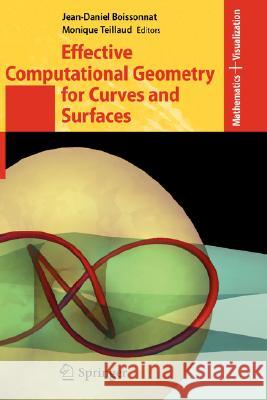
Jean-Daniel Boissonnat;Monique Teillaud
Effective Computational Geometry for Curves and Surfaces Jean-Daniel Boissonnat, Monique Teillaud 9783540332589 Springer-Verlag Berlin and Heidelberg GmbH &  - książkaWidoczna okładka, to zdjęcie poglądowe, a rzeczywista szata graficzna może różnić się od prezentowanej.

Effective Computational Geometry for Curves and Surfaces

ISBN-13: 9783540332589 / Angielski / Twarda / 2006 / 344 str.

Jean-Daniel Boissonnat;Monique Teillaud
cena 403,47 zł
(netto: 384,26 VAT:  5%)

Najniższa cena z 30 dni: 385,52 zł
Termin realizacji zamówienia:
ok. 22 dni roboczych
Bez gwarancji dostawy przed świętami

Darmowa dostawa!

Computational geometry emerged as a discipline in the seventies and has had considerable success in improving the asymptotic complexity of the solutions tobasicgeometricproblemsincludingconstructionsofdatastructures, convex hulls, triangulations, Voronoi diagrams and geometric arrangements as well as geometric optimisation. However, in the mid-nineties, it was recognized that the computational geometry techniques were far from satisfactory in practice and a vigorous e?ort has been undertaken to make computational geometry more practical. This e?ort led to major advances in robustness, geometric software engineering and experimental studies, and to the development of a large library of computational geometry algorithms, Cgal. The goal of this book is to take into consideration the multidisciplinary nature of the problem and to provide solid mathematical and algorithmic foundationsfore?ectivecomputationalgeometryforcurvesandsurfaces. This book covers two main approaches. In a ?rst part, we discuss exact geometric algorithms for curves and s- faces. We revisit two prominent data structures of computational geometry, namely arrangements (Chap. 1) and Voronoi diagrams (Chap. 2) in order to understand how these structures, which are well-known for linear objects, behave when de?ned on curved objects. The mathematical properties of these structures are presented together with algorithms for their construction. To ensure the e?ectiveness of our algorithms, the basic numerical computations that need to be performed are precisely speci?ed, and tradeo's are considered between the complexity of the algorithms (i. e. the number of primitive calls), and the complexity of the primitives and their numerical stability. Chap


Kategorie:
Nauka, Matematyka
Kategorie BISAC:
Mathematics > Geometria
Mathematics > Counting & Numeration
Mathematics > Graphic Methods
Wydawca:
Springer-Verlag Berlin and Heidelberg GmbH &
Seria wydawnicza:
Mathematics and Visualization
Język:
Angielski
ISBN-13:
9783540332589
Rok wydania:
2006
Dostępne języki:
Angielski
Wydanie:
2006
Numer serii:
000242696
Ilość stron:
344
Waga:
1.50 kg
Wymiary:
29.729.7 x 21.0
Oprawa:
Twarda
Wolumenów:
01

From the reviews:

"Boissonat and Teillaud have collected in this book the foundations of a computational geometry that no longer deals exclusively with linear objects but also with curved objects that arise in applications. The book is composed of eight chapters written by teams of experts in each theme, and is the result of an European Union project named ECG. The book can serve as an advanced graduate course on computational geometry and as a reference for researchers interested in geometric algorithms for curved objects." (Luiz Henrique de Figueiredo, MathDL, March, 2007)

1 Arrangements
Efi Fogel, Dan Halperin, Lutz Kettner, Monique Teillaud, Ron Wein, Nicola Wolpert 1.1 Introduction
1.2 Chronicles
1.3 Exact Construction of Planar Arrangements
1.3.1Construction by Sweeping
1.3.2 Incremental Construction
1.4  Software for Planar Arrangements
1.4.1 The Cgal Arrangements Package
1.4.2 Arrangements Traits
1.4.3 Traits Classes from Exacus
1.4.4An Emerging Cgal Curved Kernel
1.4.5 How To Speed UpYour Arrangement Computation in Cgal
1.5 Exact Construction in 3-Space
1.5.1 Sweeping Arrangements of Surfaces
1.5.2Arrangements of Quadricsin 3D
1.6 Controlled Perturbation: Fixed-Precision Approximation of Arrangements
1.7 Applications
1.7.1 Boolean Operations for Conics
1.7.2 Motion Planning for Discs
1.7.3 Lower Envelopes for Path Verification in Multi-Axis NC-Machining
1.7.4 Maximal Axis-Symmetric Polygon Containedin a Simple Polygon
1.7.5 Molecular Surfaces
1.7.6 Additional Applications
1.8 Further Reading and Open problems
2 Curved Voronoi Diagrams
Jean-Daniel Boissonnat, Camille Wormser, Mariette Yvinec
2.1 Introduction
2.2 Lower Envelopes and Minimization Diagrams
2.3 Affine Voronoi Diagrams
2.3.1 Euclidean Voronoi Diagrams of Points
2.3.2 Delaunay Triangulation
2.3.3 PowerDiagrams
2.4 Voronoi Diagrams with Algebraic Bisectors
2.4.1 Möbius Diagrams
2.4.2 Anisotropic Diagrams
2.4.3Apollonius Diagrams
2.5 Linearization
2.5.1Abstract Diagrams
2.5.2 Inverse Problem
2.6 Incremental Voronoi Algorithms
2.6.1 Planar Euclidean diagrams
2.6.2 Incremental Construction
2.6.3 The Voronoi Hierarchy
2.7 Medial Axis
2.7.1 Medial Axis and Lower Envelope
2.7.2 Approximation of the Medial Axis
2.8 Voronoi Diagrams in Cgal
2.9 Applications
3 Algebraic Issues in Computational Geometry
Bernard Mourrain, Sylvain Pion, Susanne Schmitt, Jean-Pierre Técourt, Elias Tsigaridas, Nicola Wolpert
3.1 Introduction
3.2 Computers and Numbers
3.2.1 Machine Floating Point Numbers: the IEEE 754 norm........119
3.2.2 Interval Arithmetic ......................................120
3.2.3 Filters..................................................121
3.3 Effective Real Numbers .......................................123
3.3.1 Algebraic Numbers ......................................124
3.3.2 Isolating Interval Representation of Real Algebraic Numbers
3.3.3 Symbolic Representation of Real Algebraic Numbers .........125
3.4 Computing with Algebraic Numbers ............................126
3.4.1 Resultant...............................................126
3.4.2 Isolation................................................131
3.4.3Algebraic Numbers of Small Degree ........................136
3.4.4 Comparison.............................................138
3.5 Multivariate Problems ........................................140
3.6  Topology of Planar Implicit Curves.............................142
3.6.1 The Algorithm from a Geometric Point of View .............143
3.6.2 Algebraic Ingredients.....................................144
3.6.3 How to Avoid Genericity Conditions .......................145
3.7  Topology of 3d Implicit Curves.................................146
3.7.1 Critical Points and Generic Position........................147
3.7.2 The Projected Curves ....................................148
3.7.3 Lifting a Point of the Projected Curve......................149
3.7.4 Computing Points of the Curve above CriticalValues.........151
3.7.5 Connecting the Branches .................................152
3.7.6 The Algorithm ..........................................153
3.8 Software ....................................................154
4 Differential Geometry on Discrete Surfaces
David Cohen-Steiner, Jean-Marie Morvan 
4.1 Geometric Properties of Subsets of Points .......................157
4.2  Length and Curvature of a Curve...............................158
4.2.1 The Length of Curves ....................................158
4.2.2 The Curvature of Curves .................................159
4.3   The Area of a Surface.........................................161
4.3.1 Definition of the Area ....................................161
4.3.2 An Approximation Theorem ..............................162
4.4 CurvaturesofSurfaces ........................................164
4.4.1 The Smooth Case........................................164
4.4.2 Pointwise Approximation of the Gaussian Curvature .........165
4.4.3 From Pointwise to Local..................................167
4.4.4 Anisotropic Curvature Measures...........................174
4.4.5 o-samples on a Surface....................................178
5 Meshing of Surfaces
Jean-Daniel Boissonnat, David Cohen-Steiner, Bernard Mourrain, Günter Rote, Gert Vegter
5.1 Introduction: What is Meshing?................................181
5.1.1 Overview ...............................................187
5.2 Marching Cubesand Cube-Based Algorithms ....................188
5.2.1 Criteria for a Correct Mesh Inside a Cube ..................190
5.2.2 Interval Arithmetic for Estimating the Range of a Function ...190
5.2.3 Global Parameterizability: Snyder’s Algorithm...............191
5.2.4 Small Normal Variation ..................................196
5.3 DelaunayRefinementAlgorithms...............................201
5.3.1 Using the Local Feature Size ..............................202
5.3.2 Using Critical Points.....................................209
5.4 A Sweep Algorithm...........................................213
5.4.1Meshing a Curve ........................................215
5.4.2Meshing a Surface .......................................216
5.5 Obtaining a Correct Mesh by Morse Theory .....................223
5.5.1 Sweeping through Parameter Space ........................223
5.5.2 Piecewise-Linear Interpolation of the Defining Function
5.6 Research Problems............................................227
6 Delaunay Triangulation Based Surface Reconstruction
Frédéric Cazals, Joachim Giesen
6.1 Introduction.................................................231
6.1.1 Surface Reconstruction ...................................231
6.1.2Applications ............................................231
6.1.3 Reconstruction Using the Delaunay Triangulation............232
6.1.4 A Classification of Delaunay Based Surface Reconstruction Methods
6.1.5 Organization of the Chapter ..............................234
6.2 Prerequisites.................................................234
6.2.1Delaunay Triangulations, Voronoi Diagrams and Related Concepts
6.2.2 Medial Axis and Derived Concepts.........................244
6.2.3 Topological and Geometric Equivalences....................249
6.2.4 Exercises ...............................................252
6.3 Overview of the Algorithms....................................253
6.3.1Tangent Plane Based Methods ............................253
6.3.2Restricted Delaunay Based Methods .......................257
6.3.3Inside/Outside Labeling.................................261
6.3.4Empty Balls Methods ....................................268
6.4 Evaluating Surface Reconstruction Algorithms
6.5 Software ....................................................272
6.6 Research Problems ...........................................273
7 Computational Topology: An Introduction
Günter Rote, Gert Vegter
7.1 Introduction.................................................277
7.2 Simplicialcomplexes..........................................278
7.3 Simplicial homology ..........................................282
7.4 MorseTheory................................................295
7.4.1 Smooth functions and manifolds ...........................295
7.4.2 Basic Results from Morse Theory..........................300
7.5 Exercises....................................................310
7.6 Appendix:SomeBasicResultsfromLinearAlgebra...............312
8 Appendix -Generic Programming and The Cgal Library
Efi Fogel, Monique Teillaud .......................................315
8.1 The Cgal OpenSourceProject ...............................315
8.2 Generic Programming ........................................316
8.3 Geometric Programming ......................................318
8.4 Cgal ......................................................320
References
Index


Udostępnij

Facebook - konto krainaksiazek.pl


Opinie o Krainaksiazek.pl na Opineo.pl

Partner Mybenefit

Krainaksiazek.pl w programie rzetelna firma Krainaksiaze.pl - płatności przez paypal

Czytaj nas na:

Facebook - krainaksiazek.pl
  • książki na zamówienie
  • granty
  • książka na prezent
  • kontakt
  • pomoc
  • opinie
  • regulamin
  • polityka prywatności

Zobacz:

  • Księgarnia czeska

  • Wydawnictwo Książkowe Klimaty

1997-2025 DolnySlask.com Agencja Internetowa

© 1997-2022 krainaksiazek.pl
     
KONTAKT | REGULAMIN | POLITYKA PRYWATNOŚCI | USTAWIENIA PRYWATNOŚCI
Zobacz: Księgarnia Czeska | Wydawnictwo Książkowe Klimaty | Mapa strony | Lista autorów
KrainaKsiazek.PL - Księgarnia Internetowa

Polityka prywatnosci - link
Krainaksiazek.pl - płatnośc Przelewy24
Przechowalnia Przechowalnia





