Economics of Natural Disasters: A Machine-Generated Literature Overview » książka





Economics of Natural Disasters: A Machine-Generated Literature Overview
ISBN-13: 9789819974290 / Angielski
Economics of Natural Disasters: A Machine-Generated Literature Overview
ISBN-13: 9789819974290 / Angielski
(netto: 614,84 VAT: 5%)
Najniższa cena z 30 dni: 616,85
ok. 22 dni roboczych
Dostawa w 2026 r.
Darmowa dostawa!
1. Overview
2. Theoretical Framework
a. Game Theory Models - disaster, floods, cyclones, earthquakes, volcano, game theory, network, optimization, stochastic, equilibrium
b. Computable general equilibrium Models and Input Output Models– disaster, floods, cyclones,
earthquakes, volcano, computable general equilibrium, input output models, equilibrium
3. Human Capital
a. Human Fatalities (disaster, floods, cyclones, earthquake, fatalities, deaths, injuries, losses to human life, female fatalities, mass fatality)
b. Investment in Health and Education (effects of disaster on education, health, children health, food security, human capital accumulation, health care workers, smoking and relapse, alcohol consumption, psychosocial effects, mental health)
c. Household Well Being (disaster, floods, cyclones, social and economic well-being, stress, trauma, hedonic and eudaemonic well-being,
4. Social Impacts of Disasters
a. Unemployment (disaster, floods, cyclones, earthquake, unemployment, employment, flood, drought,
agricultural unemployment, labour, job loss, income loss, wages)
b. Migration (disaster, floods, cyclones, earthquake, migration, climate change, mobility)
c. Gender Inequality (disaster, floods, cyclones, earthquake, gender, gender inequality, female fatality,
female employment, gender vulnerability, disaster and women)
d. Disaster-induced Crime (disaster, floods, cyclones, earthquake, crime, violence, violence against women, criminal justice, law, social order, fraud)
e. Farmer Suicides (disaster, floods, cyclones, earthquake, farmer suicide, agricultural crisis and suicide, agrarian distress, climate change and farmer’s mental health)
5. Political Economy of Disasters
a. Elections (disaster, floods, cyclones, earthquake, elections, voting, electoral cycle, election expenditure, political risk)
b. Disaster Grant (disaster, floods, cyclones, earthquake, grant, financial assistance, disaster mitigation, government funds, disaster expenditure)
c. Corruption (disaster, floods, cyclones, earthquake, corruption, bribes, intervention and strategies to reduce corruption, public sector corruption)
d. Conflicts (disaster, floods, cyclones, earthquake, conflict, riots, peace, war, violence, social crisis)
6. Economic Growth and Sectorial Impact
a. Economic Development (disaster, floods, cyclones, earthquake, economic growth, damage due to floods, GDP growth, human development index)
b. Agricultural Productivity (disaster, floods, cyclones, earthquake, agriculture, climate sensitivity, agricultural productivity)
c. Manufacturing Industry (disaster, floods, cyclones, earthquake, manufacturing, production risk, role of technology, small and medium enterprises, supply chain, industrial growth)
d. International Trade (disaster, floods, cyclones, earthquake, weather variations, international trade, macroeconomy, calamities, global value chain)
e. Foreign Direct Investment (disaster, floods, cyclones, earthquake, environmental impact, foreign direct investment, financial flows, exports and imports, remittances)
7. Fiscal Pressures (Disaster risk financing; Fiscal impact; Public finances, fiscal consequences of
natural disasters)
a. Fiscal Expenditure
b. State and Centre Revenue
8. Disaster Management and Policy (Climatic disasters; Disaster risk reduction, Disaster Management, humanitarian aid. Microeconomic impact of aid, Flood damage assessment. Extreme events Disaster risk management, Disasters. Risk, crop Insurance, Disaster mitigation policy, political economy of disaster management)
a. Risk Mitigation
b. Adaptation Strategies
c. Disaster Aid
Prarthna Agarwal Goel is Assistant Professor with the Department of Economics, University School of Humanities and Social Sciences at Guru Gobind Singh Indraprastha University. She completed her PhD and M.Phil from Jawaharlal Nehru University, Centre for International Trade and Development. She has done her Master's in Economics from Delhi School of Economics (DSE) and Bachelor's in Economics from Hansraj College, Delhi University. She has a teaching experience of more than 10 years at Delhi University and GGS Indraprastha University. Prior to joining the academics, Dr Prarthna has worked with the analytics industry for about 7 years. During her tenure with the corporate industry, she has worked extensively on credit risk modelling and marketing mix analytics. Dr Prarthna is an economist with areas of interest and specialization in the field of applied economics, development economics, environment, and gender studies. She has published in high-ranking journals and conducted field projects through national and international funding. She is the review editor for Frontiers in Climate. She also holds a patent on ‘Marketing Investment Optimizer with Dynamic Hierarchies’ in U.S., China and Australia.
Joyita Roy Chowdhury is an Assistant Professor of Economics at FLAME University, Pune, India. Before joining FLAME, she was a Visiting Assistant Professor of Economics at Hobart and William Smith Colleges, New York, USA. She received her Ph.D. and M.S. in Economics from the University of Utah, USA. She holds an M.Phil. degree in Development Studies and Economics, an MSc degree in Economics, and a BSc degree in Economics (Honors), all from the University of Calcutta, Kolkata. Her research interests lie in the areas of development microeconomics and public policy.
Charu Grover Sharma is Assistant Professor in Trade Operations and Logistics Discipline at Indian Institute of Foreign Trade (IIFT), Ministry of Commerce, New Delhi, India. Before joining IIFT, she was working as Assistant Professor, Department of Economics at Shaheed Bhagat Singh College, University of Delhi and SGND Khalsa College, University of Delhi. She has been a Visiting Professor at Symbiosis School of Economics. She received her PhD, MPhil, MA Economics from Jawaharlal Nehru University and BA(Hons) Economics from Hansraj College, University of Delhi. Her main research interests are in areas of environment economics, natural disaster, energy efficiency and labeling, choice experiments and game theory. She has published her research in ABDC ranked journals and participated in various international conferences.
Yashobanta Parida is an Assistant Professor in Economics at FLAME University, Pune, India. He has a Ph.D. in Economics from the Centre for International Trade and Development (CITD), Jawaharlal Nehru University (JNU), and an M. Phil in Economics from Delhi School of Economics (DSE), University of Delhi. His area of interest lies in applied development economics, focusing on the political economy of natural disasters, disaster policy, firm-level productivity, applied international trade, and tourism economics. Before his Ph.D., he worked as a researcher for seven years at the Institute of Rural Management Anand (IRMA) and the Institute of Economic Growth, New Delhi. He has published more than 20 articles in international journals such as World Development, Environment and Development Economics, Nature Scientific Reports, Environment, Development and Sustainability, Nature, and Economics of Disasters and Climate Change. He has published several opinion articles in national newspapers related to disaster impact and policy. He is an Associate Editor in the journal Humanities & Social Sciences Communications.
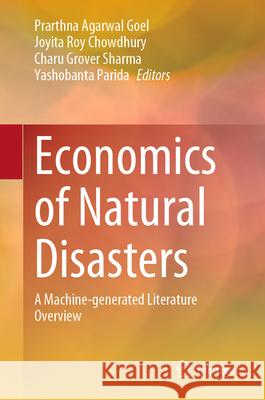
This book is a machine-generated literature overview that explores the theoretical and empirical aspects of economics of natural disasters such as floods, cyclones, droughts, and earthquakes from a policy perspective. It provides a comprehensive collection of economic theories in Disasters and empirical findings that would benefit scholars in academia and policy-making. On the theory side, there is a growing use of game theory, Input-Output, computable general equilibrium models, and Catastrophe models to analyze the economic impacts of natural disasters. These models provide optimal decisions for the government concerning disaster relief. On the empirical front, studies showing causal and associative relationships between disasters and socio-economic variables are important for estimating disaster-related losses and making appropriate policy suggestions.
The book explores different critical aspects and interlinkages of natural disasters; economic, social, and political. Besides having localized effects, disasters influence macroeconomic parameters, such as impacts on international trade and foreign direct investment. Moreover, the effects of disasters are subject to interventions from various national and international agencies. It discusses fiscal pressures caused due to disasters and existing policies related to disaster-risk mitigation and management as a guide to policy-making. It is an important guide to researchers and policymakers examining the socio-economic impact of natural disasters and public investment for disaster-risk mitigation.




Czytaj nas na:
1997-2025 DolnySlask.com Agencja Internetowa
KrainaKsiazek.PL - Księgarnia Internetowa


