• Wyszukiwanie zaawansowane
  • Kategorie
  • Kategorie BISAC
  • Książki na zamówienie
  • Promocje
  • Granty
  • Książka na prezent
  • Opinie
  • Pomoc
  • Załóż konto
  • Zaloguj się

Economic Modeling Using Artificial Intelligence Methods » książka


zaloguj się | załóż konto
Logo Krainaksiazek.pl

koszyk

konto

szukaj
topmenu
Księgarnia internetowa
Szukaj
Książki na zamówienie
Promocje
Granty
Książka na prezent
Moje konto
Pomoc
 
 
Wyszukiwanie zaawansowane
Pusty koszyk
Bezpłatna dostawa dla zamówień powyżej 20 złBezpłatna dostawa dla zamówień powyżej 20 zł

Kategorie główne

• Nauka
 [2946600]
• Literatura piękna
 [1856966]

  więcej...
• Turystyka
 [72221]
• Informatyka
 [151456]
• Komiksy
 [35826]
• Encyklopedie
 [23190]
• Dziecięca
 [619653]
• Hobby
 [140543]
• AudioBooki
 [1577]
• Literatura faktu
 [228355]
• Muzyka CD
 [410]
• Słowniki
 [2874]
• Inne
 [445822]
• Kalendarze
 [1744]
• Podręczniki
 [167141]
• Poradniki
 [482898]
• Religia
 [510455]
• Czasopisma
 [526]
• Sport
 [61590]
• Sztuka
 [243598]
• CD, DVD, Video
 [3423]
• Technologie
 [219201]
• Zdrowie
 [101638]
• Książkowe Klimaty
 [124]
• Zabawki
 [2473]
• Puzzle, gry
 [3898]
• Literatura w języku ukraińskim
 [254]
• Art. papiernicze i szkolne
 [8170]
Kategorie szczegółowe BISAC

Economic Modeling Using Artificial Intelligence Methods

ISBN-13: 9781447150091 / Angielski / Twarda / 2013 / 261 str.
Tshilidzi Marwala
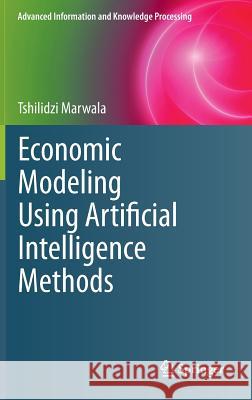
Economic Modeling Using Artificial Intelligence Methods Tshilidzi Marwala 9781447150091 Springer - książkaWidoczna okładka, to zdjęcie poglądowe, a rzeczywista szata graficzna może różnić się od prezentowanej.

Economic Modeling Using Artificial Intelligence Methods

ISBN-13: 9781447150091 / Angielski / Twarda / 2013 / 261 str.

Tshilidzi Marwala
cena 403,47 zł
(netto: 384,26 VAT:  5%)

Najniższa cena z 30 dni: 385,52 zł
Termin realizacji zamówienia:
ok. 22 dni roboczych
Bez gwarancji dostawy przed świętami

Darmowa dostawa!
inne wydania

Economic Modeling Using Artificial Intelligence Methods examines the application of artificial intelligence methods to model economic data. Traditionally, economic modeling has been modeled in the linear domain where the principles of superposition are valid. The application of artificial intelligence for economic modeling allows for a flexible multi-order non-linear modeling. In addition, game theory has largely been applied in economic modeling. However, the inherent limitation of game theory when dealing with many player games encourages the use of multi-agent systems for modeling economic phenomena.The artificial intelligence techniques used to model economic data include:

  • multi-layer perceptron neural networks
  • radial basis functions
  • support vector machines
  • rough sets
  • genetic algorithm
  • particle swarm optimization
  • simulated annealing
  • multi-agent system
  • incremental learning
  • fuzzy networks
Signal processing techniques are explored to analyze economic data, and these techniques are the time domain methods, time-frequency domain methods and fractals dimension approaches. Interesting economic problems such as causality versus correlation, simulating the stock market, modeling and controling inflation, option pricing, modeling economic growth as well as portfolio optimization are examined. The relationship between economic dependency and interstate conflict is explored, and knowledge on how economics is useful to foster peace - and vice versa - is investigated. Economic Modeling Using Artificial Intelligence Methods deals with the issue of causality in the non-linear domain and applies the automatic relevance determination, the evidence framework, Bayesian approach and Granger causality to understand causality and correlation.Economic Modeling Using Artificial Intelligence Methods makes an important contribution to the area of econometrics, and is a valuable source of reference for graduate students, researchers and financial practitioners.

Kategorie:
Informatyka, Bazy danych
Kategorie BISAC:
Computers > Computer Science
Computers > Artificial Intelligence - Computer Vision & Pattern Recognition
Computers > Mathematical & Statistical Software
Wydawca:
Springer
Seria wydawnicza:
Advanced Information and Knowledge Processing
Język:
Angielski
ISBN-13:
9781447150091
Rok wydania:
2013
Wydanie:
2013
Numer serii:
000275594
Ilość stron:
261
Waga:
0.56 kg
Wymiary:
23.39 x 15.6 x 1.75
Oprawa:
Twarda
Wolumenów:
01
Dodatkowe informacje:
Wydanie ilustrowane

From the reviews:

"The book explores the application of artificial intelligence methods to economic data modelling. ... the book is well addressed to graduate students as well as researchers and practitioners in the field of finance and economics." (Vangelis Grigoroudis, zbMATH, Vol. 1269, 2013)

Foreword.- Preface.- Acknowledgements.- Introduction to Economic Modeling.- Techniques for Economic Modeling: Unlocking the Character of Data.- Automatic Relevance Determination in Economic Modeling.- Neural Approaches to Economic Modeling.- Bayesian Support Vector Machines for Economic Modeling: Application to Option Pricing.- Rough Sets Approach to Economic Modeling: Unlocking Knowledge in Financial Data.- Missing Data Approaches to Economic Modeling: Optimization Approach.- Correlations versus Causality Approaches to Economic Modeling.- Evolutionary Approaches to Computational Economics: Application to Portfolio Optimization.- Real-time Approaches to Computational Economics: Self Adaptive Economic Systems.- Multi-Agent Approaches to Economic Modeling: Game Theory, Ensembles, Evolution and the Stock Market.- Control Approaches to Economic Modeling: Application to Inflation Targeting.- Modeling Interstate Conflict: The Role of Economic Interdependency for Maintaining Peace.- Conclusions and Further Work.- Index.

Tshilidzi Marwala, born in Venda (Limpopo, South Africa), is the Dean of Engineering at the University of Johannesburg. He is a senior member of the IEEE and distinguished member of the ACM. He is the youngest recipient of the Order of Mapungubwe and was awarded the President Award by the National Research Foundation. His research interests include the applications of computational intelligence to engineering, computer science, finance, social science and medicine.

In addition to Economic Modeling Using Artificial Intelligence Methods, he has previously published 3 books with Springer: Condition Monitoring Using Computational Intelligence Methods (2012), Militarized Conflict Modeling Using Computational Intelligence Techniques (2011); and Finite Element Model Updating Using Computational Intelligence Techniques (2010).

Economic Modeling Using Artificial Intelligence Methods examines the application of artificial intelligence methods to model economic data. Traditionally, economic modeling has been modeled in the linear domain where the principles of superposition are valid. The application of artificial intelligence for economic modeling allows for a flexible multi-order non-linear modeling. In addition, game theory has largely been applied in economic modeling. However, the inherent limitation of game theory when dealing with many player games encourages the use of multi-agent systems for modeling economic phenomena.

The artificial intelligence techniques used to model economic data include:

  • multi-layer perceptron neural networks
  • radial basis functions
  • support vector machines
  • rough sets
  • genetic algorithm
  • particle swarm optimization
  • simulated annealing
  • multi-agent system
  • incremental learning
  • fuzzy networks

Signal processing techniques are explored to analyze economic data, and these techniques are the time domain methods, time-frequency domain methods and fractals dimension approaches. Interesting economic problems such as causality versus correlation, simulating the stock market, modeling and controling inflation, option pricing, modeling economic growth as well as portfolio optimization are examined. The relationship between economic dependency and interstate conflict is explored, and knowledge on how economics is useful to foster peace – and vice versa – is investigated. Economic Modeling Using Artificial Intelligence Methods deals with the issue of causality in the non-linear domain and applies the automatic relevance determination, the evidence framework, Bayesian approach and Granger causality to understand causality and correlation.

Economic Modeling Using Artificial Intelligence Methods makes an important contribution to the area of econometrics, and is a valuable source of reference for graduate students, researchers and financial practitioners.


Udostępnij

Facebook - konto krainaksiazek.pl


Opinie o Krainaksiazek.pl na Opineo.pl

Partner Mybenefit

Krainaksiazek.pl w programie rzetelna firma Krainaksiaze.pl - płatności przez paypal

Czytaj nas na:

Facebook - krainaksiazek.pl
  • książki na zamówienie
  • granty
  • książka na prezent
  • kontakt
  • pomoc
  • opinie
  • regulamin
  • polityka prywatności

Zobacz:

  • Księgarnia czeska

  • Wydawnictwo Książkowe Klimaty

1997-2025 DolnySlask.com Agencja Internetowa

© 1997-2022 krainaksiazek.pl
     
KONTAKT | REGULAMIN | POLITYKA PRYWATNOŚCI | USTAWIENIA PRYWATNOŚCI
Zobacz: Księgarnia Czeska | Wydawnictwo Książkowe Klimaty | Mapa strony | Lista autorów
KrainaKsiazek.PL - Księgarnia Internetowa

Polityka prywatnosci - link
Krainaksiazek.pl - płatnośc Przelewy24
Przechowalnia Przechowalnia






