• Wyszukiwanie zaawansowane
  • Kategorie
  • Kategorie BISAC
  • Książki na zamówienie
  • Promocje
  • Granty
  • Książka na prezent
  • Opinie
  • Pomoc
  • Załóż konto
  • Zaloguj się

Economic Evolution and Demographic Change: Formal Models in Social Sciences » książka


zaloguj się | załóż konto
Logo Krainaksiazek.pl

koszyk

konto

szukaj
topmenu
Księgarnia internetowa
Szukaj
Książki na zamówienie
Promocje
Granty
Książka na prezent
Moje konto
Pomoc
 
 
Wyszukiwanie zaawansowane
Pusty koszyk
Bezpłatna dostawa dla zamówień powyżej 20 złBezpłatna dostawa dla zamówień powyżej 20 zł

Kategorie główne

• Nauka
 [2949965]
• Literatura piękna
 [1857847]

  więcej...
• Turystyka
 [70818]
• Informatyka
 [151303]
• Komiksy
 [35733]
• Encyklopedie
 [23180]
• Dziecięca
 [617748]
• Hobby
 [139972]
• AudioBooki
 [1650]
• Literatura faktu
 [228361]
• Muzyka CD
 [398]
• Słowniki
 [2862]
• Inne
 [444732]
• Kalendarze
 [1620]
• Podręczniki
 [167233]
• Poradniki
 [482388]
• Religia
 [509867]
• Czasopisma
 [533]
• Sport
 [61361]
• Sztuka
 [243125]
• CD, DVD, Video
 [3451]
• Technologie
 [219309]
• Zdrowie
 [101347]
• Książkowe Klimaty
 [123]
• Zabawki
 [2362]
• Puzzle, gry
 [3791]
• Literatura w języku ukraińskim
 [253]
• Art. papiernicze i szkolne
 [7933]
Kategorie szczegółowe BISAC

Economic Evolution and Demographic Change: Formal Models in Social Sciences

ISBN-13: 9783540561729 / Angielski / Miękka / 1992 / 409 str.
Gunter Haag; Ulrich Mueller; Klaus G. Troitzsch
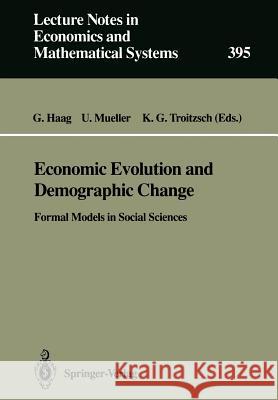
Economic Evolution and Demographic Change: Formal Models in Social Sciences Haag, Günter 9783540561729 Springer-Verlag - książkaWidoczna okładka, to zdjęcie poglądowe, a rzeczywista szata graficzna może różnić się od prezentowanej.

Economic Evolution and Demographic Change: Formal Models in Social Sciences

ISBN-13: 9783540561729 / Angielski / Miękka / 1992 / 409 str.

Gunter Haag; Ulrich Mueller; Klaus G. Troitzsch
cena 201,72
(netto: 192,11 VAT:  5%)

Najniższa cena z 30 dni: 192,74
Termin realizacji zamówienia:
ok. 22 dni roboczych
Bez gwarancji dostawy przed świętami

Darmowa dostawa!

The articles collected in this volume have two features in common: they wantto integrate economics, demography and geography, and they want to overcome the stationary approach in modelling in favour of a dynamic one. The book is subdivided into three parts, where Part I is focussing on economic evolution, Part II on geographical development and Part III is related to demographic change. The present volume aims at providing a new look at this triangle in view of the classical background of discussions by introducing new research ideas focussing in nonlinear dynamics and stochastic modelling. Thus the main purpose of this book is to make a contribution to the interdisciplinary work needed to integrate the effortsbetween these three research fields and to serve as a research source in demonstrating the current state of art in dynamic modelling. The book isaddressed to social scientists in general, and those in particular with a background in economics, geographics and demographics. It should also be of interest to mathematicians, physicists, and systems analysts interested in model building and applications of nonlinear dynamics.


Kategorie:
Nauka, Ekonomia i biznes
Kategorie BISAC:
Gardening > General
Business & Economics > Economics - Theory
Science > Earth Sciences - Geography
Wydawca:
Springer-Verlag
Seria wydawnicza:
Lecture Notes in Economic and Mathematical Systems
Język:
Angielski
ISBN-13:
9783540561729
Rok wydania:
1992
Wydanie:
Softcover Repri
Numer serii:
000221492
Ilość stron:
409
Waga:
0.75 kg
Wymiary:
24.4 x 17.0
Oprawa:
Miękka
Wolumenów:
01
Dodatkowe informacje:
Bibliografia
Wydanie ilustrowane

I Formal Models in Economics.- 1 A chaotic process with slow feed back: The case of business cycles.- 1.1 A first model.- 1.1.1 Investments.- 1.1.2 Consumption.- 1.2 The cubic iterative map.- 1.2.1 Fixed points, cycles and chaos.- 1.2.2 Formal analysis of chaotic dynamics.- 1.2.3 Symbolic dynamics.- 1.3 “Brownian random walk”.- 1.4 Digression on order and disorder.- 1.5 The general model.- 1.5.1 Relaxation cycles.- 1.5.2 Other cycles.- 1.5.3 The Slow Feed Back.- 1.6 Conclusion.- 2 Nonlinear Interactions in the Economy.- 2.1 Introduction.- 2.2 The Long Wave Model.- 2.3 Mode-Locking and Chaos.- 2.4 Conclusion.- 3 Fast and Slow Processes of Economic Evolution.- 3.1 Introduction and Background.- 3.2 The Problems of Economic Development Theory.- 3.3 Synergetic Development Economics — Some Basic Concepts.- 3.4 The Arena.- 3.5 Rules of the Game.- 3.6 Networks.- 3.7 Knowledge As Networks and Knowledge On Networks.- 3.8 Communication and Creativity — some Historical Evidence.- 3.9 Creativity and Communications — Econometric Results.- 3.10 The Inverted Explanation.- 3.11 The Destruction of the Industrial Society.- 3.12 The New Economic Structure.- 4 A stochastic model of technological evolution.- 4.1 Introduction.- 4.2 A Substitution Model.- 4.3 Application of a general evolutionary model to technological change.- 4.4 Discussion.- 5 Evolution of Production Processes.- 5.1 Introduction.- 5.2 Basic Assumptions.- 5.3 Formalization.- 5.4 Chernenko’s Results.- 5.5 An alternative macro model.- 5.6 Simulation results.- 5.7 Modeling evolution on the individual level.- 5.7.1 Simulation run with total extinction.- 5.7.2 Simulation run without extinction.- 5.8 Conclusions.- 6 Innovation Diffusion through Schumpeterian Competition.- 6.1 Introduction: From “Homo Economicus” to “Homo Socialis”: Innovation diffusion as a collective socio-ecological dynamic choice process.- 6.2 Analytical basis of Schumpeterian Competition: Collective choice and relative socio-spatial dynamics.- 6.3 Explicit analytical presentation of the innovation diffusion dynamics: Dynamic choice models.- 6.4 Intervention of an active environment: Generation of innovation adoption niches.- 6.5 Temporal innovation diffusion process.- 6.5.1 Qualitative analysis of the Schumpeter competition cycles for Clusters of competitive innovations.- 6.5.2 Variational principle of meso-level collective choice behaviour.- 6.6 Concluding Remark.- 7 Nonlinear Threshold Dynamics: Further Examples for Chaos in Social Sciences.- 7.1 Introduction.- 7.2 A Short Course into Chaos.- 7.3 How Addictive Behaviour and Threshold Adjustment May Imply Chaos.- 7.4 How Asymmetric Investment Behaviour of Two Competing Firms Generates Chaos.- 7.5 Concluding Remarks.- II Formal Models in Geography.- 8 Geography Physics and Synergetics.- 8.1 Introduction.- 8.2 Models of geographical interactions.- 8.2.1 Polarization and gravitation.- 8.2.2 Reformulations of the gravity model.- 8.2.3 The entropy maximizing approach.- 8.2.4 About men and particles.- 8.3 Models of geographical structures.- 8.3.1 The relativity of geographical space.- 8.3.2 Fractality of geographical space.- 8.3.3 Space—time convergence.- 8.3.4 The example of urban hierarchies.- 8.3.5 Processes and geographical forms.- 8.4 Conclusion.- 9 Chaotic Behaviour in Spatial Systems and Forecasting.- 9.1 Introduction.- 9.2 An Example for Chaotic Evolution: Migratory Systems.- 9.2.1 A Numerical Simulation.- 9.3 Estimation of Trend Parameters.- 9.4 The Estimation Procedure.- 9.5 Forecasting for Systems with Chaotic Evolution.- 9.5.1 Step I: Confidence Limits on Model Parameters by Monte Carlo Estimation.- 9.5.2 Step II: Monte Carlo Simulation of Systems Trajectories.- 10 Model Identification for Estimating Missing Values in Space—Time Data Series: Monthly Inflation in the US Urban System, 1977–1990.- 10.1 Introduction.- 10.2 Background.- 10.3 Update of individual urban area ARIMA models.- 10.4 Jackknife results for New York and Los Angeles.- 10.5 Transfer function interpolation.- 10.6 Implications.- 11 Explanation of Residential Segregation in one City. The Case of Cologne.- 11.1 Introduction.- 11.2 Measuring Segregation.- 11.3 Data.- 11.4 The Index of Inequality.- 11.5 Solutions.- 11.6 Statistical Explanation.- 11.7 Discussion.- 12 Determinants of Remigrant Behavior: An Application of the Grouped Cox Model.- 12.1 Introduction.- 12.2 Migrants in Germany.- 12.3 Foundations of the Survival Analysis.- 12.4 The Grouped Cox Model.- 12.5 Results.- 12.5.1 Estimations with the Total Sample.- 12.5.2 Estimations with a Subsample (20% CensoredData).- 12.6 Conclusion.- III Formal Models in Demography.- 13 Birth Control as a Social Dilemma.- 13.1 Introduction.- 13.1.1 Purpose.- 13.2 Method.- 13.3 Results.- 13.4 Discussion.- 14 Sex—Ratio, divorce, and labor force participation — An analysis of international aggregate data.- 14.1 Introduction.- 14.2 Data and measurement of variables.- 14.3 Results.- 14.4 Conclusion.- 15 Some Aspects of Competing Risks in Demography.- 15.1 Introduction.- 15.2 The Latent Failure Model.- 15.3 The Problem of Nonidentifiability.- 15.3.1 Inclusion of covariates (regressors).- 15.3.2 Bounds on net probabilities.- 15.3.3 Functional form assumptions about S.- 15.3.4 The postulate of independence.- 15.4 A Discrete-Time Model of Risk Elimination.- 15.5 Example.- 15.6 Conclusions.- 16 Dynamic Structural Equations in Discrete and Continuous Time.- 16.1 Introduction.- 16.2 Dynamic State Space Models.- 16.3 Maximum Likelihood Parameter Estimation with Continuous Measurements.- 16.4 Maximum Likelihood Parameter Estimation with Discrete Measurements.- 16.5 Conclusion.- 17 Recursive Probability Estimators for Count Data.- 17.1 Introduction.- 17.2 Katz Family.- 17.3 Separability and the A.L.D.P..- 17.4 Application.- 18 A Mathematical Model for Behavioral Changes by Pair Interactions.- 18.1 Introduction.- 18.2 The master equation.- 18.3 Most probable behavioral distribution.- 18.4 Kinds of pair interactions.- 18.4.1 Computer simulations.- 18.5 Game dynamical equations.- 18.5.1 Connection between Boltzmann-like and game dynamical equations.- 18.5.2 Stochastic version of the game dynamical equations.- 18.5.3 Selforganization of behavioral conventions by competition between equivalent strategies.- 18.6 Summary and Conclusions.- 19 Employment and Education as Non—Linear Network—Populations, Part I: Theory, Categorization and Methodology.- 19.1 Self—organization Models.- 19.2 Classification Stabilities.- 19.3 Methodolgy Considerations.- 19.3.1 Model Selection.- 19.3.2 Basic Assumptions.- 19.3.3 Micro—Macro—Relations.- 19.4 Systems Couplings.- 20 Employment and Education as Non-Linear Network Populations Part II: Model Structures, Estimations, and Scenarios.- 20.1 The Explanatory Framework.- 20.1.1 The Explanation Scheme for the Master Equation Framework.- 20.1.2 Five Different Designs for Factor Selections.- 20.2 Model Structures.- 20.2.1 The Employment Model.- 20.2.2 Equations of Motion.- 20.2.3 The Education Model.- 20.3 Estimation Results.- 20.4 Scenario Results.- 20.5 Scenario — Dimensions.- 20.6 Future Perspectives.

Mueller, Ulrich Mueller is Professor at the Institut fur Germanist... więcej >


Udostępnij

Facebook - konto krainaksiazek.pl


Opinie o Krainaksiazek.pl na Opineo.pl

Partner Mybenefit

Krainaksiazek.pl w programie rzetelna firma Krainaksiaze.pl - płatności przez paypal

Czytaj nas na:

Facebook - krainaksiazek.pl
  • książki na zamówienie
  • granty
  • książka na prezent
  • kontakt
  • pomoc
  • opinie
  • regulamin
  • polityka prywatności

Zobacz:

  • Księgarnia czeska

  • Wydawnictwo Książkowe Klimaty

1997-2025 DolnySlask.com Agencja Internetowa

© 1997-2022 krainaksiazek.pl
     
KONTAKT | REGULAMIN | POLITYKA PRYWATNOŚCI | USTAWIENIA PRYWATNOŚCI
Zobacz: Księgarnia Czeska | Wydawnictwo Książkowe Klimaty | Mapa strony | Lista autorów
KrainaKsiazek.PL - Księgarnia Internetowa

Polityka prywatnosci - link
Krainaksiazek.pl - płatnośc Przelewy24
Przechowalnia Przechowalnia






