• Wyszukiwanie zaawansowane
  • Kategorie
  • Kategorie BISAC
  • Książki na zamówienie
  • Promocje
  • Granty
  • Książka na prezent
  • Opinie
  • Pomoc
  • Załóż konto
  • Zaloguj się

Economic Decisions Under Uncertainty » książka


zaloguj się | załóż konto
Logo Krainaksiazek.pl

koszyk

konto

szukaj
topmenu
Księgarnia internetowa
Szukaj
Książki na zamówienie
Promocje
Granty
Książka na prezent
Moje konto
Pomoc
 
 
Wyszukiwanie zaawansowane
Pusty koszyk
Bezpłatna dostawa dla zamówień powyżej 20 złBezpłatna dostawa dla zamówień powyżej 20 zł

Kategorie główne

• Nauka
 [2950560]
• Literatura piękna
 [1849509]

  więcej...
• Turystyka
 [71097]
• Informatyka
 [151150]
• Komiksy
 [35848]
• Encyklopedie
 [23178]
• Dziecięca
 [617388]
• Hobby
 [139064]
• AudioBooki
 [1657]
• Literatura faktu
 [228597]
• Muzyka CD
 [383]
• Słowniki
 [2855]
• Inne
 [445295]
• Kalendarze
 [1464]
• Podręczniki
 [167547]
• Poradniki
 [480102]
• Religia
 [510749]
• Czasopisma
 [516]
• Sport
 [61293]
• Sztuka
 [243352]
• CD, DVD, Video
 [3414]
• Technologie
 [219456]
• Zdrowie
 [101002]
• Książkowe Klimaty
 [124]
• Zabawki
 [2311]
• Puzzle, gry
 [3459]
• Literatura w języku ukraińskim
 [254]
• Art. papiernicze i szkolne
 [8079]
Kategorie szczegółowe BISAC

Economic Decisions Under Uncertainty

ISBN-13: 9783790804362 / Angielski / Miękka / 1989 / 359 str.
Sinn; Hans-Werner Sinn
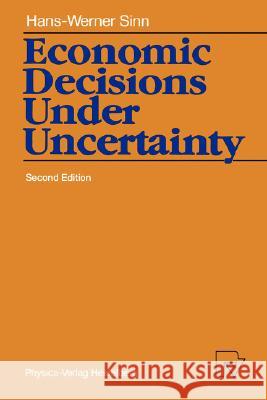
Economic Decisions Under Uncertainty Sinn                                     Hans-Werner Sinn 9783790804362 Physica-Verlag - książkaWidoczna okładka, to zdjęcie poglądowe, a rzeczywista szata graficzna może różnić się od prezentowanej.

Economic Decisions Under Uncertainty

ISBN-13: 9783790804362 / Angielski / Miękka / 1989 / 359 str.

Sinn; Hans-Werner Sinn
cena 200,77
(netto: 191,21 VAT:  5%)

Najniższa cena z 30 dni: 192,74
Termin realizacji zamówienia:
ok. 22 dni roboczych
Dostawa w 2026 r.

Darmowa dostawa!

The Fundamental Issues Involved Why do we need a theory of uncertainty? It is a fact that almost all man's economic decisions are made under conditions of uncertainty, but this fact alone does not provide a strong enough argument for making the effort necessary to generalize ordinary preference theory designed for a world of perfect certainty. In accordance with Occam's Razor, the mathematician may well welcome a generalization of assumptions even if it does not promise more than a restatement of known results. The economist, however, will only be well disposed towards making the effort if he can expect to achieve new insights and interesting results, for he is interested in the techniques necessary for the generalization only as means to an end, not as ends in themselves. A stronger reason for developing a theory of uncertainty, therefore, seems to be the fact that there are kinds of economic activities to which the non-stochastic preference theory has no access or has access only through highly artificial constructions. Such activities include portfolio decisions of wealth holders, speculation, and insurance. These will be considered in detail in the last chapter of the book. The main purpose of this book, however, is not to apply a theory of uncertainty to concrete economic problems, the purpose rather is to formulate such a theory.


Kategorie:
Nauka, Ekonomia i biznes
Kategorie BISAC:
Political Science > Public Policy - Economic Policy
Business & Economics > Operations Research
Business & Economics > Economics - Theory
Wydawca:
Physica-Verlag
Język:
Angielski
ISBN-13:
9783790804362
Rok wydania:
1989
Wydanie:
1989
Ilość stron:
359
Waga:
0.58 kg
Wymiary:
15.4 x 23.4 x 2.7
Oprawa:
Miękka
Wolumenów:
01

One The Object of Choice under Uncertainty.- A The Basic Decision-Theoretic Approach.- 1. The Ordering of Alternatives.- 2. Action Results under Uncertainty.- B Probabilities.- 1. Probabilities as Degrees of Confidence.- 2. Objective Probability and Real Indeterminateness.- 3. The Assessment of Equivalent Objective Probabilities.- 3.1. Completely Unknown Probabilities.- 3.1.1. The Ellsberg Paradox.- 3.1.2. The Axiom of Independence.- 3.1.3. A Rehabilitation of the Principle of Insufficient Reason.- 3.1.4. Equivalent Probabilities in Tree Diagrams.- 3.1.5. Criticism of the Principle of Insufficient Reason.- 3.2. Partially Known Probabilities: The Step Theory of Probability.- 3.2.1. Completely Known Probability Hierarchies.- 3.2.2. Partly Known Probability Hierarchies.- 3.3. Result.- Two Rational Behavior under Risk.- A The Two-Parametric Substitutive Criteria.- 1. Lange’s Criterion.- 2. The Domar-Musgrave Criterion.- 3. The (?, ?) Criterion.- 4. The Mean-Semivariance Criterion.- 5. The Criterion of Equivalent Gains and Losses.- 5.1. Shackle’s Approach.- 5.2. The Krelle-Schneider Approach.- 6. Limits and Possibilities of the Statistical Criteria.- B The Lexicographic Criterion.- 1. The Unconditional Maximization of the Probability of Survival.- 1.1. The Formal Approach.- 1.2. The Problem of the Disaster Level.- 2. Aspiration Levels and Saturation Probabilities: A Pragmatic View.- C The Expected-Utility Criterion.- 1. The Approach of G. Cramer and D. Bernoulli.- 1.1. The Basic Idea.- 1.2. Examples.- 1.3. An Illustrative Measure of Risk Aversion: The Intensity of Insurance Demand.- 1.4. The Problem of Cardinal Utility.- 1.5. Specific Risk Preference.- 2. The von Neumann-Morgenstern Index.- 2.1. The Axioms.- 2.2. The Derivation of the Expected-Utility Rule from the Axioms.- D Comparison of Preference Functional.- 1. Expected Utility versus Lexicographic Preference: The Decision for a Decision Criterion.- 2. Expected Utility and the Two-Parametric Substitutive Criteria: Searching for an Operational Alternative.- 2.1. Common Preference Structures.- 2.1.1 The Domar-Musgrave Criterion.- 2.1.2. The Criterion of Krelle and Schneider.- 2.1.3. The (?, ?) Criterion.- 2.1.4. The Mean-Semivariance Criterion.- 2.1.5. Result.- 2.2. The Local Quadratic Approximation.- 2.2.1. The Asymptotic Efficiency of the Variance.- 2.2.2. Examples.- 2.2.3. The Shape of the Pseudo Indifference Curves in the (?, ?) Diagram.- 2.3. Indifference Curves in the (?, ?) Diagram for Linear Distribution Classes.- 2.4. Conclusions: The (?, ?) Criterion as Proxy for the Expected-Utility Criterion.- Appendix 1.- Appendix 2.- Three The Structure of Risk Preference.- A Psychological Aspects of Risk Evaluation.- 1. Psychological Relatively Laws.- 1.1. Bernoulli’s Relatively Law.- 1.2. The Relativity of Stimulus Thresholds.- 1.3. The Psychophysical Law.- 1.3.1. Fechner’s Law.- 1.3.2. Stevens’s Law.- 1.3.3. The Missing Numeraire.- 1.3.4. Fechner’s Law versus Stevens’s Law: The Empirical Evidence.- 1.3.5. Result.- 1.4. The Common Basis: Weber’s Relativity Law.- 2. Risk Preference and Weber’s Relativity Law.- 2.1. The Relativity Law and the von Neumann-Morgenstern Function.- 2.2. The Relatively Law in the (?, ?) Diagram.- 2.3. Implications for the Intensity of Insurance Demand.- 2.3.1. The Influence of Subjective Risk Aversion.- 2.3.2. The Influence of Wealth.- 2.4. Result.- B The BLOOS Rule.- 1. The Complete Preference Ordering under Weak Risk Aversion (0 Distributions.- 1.2. Indifference Curves in the (?, ?) Diagram for Linear Distribution Classes.- 1.3. Critique of the Subjectivist Foundation of Risk Preference.- 2. The Complete Indifference-Curve System in the Case of Strong Risk Aversion (? ? 1): The Implicit Lexicographic Ordering.- C Arrow’s Hypothesis of Increasing Relative and Decreasing Absolute Risk Aversion.- 1. The St. Petersburg Paradox.- 2. The Utility Boundedness Theorem.- 3. The Missing Behavioral Implications of the Utility Boundedness Theorem.- Appendix 1.- Appendix 2.- Appendix 3.- Appendix 4.- Four Multiple Risks.- A Simultaneous Risks.- 1. The Law of Large Numbers and the Mean-Value Criterion.- 2. The Correlation of Risks.- 3. Weber’s Relativity Law as the Proper Basis of the Mean-Value Criterion in the Case of Large Numbers.- 4. Conclusions.- B Sequential Risks.- 1. Optimal Multiperiod Planning of a Pure Investment Program under Uncertainty.- 1.1. The Growth Optimum Model.- 1.2. The Solution by Means of Stochastic Dynamic Optimization.- 2. Optimal Multiperiod Planning of a Consumption-Investment Program.- 2.1. The Multiperiod Preference Functional.- 2.1.1. Specific Risk Preference in Multiperiod Planning.- 2.1.2. A Preference Functional According to Fechner’s Law.- 2.2. The Recursive Solution.- 2.3. Interpretation of the Solution.- 2.3.1. The Rehabilitation of the One-Period Approach.- 2.3.2. Time and Risk Aversion.- 2.3.3. The Optimal Consumption Strategy.- 2.4. Result: The Surprising Simplicity of Multiperiod Planning.- Five Areas of Application.- A Portfolio Theory.- 1. The Decision Problem.- 2. On the Applicability of the (?, ?) Approach for Portfolio Management.- 3. Implications of an Optimal Portfolio Structure.- 3.1. The Advantage of Diversification.- 3.2. The Age Dependence of the Optimal Portfolio Structure.- 3.3. The Wealth Independence of the Optimal Portfolio Structure.- 3.3.1. The Apparent Rejection of the Relativity Axiom by the Observation of a Decreasing Velocity of Money Circulation.- 3.3.2. A Risk-Theoretic Wealth Effect of a Government Budget Deficit.- 4. Summary.- B The Theory of Currency Speculation.- 1. The Basic Problems of the Spot and Forward Speculators.- 1.1. Forward Speculation.- 1.2. Spot Market Speculation.- 1.3. Interest Arbitrage as the Link Between Spot and Forward Speculation.- 1.4. Integrating the Speculation Problem into the Basic Multiperiod Approach.- 2. Optimal Speculation in the Ideal Case.- 2.1. The Two-Sided (?, ?) Diagram.- 2.2. The Reaction of the Demand for Forward Currency to Changes in Expectations.- 2.2.1. Changes in the Expected Spot Rate.- 2.2.2. Changes in the Variance of the Future Spot Rate.- 2.3. The Wealth Effect and the Stability Problem.- 3. On the Possibility of an Excessively Short Position.- 4. Summary.- C Theory of Insurance Demand.- 1. Insurance Demand for Given Risks.- 1.1. The Basic Calculus of the Insurance Purchaser.- 1.2. The Maximum Willingness to Pay for a Full-Coverage Insurance Contract.- 1.3. The Optimal Degree of Coverage.- 1.4. The Age Dependence of Insurance Demand.- 2. Insurance and the Size of Risk.- 2.1. The Insurance-Induced Substitution Effect under Ideal Conditions.- 2.2. Moral Hazard.- 2.2.1. Deliberate Destruction of the Object Insured.- 2.2.2. The Excess Burden of the Cost-Compensation Principle.- 2.2.3. The Optimal Loss Prevention Policy under Community Rating.- 2.3. The Allocation of Liability Risks.- 2.3.1. The Incentive to Shift Risks.- 2.3.2. The Role of the Coase Theorem.- 2.3.3. The Advantage of Compulsory Insurance.- 3. Summary.- List of Abbreviated Journals.- Author Index.

Hans-Werner Sinn ist seit 1984 Ordinarius in der volkswirtschaftlichen Fakultät der Ludwig-Maximilians-Universität München und seit 1991 Direktor des dortigen Center for Economic Studies (CES). Nach zahlreichen abgelehnten Rufen u.a. auf ein Max-Planck-Institut wurde er 1999 Präsident des ifo Instituts für Wirtschaftsforschung in München und Geschäftsführer der CESifo GmbH, die eine gemeinsame Initiative der LMU und des ifo Instituts ist. Er ist Autor zahlreicher Bücher und Fachartikel sowie ein gefragter Gesprächspartner in Medien und Politik.


Udostępnij

Facebook - konto krainaksiazek.pl


Opinie o Krainaksiazek.pl na Opineo.pl

Partner Mybenefit

Krainaksiazek.pl w programie rzetelna firma Krainaksiaze.pl - płatności przez paypal

Czytaj nas na:

Facebook - krainaksiazek.pl
  • książki na zamówienie
  • granty
  • książka na prezent
  • kontakt
  • pomoc
  • opinie
  • regulamin
  • polityka prywatności

Zobacz:

  • Księgarnia czeska

  • Wydawnictwo Książkowe Klimaty

1997-2025 DolnySlask.com Agencja Internetowa

© 1997-2022 krainaksiazek.pl
     
KONTAKT | REGULAMIN | POLITYKA PRYWATNOŚCI | USTAWIENIA PRYWATNOŚCI
Zobacz: Księgarnia Czeska | Wydawnictwo Książkowe Klimaty | Mapa strony | Lista autorów
KrainaKsiazek.PL - Księgarnia Internetowa

Polityka prywatnosci - link
Krainaksiazek.pl - płatnośc Przelewy24
Przechowalnia Przechowalnia






