• Wyszukiwanie zaawansowane
  • Kategorie
  • Kategorie BISAC
  • Książki na zamówienie
  • Promocje
  • Granty
  • Książka na prezent
  • Opinie
  • Pomoc
  • Załóż konto
  • Zaloguj się

Earthquake Geotechnical Engineering Design » książka


zaloguj się | załóż konto
Logo Krainaksiazek.pl

koszyk

konto

szukaj
topmenu
Księgarnia internetowa
Szukaj
Książki na zamówienie
Promocje
Granty
Książka na prezent
Moje konto
Pomoc
 
 
Wyszukiwanie zaawansowane
Pusty koszyk
Bezpłatna dostawa dla zamówień powyżej 20 złBezpłatna dostawa dla zamówień powyżej 20 zł

Kategorie główne

• Nauka
 [2946600]
• Literatura piękna
 [1856966]

  więcej...
• Turystyka
 [72221]
• Informatyka
 [151456]
• Komiksy
 [35826]
• Encyklopedie
 [23190]
• Dziecięca
 [619653]
• Hobby
 [140543]
• AudioBooki
 [1577]
• Literatura faktu
 [228355]
• Muzyka CD
 [410]
• Słowniki
 [2874]
• Inne
 [445822]
• Kalendarze
 [1744]
• Podręczniki
 [167141]
• Poradniki
 [482898]
• Religia
 [510455]
• Czasopisma
 [526]
• Sport
 [61590]
• Sztuka
 [243598]
• CD, DVD, Video
 [3423]
• Technologie
 [219201]
• Zdrowie
 [101638]
• Książkowe Klimaty
 [124]
• Zabawki
 [2473]
• Puzzle, gry
 [3898]
• Literatura w języku ukraińskim
 [254]
• Art. papiernicze i szkolne
 [8170]
Kategorie szczegółowe BISAC

Earthquake Geotechnical Engineering Design

ISBN-13: 9783319375076 / Angielski / Miękka / 2016 / 388 str.
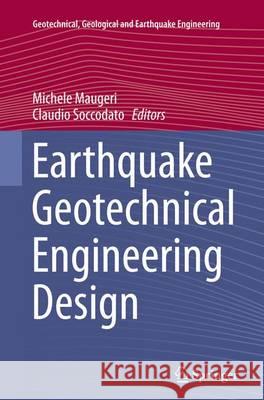
Michele Maugeri; Claudio Soccodato
Earthquake Geotechnical Engineering Design Michele Maugeri Claudio Soccodato 9783319375076 Springer - książkaWidoczna okładka, to zdjęcie poglądowe, a rzeczywista szata graficzna może różnić się od prezentowanej.

Earthquake Geotechnical Engineering Design

ISBN-13: 9783319375076 / Angielski / Miękka / 2016 / 388 str.

Michele Maugeri; Claudio Soccodato
cena 403,47 zł
(netto: 384,26 VAT:  5%)

Najniższa cena z 30 dni: 385,52 zł
Termin realizacji zamówienia:
ok. 22 dni roboczych
Bez gwarancji dostawy przed świętami

Darmowa dostawa!

Pseudo-static analysis is still the most-used method to assess the stability of geotechnical systems that are exposed to earthquake forces. However, this method does not provide any information about the deformations and permanent displacements induced by seismic activity. Moreover, it is questionable to use this approach when geotechnical systems are affected by frequent and rare seismic events. Incidentally, the peak ground acceleration has increased from 0.2-0.3 g in the seventies to the current value of 0.6-0.8 g. Therefore, a shift from the pseudo-static approach to performance-based analysis is needed.Over the past five years considerable progress has been made in Earthquake Geotechnical Engineering Design (EGED). The most recent advances are presented in this book in 6 parts.The evaluation of the site amplification is covered in Part I of the book. In Part II the evaluation of the soil foundation stability against natural slope failure and liquefaction is treated. In the following 3 Parts of the book the EGED for different geotechnical systems is presented as follows: the design of levees and dams including natural slopes in Part III; the design of foundations and soil structure interaction analysis in Part IV; underground structures in Part V. Finally in Part VI, new topics like the design of reinforced earth retaining walls and landfills are covered.


Kategorie:
Nauka
Kategorie BISAC:
Science > Earth Sciences - Meteorology & Climatology
Science > Earth Sciences - Geology
Technology & Engineering > Civil - Soil & Rock
Wydawca:
Springer
Seria wydawnicza:
Geotechnical, Geological and Earthquake Engineering
Język:
Angielski
ISBN-13:
9783319375076
Rok wydania:
2016
Wydanie:
Softcover Repri
Numer serii:
000289424
Ilość stron:
388
Waga:
6.76 kg
Wymiary:
23.5 x 15.5
Oprawa:
Miękka
Wolumenów:
01

PART I: SITE CHARACTERISATION AND SITE AMPLIFICATION


1   Spatially constrained inversion of surface wave data to build shear wave   

     Velocity models

     S. Foti, L.V. Socco


2   Site Classification and spectral amplification for seismic code provisions

     A. Anastasiadis, E. Riga


PART II: LIQUEFACTION


3   Sand Liquefaction observed during recent earthquake and Basic Laboratory   

     Studies on Aging effect

     T. Kokusho, Y. Nagao, F. Ito, T. Fukuyama


4   Liquefaction In Tokyo Bay And Kanto Regions In The 2011 Great East Japan 

     Earthquake

     K. Ishihara, K. Araki


5   Allowable settlement and inclination of houses defined after the 2011 Tohoku - 

     Pacific Ocean Earthquake in Japan

     S. Yasuda 


PART III: RIVER LEVEES AND DAMS


6   Seismic Performances of River Levees; Experience and Prediction

      I. Towhata


7   Earthquake Performance Design of Dams using Destructive Potential Factors

     G. R. Saragoni


PART IV: FOUNDATIONS AND SOIL-STRUCTURE INTERACTION


8   Seismic responses of shallow footings: a promising application for the macro- 

     Element approach

     C. di Prisco, R., M. Maugeri


9   Large-Scale Modeling of Ground and Soil-Structure Earthquake Response

     K. Kim  , A. Elgamal , G. Petropoulos , A. Askan , J. Bielak,  G. L. Fenves


10   Seismic displacement based design of structures: relevance of soil structure  

        interaction

        G. M. Calvi,  M. Cecconi , R. Paolucci


PART V: UNDERGROUND STRUCTURES


11  Performance and seismic design of underground structures

      K. Pitilakis, G. Tsinidis


PART VI: SPECIAL TOPICS


12  Reinforced Soil Walls during the Recent Great Earthquakes in Japan and Geo-   

       Risk based Design

       Y. Miyata


13  Performances Based Seismic Design of Geosynthetic Barriers for Waste 

      Containment 

      E. Kavazanjian, M. Arab, P. Fox, N. Matasovic

Pseudo-static analysis is still the most-used method to assess the stability of geotechnical systems that are exposed to earthquake forces. However, this method does not provide any information about the deformations and permanent displacements induced by seismic activity. Moreover, it is questionable to use this approach when geotechnical systems are affected by frequent and rare seismic events. Incidentally, the peak ground acceleration has increased from 0.2-0.3 g in the seventies to the current value of 0.6-0.8 g. Therefore, a shift from the pseudo-static approach to performance-based analysis is needed.

Over the past five years considerable progress has been made in Earthquake Geotechnical Engineering Design (EGED). The most recent advances are presented in this book in 6 parts.

The evaluation of the site amplification is covered in Part I of the book. In Part II the evaluation of the soil foundation stability against natural slope failure and liquefaction is treated. In the following 3 Parts of the book the EGED for different geotechnical systems is presented as follows: the design of levees and dams including natural slopes in Part III; the design of foundations and soil structure interaction analysis in Part IV; underground structures in Part V. Finally in Part VI, new topics like the design of reinforced earth retaining walls and landfills are covered.




Udostępnij

Facebook - konto krainaksiazek.pl


Opinie o Krainaksiazek.pl na Opineo.pl

Partner Mybenefit

Krainaksiazek.pl w programie rzetelna firma Krainaksiaze.pl - płatności przez paypal

Czytaj nas na:

Facebook - krainaksiazek.pl
  • książki na zamówienie
  • granty
  • książka na prezent
  • kontakt
  • pomoc
  • opinie
  • regulamin
  • polityka prywatności

Zobacz:

  • Księgarnia czeska

  • Wydawnictwo Książkowe Klimaty

1997-2025 DolnySlask.com Agencja Internetowa

© 1997-2022 krainaksiazek.pl
     
KONTAKT | REGULAMIN | POLITYKA PRYWATNOŚCI | USTAWIENIA PRYWATNOŚCI
Zobacz: Księgarnia Czeska | Wydawnictwo Książkowe Klimaty | Mapa strony | Lista autorów
KrainaKsiazek.PL - Księgarnia Internetowa

Polityka prywatnosci - link
Krainaksiazek.pl - płatnośc Przelewy24
Przechowalnia Przechowalnia



