• Wyszukiwanie zaawansowane
  • Kategorie
  • Kategorie BISAC
  • Książki na zamówienie
  • Promocje
  • Granty
  • Książka na prezent
  • Opinie
  • Pomoc
  • Załóż konto
  • Zaloguj się

Doppler Radar Physiological Sensing » książka


zaloguj się | załóż konto
Logo Krainaksiazek.pl

koszyk

konto

szukaj
topmenu
Księgarnia internetowa
Szukaj
Książki na zamówienie
Promocje
Granty
Książka na prezent
Moje konto
Pomoc
 
 
Wyszukiwanie zaawansowane
Pusty koszyk
Bezpłatna dostawa dla zamówień powyżej 20 złBezpłatna dostawa dla zamówień powyżej 20 zł

Kategorie główne

• Nauka
 [2950560]
• Literatura piękna
 [1849509]

  więcej...
• Turystyka
 [71097]
• Informatyka
 [151150]
• Komiksy
 [35848]
• Encyklopedie
 [23178]
• Dziecięca
 [617388]
• Hobby
 [139064]
• AudioBooki
 [1657]
• Literatura faktu
 [228597]
• Muzyka CD
 [383]
• Słowniki
 [2855]
• Inne
 [445295]
• Kalendarze
 [1464]
• Podręczniki
 [167547]
• Poradniki
 [480102]
• Religia
 [510749]
• Czasopisma
 [516]
• Sport
 [61293]
• Sztuka
 [243352]
• CD, DVD, Video
 [3414]
• Technologie
 [219456]
• Zdrowie
 [101002]
• Książkowe Klimaty
 [124]
• Zabawki
 [2311]
• Puzzle, gry
 [3459]
• Literatura w języku ukraińskim
 [254]
• Art. papiernicze i szkolne
 [8079]
Kategorie szczegółowe BISAC

Doppler Radar Physiological Sensing

ISBN-13: 9781118024027 / Angielski / Twarda / 2016 / 304 str.
Olga Boric-Lubecke; Amy Droitcour; Victor Lubecke
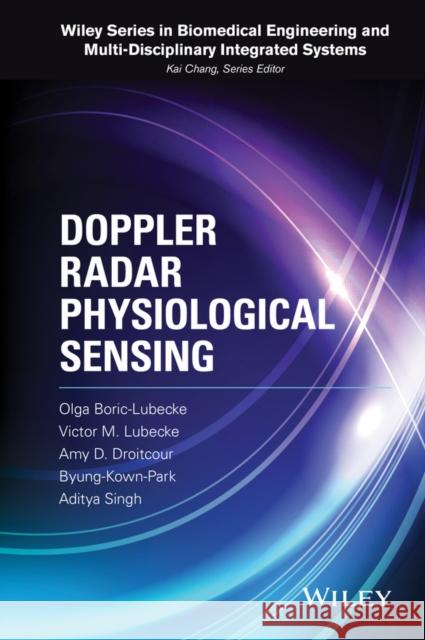
Doppler Radar Physiological Sensing Olga Boric-Lubecke Amy Droitcour Victor Lubecke 9781118024027 John Wiley & Sons - książkaWidoczna okładka, to zdjęcie poglądowe, a rzeczywista szata graficzna może różnić się od prezentowanej.

Doppler Radar Physiological Sensing

ISBN-13: 9781118024027 / Angielski / Twarda / 2016 / 304 str.

Olga Boric-Lubecke; Amy Droitcour; Victor Lubecke
cena 623,60
(netto: 593,90 VAT:  5%)

Najniższa cena z 30 dni: 619,75
Termin realizacji zamówienia:
ok. 30 dni roboczych
Dostawa w 2026 r.

Darmowa dostawa!

Presents a comprehensive description of the theory and practical implementation of Doppler radar-based physiological monitoring This book includes an overview of current physiological monitoring techniques and explains the fundamental technology used in remote non-contact monitoring methods. Basic radio wave propagation and radar principles are introduced along with the fundamentals of physiological motion and measurement. Specific design and implementation considerations for physiological monitoring radar systems are then discussed in detail. The authors address current research and commercial development of Doppler radar based physiological monitoring for healthcare and other applications.

  • Explains pros and cons of different Doppler radar architectures, including CW, FMCW, and pulsed Doppler radar
  • Discusses nonlinear demodulation methods, explaining dc offset, dc information, center tracking, and demodulation enabled by dc cancellation
  • Reviews advanced system architectures that address issues of dc offset, spectrum folding, motion interference, and range resolution
  • Covers Doppler radar physiological measurements demonstrated to date, from basic cardiopulmonary rate extractions to more involved volume assessments
Doppler Radar Physiological Sensing serves as a fundamental reference for radar, biomedical, and microwave engineers as well as healthcare professionals interested in remote physiological monitoring methods. Olga Boric-Lubecke, PhD, is a Professor of Electrical Engineering at the University of Hawaii at Manoa, and an IEEE Fellow. She is widely recognized as a pioneer and leader in microwave radar technologies for non-contact cardiopulmonary monitoring, and in the design of integrated circuits for biomedical applications. Victor M. Lubecke, PhD, is a Professor of Electrical Engineering at the University of Hawaii at Manoa. He is an emeritus IEEE Distinguished Microwave Lecturer and has over 25 years of experience in research and development of devices and methods for radio-based remote sensing systems. Amy Droitcour, PhD, has spent ten years developing radar-based vital signs measurement technology through her dissertation research and leading product development as CTO of Kai Medical. She currently serves as Senior Vice President of R&D at Wave 80 Biosciences. Byung-Kwon-Park, PhD, is a senior research engineer at the Mechatronics R&D Center in Korea. Aditya Singh, PhD, is currently a postdoctoral researcher at the University of Hawaii Neuroscience and MRI research Program.

Kategorie:
Nauka, Medycyna
Kategorie BISAC:
Science > Biotechnology
Medical > Fizjologia
Wydawca:
John Wiley & Sons
Seria wydawnicza:
Wiley Series in Biomedical Engineering and Multi-Disciplinar
Język:
Angielski
ISBN-13:
9781118024027
Rok wydania:
2016
Numer serii:
000423499
Ilość stron:
304
Waga:
0.54 kg
Wymiary:
23.88 x 16.26 x 2.29
Oprawa:
Twarda
Wolumenów:
01
Dodatkowe informacje:
Bibliografia

List of Contributors xi

1 Introduction 1
Amy D. Droitcour, Olga Boric–Lubecke, Shuhei Yamada, and Victor M. Lubecke

1.1 Current Methods of Physiological Monitoring, 2

1.2 Need for Noncontact Physiological Monitoring, 3

1.2.1 Patients with Compromised Skin, 3

1.2.2 Sleep Monitoring, 4

1.2.3 Elderly Monitoring, 5

1.3 Doppler Radar Potential for Physiological Monitoring, 5

1.3.1 Principle of Operation and Power Budget, 6

1.3.2 History of Doppler Radar in Physiological Monitoring, 8

References, 16

2 Radar Principles 21
Ehsan Yavari, Olga Boric–Lubecke, and Shuhei Yamada

2.1 Brief History of Radar, 21

2.2 Radar Principle of Operation, 22

2.2.1 Electromagnetic Wave Propagation and Reflection, 23

2.2.2 Radar Cross Section, 24

2.2.3 Radar Equation, 25

2.3 Doppler Radar, 28

2.3.1 Doppler Effect, 28

2.3.2 Doppler Radar Waveforms: CW, FMCW, Pulsed, 29

2.4 Monostatic and Bistatic Radar, 32

2.5 Radar Applications, 35

References, 36

3 Physiological Motion and Measurement 39
Amy D. Droitcour and Olga Boric–Lubecke

3.1 Respiratory System Motion, 39

3.1.1 Introduction to the Respiratory System, 39

3.1.2 Respiratory Motion, 40

3.1.3 Chest Wall Motion Associated with Breathing, 43

3.1.4 Breathing Patterns in Disease and Disorder, 43

3.2 Heart System Motion, 44

3.2.1 Location and Gross Anatomy of the Heart, 45

3.2.2 Electrical and Mechanical Events of the Heart, 46

3.2.3 Chest Surface Motion Due to Heart Function, 48

3.2.4 Quantitative Measurement of Chest Wall Motion Due to Heartbeat, 50

3.3 Circulatory System Motion, 53

3.3.1 Location and Structure of the Major Arteries and Veins, 54

3.3.2 Blood Flow Through Arteries and Veins, 55

3.3.3 Surface Motion from Blood Flow, 56

3.3.4 Circulatory System Motion: Variation with Age, 57

3.4 Interaction of Respiratory, Heart, and Circulatory Motion at the Skin Surface, 58

3.5 Measurement of Heart and Respiratory Surface Motion, 58

3.5.1 Radar Measurement of Physiological Motion, 59

3.5.2 Surface Motion Measurement of Respiration Rate, 59

3.5.3 Surface Motion Measurement of Heart/Pulse Rate, 61

References, 63

4 Physiological Doppler Radar Overview 69
Aditya Singh, Byung–Kwon Park, Olga Boric–Lubecke, Isar Mostafanezhad, and Victor M. Lubecke

4.1 RF Front End, 70

4.1.1 Quadrature Receiver, 73

4.1.2 Phase Coherence and Range Correlation, 77

4.1.3 Frequency Choice, 79

4.1.4 Antenna Considerations, 80

4.1.5 Power Budget, 80

4.2 Baseband Module, 83

4.2.1 Analog Signal Conditioning and Coupling Methods, 83

4.2.2 Data Acquisition, 85

4.3 Signal Processing, 86

4.3.1 Phase Demodulation, 86

4.3.2 Demodulated Phase Processing, 87

4.4 Noise Sources, 90

4.4.1 Electrical Noise, 90

4.4.2 Mechanical Noise, 92

4.5 Conclusions, 92

References, 93

5 CW Homodyne Transceiver Challenges 95
Aditya Singh, Alex Vergara, Amy D. Droitcour, Byung–Kwon Park, Olga Boric–Lubecke, Shuhei Yamada, and Victor M. Lubecke

5.1 RF Front End, 95

5.1.1 Single–Channel Limitations, 96

5.1.2 LO Leakage Cancellation, 103

5.1.3 IQ Imbalance Assessment, 109

5.2 Baseband Module, 113

5.2.1 AC and DC Coupling, 113

5.2.2 DC Canceller, 114

5.3 Signal Demodulation, 118

5.3.1 DC Offset and DC Information, 118

5.3.2 Center Tracking, 125

5.3.3 DC Cancellation Results, 130

References, 134

6 Sources of Noise and Signal–to–Noise Ratio 137
Amy D. Droitcour, Olga Boric–Lubecke, and Shuhei Yamada

6.1 Signal Power, Radar Equation, and Radar Cross Section, 138

6.1.1 Radar Equation, 138

6.1.2 Radar Cross Section, 140

6.1.3 Reflection and Absorption, 141

6.1.4 Phase–to–Amplitude Conversion, 141

6.2 Oscillator Phase Noise, Range Correlation and Residual Phase Noise, 143

6.2.1 Oscillator Phase Noise, 143

6.2.2 Range Correlation and Residual Phase Noise, 147

6.3 Contributions of Various Noise Sources, 151

6.3.1 Phase Noise, 151

6.3.2 Baseband 1/f Noise, 154

6.3.3 RF Additive White Gaussian Noise, 154

6.4 Signal–to–Noise Ratio, 155

6.5 Validation of Range Correlation, 157

6.6 Human Testing Validation, 158

References, 168

7 Doppler Radar Physiological Assessments 171
John Kiriazi, Olga Boric–Lubecke, Shuhei Yamada, Victor M. Lubecke, and Wansuree Massagram

7.1 Actigraphy, 172

7.2 Respiratory Rate, 176

7.3 Tidal Volume, 179

7.4 Heart Rates, 184

7.5 Heart Rate Variability, 185

7.6 Respiratory Sinus Arrhythmia, 190

7.7 RCs and Subject Orientation, 196

References, 204

8 Advanced Performance Architectures 207
Aditya Singh, Aly Fathy, Isar Mostafanezhad, Jenshan Lin, Olga Boric–Lubecke, Shuhei Yamada, Victor M. Lubecke, and Yazhou Wang

8.1 DC Offset and Spectrum Folding, 208

8.1.1 Single–Channel Homodyne System with Phase Tuning, 208

8.1.2 Heterodyne System with Frequency Tuning, 213

8.1.3 Low–IF Architecture, 220

8.2 Motion Interference Suppression, 224

8.2.1 Interference Cancellation, 226

8.2.2 Bistatic Radar: Sensor Nodes, 231

8.2.3 Passive RF Tags, 240

8.3 Range Detection, 250

8.3.1 Physiological Monitoring with FMCW Radar, 250

8.3.2 Physiological Monitoring with UWB Radar, 251

References, 266

9 Applications and Future Research 269
Aditya Singh and Victor M. Lubecke

9.1 Commercial Development, 269

9.1.1 Healthcare, 269

9.1.2 Defense, 272

9.2 Recent Research Areas, 272

9.2.1 Sleep Study, 272

9.2.2 Range, 275

9.2.3 Multiple Subject Detection, 276

9.2.4 Animal Monitoring, 279

9.3 Conclusion, 282

References, 282

Index 285

Olga Boric–Lubecke, PhD, is a Professor of Electrical Engineering at the University of Hawaii at Manoa, and an IEEE Fellow. She is widely recognized as a pioneer and leader in microwave radar technologies for non–contact cardiopulmonary monitoring, and in the design of integrated circuits for biomedical applications.

Victor M. Lubecke, PhD, is a Professor of Electrical Engineering at the University of Hawaii at Manoa. He is an emeritus IEEE Distinguished Microwave Lecturer and has over 25 years of experience in research and development of devices and methods for radio–based remote sensing systems.

Amy Droitcour, PhD, has spent ten years developing radar–based vital signs measurement technology through her dissertation research and leading product development as CTO of Kai Medical. She currently serves as Senior Vice President of R&D at Wave 80 Biosciences.

Byung–Kwon–Park, PhD, is a senior research engineer at the Mechatronics R&D Center in Korea.

Aditya Singh, PhD, is currently a postdoctoral researcher at the University of Hawaii Neuroscience and MRI research Program.

Presents a comprehensive description of the theory and practical implementation of Doppler radar–based physiological monitoring

This book includes an overview of current physiological monitoring techniques and explains the fundamental technology used in remote non–contact monitoring methods.  Basic radio wave propagation and radar principles are introduced along with the fundamentals of physiological motion and measurement. Specific design and implementation considerations for physiological monitoring radar systems are then discussed in detail. The authors address current research and commercial development of Doppler radar based physiological monitoring for healthcare and other applications.

  • Explains pros and cons of different Doppler radar architectures, including CW, FMCW, and pulsed Doppler radar
  • Discusses nonlinear demodulation methods, explaining dc offset, dc information, center tracking, and demodulation enabled by dc cancellation
  • Reviews advanced system architectures that address issues of dc offset, spectrum folding, motion interference, and range resolution
  • Covers Doppler radar physiological measurements demonstrated to date, from basic cardiopulmonary rate extractions to more involved volume assessments


Doppler Radar Physiological Sensing serves as a fundamental reference for radar, biomedical, and microwave engineers as well as healthcare professionals interested in remote physiological monitoring methods.


Udostępnij

Facebook - konto krainaksiazek.pl


Opinie o Krainaksiazek.pl na Opineo.pl

Partner Mybenefit

Krainaksiazek.pl w programie rzetelna firma Krainaksiaze.pl - płatności przez paypal

Czytaj nas na:

Facebook - krainaksiazek.pl
  • książki na zamówienie
  • granty
  • książka na prezent
  • kontakt
  • pomoc
  • opinie
  • regulamin
  • polityka prywatności

Zobacz:

  • Księgarnia czeska

  • Wydawnictwo Książkowe Klimaty

1997-2025 DolnySlask.com Agencja Internetowa

© 1997-2022 krainaksiazek.pl
     
KONTAKT | REGULAMIN | POLITYKA PRYWATNOŚCI | USTAWIENIA PRYWATNOŚCI
Zobacz: Księgarnia Czeska | Wydawnictwo Książkowe Klimaty | Mapa strony | Lista autorów
KrainaKsiazek.PL - Księgarnia Internetowa

Polityka prywatnosci - link
Krainaksiazek.pl - płatnośc Przelewy24
Przechowalnia Przechowalnia





