• Wyszukiwanie zaawansowane
  • Kategorie
  • Kategorie BISAC
  • Książki na zamówienie
  • Promocje
  • Granty
  • Książka na prezent
  • Opinie
  • Pomoc
  • Załóż konto
  • Zaloguj się

Document Management for Hypermedia Design » książka


zaloguj się | załóż konto
Logo Krainaksiazek.pl

koszyk

konto

szukaj
topmenu
Księgarnia internetowa
Szukaj
Książki na zamówienie
Promocje
Granty
Książka na prezent
Moje konto
Pomoc
 
 
Wyszukiwanie zaawansowane
Pusty koszyk
Bezpłatna dostawa dla zamówień powyżej 20 złBezpłatna dostawa dla zamówień powyżej 20 zł

Kategorie główne

• Nauka
 [2946600]
• Literatura piękna
 [1856966]

  więcej...
• Turystyka
 [72221]
• Informatyka
 [151456]
• Komiksy
 [35826]
• Encyklopedie
 [23190]
• Dziecięca
 [619653]
• Hobby
 [140543]
• AudioBooki
 [1577]
• Literatura faktu
 [228355]
• Muzyka CD
 [410]
• Słowniki
 [2874]
• Inne
 [445822]
• Kalendarze
 [1744]
• Podręczniki
 [167141]
• Poradniki
 [482898]
• Religia
 [510455]
• Czasopisma
 [526]
• Sport
 [61590]
• Sztuka
 [243598]
• CD, DVD, Video
 [3423]
• Technologie
 [219201]
• Zdrowie
 [101638]
• Książkowe Klimaty
 [124]
• Zabawki
 [2473]
• Puzzle, gry
 [3898]
• Literatura w języku ukraińskim
 [254]
• Art. papiernicze i szkolne
 [8170]
Kategorie szczegółowe BISAC

Document Management for Hypermedia Design

ISBN-13: 9783540594833 / Angielski / Miękka / 1997 / 286 str.
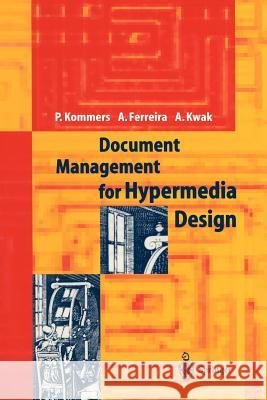
Piet A.M. Kommers;Alcindo F. Ferreira;Alex W. Kwak
Document Management for Hypermedia Design Piet A.M. Kommers, Alcindo F. Ferreira, Alex W. Kwak 9783540594833 Springer-Verlag Berlin and Heidelberg GmbH &  - książkaWidoczna okładka, to zdjęcie poglądowe, a rzeczywista szata graficzna może różnić się od prezentowanej.

Document Management for Hypermedia Design

ISBN-13: 9783540594833 / Angielski / Miękka / 1997 / 286 str.

Piet A.M. Kommers;Alcindo F. Ferreira;Alex W. Kwak
cena 201,72 zł
(netto: 192,11 VAT:  5%)

Najniższa cena z 30 dni: 192,74 zł
Termin realizacji zamówienia:
ok. 22 dni roboczych
Bez gwarancji dostawy przed świętami

Darmowa dostawa!

Migrating from paper-based to electronic documentation is a task that needs careful planning. Electronic texts offer new ways to store, retrieve, update, and cross-link information. Hypermedia documents, in which texts are cross-linked via keywords and in which audio and video files may also be integrated, require new levels of organization and strict discipline from authors, editors, and managers. As documents become "living" their document managers must control access, privileges, interconnections, segmentation, and flexibility for different readers. This book introduces and surveys these new developments. Based on a wealth of experience in large hypermedia projects, it provides a step-by-step guide to all aspects of hypermedia development, from strategic decision-making to editing formats and production methods.


Kategorie:
Informatyka, Bazy danych
Kategorie BISAC:
Computers > Speech & Audio Processing
Computers > Interactive & Multimedia
Business & Economics > Information Management
Wydawca:
Springer-Verlag Berlin and Heidelberg GmbH &
Język:
Angielski
ISBN-13:
9783540594833
Rok wydania:
1997
Dostępne języki:
Angielski
Ilość stron:
286
Waga:
0.46 kg
Wymiary:
23.523.5 x 15.5
Oprawa:
Miękka
Wolumenów:
01
Dodatkowe informacje:
Glosariusz/słownik
Wydanie ilustrowane

I Hypermedia Enterprises.- 1 Hypermedia Production Scenarios.- 1.1 Introduction.- 1.2 What are Hypermedia?.- 1.3 Overall Scenario and Definitions.- 2 Market-Driven Scenario Elements.- 2.1 Production.- 2.2 Scenario Templates.- 2.3 Scenario Templates Within the First Stream of Initiative.- 2.3.1 First Stream, Template One.- 2.3.2 First Stream, Template Two.- 2.3.3 First Stream, Template Three.- 2.4 Scenario Templates Within the Second Stream of Initiative.- 2.5 Fourteen Steps in the Development of Hypermedia.- 2.5.1 The Preparatory Steps la-lf.- 2.5.2 Entering Multimedia Material.- 2.5.3 Editing Multimedia.- 2.5.4 Defining Properties.- 2.5.5 Entering Properties, Adding Properties.- 2.5.6 Automatic Linking.- 2.5.7 Manual Linking, Adding Anchors.- 2.5.8 Testing and Reviewing.- 2.5.9 Production.- 2.5.10 Conclusions.- 3 Sales and Royalties.- 3.1 Rights.- 3.2 Revising.- 3.3 Re-using.- 3.4 Procedures.- 3.5 Conclusions.- 4 The Publishing Corporation Case.- 4.1 Public Information Division.- 4.1.1 Management.- 4.1.2 General Management.- 4.1.3 Marketing Department.- 4.1.4 Sales Management.- 4.1.5 Production Management.- 4.1.6 Pick and Mix.- 4.1.7 Administration.- 4.1.8 Predictions About the Future.- 4.2 Scientific Information Division.- 4.3 Professional Information Division.- 4.3.1 The Market.- 4.3.2 Data Management.- 4.3.3 Overview of Use.- 4.3.4 Data Entry.- 4.3.5 Management Reports.- 4.4 Training Divisions.- 4.4.1 Prospectus.- 4.4.2 Production.- 4.4.3 Reference Material.- 4.4.4 Homework Management and Administration.- 4.5 Annex: Text Circulation in the Production Process.- II Producing Hypermedia.- 5 Popular Formats.- 5.1 SGML.- 5.1.1 Using SGML for Multimedia Development.- 5.1.2 SGML Document Structure..- 5.1.3 Creating and Editing SGML.- 5.1.4 Hypertext.- 5.2 HyTime and SMSL.- 5.3 HTML.- 5.4 VRML..- 5.5 MHEG.- 5.6 CALS.- 5.7 TeX.- 5.8 Conclusions.- 6 Editing.- 6.1 Introduction.- 6.2 MS Word.- 6.3 WordPerfect.- 6.4 Implementing Your Own System.- 7 Authoring.- 7.1 Processes.- 7.2 The Primary Author.- 7.3 The Secondary Author.- 7.4 Tools for the Secondary Author.- 7.5 Extending Hypermedia to an Educational Tool.- 8 Preparing Textual Material.- 8.1 Introduction.- 8.2 Implicit and Explicit Semantic Information.- 8.3 Paper Text.- 8.4 Unstructured Text.- 8.5 Structured Text.- 8.6 Tagged Text.- 8.7 Automatic References.- 8.8 Converting SGML to RTF.- 8.8.1 SGML to RTF macro.- 8.8.2 SGML to RTF Translator application.- 8.9 Converting RTF to SGML.- 8.9.1 RTF to SGML Translator Application.- 8.9.2 RTF.- 8.9.3 From RTF to SGML.- 8.9.4 Implementation.- 9 Creating Hypertext.- 9.1 Storage: Compiling, Importing, or Indexing.- 9.1.1 Database Selection.- 9.1.2 Tagged Information.- 10 Picture, Sound, and Video Resources.- 10.1 Embedded Resources.- 10.2 Linked Resources.- 10.3 Hotspots Within Picture Resources.- 10.4 Conclusions.- 11 Managing Hypermedia Documents.- 11.1 The Management of the Production.- 11.2 Paper for Quick Annotations.- 11.3 Computer Assisted Document Management.- 11.3.1 Creation.- 11.3.2 Librarian.- 11.3.3 Production.- 11.3.4 Annotation.- 11.3.5 Versioning.- 11.4 Outlining Tools.- 11.4.1 Word Processor Outlining Tools.- 11.4.2 Groupware Outlining Tools.- 11.4.3 Limitations of Outlining Tools.- 11.5 Author and Editor Plans.- 11.5.1 ASCII/Word Processor A/E Plans.- 11.5.2 Groupware A/E Plans.- 11.5.3 Project Management Tools for A/E Plans.- 11.5.4 Limitations of A/E Plans.- 11.6 Why Still use Paper?.- 11.7 Conclusion.- 11.8 Enriching Information: From Implicit to Explicit.- 11.9 DIS: Documentary Information Systems.- 12 Popular Multimedia Applications.- 12.1 Microsoft’s Multimedia Viewer.- 12.1.1 Searching.- 12.1.2 Browsing.- 12.1.3 From Help to Viewer.- 12.1.4 Conclusions.- 12.2 DynaText.- 12.2.1 InStEd.- 13 Recipes.- 13.1 Introduction.- 13.2 Paper Recipes.- 13.2.1 Figures and Pictures.- 13.2.2 Computer Applications.- 13.3 Plain Text Recipes.- 13.3.1 Conclusion.- 13.4 Microsoft Windows Help Recipes.- 13.4.1 Creating Windows Help Files from Existing Material.- 13.4.2 Rich Text Format.- 13.4.3 RTF and the Help Compiler.- 13.4.4 Pictures.- 13.4.5 Typefaces and Fonts.- 13.4.6 Extending Help.- 13.4.7 Weaknesses.- 13.4.8 Examples.- III Navigational Support.- 14 Graph Computation in Structuring Hypermedia.- 14.1 Formalisms for the Representation of Relational Patterns.- 14.1.1 Unlabeled Directed Graphs for Representing Hypermedia Relations.- 14.1.2 Hypergraphs.- 14.1.3 The Bipartite, Directed (Conditional) Graph or Petri-Net Graph.- 14.2 Unlabeled Directed Graph Reflecting Conceptual Entailments.- 14.2.1 The Problem Space of the Hypermedia User and the Need for Graph Computation.- 14.2.2 Problem at the Level of a Complete Hypermedia Network.- 14.2.3 Computational Approaches of the Hypermedia Entailment Complexity.- 14.2.4 Structural Centrality Based on Direct and Indirect Influence.- 14.2.5 Adjacency Matrix Representing Hypermedia Relations.- 14.2.6 Small Scale Example.- 14.2.7 Hoede’s Status Index.- 14.2.8 Centrality Computation by Hoede’s Status Index.- 14.2.9 Alternative Graph Computations for Structural Centrality.- 14.2.10 Rush: A Measure to Unify Centrality Based on In- and Outdegree.- 14.3 Graph Structures as Concise Conceptual Representations.- 15 Graphical Display of Concept Maps.- 15.1 Displaying Two-Dimensional Concept Maps.- 15.2 Displaying Three-Dimensional Concept Maps.- 15.2.1 Illusions of Depth.- 15.2.2 Vagueness.- 15.2.3 Radius of the Concepts.- 15.2.4 Shading Spheres.- 15.2.5 Shadows.- 15.2.6 Text Size.- 15.2.7 Inner Sphere.- 15.2.8 Algorithms for Showing 3D Concept Maps.- 15.2.9 Conclusions.- 16 Rule-Based Navigation in Hypermedia Systems.- 16.1 Coaching Methods.- 16.2 Navigation Tools.- 16.3 Navigation Rules.- 16.4 Implementation of Coaching Methods.- 16.5 Preparing a Path.- 17 Calculating a Path.- 17.1 Prolog Clauses.- IV Seven Hypermedia Project Cases.- Case I Publishers’ Documentation Support System.- Case II Genealogical Research Support.- Case III Newspaper Archiving and Delivery on CD-ROM.- Case IV Document Maintenance via CD-I.- Case V Preparing Encyclopedias for CD-ROM.- Case VI Managing Instructional Material.- Case VII Product Catalogues for Delivery on Demand.- PartV Appendices Appendix A. References.- SGML.- Graphical Display of Two-Dimensional Concept Maps.- General.- Deliverables by the COSYS Project.- Appendix B. Word Translation Macros.- Appendix C. Glossary.- Appendix D. First Demonstrator Case Description.- Top View.- Zooming.- Browsing.- Pruning.- Inside View.- Example.- Appendix E. Second Demonstrator Case Description.- General information.- Use.- Opening Texts.- Opening Pictures.- Opening an Overview.- Selecting a Database.- Opening an Article from a Text.- Opening an Overview from a Text.- Icons.- Hotspots.- Overviews.- Overview Windows.- Selecting and Deselecting Nodes.- Dragging a Node.- Opening an Overview from Another Overview.- Overview Icons.- Menus.- Dialogue Change Settings.- Appendix F. TextVision-3D.- Adding New Concepts.- Adding Relations.- XVI Table of Contents.- Deleting Relations.- Selecting Concepts and Relations.- Moving Concepts.- Revising to Indegree.- Revising to Outdegree.- Text Windows.- Subterm View.- Superterm View.- Text View.- Rotating the Network.- Appendix G. Prolog Interpretation of SGML Documents.- Appendix H. SGML ?RTF Conversion.- CPART.G.- F.G.- GRAMMAR.G.- TOKENDEF.G.- Appendix I. Interesting FTP and WWW Sites.- FTP Sites.- WWW Sites.- About the Authors.- Figures and Tables.

Hypermedia documentation projects require new management skills. Electronic documents require control of access, authoring and editing privileges, interconnection, segmentation, and flexibility for different readers. This book is a step-by-step guide to these new developments.


Udostępnij

Facebook - konto krainaksiazek.pl


Opinie o Krainaksiazek.pl na Opineo.pl

Partner Mybenefit

Krainaksiazek.pl w programie rzetelna firma Krainaksiaze.pl - płatności przez paypal

Czytaj nas na:

Facebook - krainaksiazek.pl
  • książki na zamówienie
  • granty
  • książka na prezent
  • kontakt
  • pomoc
  • opinie
  • regulamin
  • polityka prywatności

Zobacz:

  • Księgarnia czeska

  • Wydawnictwo Książkowe Klimaty

1997-2025 DolnySlask.com Agencja Internetowa

© 1997-2022 krainaksiazek.pl
     
KONTAKT | REGULAMIN | POLITYKA PRYWATNOŚCI | USTAWIENIA PRYWATNOŚCI
Zobacz: Księgarnia Czeska | Wydawnictwo Książkowe Klimaty | Mapa strony | Lista autorów
KrainaKsiazek.PL - Księgarnia Internetowa

Polityka prywatnosci - link
Krainaksiazek.pl - płatnośc Przelewy24
Przechowalnia Przechowalnia





