• Wyszukiwanie zaawansowane
  • Kategorie
  • Kategorie BISAC
  • Książki na zamówienie
  • Promocje
  • Granty
  • Książka na prezent
  • Opinie
  • Pomoc
  • Załóż konto
  • Zaloguj się

Do They Walk Like They Talk?: Speech and Action in Policy Processes » książka


zaloguj się | załóż konto
Logo Krainaksiazek.pl

koszyk

konto

szukaj
topmenu
Księgarnia internetowa
Szukaj
Książki na zamówienie
Promocje
Granty
Książka na prezent
Moje konto
Pomoc
 
 
Wyszukiwanie zaawansowane
Pusty koszyk
Bezpłatna dostawa dla zamówień powyżej 20 złBezpłatna dostawa dla zamówień powyżej 20 zł

Kategorie główne

• Nauka
 [2949965]
• Literatura piękna
 [1857847]

  więcej...
• Turystyka
 [70818]
• Informatyka
 [151303]
• Komiksy
 [35733]
• Encyklopedie
 [23180]
• Dziecięca
 [617748]
• Hobby
 [139972]
• AudioBooki
 [1650]
• Literatura faktu
 [228361]
• Muzyka CD
 [398]
• Słowniki
 [2862]
• Inne
 [444732]
• Kalendarze
 [1620]
• Podręczniki
 [167233]
• Poradniki
 [482388]
• Religia
 [509867]
• Czasopisma
 [533]
• Sport
 [61361]
• Sztuka
 [243125]
• CD, DVD, Video
 [3451]
• Technologie
 [219309]
• Zdrowie
 [101347]
• Książkowe Klimaty
 [123]
• Zabawki
 [2362]
• Puzzle, gry
 [3791]
• Literatura w języku ukraińskim
 [253]
• Art. papiernicze i szkolne
 [7933]
Kategorie szczegółowe BISAC

Do They Walk Like They Talk?: Speech and Action in Policy Processes

ISBN-13: 9780387896717 / Angielski / Twarda / 2009 / 306 str.
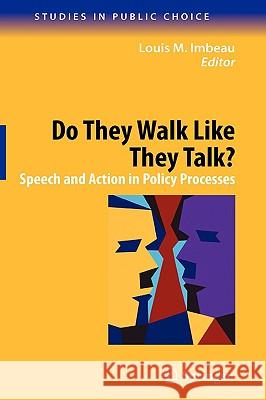
Louis M. Imbeau
Do They Walk Like They Talk?: Speech and Action in Policy Processes Imbeau, Louis M. 9780387896717 Springer - książkaWidoczna okładka, to zdjęcie poglądowe, a rzeczywista szata graficzna może różnić się od prezentowanej.

Do They Walk Like They Talk?: Speech and Action in Policy Processes

ISBN-13: 9780387896717 / Angielski / Twarda / 2009 / 306 str.

Louis M. Imbeau
cena 605,23 zł
(netto: 576,41 VAT:  5%)

Najniższa cena z 30 dni: 578,30 zł
Termin realizacji zamówienia:
ok. 22 dni roboczych
Bez gwarancji dostawy przed świętami

Darmowa dostawa!
inne wydania

George Bush's 1988 campaign pledge, "Read my lips: no new taxes," has become a mantra for those who distrust politicians and bureaucrats. The gulf between what political leaders say and do seems to be widening, and in democratic societies around the world, contributing to an atmosphere of cynicism and apathy among the citizenry. Understanding the characteristics and functions of speech in policy processes is a requirement for trying to overcome this problem; indeed, politicians and bureaucrats spend a good proportion of their time and resources discoursing, i.e., writing, speaking, and publishing. However, there has been scant analysis of political discourse; the aim of this book is to fill this analytical gap, by exploring political speech from a variety of perspectives, including normative, epistemological, and empirical. Incorporating insights from economics, political science, philosophy, and law, and evidence from the United States, Canada, France, Italy, Turkey, and the EU, the book addresses a wide variety of timely issues, including: .

  • Fiscal discipline in speeches vs budget balance: Is an improvement (deterioration) of the budget balance preceded by a more (less) fiscally disciplined discourse?
  • Revenues and spending forecasted in budget speeches vs realised budget outcomes: Is there a systematic bias? If so, how can we explain it?
  • Electoral pledges vs actual realisations: Do governments follow up on their electoral pledges?
  • Ideological stance in party publications vs spending and revenues of party governments: Do parties of the right and the left speak different languages? How can we validly classify a government as of the left or of the right? Is there a systematic difference between governments of the right and of the left in terms of their policy?
  • Speeches by central bank officers vs monetary policy: Can changes in monetary policy be predicted by official speeches?
  • The political business cycle: How can taking into consideration the speech-action relationship strengthen (or threaten) our knowledge about electoral and partisan cycles in public spending?
Other questions explored include: Should policy makers always tell the truth and all the truth? What are the benefits and the costs of transparency? How can we resolve the apparent contradiction between the democratic demand for transparency and the efficiency requirement of secrecy in many policy areas (budget preparation, monetary policy, foreign policy, security, etc.)? Under which conditions is secrecy acceptable in a democratic society? To what extent may deception and lies lead to a breach of trust or to power abuse? What are the most efficient institutional mechanisms to prevent such abuse? Collectively, the authors present new insights for understanding political process and government activity, and suggest avenues for further research.

Kategorie:
Nauka, Polityka
Kategorie BISAC:
Philosophy > Political
Political Science > General
Language Arts & Disciplines > Linguistics - Semantics
Wydawca:
Springer
Seria wydawnicza:
Studies in Public Choice
Język:
Angielski
ISBN-13:
9780387896717
Rok wydania:
2009
Wydanie:
2009
Numer serii:
000162797
Ilość stron:
306
Waga:
0.62 kg
Wymiary:
23.6 x 16.3 x 3.3
Oprawa:
Twarda
Wolumenów:
01
Dodatkowe informacje:
Bibliografia
Wydanie ilustrowane

Dissonance in Policy Processes: An Introduction.- Disciplinary Perspectives.- The Power of Words: A Philosophical Perspective.- Information Shrouding and the Governmental Supply of Goods and Services: An Economic Perspective.- Party Rhetoric and Practice: A Normative Perspective from Political Science.- Measuring How Political Parties Keep Their Promises: A Positive Perspective from Political Science.- Empirical Studies.- Measuring US Presidents’ Political Commitment for Fiscal Discipline Between 1920 and 2008.- Would You Trust an Italian Politician? Evidence from Italian Regional Politics.- General Policy Speech of Prime Ministers and Fiscal Choices in France: “Preach Water and Drink Wine!”.- Do Governments Manipulate Their Revenue Forecasts? Budget Speech and Budget Outcomes in the Canadian Provinces.- Dissonance in Fiscal Policy: A Power Approach.- Speeches and Legislative Extremism in the U.S. Senate.- Do Parties Matter? A Qualitative Answer with Numbers.- Talking Like a Tax Collector or a Social Guardian? The Use of Administrative Discourse by U.S. State Lottery Agencies.- The Early European “FederalismFederalism ”: Ambiguities of Talks About How to Walk Toward a Political UnionPolitical Union .- A Semiotic Network Comparison of Technocratic and Populist Discourses in Turkey.- Conclusion.- Do They Walk Like They Talk? A Conclusion.

George Bush’s 1988 campaign pledge, "Read my lips: no new taxes," has become a mantra for those who distrust politicians and bureaucrats. The gulf between what political leaders say and do seems to be widening, and in democratic societies around the world, contributing to an atmosphere of cynicism and apathy among the citizenry. Understanding the characteristics and functions of speech in policy processes is a requirement for trying to overcome this problem. However, there has been scant analysis of political discourse; the aim of this book is to help fill this analytical gap, by exploring political speech from a variety of perspectives, including normative, epistemological, and empirical. Incorporating insights from economics, political science, philosophy, and law, and evidence from the United States, Canada, France, Italy, Turkey, and the EU, the book addresses a wide variety of timely issues, including:

  • Fiscal discipline in speeches vs budget balance

    Revenues forecasted in budget speeches vs realized budget outcomes

    Electoral pledges vs actual realizations

    Ideological stance in party publications vs spending and revenues of party governments

    The political business cycle

Other questions explored include: Should policy makers always tell the truth and all the truth? What are the benefits and the costs of transparency? How can we resolve the apparent contradiction between the democratic demand for transparency and the efficiency requirement of secrecy in many policy areas? Under which conditions is secrecy acceptable in a democratic society? To what extent may deception and lies lead to a breach of trust or to power abuse? What are the most efficient institutional mechanisms to prevent such abuse? Collectively, the authors present new insights for understanding political process and government activity, and suggest avenues for further research.


Udostępnij

Facebook - konto krainaksiazek.pl


Opinie o Krainaksiazek.pl na Opineo.pl

Partner Mybenefit

Krainaksiazek.pl w programie rzetelna firma Krainaksiaze.pl - płatności przez paypal

Czytaj nas na:

Facebook - krainaksiazek.pl
  • książki na zamówienie
  • granty
  • książka na prezent
  • kontakt
  • pomoc
  • opinie
  • regulamin
  • polityka prywatności

Zobacz:

  • Księgarnia czeska

  • Wydawnictwo Książkowe Klimaty

1997-2025 DolnySlask.com Agencja Internetowa

© 1997-2022 krainaksiazek.pl
     
KONTAKT | REGULAMIN | POLITYKA PRYWATNOŚCI | USTAWIENIA PRYWATNOŚCI
Zobacz: Księgarnia Czeska | Wydawnictwo Książkowe Klimaty | Mapa strony | Lista autorów
KrainaKsiazek.PL - Księgarnia Internetowa

Polityka prywatnosci - link
Krainaksiazek.pl - płatnośc Przelewy24
Przechowalnia Przechowalnia






