• Wyszukiwanie zaawansowane
  • Kategorie
  • Kategorie BISAC
  • Książki na zamówienie
  • Promocje
  • Granty
  • Książka na prezent
  • Opinie
  • Pomoc
  • Załóż konto
  • Zaloguj się

Disrupting Buildings: Digitalisation and the Transformation of Deep Renovation » książka


zaloguj się | załóż konto
Logo Krainaksiazek.pl

koszyk

konto

szukaj
topmenu
Księgarnia internetowa
Szukaj
Książki na zamówienie
Promocje
Granty
Książka na prezent
Moje konto
Pomoc
 
 
Wyszukiwanie zaawansowane
Pusty koszyk
Bezpłatna dostawa dla zamówień powyżej 20 złBezpłatna dostawa dla zamówień powyżej 20 zł

Kategorie główne

• Nauka
 [2949965]
• Literatura piękna
 [1857847]

  więcej...
• Turystyka
 [70818]
• Informatyka
 [151303]
• Komiksy
 [35733]
• Encyklopedie
 [23180]
• Dziecięca
 [617748]
• Hobby
 [139972]
• AudioBooki
 [1650]
• Literatura faktu
 [228361]
• Muzyka CD
 [398]
• Słowniki
 [2862]
• Inne
 [444732]
• Kalendarze
 [1620]
• Podręczniki
 [167233]
• Poradniki
 [482388]
• Religia
 [509867]
• Czasopisma
 [533]
• Sport
 [61361]
• Sztuka
 [243125]
• CD, DVD, Video
 [3451]
• Technologie
 [219309]
• Zdrowie
 [101347]
• Książkowe Klimaty
 [123]
• Zabawki
 [2362]
• Puzzle, gry
 [3791]
• Literatura w języku ukraińskim
 [253]
• Art. papiernicze i szkolne
 [7933]
Kategorie szczegółowe BISAC

Disrupting Buildings: Digitalisation and the Transformation of Deep Renovation

ISBN-13: 9783031323089 / Angielski
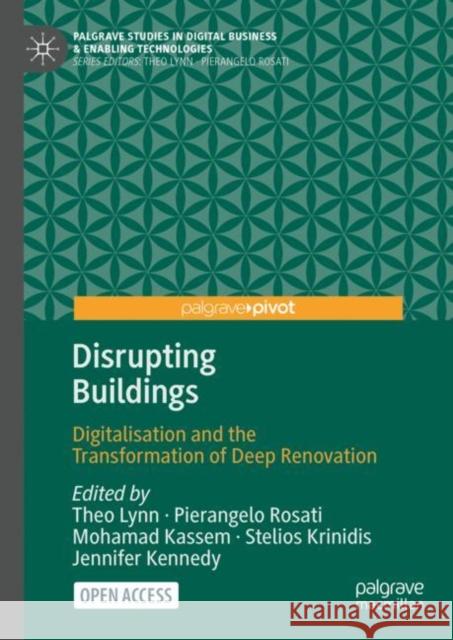
Theo Lynn;Pierangelo Rosati;Mohamad Kassem
Disrupting Buildings: Digitalisation and the Transformation of Deep Renovation Theo Lynn Pierangelo Rosati Mohamad Kassem 9783031323089 Palgrave Macmillan - książkaWidoczna okładka, to zdjęcie poglądowe, a rzeczywista szata graficzna może różnić się od prezentowanej.

Disrupting Buildings: Digitalisation and the Transformation of Deep Renovation

ISBN-13: 9783031323089 / Angielski

Theo Lynn;Pierangelo Rosati;Mohamad Kassem
cena 201,72
(netto: 192,11 VAT:  5%)

Najniższa cena z 30 dni: 192,74
Termin realizacji zamówienia:
ok. 22 dni roboczych
Bez gwarancji dostawy przed świętami

Darmowa dostawa!

The world's extant building stock accounts for a significant portion of worldwide energy consumption and greenhouse gas emissions. In 2020, buildings and construction accounted for 36% of global final energy consumption and 37% of energy related CO2 emissions. The EU estimates that up to 75% of the EU's existing building stock has poor energy performance, 85-95% of which will still be in use in 2050. To meet the goals of the Paris Agreement on Climate Change will require a transformation of construction processes and deep renovation of the extant building stock. It is widely recognized that ICTs can play an important role in construction, renovation and maintenance as well as supporting the financing of deep renovation. Technologies such as sensors, big data analytics and machine learning, BIM, digital twinning, simulation, robots, cobots and UAVs, and additive manufacturing are transforming the deep renovation process, improving sustainability performance, and developing new services and markets. This open access book defines a deep renovation digital ecosystem for the 21st century, providing a state-of-the art review of current literature, suggesting avenues for new research, and offering perspectives from business, technology and industry domains.This is an open access book.


Kategorie:
Nauka, Ekonomia i biznes
Kategorie BISAC:
Business & Economics > Management Science
Technology & Engineering > Construction - Heating, Ventilation & Air Conditioning
Technology & Engineering > Civil - General
Wydawca:
Palgrave Macmillan
Język:
Angielski
ISBN-13:
9783031323089

Chapter 1 – Deep Renovation:

Definitions, Drivers and Barriers

Chapter 1 defines the key elements of the deep renovation
lifecycle. Investment in deep renovation is driven by a wide
range of rationales including societal, economic,
environmental, energy security, quality, opportunistic, and
catalytic motivations and benefits. At the same time, both
deep renovation and digital technology adoption to
support deep renovation are impacted by human,
organisational, technological, and external environment
challenges. This chapter explores the key drivers and
barriers for deep renovation and associated digitalisation.
It establishes the motivation for the remainder of the book.

Chapter 2 - Embedded Sensors,
Ubiquitous Connectivity and Tracking

Digitalisation of the deep renovation process and build
environment is enabled by ubiquitous connectivity and
monitoring of the environment itself, the artefacts and
actors within it, and events that occur. Such monitoring is
critical for dynamic peak demand reduction and
affordability. Chapter 2 provides an overview of how
computation capabilities are being integrated into the
physical environment and the role of sensor networks in
the context of deep renovation. The key advantages and

benefits of these technologies at the pre, during and post-
renovation stages are discussed together with different

application use cases e.g. home automation vs building
infrastructure systems. The role and value of sensor
network infrastructures and the legal and ethical
implications of the use of such sensor infrastructures is
also discussed.

Chapter 3 – Building Information
Modelling

Chapter 3 defines BIM and discusses the evolution of

building information modelling from computer-aided three-
dimensional modelling to include time scheduling (4D) and

the next generation of BIM that integrates building design
with estimates and costing to provide a decision support

system for making reliable decisions across a building life-
cycle. This chapter summarises the state-of-the-art on

BIM, with a specific emphasis on deep renovation, as well
as future trends for BIM solutions.

Chapter 4 – Simulation Simulation is a proven technique that uses computational
mathematical models to represent the physical
characteristics, expected or actual operation, and control
strategies of a building and its energy systems. There are
many opportunities for using simulations across the deep
renovation life cycle including (1) integrating simulations
with other knowledge-based systems to support decision
making, (2) using simulations to evaluate and compare
design scenarios, (3) integrating simulations with real-time
monitoring and diagnostic systems for building energy
management and control, (4) integrating multiple
simulation applications, and (5) using VR to enable digital
building design and operation experiences. While building
performance simulation is relatively well established, there
are numerous challenges to implementation across the life
cycle, not least integrating data from fragmented building
systems, modelling human-building interaction, amongst
others. Chapter 4 defines the building performance
simulation space outlining significant use cases, drivers for
adoption and challenges for implementation.

Chapter 5 – Big Data and Analytics Similarly to a number of other industries, the construction
sector has been impacted and somewhat changed by the
growing volume of heterogeneous data available at
different stages of the construction process. This trend is
expected to continue as technologies such as sensors and
the Internet of Things become more and more accessible
and commoditised. The availability of data is particularly
useful in the context of deep renovation where it can
dramatically accelerate the decision making for building
stock retrofit. Chapter 5 defines Big Data and analytics in
the context of deep renovation and describes how the use
of Big Data and advanced analytics such as Machine
Learning and Artificial Intelligence have impacted the
different stages of the deep renovation lifecycle.

Chapter 6 – Mobile Interfaces and
Augmented Reality

As the technologies and the building elements
implemented in deep renovation projects become more
advanced and complex, there is growing need for
specialist skills and knowledge which may not be always
available on-site therefore reducing productivity and
safety. The use of mobile interfaces and augmented reality
may provide on-site operators with timely information and
therefore overcome some of these issues. Chapter 6
explores the implications of the ever-increasing use of
mobile technologies in the deep renovation process with a
particular focus on augmented reality and the role it plays
in the design as well as the implementation phase of the
deep renovation. Key drivers and barriers to adoption, and
implications for the workforce are also discussed.

Chapter 7 – 3D Scanning and Digital
Twinning

Chapter 7 introduces the role of digital twinning and 3D
scanning in the deep renovation lifecycle. These
technologies are often confused with BIM and other
building-related cyber-physical systems. This chapter
starts by defining digital twinning and constituent
technologies and elements. Once defined, the state-of-art
in both (i) the creation, and (ii) the use of digital twinning
across the deep renovation lifecycle is explored including
drivers for adoption and barriers.

Chapter 8 - Additive manufacturing Chapter 8 defines and discusses the key elements and
attributes of additive manufacturing and the role it plays in
deep renovation projects. Additive manufacturing,
including 3D printing, has potential opportunities for the
construction industry and specific applications in the deep
renovation process. While additive manufacturing can
provide significant benefits in the deep renovation process,
it is not without its own environmental footprint and
barriers. Upcoming technological advancements and
trends are discussed together with their potential impact
for different stakeholders.

Chapter 9 – Intelligent Construction
Equipment and Robotics

The primary motivation behind the use of intelligent
construction equipment and industrial exoskeletons is to
prevent occupational injuries, human error, and associated
financial consequences. While these technologies offer
significant opportunities for the construction sector, they
may not be cost-effective, or suitable for complex,
unpredictable and varied moves. Chapter 9 presents the
main advantages and benefits of the use of cobots,
exoskeletons, UAVs and other robotics technologies in
construction and deep renovation contexts. It summarises
the state-of-the-art of these technologies and current use
cases. Operational, legal and ethical challenges to
adoption and implementation are also discussed.

Chapter 10 - Open Access and
Interoperability

Interoperability is one the technological barriers to deep
renovation. Deep renovation is a multi-domain area with
multiple inbound and outbound linkages to a wide variety
of stakeholders and systems. This results in significant
interoperability issues that impact data flows. Chapter 10
discusses the concept of technological interoperability,
and specifically data linking, across the deep renovation
lifecycle. The state-of-the-art for addressing these issues
are discussed including advantages and limitations.

Chapter 11 - Security and Data
Privacy for Deep Renovation

Digitalisation during the deep renovation process will
produce significant volumes of data. Smart building and
smart home technologies assume massive increases in
heterogeneous end-points with varying computational
capabilities, intermittent connectivity and a wide variety of
potentially conflicting data requirements, decision
criticalities and priorities. Furthermore, it is envisaged that
machine learning of increasing sophistication will be used
to make sense of this data in near-real time and, in some
cases, actuate changes close to the edge of networks.
Chapter 11 explores the security and data privacy issues
inherent in greater digitalisation of the deep renovation
process and the built environment including vulnerabilities
and threats associated with edge computing and edge
intelligence, and associated countermeasures.

Chapter 12 - Fintech for Deep
Renovation and Smart Contracts

Access to capital is one of the key barriers for deep
renovation. This chapter presents the potential advantages
and benefits that financial technology (fintech) solutions
such as crowdfunding, peer-to-peer lending and smart
contracts can provide to building owners and construction
companies in terms of financing. Future avenues for
research in this space are also presented.

Theo Lynn is Full Professor of Digital at DCU Business School, Ireland. He is Series Editor on the Palgrave Studies in Digital Business & Enabling Technologies. 

Pierangelo Rosati is Associate Professor of Digital Business & Society at the University of Galway, Ireland and is Series Editor on the Palgrave Studies in Digital Business & Enabling Technologies. 

Mohamad Kassem is Professor of Digital Construction Management at Newcastle University, United Kingdom. 

Stelios Krinidis is an Assistant Professor at the Department of Management Science & Technology of the International Hellenic University, Greece and a Post-Doctoral Researcher at the Centre of Research & Technology Hellas, Greece.

Jennifer Kennedy is a Postdoctoral Researcher at the Irish Institute of Digital Business at DCU Business School, Ireland.

The world’s extant building stock accounts for a significant portion of worldwide energy consumption and greenhouse gas emissions. In 2020, buildings and construction accounted for 36% of global final energy consumption and 37% of energy related CO2 emissions. The EU estimates that up to 75% of the EU’s existing building stock has poor energy performance, 85–95% of which will still be in use in 2050.

To meet the goals of the Paris Agreement on Climate Change will require a transformation of construction processes and deep renovation of the extant building stock. It is widely recognized that ICTs can play an important role in construction, renovation and maintenance as well as supporting the financing of deep renovation. Technologies such as sensors, big data analytics and machine learning, BIM, digital twinning, simulation, robots, cobots and UAVs, and additive manufacturing are transforming the deep renovation process, improving sustainability performance, and developing new services and markets.

This open access book defines a deep renovation digital ecosystem for the 21st century, providing a state-of-the art review of current literature, suggesting avenues for new research, and offering perspectives from business, technology and industry domains.

Theo Lynn is Full Professor of Digital at DCU Business School, Ireland. He is Series Editor on the Palgrave Studies in Digital Business & Enabling Technologies. 

Pierangelo Rosati is Associate Professor of Digital Business & Society at the University of Galway, Ireland and is Series Editor on the Palgrave Studies in Digital Business & Enabling Technologies. 

Mohamad Kassem is Professor of Digital Construction Management at Newcastle University, United Kingdom. 

Stelios Krinidis is an Assistant Professor at the Department of Management Science & Technology of the International Hellenic University, Greece and a Post-Doctoral Researcher at the Centre of Research & Technology Hellas, Greece.

Jennifer Kennedy is a Postdoctoral Researcher at the Irish Institute of Digital Business at DCU Business School, Ireland.


Udostępnij

Facebook - konto krainaksiazek.pl


Opinie o Krainaksiazek.pl na Opineo.pl

Partner Mybenefit

Krainaksiazek.pl w programie rzetelna firma Krainaksiaze.pl - płatności przez paypal

Czytaj nas na:

Facebook - krainaksiazek.pl
  • książki na zamówienie
  • granty
  • książka na prezent
  • kontakt
  • pomoc
  • opinie
  • regulamin
  • polityka prywatności

Zobacz:

  • Księgarnia czeska

  • Wydawnictwo Książkowe Klimaty

1997-2025 DolnySlask.com Agencja Internetowa

© 1997-2022 krainaksiazek.pl
     
KONTAKT | REGULAMIN | POLITYKA PRYWATNOŚCI | USTAWIENIA PRYWATNOŚCI
Zobacz: Księgarnia Czeska | Wydawnictwo Książkowe Klimaty | Mapa strony | Lista autorów
KrainaKsiazek.PL - Księgarnia Internetowa

Polityka prywatnosci - link
Krainaksiazek.pl - płatnośc Przelewy24
Przechowalnia Przechowalnia






