Disaster Risks and Hazards: Practice for Resilience- Case for Zimbabwe » książka





Disaster Risks and Hazards: Practice for Resilience- Case for Zimbabwe
ISBN-13: 9789819645763 / Angielski / Twarda / 2025 / 300 str.
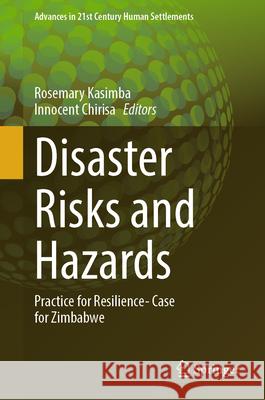
This book discusses disaster risks and hazards as well as measures to increase people’s resilience. The 21st Century has experienced a number of disasters that resulted in hampering socio-economic development, the loss of lives and property, hence they are a threat to sustainable development. Disaster risk management efforts and practices have failed to arrest the underlying drivers of increased global risk. No country is immune to disaster risk; thus, resilience has become a critical component of disaster management. It provides an opportunity to confront the social-ecological foundations of disasters. However, it has been vaguely conceptualised, and lacks a concrete approach to operationalization. Some developing countries are gradually coming to realise that preparedness, hazard mapping, prediction, risk and vulnerability assessment and planning are critical for increasing resilience and reducing losses following disasters. A paradigm shift is required from reactionary to proactive measures in disaster management as the later focuses more on increasing the resilience of the community. Zimbabwe’s disaster management policy of 1979 is in the process of review following Cyclone Idai in March 2019 and the Corona Virus 19 (COVID-19). Furthermore, the consequences of climate change disaster are being felt with across the world, particularly, developing countries, whose preparatory measures for such disasters are inadequate. Disasters have become inevitable and no country is every country is vulnerable to them. In the event of these disasters, the vulnerable people are at risk and are affected more as majority of them are not able to cope. In developed countries measures are in place to assist the vulnerable in the event that a disaster strikes. However, Zimbabwe, being a developing country is not able to deal with unpredictable disasters due to lack of resources, hence the need for it to adopt mitigatory and transformative measures to reduce the impact of any form of disasters.
This book discusses disaster risks and hazards as well as measures to increase people’s resilience. The 21st Century has experienced a number of disasters that resulted in hampering socio-economic development, the loss of lives and property, hence they are a threat to sustainable development. Disaster risk management efforts and practices have failed to arrest the underlying drivers of increased global risk. No country is immune to disaster risk; thus, resilience has become a critical component of disaster management. It provides an opportunity to confront the social-ecological foundations of disasters. However, it has been vaguely conceptualised, and lacks a concrete approach to operationalization. Some developing countries are gradually coming to realise that preparedness, hazard mapping, prediction, risk and vulnerability assessment and planning are critical for increasing resilience and reducing losses following disasters. A paradigm shift is required from reactionary to proactive measures in disaster management as the later focuses more on increasing the resilience of the community. Zimbabwe’s disaster management policy of 1979 is in the process of review following Cyclone Idai in March 2019 and the Corona Virus 19 (COVID-19). Furthermore, the consequences of climate change disaster are being felt with across the world, particularly, developing countries, whose preparatory measures for such disasters are inadequate. Disasters have become inevitable and no country is every country is vulnerable to them. In the event of these disasters, the vulnerable people are at risk and are affected more as majority of them are not able to cope. In developed countries measures are in place to assist the vulnerable in the event that a disaster strikes. However, Zimbabwe, being a developing country is not able to deal with unpredictable disasters due to lack of resources, hence the need for it to adopt mitigatory and transformative measures to reduce the impact of any form of disasters.




Czytaj nas na:
KrainaKsiazek.PL - Księgarnia Internetowa


