• Wyszukiwanie zaawansowane
  • Kategorie
  • Kategorie BISAC
  • Książki na zamówienie
  • Promocje
  • Granty
  • Książka na prezent
  • Opinie
  • Pomoc
  • Załóż konto
  • Zaloguj się

Digital Technologies and Institutions for Sustainable Development » książka

zaloguj się | załóż konto
Logo Krainaksiazek.pl

koszyk

konto

szukaj
topmenu
Księgarnia internetowa
Szukaj
Książki na zamówienie
Promocje
Granty
Książka na prezent
Moje konto
Pomoc
 
 
Wyszukiwanie zaawansowane
Pusty koszyk
Bezpłatna dostawa dla zamówień powyżej 20 złBezpłatna dostawa dla zamówień powyżej 20 zł

Kategorie główne

• Nauka
 [2946600]
• Literatura piękna
 [1856966]

  więcej...
• Turystyka
 [72221]
• Informatyka
 [151456]
• Komiksy
 [35826]
• Encyklopedie
 [23190]
• Dziecięca
 [619653]
• Hobby
 [140543]
• AudioBooki
 [1577]
• Literatura faktu
 [228355]
• Muzyka CD
 [410]
• Słowniki
 [2874]
• Inne
 [445822]
• Kalendarze
 [1744]
• Podręczniki
 [167141]
• Poradniki
 [482898]
• Religia
 [510455]
• Czasopisma
 [526]
• Sport
 [61590]
• Sztuka
 [243598]
• CD, DVD, Video
 [3423]
• Technologie
 [219201]
• Zdrowie
 [101638]
• Książkowe Klimaty
 [124]
• Zabawki
 [2473]
• Puzzle, gry
 [3898]
• Literatura w języku ukraińskim
 [254]
• Art. papiernicze i szkolne
 [8170]
Kategorie szczegółowe BISAC

Digital Technologies and Institutions for Sustainable Development

ISBN-13: 9783031042911 / Angielski / Miękka / 2023
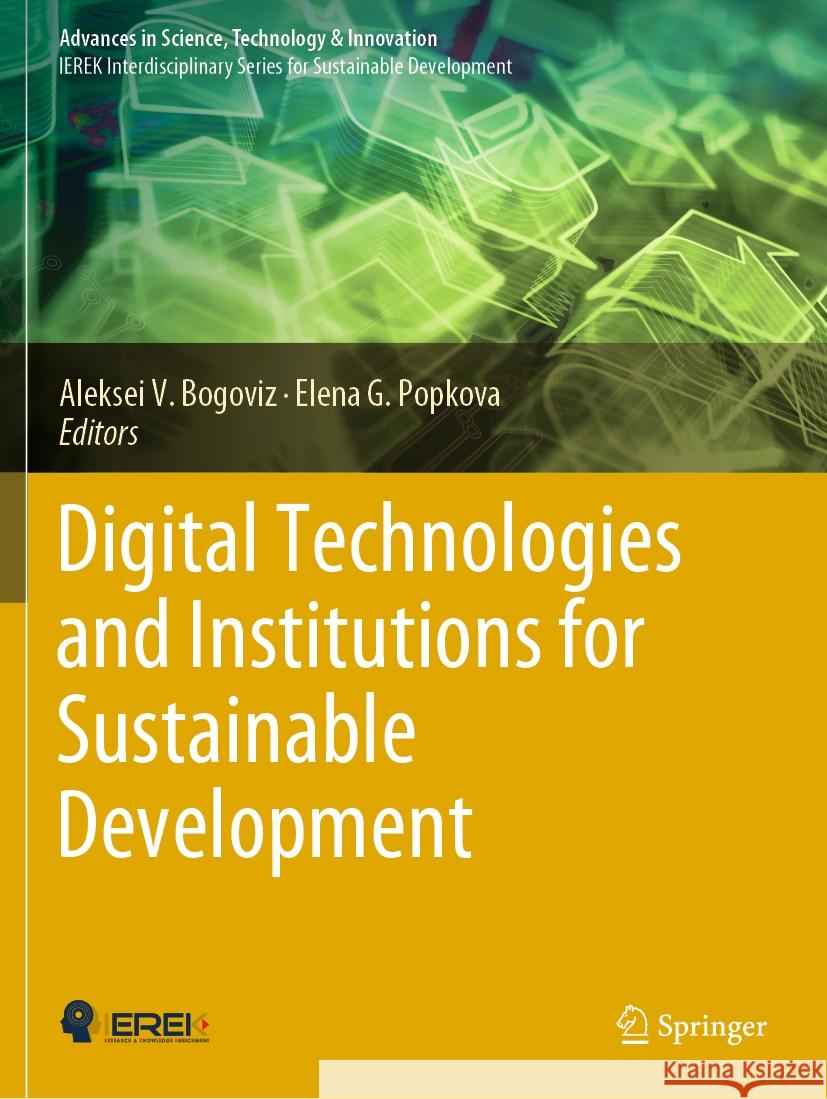
Digital Technologies and Institutions for Sustainable Development  9783031042911 Springer International Publishing - książkaWidoczna okładka, to zdjęcie poglądowe, a rzeczywista szata graficzna może różnić się od prezentowanej.

Digital Technologies and Institutions for Sustainable Development

ISBN-13: 9783031042911 / Angielski / Miękka / 2023

cena 806,99 zł
(netto: 768,56 VAT:  5%)

Najniższa cena z 30 dni: 771,08 zł
Termin realizacji zamówienia:
ok. 22 dni roboczych
Bez gwarancji dostawy przed świętami

Darmowa dostawa!
inne wydania

This book focuses on digital institutions and the advanced technologies used on their basis, as well as their contribution to sustainable development in the unity of seventeen SDGs formulated by the UN, which is sequentially disclosed in six parts of the book. This book is dedicated to comprehensive coverage of the role of the digital economy in sustainable development and the offering of a set of scientific, methodological, and practical recommendations to increase the scale and effectiveness of this role. The first part explores the training of digital personnel for sustainable development, the second part reveals the regional features of Russia, and the third part describes the industry specifics of using digital technologies in entrepreneurship in support of sustainable development. The fourth part deals with financial, organizational, and managerial issues of using digital technologies in entrepreneurship in support of sustainable development, the fifth part is devoted to security, international factors, and risks, and the sixth part deals with the legal framework and state regulation of digital technologies and sustainable development institutions. The novelty of the book lies in its reliance on an institutional approach that allows rethinking and systematically studying the contribution of the digital economy to sustainable development. The book is aimed at scholars who will find in it an institutional understanding of the digital economy’s support for sustainable development and ways to improve it. The secondary target audience of the book is the subject of managing the sustainable development of the digital economy. For them, the book contains relevant and illustrative examples from practice and applied recommendations.   


Kategorie:
Nauka, Pedagogika i oświata
Kategorie BISAC:
Education > General
Social Science > Socjologia
Wydawca:
Springer International Publishing
Seria wydawnicza:
Advances in Science, Technology & Innovation
Język:
Angielski
ISBN-13:
9783031042911
Rok wydania:
2023
Waga:
1.55 kg
Wymiary:
27.9 x 21.0
Oprawa:
Miękka
Dodatkowe informacje:
Wydanie ilustrowane

Introduction

Training of Digital Personnel for the Sustainable Development of the Economy

The Impact of the COVID-19 Recession on the Russian Labor Market.- Remote Management as a New Form of HR Management

Human Capital and Prospects for the Development of its Motivation Technology in the Digital Economy

Application of Digital Technology in Professional Training

Qualitative Update of the Characteristics of Labor Force in the Context of Digitalization of the Economy of the Region

Human Capital as an Internal Resource for Innovative Development of the Region

Higher Agricultural Education: Orienting Professional Tasks to Shape Sectoral Digital Competencies

Problems of Development of Small Innovative Enterprises on the Basis of Higher Education Institutions

Methods of Labor Market Analysis in the Digital Economy

The Professional Teachers` Training as an Important Factor of Quality Education

Peculiarities of the Educational System in the European Region: Problems and Trends

Reputation Capital of a University Lecturer: Identification and Assessment

Current System of Higher Legal Education

Target Vectors of Life Self-Determination of the University Economic Programs’ Graduates

Regional Features of Digital Technologies and Sustainable Development Institutions in Russia

The Use of Economic and Mathematical Modeling Tools for the Effective Distribution of Subsidies to Regional Budgets

Integral Assessment of the Level of Digitalization of the Region’s Economy

Smart Cities in Russia: Experience, Problems, and Solutions

Monitoring of Degradation Processes and Problems of Sustainable Agricultural Land Use in the Arid Agroclimatic Zone of Stavropol Territory

Digitalization of the Agricultural Economy in the Krasnodar Territory

Educational Space and the Issues of Digitalization in the Mining Region

Socio-Cultural Capital of Rural Areas in the Context of the Sustainable Development of the Digital Economy

Sustainable Development of Small Towns in a Digital Economy

Monetary Evaluation of an Ecosystem Service for Reducing Radiation Impact on Crop Production at the Local Level

Challenges of Regional Economic Development: Building Export Potential and Food Security

Issues of the Development of Digital Entrepreneurship in the Regions of Kyrgyzstan

The Level of Economic Security as an Indicator of the Region Depression

Features of Soil and Ground Conditions of the Southern Region of Kyrgyzstan for Clarifying the Boundaries of Road and Climatic Zones

Assessment of the Economic Efficiency of the Production System of a Regional Industrial Cluster

Ecological Problems of Municipal Transport Systems in Innovative Economy.


Aleksei V. Bogoviz received his Ph.D. in Economics in 2007, having defended his thesis on the Economics of Regional Agro-Industrial Complexes. This topic also prevailed in further research. His scientific activity aimed at creating and developing viable solutions for a sustainable future and positive social transformations in the field of cooperation, based on integrated and innovative science-based approaches. His research interests are related to the mechanisms of cooperation in the context of the digitalization of the economy and the spread of artificial intelligence technologies, the study of which contributes to the understanding of measures and actions aimed at achieving the 17 Sustainable Development Goals set out in the UN for 2030. Aleksei V. Bogoviz does a lot of organizational work to form temporary research teams and collaborations between universities in Russia and foreign countries. He is the author of more than 200 contributions in international top-rated publishers in their field, is a member of the organizing committees of some International Scientific Conferences. He combines his research activity with many years of pedagogical work.  Aleksei V. Bogoviz has been working as a Professor at the National Research University “Higher School of Economics”, and for now, he is a visiting Professor at several Russian universities.

Elena G. Popkova – Doctor of Science (Economics), the founder and president of the Institute of Scientific Communications (Russia) and Leading researcher of the Center for applied research of the chair “Economic policy and public-private partnership” of Moscow State Institute of International Relations (MGIMO) (Moscow, Russia). Her scientific interests include the theory of economic growth, sustainable development, globalization, humanization of economic growth, emerging markets, social entrepreneurship, and the digital economy and Industry 4.0. Elena G. Popkova organizes Russian and international scientific and practical conferences and is the editor and author of collective monographs. She also serves as a guest editor of international scientific journals. She has published more than 300 works in Russian and foreign peer-reviewed scientific journals and books.


This book focuses on digital institutions and the advanced technologies used on their basis, as well as their contribution to sustainable development in the unity of seventeen SDGs formulated by the UN, which is sequentially disclosed in six parts of the book. This book is dedicated to comprehensive coverage of the role of the digital economy in sustainable development and the offering of a set of scientific, methodological, and practical recommendations to increase the scale and effectiveness of this role. 

The first part explores the training of digital personnel for sustainable development, the second part reveals the regional features of Russia, and the third part describes the industry specifics of using digital technologies in entrepreneurship in support of sustainable development. The fourth part deals with financial, organizational, and managerial issues of using digital technologies in entrepreneurship in support of sustainable development, the fifth part is devoted to security, international factors, and risks, and the sixth part deals with the legal framework and state regulation of digital technologies and sustainable development institutions. 

The novelty of the book lies in its reliance on an institutional approach that allows rethinking and systematically studying the contribution of the digital economy to sustainable development. The book is aimed at scholars who will find in it an institutional understanding of the digital economy’s support for sustainable development and ways to improve it. The secondary target audience of the book is the subject of managing the sustainable development of the digital economy. For them, the book contains relevant and illustrative examples from practice and applied recommendations.




Udostępnij

Facebook - konto krainaksiazek.pl


Opinie o Krainaksiazek.pl na Opineo.pl

Partner Mybenefit

Krainaksiazek.pl w programie rzetelna firma Krainaksiaze.pl - płatności przez paypal

Czytaj nas na:

Facebook - krainaksiazek.pl
  • książki na zamówienie
  • granty
  • książka na prezent
  • kontakt
  • pomoc
  • opinie
  • regulamin
  • polityka prywatności

Zobacz:

  • Księgarnia czeska

  • Wydawnictwo Książkowe Klimaty

1997-2025 DolnySlask.com Agencja Internetowa

© 1997-2022 krainaksiazek.pl
     
KONTAKT | REGULAMIN | POLITYKA PRYWATNOŚCI | USTAWIENIA PRYWATNOŚCI
Zobacz: Księgarnia Czeska | Wydawnictwo Książkowe Klimaty | Mapa strony | Lista autorów
KrainaKsiazek.PL - Księgarnia Internetowa

Polityka prywatnosci - link
Krainaksiazek.pl - płatnośc Przelewy24
Przechowalnia Przechowalnia







