• Wyszukiwanie zaawansowane
  • Kategorie
  • Kategorie BISAC
  • Książki na zamówienie
  • Promocje
  • Granty
  • Książka na prezent
  • Opinie
  • Pomoc
  • Załóż konto
  • Zaloguj się

Digital Disinformation: Computational Analysis of Culture and Conspiracy Theories in Russia and Eastern Europe » książka


zaloguj się | załóż konto
Logo Krainaksiazek.pl

koszyk

konto

szukaj
topmenu
Księgarnia internetowa
Szukaj
Książki na zamówienie
Promocje
Granty
Książka na prezent
Moje konto
Pomoc
 
 
Wyszukiwanie zaawansowane
Pusty koszyk
Bezpłatna dostawa dla zamówień powyżej 20 złBezpłatna dostawa dla zamówień powyżej 20 zł

Kategorie główne

• Nauka
 [2946600]
• Literatura piękna
 [1856966]

  więcej...
• Turystyka
 [72221]
• Informatyka
 [151456]
• Komiksy
 [35826]
• Encyklopedie
 [23190]
• Dziecięca
 [619653]
• Hobby
 [140543]
• AudioBooki
 [1577]
• Literatura faktu
 [228355]
• Muzyka CD
 [410]
• Słowniki
 [2874]
• Inne
 [445822]
• Kalendarze
 [1744]
• Podręczniki
 [167141]
• Poradniki
 [482898]
• Religia
 [510455]
• Czasopisma
 [526]
• Sport
 [61590]
• Sztuka
 [243598]
• CD, DVD, Video
 [3423]
• Technologie
 [219201]
• Zdrowie
 [101638]
• Książkowe Klimaty
 [124]
• Zabawki
 [2473]
• Puzzle, gry
 [3898]
• Literatura w języku ukraińskim
 [254]
• Art. papiernicze i szkolne
 [8170]
Kategorie szczegółowe BISAC

Digital Disinformation: Computational Analysis of Culture and Conspiracy Theories in Russia and Eastern Europe

ISBN-13: 9783031288340 / Angielski
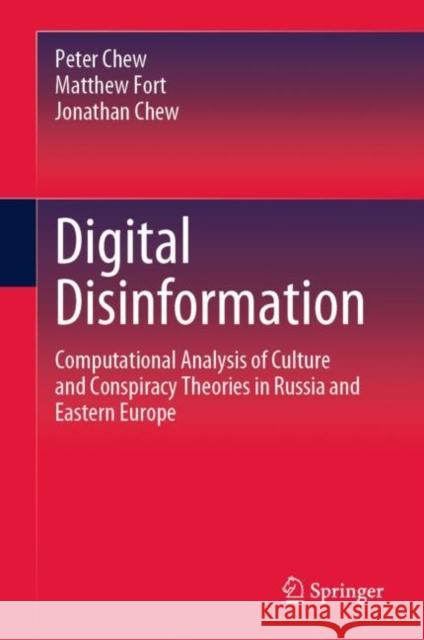
Jonathan Chew
Digital Disinformation: Computational Analysis of Culture and Conspiracy Theories in Russia and Eastern Europe Jonathan Chew 9783031288340 Springer International Publishing AG - książkaWidoczna okładka, to zdjęcie poglądowe, a rzeczywista szata graficzna może różnić się od prezentowanej.

Digital Disinformation: Computational Analysis of Culture and Conspiracy Theories in Russia and Eastern Europe

ISBN-13: 9783031288340 / Angielski

Jonathan Chew
cena 564,88 zł
(netto: 537,98 VAT:  5%)

Najniższa cena z 30 dni: 539,74 zł
Termin realizacji zamówienia:
ok. 22 dni roboczych
Bez gwarancji dostawy przed świętami

Darmowa dostawa!
inne wydania

This book uniquely combines the authors’ personal experiences, deep cultural and professional experience of living and working in Russia and the former USSR, and interest and experience with language and computational analysis, to shed light on a highly contemporary question: what is motivating conflict and unrest in Russia and its surrounding countries? How does Russian government suppression of information manifest in practice today, and how does it fit into the historical cultural pattern for Russia? The authors take a computational look at social and traditional media in the original languages, from Russia, Ukraine, Lithuania, Latvia, Estonia, Poland, and the English-speaking world, to glean insights and separate fact from fiction.This book helps readers interested in Eastern Europe to ‘take the temperature’ of the region today, but it is also of interest to readers in the policy and analysis community, because it offers a template, an analytical ‘how-to’ guide which aims to follow in the footsteps of CIA author Richards Heuer’s ‘Psychology of Intelligence Analysis’, to show how state-of-the-art computational analysis techniques could be applied to similar problems in other topic areas, with the human analyst and computational techniques each working together to create a whole greater than the sum of its parts.


This book uniquely combines the authors’ personal experiences, deep cultural and professional experience of living and working in Russia and the former USSR, and interest and experience with language and computational analysis, to shed light on a highly contemporary question: what is motivating conflict and unrest in Russia and its surrounding countries? How does Russian government suppression of information manifest in practice today, and how does it fit into the historical cultural pattern for Russia? The authors take a computational look at social and traditional media in the original languages, from Russia, Ukraine, Lithuania, Latvia, Estonia, Poland, and the English-speaking world, to glean insights and separate fact from fiction.This book helps readers interested in Eastern Europe to ‘take the temperature’ of the region today, but it is also of interest to readers in the policy and analysis community, because it offers a template, an analytical ‘how-to’ guide which aims to follow in the footsteps of CIA author Richards Heuer’s ‘Psychology of Intelligence Analysis’, to show how state-of-the-art computational analysis techniques could be applied to similar problems in other topic areas, with the human analyst and computational techniques each working together to create a whole greater than the sum of its parts.

Kategorie:
Nauka
Kategorie BISAC:
Social Science > Media Studies
Political Science > Public Policy - General
Language Arts & Disciplines > Linguistics - General
Wydawca:
Springer International Publishing AG
Język:
Angielski
ISBN-13:
9783031288340

Information Maneuvers in and around Ukraine: What is Really Driving Conflict with Russia?


1            Background

1.1         A widespread Russian view of Ukraine: rooted in language, culture, and religion


2            Issues surrounding Ukraine

2.1         Russian troop buildup on the border

2.2         Russian hydrocarbons and their place in Europe

2.2.1     A cultural specific of the Russian hydrocarbon landscape

2.2.2     Russian dependence on hydrocarbons, and its pipelines and infrastructure

2.2.3     The Russia-EU co-dependency

2.2.4     Summary

2.3         NATO enlargement


3            What does social media say about the issues?

3.1         Discussion of ‘Ukraine’ in Russian-speaking Twitter

3.2         Discussion of ‘Ukraine’ in Ukrainian-speaking Twitter

3.3         Discussion of ‘NATO’ in both Russian- and Ukrainian-speaking Twitter


4            Conclusions and recommendations for strategic communications


Information Maneuvers in the Baltic region

1               Contents


2               Background: brief history of the Baltics


3               A distillation of multiple threat assessments and perspectives

3.1            Brief background on threat assessment

3.2            Environmental Threats

3.3            Espionage Threats

3.4            Military Threats

3.5            Cyber Threats

3.6            Destabilizing Threats

3.7            Russian Limitations


4               Analysis of social media landscape

4.1            The ‘BEND’ framework

4.2            Research hypotheses

4.3            Topic selection

4.4            Data retrieval

4.5            Data processing

4.6            Exploration of results

4.7            Discussion


5 Conclusions and recommendations for strategic communications


Information Maneuvers in and around Poland: Historical Revisionism and Rule of Law


1            Background

1.1         Language, culture, and religion as predictors of geopolitical fault lines


2            Current issues surrounding Poland

2.1         The EU versus Poland on primacy of law

2.2         Polish nationalism and World War II

2.3         The Polish-Belarus border

2.4         The Suwałki Corridor

2.5         The buildup of Russian forces along Ukraine’s border


3            Analysis of social media landscape in Poland versus East Slavdom

3.1         Interpretation of the maneuvers that have led to the current point

3.2         Twitter data collection and analysis

3.2.1     Data collection

3.2.2     Analytical approach

3.2.3     Results of analysis


4            Conclusions and recommendations for strategic communications


5            References


Appendix 1: Polish ‘border’ tweets          49

Appendix 2: Russian ‘border’ tweets       62


Information Maneuvers for Soviet Union 2.0


1            Background


2            Features of everyday Soviet life in the twentieth century             

2.1         The ‘information island’ created by the Iron Curtain

2.2         Soviet indoctrination

2.3         Repression

2.4         Soviet life – drab and dilapidated

2.5         The ideology of Soviet life

2.6         The bureaucracy of Soviet life


3            Social media analysis


4            Conclusions and recommendations for strategic communications


Finding and Analyzing Information Maneuvers on the Fringe


1            Fringe narratives: an illustrative example involving Russia and its Eurasian ambitions


2            The ‘brotherhood of nations’ – a historical pattern, not an anomaly


3            Eurasian integration: coming in the near future?


4            How can we analyze fringe beliefs?

4.1         Why fringe beliefs matter: did they help end the Cold War?

4.2         The role of language in fringe beliefs

4.3         Connection to foundational computational linguistics concepts

4.3.1     Word probabilities

4.3.2     ‘Distinctiveness’ in words and combinations of words

4.3.3     From probability to pointwise mutual information

4.4         Problem statements with respect to fringe beliefs

4.4.1     Analytical approach to ‘known unknowns’

4.4.2     Analytical approach to ‘unknown unknowns’

4.5         Combining PMI and clustering to find ‘unknown unknowns’


5            Demonstration and technical implementation

5.1         Dataset

5.2         Technical implementation

5.3         Key ‘waypoints’ in the approach

5.3.1     Pointwise mutual information

5.3.2     Singular value decomposition

5.3.3     Composition of adjacency matrix

5.3.4     Detection of anomalous clusters


6            Conclusions


Appendix 1. The Scythians (by Aleksandr Blok)    54

Appendix 2. Hand-curated ‘fringe belief’ text       57

Appendix 3. Python Jupyter notebook for identifying fringe beliefs           59


Russian media narratives on Ukraine in 2022:
a computational analysis

1            Background


2            Data used for this report, and method of collection


3            Our approach: signal processing (and SVD) fundamentals


4            Key narratives in 2022 in Russian media

4.1         Application of SVD to our data

4.2         Topics of interest: detailed discussion

4.2.1     A Russian fake about alleged Ukrainian incursion

4.2.2     Mockery of changing Ukrainian positions on NATO membership

4.2.3     ‘Humanitarian corridors’ propaganda, claims of Russian air superiority

4.2.4     Pre-invasion denials that an invasion would happen

4.2.5     Conspiracy theories about U.S. biolabs in Ukraine

4.2.6     Fears of sabotage in border regions of Russia

4.2.7     Mockery of gaffe by British Foreign Secretary

4.2.8     2014 events in Ukraine described as a ‘coup’ to justify the invasion before the fact

4.2.9     Putin’s NATO grievances

4.2.10   Putin’s ‘my beauty’ remark

4.2.11   Russian reaction to U.S. ‘pre-bunking’ of Russian false flag narratives

4.2.12   Russian comparisons of Ukrainian nationalism and terrorism

4.3         Key takeaways


5            What’s ‘mainstream’ and what’s ‘fringe’ in Russian media?

5.1         How we can answer this question with SVD

5.2         Digging deeper with Keyness analysis

5.2.1     What is a Keyness Relative Frequency Analysis?

5.2.2     Comparing RT and Meduza

5.3         Key takeaways


6            How topics changed over time in Russian media

6.1         January 1st-15th: Kazakhstan unrest

6.2         January 16th-31st: Fractious political relations between Ukraine and Russia

6.3         February 1st-15th: Mockery of Ukrainian and British politicians

6.4         February 16th-28th: Russia’s invasion of Ukraine

6.5         March 1st-15th: Evacuating civilians; Ukraine-Russia peace talks

6.6         March 16th-31st: Ukrainian deaths; Chechen fighters in Ukraine

6.7         April 1st-15th: Ukrainians killed in Bucha; alleged terrorist threats within Russia

6.8         April 16th-30th: Russian media stops talking about Ukraine

6.9         May 1st-May 16th: Victory Day in Russia

6.10       Key takeaways


7            Conclusions


Appendix 1. Scraping the web for Russian media articles

Appendix 2. Full list of topics extracted from 2,838 Russian media articles, 1/1/2022-5/16/2022

Appendix 3. Jupyter Notebook code snippets

Appendix 4. Russian stopwords used for Keyness analysis

Appendix 5. Time Relative Frequency Analyses: full list of charts by half-month


Peter Chew is the President and owner of Galisteo Consulting Group, Inc., a consulting company in Albuquerque, New Mexico with a focus on national security. His specialty is in data analytics. Peter has previously worked in a research capacity for the U.S. national laboratories, and as an auditor for Price Waterhouse, where his assignments included field audits of Russian oil and gas companies. Peter’s education is a D.Phil. in Russian computational linguistics at the University of Oxford (where he was a recipient of a British Academy scholarship) and a B.A. in Russian and Polish language and literature at the School of Slavonic and East European Studies (University of London), where he earned distinctions in linguistics. Peter has authored and co-authored many articles, primarily in the field of computational linguistics. In the area of finance, where he has also applied his analytical skills, Peter is also a Certified Public Accountant and Certified Fraud Examiner. Peter is fluent in Russian and competent in Polish.

This book uniquely combines the authors’ personal experiences, deep cultural and professional experience of living and working in Russia and the former USSR, and interest and experience with language and computational analysis, to shed light on a highly contemporary question: what is motivating conflict and unrest in Russia and its surrounding countries? How does Russian government suppression of information manifest in practice today, and how does it fit into the historical cultural pattern for Russia? The authors take a computational look at social and traditional media in the original languages, from Russia, Ukraine, Lithuania, Latvia, Estonia, Poland, and the English-speaking world, to glean insights and separate fact from fiction.

This book helps readers interested in Eastern Europe to ‘take the temperature’ of the region today, but it is also of interest to readers in the policy and analysis community, because it offers a template, an analytical ‘how-to’ guide which aims to follow in the footsteps of CIA author Richards Heuer’s ‘Psychology of Intelligence Analysis’, to show how state-of-the-art computational analysis techniques could be applied to similar problems in other topic areas, with the human analyst and computational techniques each working together to create a whole greater than the sum of its parts.




Udostępnij

Facebook - konto krainaksiazek.pl


Opinie o Krainaksiazek.pl na Opineo.pl

Partner Mybenefit

Krainaksiazek.pl w programie rzetelna firma Krainaksiaze.pl - płatności przez paypal

Czytaj nas na:

Facebook - krainaksiazek.pl
  • książki na zamówienie
  • granty
  • książka na prezent
  • kontakt
  • pomoc
  • opinie
  • regulamin
  • polityka prywatności

Zobacz:

  • Księgarnia czeska

  • Wydawnictwo Książkowe Klimaty

1997-2025 DolnySlask.com Agencja Internetowa

© 1997-2022 krainaksiazek.pl
     
KONTAKT | REGULAMIN | POLITYKA PRYWATNOŚCI | USTAWIENIA PRYWATNOŚCI
Zobacz: Księgarnia Czeska | Wydawnictwo Książkowe Klimaty | Mapa strony | Lista autorów
KrainaKsiazek.PL - Księgarnia Internetowa

Polityka prywatnosci - link
Krainaksiazek.pl - płatnośc Przelewy24
Przechowalnia Przechowalnia




