• Wyszukiwanie zaawansowane
  • Kategorie
  • Kategorie BISAC
  • Książki na zamówienie
  • Promocje
  • Granty
  • Książka na prezent
  • Opinie
  • Pomoc
  • Załóż konto
  • Zaloguj się

Difference Matrices for Ode and Pde: A Matlab(r) Companion » książka


zaloguj się | załóż konto
Logo Krainaksiazek.pl

koszyk

konto

szukaj
topmenu
Księgarnia internetowa
Szukaj
Książki na zamówienie
Promocje
Granty
Książka na prezent
Moje konto
Pomoc
 
 
Wyszukiwanie zaawansowane
Pusty koszyk
Bezpłatna dostawa dla zamówień powyżej 20 złBezpłatna dostawa dla zamówień powyżej 20 zł

Kategorie główne

• Nauka
 [2939893]
• Literatura piękna
 [1808953]

  więcej...
• Turystyka
 [70366]
• Informatyka
 [150555]
• Komiksy
 [35137]
• Encyklopedie
 [23160]
• Dziecięca
 [608786]
• Hobby
 [136447]
• AudioBooki
 [1631]
• Literatura faktu
 [225099]
• Muzyka CD
 [360]
• Słowniki
 [2914]
• Inne
 [442115]
• Kalendarze
 [1068]
• Podręczniki
 [166599]
• Poradniki
 [468390]
• Religia
 [506548]
• Czasopisma
 [506]
• Sport
 [61109]
• Sztuka
 [241608]
• CD, DVD, Video
 [3308]
• Technologie
 [218981]
• Zdrowie
 [98614]
• Książkowe Klimaty
 [124]
• Zabawki
 [2174]
• Puzzle, gry
 [3275]
• Literatura w języku ukraińskim
 [260]
• Art. papiernicze i szkolne
 [7376]
Kategorie szczegółowe BISAC

Difference Matrices for Ode and Pde: A Matlab(r) Companion

ISBN-13: 9783031119996 / Angielski / Miękka / 2023 / 204 str.
John M. Neuberger
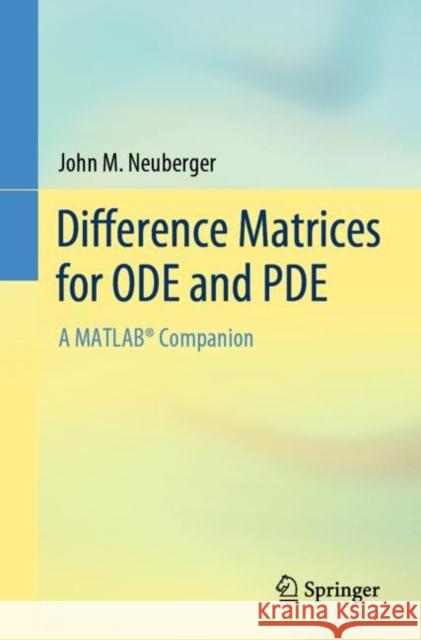
Difference Matrices for Ode and Pde: A Matlab(r) Companion Neuberger, John M. 9783031119996 Springer International Publishing AG - książkaWidoczna okładka, to zdjęcie poglądowe, a rzeczywista szata graficzna może różnić się od prezentowanej.

Difference Matrices for Ode and Pde: A Matlab(r) Companion

ISBN-13: 9783031119996 / Angielski / Miękka / 2023 / 204 str.

John M. Neuberger
cena 200,77
(netto: 191,21 VAT:  5%)

Najniższa cena z 30 dni: 192,74
Termin realizacji zamówienia:
ok. 22 dni roboczych.

Darmowa dostawa!

The use of difference matrices and high-level MATLAB® commands to implement finite difference algorithms is pedagogically novel. This unique and concise textbook gives the reader easy access and a general ability to use first and second difference matrices to set up and solve linear and nonlinear systems in MATLAB which approximate ordinary and partial differential equations. Prerequisites include a knowledge of basic calculus, linear algebra, and ordinary differential equations. Some knowledge of partial differential equations is a plus though the text may easily serve as a supplement for the student currently working through an introductory PDEs course.  Familiarity with MATLAB is not required though a little prior experience with programming would be helpful.In addition to its special focus on solving in MATLAB, the abundance of examples and exercises make this text versatile in use. It would serve well in a graduate course in introductory scientific computing for partial differential equations. With prerequisites mentioned above plus some elementary numerical analysis, most of the material can be covered and many of the exercises assigned in a single semester course. Some of the more challenging exercises make substantial projects and relate to topics from other typical graduate mathematics courses, e.g., linear algebra, differential equations, or topics in nonlinear functional analysis. A selection of the exercises may be assigned as projects throughout the semester. The student will develop the skills to run simulations corresponding to the primarily theoretical course material covered by the instructor. The book can serve as a supplement for the instructor teaching any course in differential equations. Many of the examples can be easily implemented and the resulting simulation demonstrated by the instructor. If the course has a numerical component, a few of the more difficult exercises may be assigned as student projects.Established researchers in theoretical partial differential equations may find this book useful as well, particularly as an introductory guide for their research students. Those unfamiliar with MATLAB can use the material as a reference to quickly develop their own applications in that language. Practical assistance in implementing algorithms in MATLAB can be found in these pages. A mathematician who is new to the practical implementation of methods for scientific computation in general can learn how to implement and execute numerical simulations of differential equations in MATLAB with relative ease by working through a selection of exercises. Additionally, the book can serve as a practical guide in independent study, undergraduate or graduate research experiences, or for reference in simulating solutions to specific thesis or dissertation-related experiments.


The use of difference matrices and high-level MATLAB® commands to implement finite difference algorithms is pedagogically novel. This unique and concise textbook gives the reader easy access and a general ability to use first and second difference matrices to set up and solve linear and nonlinear systems in MATLAB which approximate ordinary and partial differential equations. Prerequisites include a knowledge of basic calculus, linear algebra, and ordinary differential equations. Some knowledge of partial differential equations is a plus though the text may easily serve as a supplement for the student currently working through an introductory PDEs course.  Familiarity with MATLAB is not required though a little prior experience with programming would be helpful.In addition to its special focus on solving in MATLAB, the abundance of examples and exercises make this text versatile in use. It would serve well in a graduate course in introductory scientific computing for partial differential equations. With prerequisites mentioned above plus some elementary numerical analysis, most of the material can be covered and many of the exercises assigned in a single semester course. Some of the more challenging exercises make substantial projects and relate to topics from other typical graduate mathematics courses, e.g., linear algebra, differential equations, or topics in nonlinear functional analysis. A selection of the exercises may be assigned as projects throughout the semester. The student will develop the skills to run simulations corresponding to the primarily theoretical course material covered by the instructor. The book can serve as a supplement for the instructor teaching any course in differential equations. Many of the examples can be easily implemented and the resulting simulation demonstrated by the instructor. If the course has a numerical component, a few of the more difficult exercises may be assigned as student projects.Established researchers in theoretical partial differential equations may find this book useful as well, particularly as an introductory guide for their research students. Those unfamiliar with MATLAB can use the material as a reference to quickly develop their own applications in that language. Practical assistance in implementing algorithms in MATLAB can be found in these pages. A mathematician who is new to the practical implementation of methods for scientific computation in general can learn how to implement and execute numerical simulations of differential equations in MATLAB with relative ease by working through a selection of exercises. Additionally, the book can serve as a practical guide in independent study, undergraduate or graduate research experiences, or for reference in simulating solutions to specific thesis or dissertation-related experiments.

Kategorie:
Nauka, Matematyka
Kategorie BISAC:
Mathematics > Counting & Numeration
Mathematics > Mathematical Analysis
Wydawca:
Springer International Publishing AG
Język:
Angielski
ISBN-13:
9783031119996
Rok wydania:
2023
Dostępne języki:
Ilość stron:
204
Oprawa:
Miękka

1. Introduction.- 2. Review of elementary numerical methods and MATLAB(R).- 3. Ordinary Differential Equations.- 4. Partial Differential Equations.- 5. Advanced topics in semilinear elliptic BVP.- References.

​John M. Neuberger is Professor of Mathematics in the Department of Mathematics and Statistics, College of Engineering, Forestry, and Natural Sciences at Northern Arizona University.

The use of difference matrices and high-level MATLAB® commands to implement finite difference algorithms is pedagogically novel. This unique and concise textbook gives the reader easy access and a general ability to use first and second difference matrices to set up and solve linear and nonlinear systems in MATLAB which approximate ordinary and partial differential equations. Prerequisites include a knowledge of basic calculus, linear algebra, and ordinary differential equations. Some knowledge of partial differential equations is a plus though the text may easily serve as a supplement for the student currently working through an introductory PDEs course.  Familiarity with MATLAB is not required though a little prior experience with programming would be helpful.In addition to its special focus on solving in MATLAB, the abundance of examples and exercises make this text versatile in use. It would serve well in a graduate course in introductory scientific computing for partial differential equations. With prerequisites mentioned above plus some elementary numerical analysis, most of the material can be covered and many of the exercises assigned in a single semester course. Some of the more challenging exercises make substantial projects and relate to topics from other typical graduate mathematics courses, e.g., linear algebra, differential equations, or topics in nonlinear functional analysis. A selection of the exercises may be assigned as projects throughout the semester. The student will develop the skills to run simulations corresponding to the primarily theoretical course material covered by the instructor. The book can serve as a supplement for the instructor teaching any course in differential equations. Many of the examples can be easily implemented and the resulting simulation demonstrated by the instructor. If the course has a numerical component, a few of the more difficult exercises may be assigned as student projects.

Established researchers in theoretical partial differential equations may find this book useful as well, particularly as an introductory guide for their research students. Those unfamiliar with MATLAB can use the material as a reference to quickly develop their own applications in that language. Practical assistance in implementing algorithms in MATLAB can be found in these pages. A mathematician who is new to the practical implementation of methods for scientific computation in general can learn how to implement and execute numerical simulations of differential equations in MATLAB with relative ease by working through a selection of exercises. Additionally, the book can serve as a practical guide in independent study, undergraduate or graduate research experiences, or for reference in simulating solutions to specific thesis or dissertation-related experiments.




Udostępnij

Facebook - konto krainaksiazek.pl


Opinie o Krainaksiazek.pl na Opineo.pl

Partner Mybenefit

Krainaksiazek.pl w programie rzetelna firma Krainaksiaze.pl - płatności przez paypal

Czytaj nas na:

Facebook - krainaksiazek.pl
  • książki na zamówienie
  • granty
  • książka na prezent
  • kontakt
  • pomoc
  • opinie
  • regulamin
  • polityka prywatności

Zobacz:

  • Księgarnia czeska

  • Wydawnictwo Książkowe Klimaty

1997-2026 DolnySlask.com Agencja Internetowa

© 1997-2022 krainaksiazek.pl
     
KONTAKT | REGULAMIN | POLITYKA PRYWATNOŚCI | USTAWIENIA PRYWATNOŚCI
Zobacz: Księgarnia Czeska | Wydawnictwo Książkowe Klimaty | Mapa strony | Lista autorów
KrainaKsiazek.PL - Księgarnia Internetowa

Polityka prywatnosci - link
Krainaksiazek.pl - płatnośc Przelewy24
Przechowalnia Przechowalnia




