• Wyszukiwanie zaawansowane
  • Kategorie
  • Kategorie BISAC
  • Książki na zamówienie
  • Promocje
  • Granty
  • Książka na prezent
  • Opinie
  • Pomoc
  • Załóż konto
  • Zaloguj się

Development of Antibody-Based Therapeutics: Translational Considerations » książka


zaloguj się | załóż konto
Logo Krainaksiazek.pl

koszyk

konto

szukaj
topmenu
Księgarnia internetowa
Szukaj
Książki na zamówienie
Promocje
Granty
Książka na prezent
Moje konto
Pomoc
 
 
Wyszukiwanie zaawansowane
Pusty koszyk
Bezpłatna dostawa dla zamówień powyżej 20 złBezpłatna dostawa dla zamówień powyżej 20 zł

Kategorie główne

• Nauka
 [2944077]
• Literatura piękna
 [1814251]

  więcej...
• Turystyka
 [70679]
• Informatyka
 [151074]
• Komiksy
 [35590]
• Encyklopedie
 [23169]
• Dziecięca
 [611005]
• Hobby
 [136031]
• AudioBooki
 [1718]
• Literatura faktu
 [225599]
• Muzyka CD
 [379]
• Słowniki
 [2916]
• Inne
 [443741]
• Kalendarze
 [1187]
• Podręczniki
 [166463]
• Poradniki
 [469211]
• Religia
 [506887]
• Czasopisma
 [481]
• Sport
 [61343]
• Sztuka
 [242115]
• CD, DVD, Video
 [3348]
• Technologie
 [219293]
• Zdrowie
 [98602]
• Książkowe Klimaty
 [124]
• Zabawki
 [2385]
• Puzzle, gry
 [3504]
• Literatura w języku ukraińskim
 [260]
• Art. papiernicze i szkolne
 [7151]
Kategorie szczegółowe BISAC

Development of Antibody-Based Therapeutics: Translational Considerations

ISBN-13: 9781489991133 / Angielski / Miękka / 2014 / 426 str.
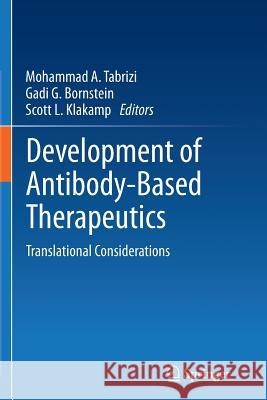
Mohammad A. Tabrizi; Gadi G. Bornstein; Scott L. Klakamp
Development of Antibody-Based Therapeutics: Translational Considerations Tabrizi, Mohammad A. 9781489991133 Springer - książkaWidoczna okładka, to zdjęcie poglądowe, a rzeczywista szata graficzna może różnić się od prezentowanej.

Development of Antibody-Based Therapeutics: Translational Considerations

ISBN-13: 9781489991133 / Angielski / Miękka / 2014 / 426 str.

Mohammad A. Tabrizi; Gadi G. Bornstein; Scott L. Klakamp
cena 601,92
(netto: 573,26 VAT:  5%)

Najniższa cena z 30 dni: 576,49
Termin realizacji zamówienia:
ok. 22 dni roboczych.

Darmowa dostawa!

The biologics market continues to witness an impressive rate of growth and the monoclonal antibody market, in particular, has contributed remarkably to the expansion of this segment within the pharmaceutical industry. In 2006, close to 80% of the annual biologics growth rate in the United States (US) was attributed to cancer and anti-TNF antibodies, with increases in growth of 56% and 25%, respectively, compared to those in the previous year. Additionally, the monoclonal antibody sector is anticipated to achieve a growth rate of approximately 14% by 2012, easily outstripping the predicted 0.6% growth rate in the small molecules market. The robust late-stage antibody pipeline within the biotech sector has drawn an increasing amount of interest from the large pharmaceutical industry and has triggered the largest product and platform deals in 2006, with values more than $2.1 and $5.1 billion in partnering and mergers and acquisitions, respectively. Additionally, with the forthcoming emergence of biogenerics, next-generation bio-improved antibodies have drawn much attention and increasingly contribute to the growth of the biologics segment. As next-generation monoclonal antibodies confront their first-generation rivals, it is critical that these next-generation products offer a clear differentiating advantage against the existing competition. Successful strategies for the development of monoclonal antibodies require integration of knowledge with respect to target antigen properties, antibody design criteria such as affinity, isotype selection, Fc domain engineering, pharmacokinetic and pharmacodynamic (PK/PD) properties, antibody cross-reactivity across species, market differentiation opportunities for the first- and next-generation leads, and regulatory requirements from the early stages of antibody development. Biophysical measurements are one of the critical components necessary for the design of effective translational strategies for lead selection and evaluation of relevant animal species for preclinical safety and efficacy studies. Incorporation of effective translational strategies from the early stages of the antibody development process is a necessity, and when considered, it not only reduces development time and cost, but also fosters implementation of rational decision-making throughout all phases of antibody development. Translational strategies for development of antibody-based therapeutics should allow understanding of the relationship between the 'unit dose' and 'unit effect' with respect to both beneficial and deleterious effects from early stages of development. The flow of information from later to earlier stages of development should provide opportunities to facilitate selection of more effective and novel next-generation drug candidates. Selection and evaluation of relevant biomarkers in early preclinical development in "relevant" animal models should allow for identifying potential risks to humans and establishing safe First-In-Human (FIH) dosing strategies. Hence, integration of knowledge with respect to target antigen properties such as antigen distribution, expression profile, kinetic properties, target pharmacology, antigen isoforms and pharmacological redundancy in health and disease, as well as antibody design criteria, such as antibody isotype, affinity, PK/PD and safety is a critical necessity for the design of effective translational strategies. Additionally, these factors will further offer critical differentiating characteristics for next-generation antibodies, and novel technologies prove instrumental in generation of bio-improved antibody candidates for market entry. This book will examine many important considerations necessary for the design of effective translational strategies during the development of antibody-based therapeutics.


Kategorie:
Nauka, Medycyna
Kategorie BISAC:
Medical > Farmacja
Medical > Immunology
Medical > Farmakologia
Wydawca:
Springer
Język:
Angielski
ISBN-13:
9781489991133
Rok wydania:
2014
Wydanie:
2012
Ilość stron:
426
Waga:
0.61 kg
Wymiary:
23.39 x 15.6 x 2.26
Oprawa:
Miękka
Wolumenów:
01
Dodatkowe informacje:
Wydanie ilustrowane

Translational Strategies for Development of Antibody-Based Therapeutics: An Overview.- Discovery Process for Antibody-Based Therapeutics.- Technologies for the Generation of Human Antibodies.- Application of Antibody Engineering in the Development of Next Generation Antibody-Based Therapeutics.- Biophysical Considerations.- Considerations in Establishing Affinity Design Goals.- BioAnalytical Considerations: Pharmacokinetics and Immunogenicity.- Antibody-Based Therapeutics in Oncology : Preclinical Considerations.- Factors Impacting the Tumor Localization and Distribution.- Antibody-Based Therapeutics: Preclinical Safety Considerations.- Application of Pharmacokinetic/Pharmacodynamic Modeling.- Design of Translational Strategies : Application of Population Pharmacokinetic-Pharmacodynamic (PK-PD) Approaches.- Translational Biomarkers: Essential Tools in Development of Antibody-Based Therapeutics.- Development of Antibody-Based Therapeutics: Translational Research in Alzheimer’s Disease.- Considerations in Manufacturing Process Development.- Next Generation Antibody-Based Therapeutics.- Immune Complex Therapies for Treatment of Immune Thrombocytopenia (ITP).- Application of Bioinformatics Principles for Target Evaluation.- Concluding Remarks.

Mohammad Tabrizi, Ph.D., Vice President, Preclinical Development, AnaptysBio Inc. Mohammad Tabrizi is a leader in translational sciences as related to development of antibody-based therapeutics. His product development experience spans many therapeutic areas including oncology and inflammatory disease, and his technical expertise includes preclinical pharmacology and safety, preclinical and clinical pharmacokinetics, pharmacodynamics, GLP-compliant bioanalytics, and clinical pharmacology of therapeutic monoclonal antibodies. He is currently the Vice President of Preclinical Development at AnaptysBio, Inc., a privately held biotechnology company in San Diego CA, USA, the leader in Somatic HyperMutation (SHM) for development of therapeutic antibodies where he advances the preclinical development efforts.

Gadi Gazit Bornstein, Ph.D., Principal Scientist, AstraZeneca R&D Boston Dr. Bornstein has experience in research and development with an emphasis in development of therapeutic monoclonal antibodies in oncology. Dr. Bornstein is a Principal Scientist at AstraZeneca, where he currently leads several antibody programs within the Preclinical oncology portfolio. He received his B.S. in biochemistry at the University of California, Davis and his doctoral degree in biochemistry at the Keck School of Medicine of the University of Southern California. Dr. Bornstein completed his postdoctoral training at Stanford University School of Medicine in the Division of Immunology and Rheumatology. Following his postdoctoral training, Dr. Bornstein joined Amgen Fremont, Inc. (formerly Abgenix, Inc.) as a Staff Scientist in the Preclinical Oncology Department. During his tenure at Abgenix, he was a project team leader and lead biologist for multiple antibody programs.

Scott L. Klakamp, Ph.D., Research Fellow, Biophysical Chemistry and Research Informatics, Takeda San Francisco Scott Klakamp is one of the leading scientists in utilizing Biacore®, KinExA®, and FACS techniques to measure the binding kinetics and equilibrium constants of human monoclonal antibody/antigen complexes. He has extensive experience in research and development involving the biophysical and analytical characterization of biologics and monoclonal antibodies (mAb). He has also contributed significantly to the clinical immunology field by applying highly rigorous analytical detection concepts, previously unknown to the discipline, to immunogenicity studies of therapeutic mAbs. Currently, he is a Research Fellow at Takeda San Francisco, the therapeutic monoclonal antibody discovery engine for Takeda Pharmaceutical Company, and leads the Biophysical Chemistry and Research Informatics Groups.

Development of Antibody-Based Therapeutics: Translational Considerations examines important considerations necessary for the design of effective translational strategies during the development of antibody-based therapeutics. Translational strategies for development of antibody-based therapeutics require an understanding of the relationship between the ‘unit dose’ and ‘unit effect’ with respect to both beneficial and deleterious biological effects from early stages of development. The flow of information across various stages of development should provide opportunities to facilitate selection of more effective novel and next-generation drug candidates.  Successful strategies for the development of monoclonal antibodies require integration of knowledge with regards to target antigen properties in health and disease, as well as antibody design criteria including affinity, isotype selection, pharmacokinetics/pharmacodynamics (PK/PD) properties, antibody cross-reactivity across species, and safety. Selection and evaluation of appropriate biomarkers in early preclinical development in “relevant” animal models should allow identification of potential risks and liabilities of an antibody drug candidate to humans and establishment of safe First-In-Human (FIH) dosing strategies.  This volume provides a comprehensive review of the topics critical for establishing successful translational strategies for the development of antibody-based therapeutics.




Udostępnij

Facebook - konto krainaksiazek.pl


Opinie o Krainaksiazek.pl na Opineo.pl

Partner Mybenefit

Krainaksiazek.pl w programie rzetelna firma Krainaksiaze.pl - płatności przez paypal

Czytaj nas na:

Facebook - krainaksiazek.pl
  • książki na zamówienie
  • granty
  • książka na prezent
  • kontakt
  • pomoc
  • opinie
  • regulamin
  • polityka prywatności

Zobacz:

  • Księgarnia czeska

  • Wydawnictwo Książkowe Klimaty

1997-2026 DolnySlask.com Agencja Internetowa

© 1997-2022 krainaksiazek.pl
     
KONTAKT | REGULAMIN | POLITYKA PRYWATNOŚCI | USTAWIENIA PRYWATNOŚCI
Zobacz: Księgarnia Czeska | Wydawnictwo Książkowe Klimaty | Mapa strony | Lista autorów
KrainaKsiazek.PL - Księgarnia Internetowa

Polityka prywatnosci - link
Krainaksiazek.pl - płatnośc Przelewy24
Przechowalnia Przechowalnia




