• Wyszukiwanie zaawansowane
  • Kategorie
  • Kategorie BISAC
  • Książki na zamówienie
  • Promocje
  • Granty
  • Książka na prezent
  • Opinie
  • Pomoc
  • Załóż konto
  • Zaloguj się

Developing Information Systems Accurately: A Wholistic Approach » książka


zaloguj się | załóż konto
Logo Krainaksiazek.pl

koszyk

konto

szukaj
topmenu
Księgarnia internetowa
Szukaj
Książki na zamówienie
Promocje
Granty
Książka na prezent
Moje konto
Pomoc
 
 
Wyszukiwanie zaawansowane
Pusty koszyk
Bezpłatna dostawa dla zamówień powyżej 20 złBezpłatna dostawa dla zamówień powyżej 20 zł

Kategorie główne

• Nauka
 [2949965]
• Literatura piękna
 [1857847]

  więcej...
• Turystyka
 [70818]
• Informatyka
 [151303]
• Komiksy
 [35733]
• Encyklopedie
 [23180]
• Dziecięca
 [617748]
• Hobby
 [139972]
• AudioBooki
 [1650]
• Literatura faktu
 [228361]
• Muzyka CD
 [398]
• Słowniki
 [2862]
• Inne
 [444732]
• Kalendarze
 [1620]
• Podręczniki
 [167233]
• Poradniki
 [482388]
• Religia
 [509867]
• Czasopisma
 [533]
• Sport
 [61361]
• Sztuka
 [243125]
• CD, DVD, Video
 [3451]
• Technologie
 [219309]
• Zdrowie
 [101347]
• Książkowe Klimaty
 [123]
• Zabawki
 [2362]
• Puzzle, gry
 [3791]
• Literatura w języku ukraińskim
 [253]
• Art. papiernicze i szkolne
 [7933]
Kategorie szczegółowe BISAC

Developing Information Systems Accurately: A Wholistic Approach

ISBN-13: 9783031168611 / Angielski / Miękka / 2023 / 253 str.
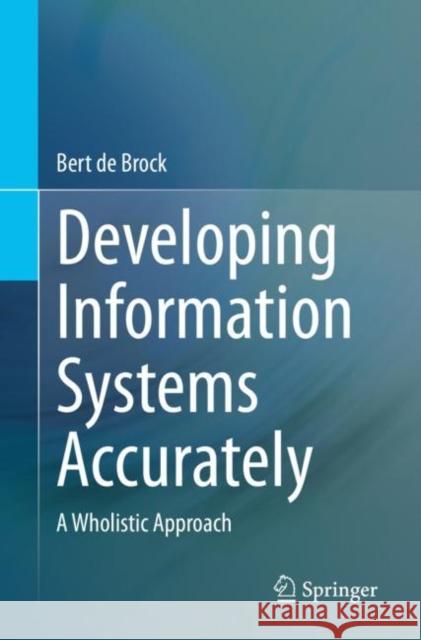
Bert de Brock
Developing Information Systems Accurately: A Wholistic Approach Bert de Brock 9783031168611 Springer International Publishing AG - książkaWidoczna okładka, to zdjęcie poglądowe, a rzeczywista szata graficzna może różnić się od prezentowanej.

Developing Information Systems Accurately: A Wholistic Approach

ISBN-13: 9783031168611 / Angielski / Miękka / 2023 / 253 str.

Bert de Brock
cena 221,90 zł
(netto: 211,33 VAT:  5%)

Najniższa cena z 30 dni: 212,02 zł
Termin realizacji zamówienia:
ok. 22 dni roboczych
Bez gwarancji dostawy przed świętami

Darmowa dostawa!

This textbook shows how to develop the functional requirements of (information) systems. It emphasizes the importance to consider the complete development path of a functional requirement, i.e. not only the individual development steps but also their proper combination and their alignment.The book consists of two parts: Part I presents the underlying theory while Part II contains various illustrative case studies. Part I starts with an introduction to the topic (Chapter 1). Then it explains how to develop functional requirements that represent the conceptualdynamicsof an information system (Chapters 2 and 3). Chapters 4 and 5 explain how to model the conceptualstaticsof an information system. Chapter 6 gives some directions for implementation. Finally, Chapter 7 explains how a ‘technical manager’ can organize and manage the development process.As an illustration of the theory, Part II contains three substantial case studies. The first one (Chapter 8) presents a stepwise development starting from an informal situation sketch via a simple domain model towards a precisely specified, full-fledged conceptual data model, which finally is translated to an SQL database. In the second case study (Chapter 9) the author converts the well-known non-trivial use caseProcess Salefrom Larman into a textual System Sequence Description (SSD). For validation purposes, that textual SSD is subsequently translated into natural language and into a graphical SSD. The third case study (Chapter 10) shows the applicability of the author’s approach to acontrol systemand also illustrates the typical situation that the requirements are constantly changing during development.This book is written for (under)graduate students in software engineering or information systems who want to learn how to carry out adequate problem analysis, to make good system specifications, and/or to understand how to organize and manage an IS-development process. It also targets practitioners who want to improve their problem analysis abilities and/or their ability to make good system specifications. To this end, it includes more than 150 explanatory figures and is accompanied by a Web site which provides additional course material such as slides, additional exercises, solutions to exercises, and the code for the figures used in the book.


This textbook shows how to develop the functional requirements of (information) systems. It emphasizes the importance to consider the complete development path of a functional requirement, i.e. not only the individual development steps but also their proper combination and their alignment.
The book consists of two parts: Part I presents the underlying theory while Part II contains various illustrative case studies. Part I starts with an introduction to the topic (Chapter 1). Then it explains how to develop functional requirements that represent the conceptual dynamics of an information system (Chapters 2 and 3). Chapters 4 and 5 explain how to model the conceptual statics of an information system. Chapter 6 gives some directions for implementation. Finally, Chapter 7 explains how a ‘technical manager’ can organize and manage the development process. 
As an illustration of the theory, Part II contains three substantial case studies. The first one (Chapter 8) presents a stepwise development starting from an informal situation sketch via a simple domain model towards a precisely specified, full-fledged conceptual data model, which finally is translated to an SQL database. In the second case study (Chapter 9) the author converts the well-known non-trivial use case Process Sale from Larman into a textual System Sequence Description (SSD). For validation purposes, that textual SSD is subsequently translated into natural language and into a graphical SSD. The third case study (Chapter 10) shows the applicability of the author’s approach to a control system and also illustrates the typical situation that the requirements are constantly changing during development.
This book is written for (under)graduate students in software engineering or information systems who want to learn how to carry out adequate problem analysis, to make good system specifications, and/or to understand how to organize and manage an IS-development process. It also targets practitioners who want to improve their problem analysis abilities and/or their ability to make good system specifications. To this end, it includes more than 150 explanatory figures and is accompanied by a Web site which provides additional course material such as slides, additional exercises, solutions to exercises, and the code for the figures used in the book.

Kategorie:
Informatyka
Kategorie BISAC:
Computers > Data Science - General
Computers > Software Development & Engineering - General
Computers > Business & Productivity Software - Business Intelligence
Wydawca:
Springer International Publishing AG
Język:
Angielski
ISBN-13:
9783031168611
Rok wydania:
2023
Dostępne języki:
Ilość stron:
253
Oprawa:
Miękka
Dodatkowe informacje:
Wydanie ilustrowane

- 1. Introduction. - Part I Theory. - 2. Developing a Functional Requirement. - 3. Development Patterns. - 4. Domain Modelling. - 5. Conceptual Data Models. - 6. Directions for Implementation. - 7. Organizing and Managing the Development Process. - Part II Case Studies. - 8. A Non-trivial University Example Worked Out. - 9. Converting a Large Use Case. - 10. Development Example Where Requirements Constantly Change.

Bert de Brock is Professor Emeritus of Business Information Modelling at the Faculty of Economics and Business of the University of Groningen, The Netherlands, a position he held for 15 years. Prior to that, he was Associate Professor of Information Technology, in particular Software Engineering, for more than 10 year.

Before moving into academia, Bert had worked as a senior researcher at Philips Research, e.g. developing generators for generic workflow software; and he had been founder, owner, and director of Remmen & De Brock, a software and consultancy firm specialized in requirements engineering and designing and building dedicated information systems for various customers.

Bert has taught Information Systems Development, Databases, Business Intelligence, E-venturing, and Programming for several decades, both to students and to practitioners.


This textbook shows how to develop the functional requirements of (information) systems. It emphasizes the importance to consider the complete development path of a functional requirement, i.e. not only the individual development steps but also their proper combination and their alignment.


The book consists of two parts: Part I presents the underlying theory while Part II contains various illustrative case studies. Part I starts with an introduction to the topic (Chapter 1). Then it explains how to develop functional requirements that represent the conceptual dynamics of an information system (Chapters 2 and 3). Chapters 4 and 5 explain how to model the conceptual statics of an information system. Chapter 6 gives some directions for implementation. Finally, Chapter 7 explains how a ‘technical manager’ can organize and manage the development process.


As an illustration of the theory, Part II contains three substantial case studies. The first one (Chapter 8) presents a stepwise development starting from an informal situation sketch via a simple domain model towards a precisely specified, full-fledged conceptual data model, which finally is translated to an SQL database. In the second case study (Chapter 9) the author converts the well-known non-trivial use case Process Sale from Larman into a textual System Sequence Description (SSD). For validation purposes, that textual SSD is subsequently translated into natural language and into a graphical SSD. The third case study (Chapter 10) shows the applicability of the author’s approach to a control system and also illustrates the typical situation that the requirements are constantly changing during development.


This book is written for (under)graduate students in software engineering or information systems who want to learn how to carry out adequate problem analysis, to make good system specifications, and/or to understand how to organize and manage an IS-development process. It also targets practitioners who want to improve their problem analysis abilities and/or their ability to make good system specifications. To this end, it includes more than 150 explanatory figures and is accompanied by a Web site which provides additional course material such as slides, additional exercises, solutions to exercises, and the code for the figures used in the book.



Udostępnij

Facebook - konto krainaksiazek.pl


Opinie o Krainaksiazek.pl na Opineo.pl

Partner Mybenefit

Krainaksiazek.pl w programie rzetelna firma Krainaksiaze.pl - płatności przez paypal

Czytaj nas na:

Facebook - krainaksiazek.pl
  • książki na zamówienie
  • granty
  • książka na prezent
  • kontakt
  • pomoc
  • opinie
  • regulamin
  • polityka prywatności

Zobacz:

  • Księgarnia czeska

  • Wydawnictwo Książkowe Klimaty

1997-2025 DolnySlask.com Agencja Internetowa

© 1997-2022 krainaksiazek.pl
     
KONTAKT | REGULAMIN | POLITYKA PRYWATNOŚCI | USTAWIENIA PRYWATNOŚCI
Zobacz: Księgarnia Czeska | Wydawnictwo Książkowe Klimaty | Mapa strony | Lista autorów
KrainaKsiazek.PL - Księgarnia Internetowa

Polityka prywatnosci - link
Krainaksiazek.pl - płatnośc Przelewy24
Przechowalnia Przechowalnia




