• Wyszukiwanie zaawansowane
  • Kategorie
  • Kategorie BISAC
  • Książki na zamówienie
  • Promocje
  • Granty
  • Książka na prezent
  • Opinie
  • Pomoc
  • Załóż konto
  • Zaloguj się

Design and Implementation of Computer-Based Information Systems » książka


zaloguj się | załóż konto
Logo Krainaksiazek.pl

koszyk

konto

szukaj
topmenu
Księgarnia internetowa
Szukaj
Książki na zamówienie
Promocje
Granty
Książka na prezent
Moje konto
Pomoc
 
 
Wyszukiwanie zaawansowane
Pusty koszyk
Bezpłatna dostawa dla zamówień powyżej 20 złBezpłatna dostawa dla zamówień powyżej 20 zł

Kategorie główne

• Nauka
 [2952079]
• Literatura piękna
 [1850969]

  więcej...
• Turystyka
 [71058]
• Informatyka
 [151066]
• Komiksy
 [35579]
• Encyklopedie
 [23181]
• Dziecięca
 [620496]
• Hobby
 [139036]
• AudioBooki
 [1646]
• Literatura faktu
 [228729]
• Muzyka CD
 [379]
• Słowniki
 [2932]
• Inne
 [445708]
• Kalendarze
 [1409]
• Podręczniki
 [164793]
• Poradniki
 [480107]
• Religia
 [510956]
• Czasopisma
 [511]
• Sport
 [61267]
• Sztuka
 [243299]
• CD, DVD, Video
 [3411]
• Technologie
 [219640]
• Zdrowie
 [100984]
• Książkowe Klimaty
 [124]
• Zabawki
 [2281]
• Puzzle, gry
 [3363]
• Literatura w języku ukraińskim
 [258]
• Art. papiernicze i szkolne
 [8020]
Kategorie szczegółowe BISAC

Design and Implementation of Computer-Based Information Systems

ISBN-13: 9789400995703 / Angielski / Miękka / 2011 / 368 str.
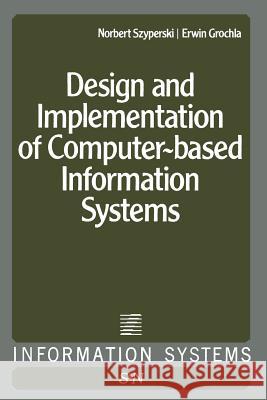
N. Szyperski; E. Grochia
Design and Implementation of Computer-Based Information Systems N. Szyperski E. Grochia 9789400995703 Springer - książkaWidoczna okładka, to zdjęcie poglądowe, a rzeczywista szata graficzna może różnić się od prezentowanej.

Design and Implementation of Computer-Based Information Systems

ISBN-13: 9789400995703 / Angielski / Miękka / 2011 / 368 str.

N. Szyperski; E. Grochia
cena 201,24
(netto: 191,66 VAT:  5%)

Najniższa cena z 30 dni: 192,74
Termin realizacji zamówienia:
ok. 22 dni roboczych
Dostawa w 2026 r.

Darmowa dostawa!

From 18th to 20th September, 1978, about forty scientists and practitioners from Australia, Canada, Denmark, Finland, Great Britain, the United States and the Federal Republic of Germany joined in an international symposium entitled "Design and Implementation of Computer-based Information Systems" . This symposium was initiated by the invitation of the BIFOA (Betriebswirtschaft- liches Institut fur Organisation und Automation an der Universitiit zu Koln) as a part of the institute's research project IMPLAN (Development of Tools for the IMPLemen- tation of Computer-based PLANning Systems). This book includes the opening address, the papers presented at the symposium -revised by the authors after presentation-the chairmen's summaries of the various working group sessions, and an edited version of the concluding"Blue- print for Research on Implementation". Xl Acknowledgements The symposium was made possible by a federal grant from the Bundesminister fur Forschung und Technologie (BMIT), Bonn, reptesented by the Gesellschaftfur Mathe- matik und Datenverarbeitung (GMD), St. Augustin, who sponsored the whole IMPLAN research project and the symposium. We are extremely appreciative of their valuable cooperation and support; in this respect our special thanks go to Mrs. Katharina Gregor and Dr. J urgen Marock of the G MD. Our sincere thanks and appreciation are due to the authors for the many hours of work, for their contributions and for preparing and revising them after the symposium. We appreciate the valuable help of the chairmen for conducting the working sessions and preparing summaries of the sessions.


Kategorie:
Informatyka
Kategorie BISAC:
Business & Economics > Zarządzenie i techniki zarządzania
Computers > Computer Science
Wydawca:
Springer
Seria wydawnicza:
Information Systems
Język:
Angielski
ISBN-13:
9789400995703
Rok wydania:
2011
Wydanie:
Softcover Repri
Numer serii:
000011531
Ilość stron:
368
Waga:
0.54 kg
Wymiary:
23.39 x 15.6 x 2.03
Oprawa:
Miękka
Wolumenów:
01

A. Basic Considerations on Design and Implementation of Computer-based Information Systems.- I. Introduction.- 1. State of the Art of Implementation Research on Computer-based Information Systems.- 1. Introduction.- 2. Basic Notes on the Implementation Game.- 3. Contributions from Research to System Design and Implementation.- 4. Some Preliminary Remarks on Consequences for Implementation Research.- 2. Evaluating the Quality of Information Systems.- 1. Introduction.- 2. Conceptual and Operational Issues.- 3. A Survey of the Research Literature.- 4. Conclusion.- II. Technical Aspects of Systems Design and Implementation.- 3. The Modeling Process: Steps Versus Components.- I. The Topic.- 2. The Role of the Model.- 3. The Plea for the Assemblage-of-Components Concept.- 4. The Components of the Modeling Process.- 5. Modeling, an Art or a Science?.- 4. Implementation of Planning Models: Presentation of the APIS Approach.- 1. Introduction.- 2. Diagnosis of Problem Areas.- 3. Consequences in the APIS Project.- 4. APIS Results.- 5. Conclusion.- III. Organizational Aspects of Systems Design and Implementation.- 5. Basic Considerations in Organizational and Human Aspects in Systems Design: the State of the Art of Implementation Research.- 1. Introduction.- 2. Approaches to Implementation Research.- 3. Research Designs.- 4. Three Examples.- 5. Future Research.- 6. A Design-Oriented Approach in Implementation Research: The Project PORGI.- 1. Statement of the Problem.- 2. Research Design of Project PORGI.- 3. PORGI-Implementation Handbook: The Concept.- B. Working Group: Technical Aspects of Systems Design and Implementation.- I. Selection of Planning Methods.- 7. The Feasibility of Linear Planning Models in Business Administration.- 1. Survey.- 2. Methods and Tools for Planning.- 3. Implementation of the Planning System.- 4. Problems of Evolution.- 5. Feasibility Problems.- 6. Future Development.- 8. Application Areas for Planning Software.- 1. The Purpose of Planning Software.- 2. Categories of Planning Software.- 3. Features of Planning Languages.- 4. The Planning Languages PLATO, PS1, ITS/73, ITS/DMS.- 5. Various Applications of a Planning Language.- II. Modeling Methodology.- 9. A Data-Centered, User-Evolutionary Approach to the Development of Planning Support Systems.- 1. Development Strategies and Design Approaches.- 2. Detailed Considerations in the Data-Centered Design Approach.- 3. A User-Evolutionary Approach to Planning Model Development.- 4. Conclusion.- 10. Implementation and Design Problems of Corporate Simulation and Planning Systems.- 1. Introduction.- 2. Languages, Systems, and Operation.- 3. Organization, Task Structure, and Planning Process.- 4. Personal and Behavioural Aspects.- 5. Conclusions.- 11. An Information System on Planning Models: A General Concept.- 1. Objectives, Necessity, Goals.- 2. Problematic Nature of Models: Definition, Process of Model Design.- 3. Descriptive Characteristics of Models.- 4. System Organization and Operation.- 5. Special Model Files Prototypes—Present Work.- III. Tools for Model Implementation.- 12. Interactive Modelling: Problems in Design and Practical Use.- 1. Interactive Modelling: A Way of Getting Better Answers More Quickly.- 2. A Framework for a Reasonable Use of the Interactive Approach.- 3. Modelling Process and Planning Functions: When to Recommend Direct Communication with the Computer.- 4. Planners and Analysts: What Must Be Their Abilities?.- 5. Software Tools.- 6. Conclusion.- 13. User-Oriented Programming Languages—Tendencies of Development.- 1. Introduction.- 2. Features of Planning Languages.- 3. Generations of Planning Languages.- 4. Tendencies of Development.- 5. Final Remarks.- 14. On Designing LP Interface Structures.- 1. Concepts and Notations.- 2. LP Matrix as a Relation.- 3. The Case Model.- 4. The LP-Matrix Definition.- 5. Computer Implementation.- C. Working Group: Organizational Aspects of Systems Design and Implementation.- I. Participative System Design.- 15. Consensus Systems Design: An Evaluation of this Approach.- 1. Introduction.- 2. Participative Systems Design: Its Rationale.- 3. Participative Systems Design: Different Approaches.- 4. Procedures for Consensus Design.- 5. Problems of Using a Consensus Design Approach.- 6. Advantages of Using a Consensus Design Approach.- 7. Training, Monitoring and Development.- 8. Conclusions.- 16. Concepts and Experiences with Participative Design Approaches.- 1. A Practical Example.- 2. Why Participation?.- 3. Socio-Technique in the Hands of Computer Specialists.- 4. The Activities of the Unions.- 5. Some Consequences of Taking the Participation Problem Seriously in Connection With the System Design Process.- 6. Summary.- 17. High Level Languages—A Basis for Participative Design.- 1. Introduction.- 2. The Setting.- 3. Role Centered Systems Design.- 4. The Nature of Change.- 5. Role Maps.- 6. The Accounting Map.- 7. Applying the Model to Systems Design.- 8. The Solution.- 9. A Language Design.- 10. Conclusion.- II. Evaluation of Systems.- 18. Effectiveness Measurement of Computer-Based Information Systems through Cost-Benefit Analysis: Empirical Research and Perspectives.- 1. Problem Definition and Initial Situation.- 2. Pilot Study on System Investments.- 3. Analytical Study for Evaluating System Investments.- 4. First Formulation of Hypotheses and Further Research.- 5. Summary.- 19. User and Specialist Evaluations in System Development.- 1. Processes of Goal Definition and Evaluation to Start System Development.- 2. Definitions of and Relationships between Effectiveness and Efficiency of CBIS-Development.- 3. Different Levels of Goal Definition and Evaluation.- 4. Examples of Goals Belonging to Different Levels.- 5. Organizational Consequences of Differentiation and Integration of Goal-Levels.- 20. The Evaluation of an Information System Implementation.- 1. Introduction.- 2. Activity Analysis.- 3. Possibility Analysis.- 4. Utility Analysis.- III. Instruments and Tools for Organizational Implementation.- 21. Early Diagnosis of Implementation Failure: A Plan For Research.- 1. Overview.- 2. The Concept of Early Warning.- 3. Is Early Diagnosis Possible: Theoretical and Empirical Clues.- 4. A Program of Research.- 5. Phase 1.- 6. Preliminary Results, Discussion, and Conclusion.- 22. Concepts and Experience with the PORGITmplementation Handbook.- 1. PORGI-Tmplementation Handbook: The Concept.- 2. Practical Application of PORGI-Tools.- 3. Implications and Limitations of the PORGI-Approach.- D. Review.- Challenges and Consequences for Future Research on Implementation.- 1. Introduction.- 2. Actual Challenges in Information Systems Implementation.- 3. Consequences for Future Research.- List of Participants.


Udostępnij

Facebook - konto krainaksiazek.pl


Opinie o Krainaksiazek.pl na Opineo.pl

Partner Mybenefit

Krainaksiazek.pl w programie rzetelna firma Krainaksiaze.pl - płatności przez paypal

Czytaj nas na:

Facebook - krainaksiazek.pl
  • książki na zamówienie
  • granty
  • książka na prezent
  • kontakt
  • pomoc
  • opinie
  • regulamin
  • polityka prywatności

Zobacz:

  • Księgarnia czeska

  • Wydawnictwo Książkowe Klimaty

1997-2025 DolnySlask.com Agencja Internetowa

© 1997-2022 krainaksiazek.pl
     
KONTAKT | REGULAMIN | POLITYKA PRYWATNOŚCI | USTAWIENIA PRYWATNOŚCI
Zobacz: Księgarnia Czeska | Wydawnictwo Książkowe Klimaty | Mapa strony | Lista autorów
KrainaKsiazek.PL - Księgarnia Internetowa

Polityka prywatnosci - link
Krainaksiazek.pl - płatnośc Przelewy24
Przechowalnia Przechowalnia





